GAC Toyota Motor, an automobile manufacturing company headquartered in Guangzhou, China and a joint-venture between GAC Group and Toyota Motor Company, has officially launched its first independently developed model on Thursday, with executives touting the vehicle's ability to emulate human driving through advanced technology.
The company's new bZ3X, a battery-electric compact crossover SUV, possesses innovative smart driving features, including advanced algorithms and acute perception.
"Now, the 'human-like driving' function in our self-driving system can provide even more accurate predictions than a human," Peng Baolin, deputy general manager of GAC Toyota, told attendees at the vehicle's launch event in east China's Hangzhou City.
Although the model has several configurations, they all share the same smart driving experience. Even with these features, the vehicle's price is standard for an entry-level SUV, ranging from 109,800 yuan to 159,800 yuan (about 15,000 U.S. dollars to 22,000 U.S. dollars).
"GAC Toyota has been actively embracing the wave of smart driving. We have taken the lead in realizing smart driving in the entire series, which will open an inclusive era for advanced smart driving," said Wen Dali, executive deputy general manager of GAC Toyota.
In terms of safety, the SUV is not only equipped with the high-quality features associated with Toyota, but was also developed in line with the latest standards of C-NCAP, a Chinese car safety assessment program, and CIASI, the China Insurance Automotive Safety Index.
It also boasts better performance in space arrangement than its peers, with as many as 30 compartments and areas for storage.
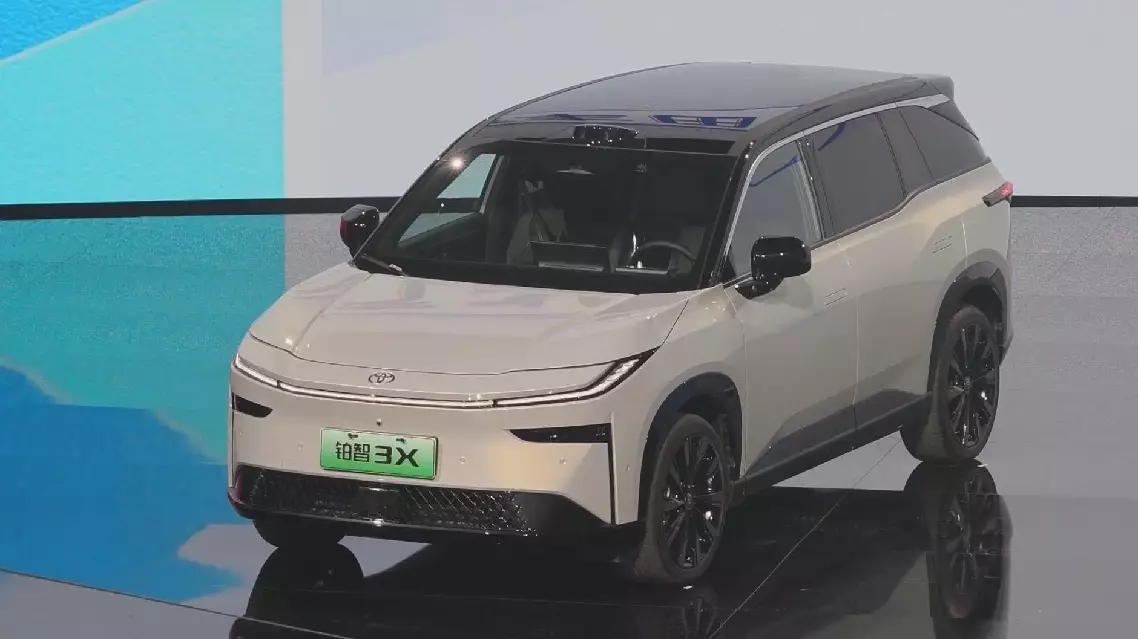
GAC Toyota launches smart-driving electric SUV as first independently developed model
Large crowds gathered in Iranian capital of Tehran on Thursday to mark the 40th day since the killing of the country's former Supreme Leader Ayatollah Ali Khamenei, with grief and tension shaping the mood in the capital as the traditional mourning period came to its close.
The 40th day of mourning is a significant moment in Iran, traditionally marking the end of a period of national grief.
Ali Khamenei was killed on February 28 minutes after the outbreak of the U.S.-Israeli war with Iran. Iranian state media confirmed his death the following day, and authorities announced 40 days of public mourning.
Ceremonies began early in the day, with people gathering at Jomhouri Square before moving toward the site of the killing. Many carried flags and portraits of Ali khamenei, saying that they came not only to mourn but also to show their loyalty and respect.
"I am here to show respect for our late supreme leader, as it is the 40th day of his death. I appreciate what he has done, and for the love of our country. I am ready to die for my country," said Fateme Zahra, a Tehran resident.
Government officials also joined the ceremonies, saying that the turnout demonstrated unity and support for the new leadership.
"The large crowds here show that they remember their martyred supreme leader, and that they pay homage to the new leadership. They will stand until the end," said Mohammad Eslami, head of Iran's Atomic Energy Organization.
Despite Khamenei's death, local political analysts believe the political system in Iran remains stable.
"In the Iranian constitution, the leader is the commander-in-chief. So what you see is the result of a system he set up as the commander-in-chief," said Foad Izadi, a political analyst at the University of Tehran.
The commemorations came amid a fragile two-week ceasefire with the United States, leaving the coming weeks critical for Iran's future.
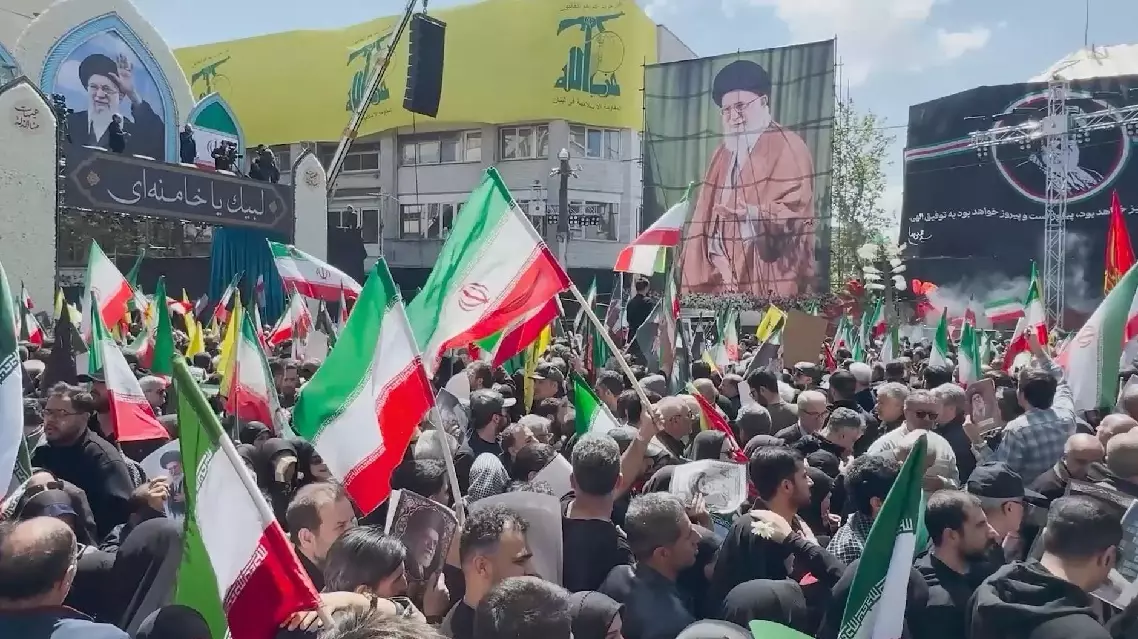
Iran marks Ali Khamenei 40th day amid fragile ceasefire with US