Drones are playing an increasingly vital role in firefighting and emergency response efforts in China, boosting efficiency, precision, and safety while driving a technology-driven transformation of traditional emergency response methods.
With their extensive monitoring range, high mobility, and flexibility, drones have become indispensable to fire and emergency response teams nationwide, providing critical support for urban and forest firefighting.
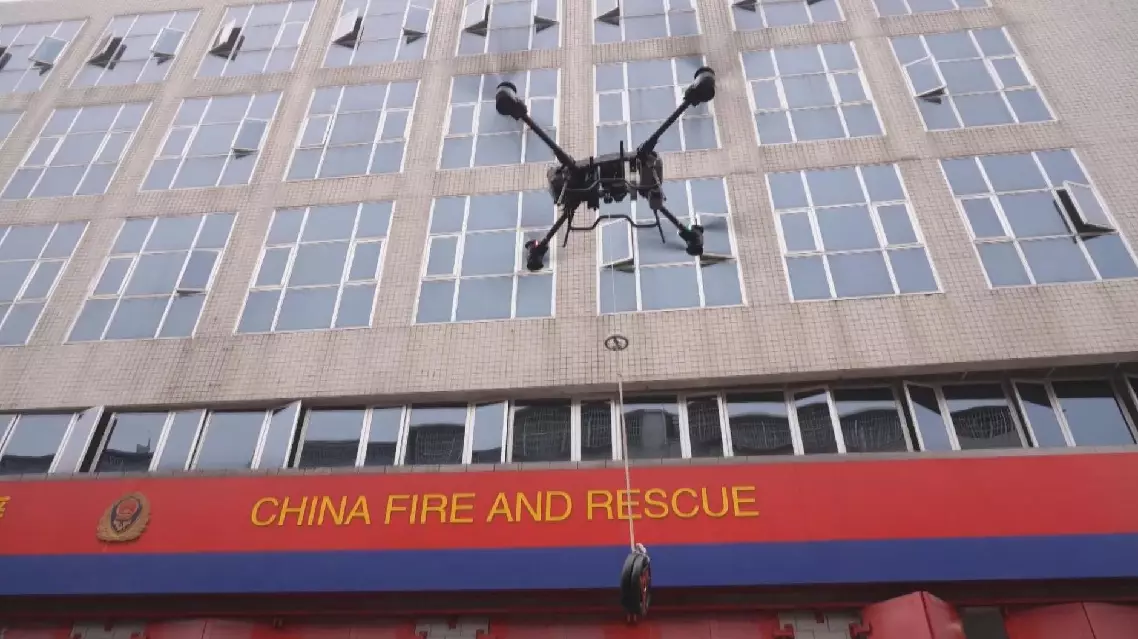
A recent high-rise firefighting drill in Fuzhou City, in east China's Fujian Province, showcased the remarkable capabilities of drones in complex urban environments.
The drill simulated a fire in a 110-meter-high building, with the burned area exceeding 500 square meters. Within 20 seconds, drones equipped with fire hoses ascended to the targeted height, and in just 30 minutes, the fire was successfully contained -- nearly twice as fast as traditional firefighting methods.
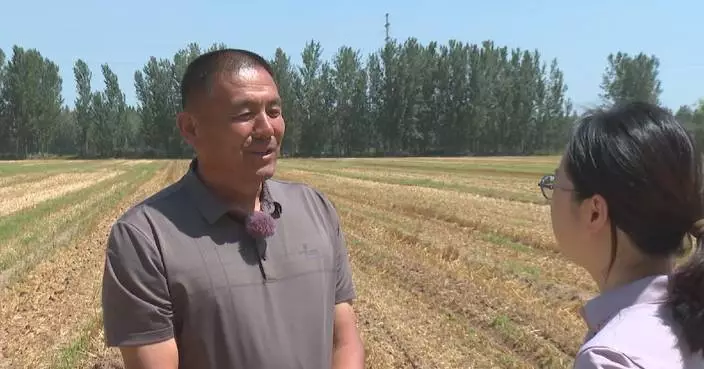
"Drones offer significant advantages, including rapid response, high mobility, and minimal impact from ground obstacles. In emergencies, they can quickly reach the scene, assess the situation, and carry out rescue operations. The integration of drones with ground teams has transformed traditional firefighting methods, addressing challenges that were previously difficult or even impossible to overcome, fundamentally reshaping rescue strategies," explained Ma Yuchun, a senior commander at the National Fire and Rescue Administration's Forest and Grassland Firefighting and Aerial Rescue Division. In forest and grassland fire response, drones provide indispensable assistance, enabling faster and more accurate emergency detection while offering 24/7 aerial supervision.
In the Daxing'anling Mountains, one of China's largest forested regions located in the Inner Mongolia Autonomous Region of northern China, forest fire units have integrated drones into daily patrols. Equipped with thermographic imaging cameras, these drones can accurately detect fire sources even at night, enhancing early warning capabilities.
"As the responsibilities of our brigade continue to expand, drones are playing an increasingly vital role in rescue operations. Previously, firefighters had to conduct foot patrols or deploy helicopters to assess fire risks. Now, these tasks have been assigned to drones, significantly enhancing patrol efficiency, improving fire detection, and extending aerial surveillance capabilities for forest protection," said Sun Qi, deputy director of the Firefighting and Rescue Command at the Daxing'anling Mountains Forest Fire Unit.
Drones transform firefighting, emergency response in China

International guests who have dedicated their lives to historical truth joined China's 12th national memorial event honoring the hundreds of thousands of victims killed by Japanese troops in the Nanjing Massacre during World War II.
The memorial was held on Saturday at the public square of the Memorial Hall of the Victims in Nanjing Massacre by Japanese Invaders in Nanjing, capital of east China's Jiangsu Province. China's national flag was flown at half-mast in the presence the crowd that included survivors of the massacre, local students, and international guests.
In one of the most barbaric episodes during WWII, the Nanjing Massacre took place when Japanese troops captured the then-Chinese capital Nanjing on Dec 13, 1937. Over the course of six weeks, they proceeded to kill approximately 300,000 Chinese civilians and unarmed soldiers.
Joining the crowd was Christoph Reinhardt, the great-grandson of John Rabe (1882-1950) who was then a representative of German conglomerate Siemens in the war-ravaged Nanjing. During the Nanjing Massacre, Rabe set up an international safety zone with other foreigners, and they together saved the lives of around 250,000 Chinese people between 1937 and 1938 from the Japanese invaders.
Throughout the massacre, Rabe continued to keep a diary. To this day, all his pages remain one of the most comprehensive historical records of the atrocities committed by the Japanese aggressors.
Sayoko Yamauchi, who was also in the crowd of mourners, arrived in Nanjing on Friday from Japan's Osaka to attend Saturday's ceremony, just as she has done almost every year since China designated Dec 13 as the National Memorial Day for the Victims of the Nanjing Massacre in 2014.
Yamauchi's grandfather was one of the Japanese soldiers who invaded Nanjing in January 1938. However, since first setting foot in Nanjing in 1987, she has dedicated herself to uncovering and spreading the truth about Japan's history of aggression and enlightening the Japanese public about their country's wartime atrocities.
In 2014, ahead of China's first National Memorial Day for the Victims of the Nanjing Massacre, Yamauchi, along with 10 other individuals, received an award for her special contribution to the Memorial Hall of the Victims in the Nanjing Massacre by Japanese Invaders.
By attending the grand memorial event, Reinhardt and Yamauchi both said they hope to convey a message of remembering history and cherishing peace.
"This is my fifth visit to China, and Nanjing, and the third times I visited the ceremony. I have a wish that these survivors survive again and again and again. But my other wish is that the families of the survivors, that they transport the information, the right intention like their ancestors, because anyone must hold a hand (during) this remembering," Reinhardt told China Central Television (CCTV) in an interview before the event began on Saturday.
"Our delegation is on its 20th visit to China, coming to Nanjing to express our heartfelt condolences to those who perished 88 years ago, to remember this history, and to reflect on what we can do for a new future. That's why we are here," Yamauchi told CCTV on board the bus that took her to a local hotel in Nanjing on Friday evening.
Int'l guests call for remembering history at China's national event honoring Nanjing Massacre victims