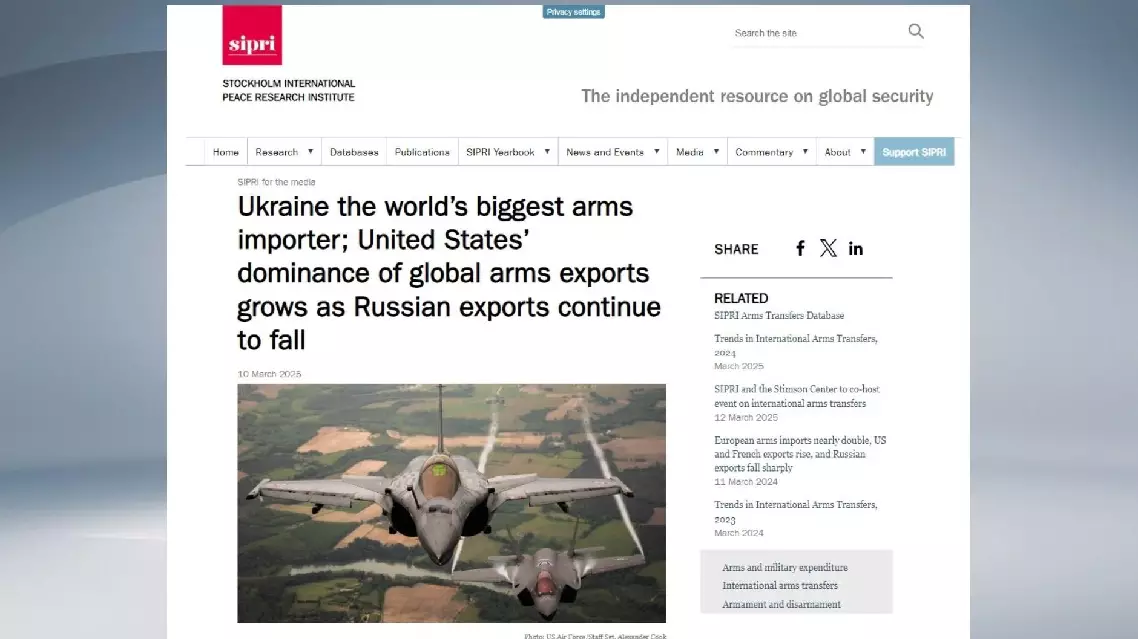
The U.S. maintained its position as the largest arms exporter, while the North Atlantic Treaty Organization (NATO) members in Europe failed to achieve defense autonomy, said a leading Swedish think tank in a report Monday.
Data from the Stockholm International Peace Research Institute (SIPRI) reveals that between 2020 and 2024, the share of U.S. arms in total global arms export rose to 43 percent, a significant increase from 35 percent between 2015 and 2019.
The report shows that the U.S. share of exports is more than four times that of second-ranked France, and about equal to the share of the countries ranked second through ninth combined.
Over the past five years, the U.S. has exported arms to over100 countries and regions, making it Ukraine's largest arms supplier. Ukraine has become the world's largest arms importer, with imports rising nearly 100 times from 2015 to 2019, 45 percent of which came from the United States.
The arms imports by the European members of NATO also increased 105 percent from 2015 to 2019, with the share of U.S. weapons rising from 52 percent to 64 percent.
Pieter Wezeman, senior researcher with the SIPRI, said that although European NATO states have taken steps to reduce their dependence on arms imports and to strengthen the European arms industry, the transatlantic arms-supply relationship has deep roots.
For the first time in 20 years, Europe has overtaken the Middle East as the largest exporter of U.S. arms. Compared to the previous five-year period, the share of U.S. arms exports to Europe jumped from 13 percent to 35 percent between 2020 and 2024. The exports to the Middle East accounted for 33 percent between 2020 and 2024.
Compared to the previous five-year period, France's share of the global arms export market rose to 9.6 percent between 2020 and 2024 from 8.6 percent. Exports to European countries nearly trebled, led by a surge in exports to Greece, Croatia and Ukraine.
US remains largest arms exporter: think tank
China's commitment to its path of opening up will continue as a long-term national strategy and should increasingly be defined by inclusiveness, a national political advisor said Friday.
Zhou Hanmin, a member of the Standing Committee of the National Committee of the 14th Chinese People's Political Consultative Conference (CPPCC) and president of the Shanghai Public Diplomacy Association, made the remarks in an interview with China Media Group (CMG) during the annual political "two sessions" underway in Beijing.
"Opening-up is and has been a long-term national policy and a strategy ever since China opened itself up (to the world) some 48 years ago. Ever since China joined WTO (World Trade Organization), you could see it has fundamentally changed the formats of economic movements. So opening-up is a reference and also a driving force," he said.
Zhou stressed China must also invite less privileged nations to share in the prosperity of a more open world.
"Inclusiveness is one word that should be used to modify China's opening-up. I (previously) submitted a bill in CPPCC for the zero tariff for those least developed nations' exportation to China. Because for each and every China International Import Expo, you can see quite a large number of exhibitors coming from the least developed countries. We need to give them very genuine help. We are just in the situation of that. We just try to do not only with developed nations, but the Global South and rest of the countries, all together," he said.
Zhou's comments come amid the ongoing "two sessions", the annual meetings of China's top legislature, the National People's Congress (NPC), and the top political advisory body, the National Committee of the CPPCC. Both bodies serve a five-year term and hold a plenary session each year, generally in March.
The fourth session of the 14th NPC and the fourth session of the 14th National Committee of the CPPCC kicked off in Beijing on Thursday and Wednesday, respectively. A main focus is the adoption of the country's 15th Five-Year Plan (2026-2030), a key blueprint guiding China's drive toward modernization. When asked about key signals from the plan that the international community should closely watch, Zhou outlined several key issues.
"We are now carrying on this Five-Year Plan in the most crucial period of time. We are going to generally modernize the country (in) another 10 years. In this five-year period of time, we need to focus more on creation. Creation not necessarily in the field of technology. Creation means the modernization of the governance, create lots of new things in the system and methods of governance. This is also important," Zhou said.
"The modernization of industrial systems, the further expansion of the ability of consumption, and we try to know very well the longevity, whatever solves people's daily needs. The last but not least, we try to understand fully international collaboration. Opening-up is still a driving force," he said.
China's opening-up should continue path of inclusiveness: political advisor