With China's annual "two sessions" underway, foreign-funded enterprises are closely monitoring policy signals, with many expressing optimism about deepening their investments in the country, according to a commentary of The Real Point published on Monday.
An edited version of the commentary is as follows:
Spring is a time for growth, and it is also the perfect season for foreign companies to deepen their investments in China, where the annual "two sessions" meetings are sending strong signals to boost foreign investor confidence.
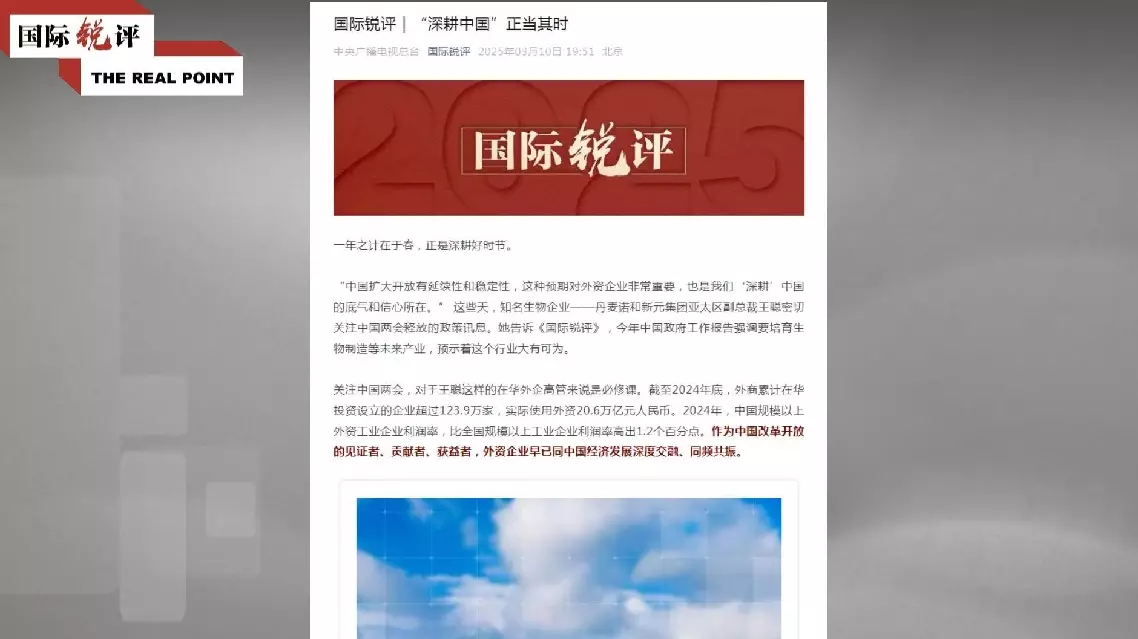
"The continuity and stability of China's policy of expanding openness are crucial for foreign enterprises. This certainty strengthens our confidence in further investing in China," said Wang Cong, vice director for the Asia-Pacific region for Danish biotech company Novonesis.
Wang has been closely following policy signals from China's "two sessions" and says that this year's government work report highlights the development of future industries such as bio-manufacturing, underlining the vast opportunities for the sector.
For executives of foreign companies like Wang, keeping an eye on China's "two sessions" has become an essential part of running an international business.
By the end of 2024, foreign investors had established over 1.239 million enterprises in China, with actual utilized foreign capital reaching 20.6 trillion yuan (about 2.85 trillion US dollars), China's Ministry of Commerce said at a press conference in Beijing on Feb 20.
Statistics from the National Bureau of Statistics showed that in 2024, the profit margin of industrial enterprises above the designated size funded by foreign investors was 1.2 percentage points higher than that of domestic industrial enterprises above the designated size.
As witnesses, contributors and beneficiaries of China's reform and opening up policy, foreign-funded enterprises have long been deeply integrated and closely aligned with the country's economic development.
In the face of rising economic unilateralism and protectionism globally, how will China ensure high-quality development in the new year? What policy incentives will the government introduce?
The policy signals emerging from this year's "two sessions" have given foreign investors reasons to be optimistic.
The 2025 government work report lists "expanding high-level opening-up and stabilizing foreign trade and investment" as one of the government's ten key tasks.
Measures to be rolled out include expanding pilot programs for foreign investment in sectors such as telecommunications, healthcare, and education, encouraging reinvestment by foreign enterprises, ensuring national treatment for foreign businesses, and continuously improving a market-oriented, law-based, and international business environment.
These policies align with the recently released action plan to stabilize foreign investment in 2025, sending a clear message -- China's doors to foreign investment are opening wider, and market opportunities for foreign enterprises are growing.
China's focus on innovation has been a distinctive feature of the country's economic development in recent years, creating fertile ground for foreign enterprises to deepen their investment.
During the "two sessions", China's top leadership emphasized that technological and industrial innovation is the fundamental path to developing new quality productive forces.
This has resonated with foreign businesses operating in China, which are actively positioning themselves in emerging sectors to enhance their competitiveness.
Japan's Panasonic, one of the earliest foreign investors in China, has been deeply involved in the country's reform and opening-up for over 40 years.
Now the home appliance giant is focusing on new quality productive forces.
"China is not only a manufacturing powerhouse but also a hub for engineers and innovation," said Tetsuro Homma, vice president of Panasonic Holdings.
The company is actively engaging with Chinese AI and automation technology firms and expanding strategic cooperation across multiple fields, Homma said, adding that he sees vast potential for China-Japan collaboration in healthcare, new energy, and advanced materials.
Another long-term partner of China is global health product manufacturer Haleon headquartered in Britain.
According to Fu Yue, vice president of Haleon China, this year's "two sessions" have emphasized boosting consumption, expanding domestic demand, and improving people's livelihoods, signaling significant opportunities.
To deepen its presence in China, the company has a clear plan -- expanding its health products and services into second- and third-tier cities to meet diverse health needs while collaborating with local partners to build a robust health ecosystem, said Fu.
At the same time, it will work with Chinese partners to build an ecosystem and ecological chain to improve health care for Chinese people, said Fu.
Foreign enterprises are choosing to expand their presence in China for clear reasons: the advantages of a super-scale market, complete and highly efficient industrial and supply chains, a continuously improving innovation environment, abundant skilled workers, and growing consumer demand. These advantages are difficult to replicate elsewhere.
Oliver Oehms, executive director and board member of the German Chamber of Commerce in China - North China, said that over 90 percent of the chamber's member companies are committed to developing in China, with more than half planning to increase their investments in the next two years.
A survey from the American Chamber of Commerce in China also indicates that nearly 70 percent of survey respondents from the consumer industry expect to increase their investment in China this year.
This is a clear vote of confidence from the global business community in China's economic prospects.
Foreign-funded firms eye opportunities from "two sessions" policy signals: commentary