More than 3,500 participants from nearly 30 countries and regions gathered in Beijing for the 2025-2026 VEX Robotics Asia Open Signature Event, a contest focused on integrated robotic skills such as robot programming, construction and control.
Held at the Shougang Park in the Chinese capital city's Shijingshan District from Thursday to Sunday, the event drew 600 teams across age groups from kindergarten to university.
Separate divisions allow students of different ages to demonstrate abilities from operating mini robots to designing complex competitive machines.
"We think they are very strong. We have never seen teams so strong, and their robots work so perfectly. We think we are going to learn from them, and we will try to do our best," said Pol Serra Carner, a participant from Spain.
The VEX Robotics competition has been hosted across many countries, attracting millions of young people each year. It has become an important platform connecting global youth in science, technology and innovation.
"The competition brings together top teams from all continents, including Europe, North America, South America and Africa. We will fully leverage our resource integration advantages to cultivate new talents for development of the artificial intelligence industry," said Jia Hao, secretary-general of the Beijing-based Zhongguancun Shuzhi Artificial Intelligence Industry Alliance.
Organizers said the event not only features high-level technological contests but also promotes in‑depth cross‑cultural exchanges among young participants worldwide.
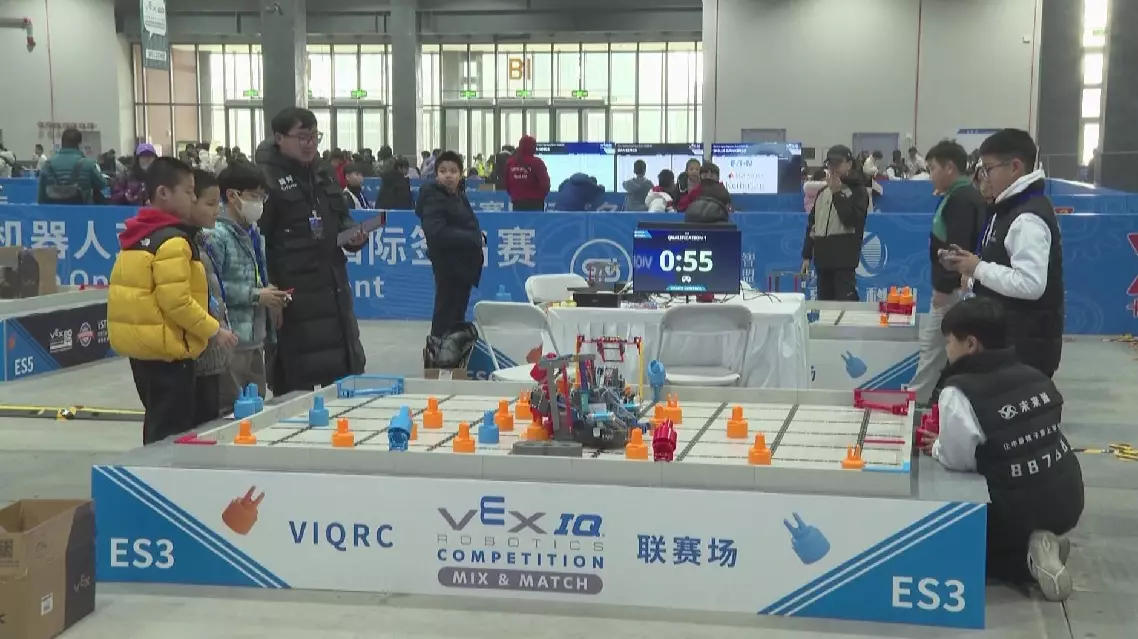
Over 3,500 participants compete in VEX Robotics Asia Open in China
As fighting continues along the Cambodia-Thailand border, a school in Siem Reap Province in northwest Cambodia has striven to open its doors to provide a safe haven for displaced students.
The school has taken in 13 refugee students, some of whom had to flee their homes in the conflict-affected Oddar Meanchey Province.
Among them is Chui Sreymom, who said that the upheaval has disrupted her studies.
"It had impacted my studies. I'm now in ninth grade and have important exams coming up soon," she said.
"We've enrolled 13 refugees into our school, including nine girls. And there are even more students signing up," said principal Dorn Chantrea.
According to Chantrea, the school has proactively reached out to refugee camps and posted enrollment notices on social media platforms to help as many displaced students as possible continue their schooling.
Chen Chhunly, a worker at a nearby refugee camp, said that other schools in the area have also stepped up to accommodate the influx of students.
"Schools that have accepted refugee students have accordingly set up additional courses based on the actual arrivals, in order to help them catch up," Chhunly said.
However, Cambodia's education system faces significant resource constraints, with limited teacher staffing and budgets even before the conflict. Many schools had already resorted to running morning and afternoon shifts to maximize capacity.
With the growing influx of refugees and children, many students have been unable to secure appropriate school placements.
While refugee camps have erected temporary education centers, their focus remains on emotional support and stabilization rather than formal instruction.
"I haven't yet found a suitable school placement. I don't know where I'll be able to study," said Dorn Chantrea, a displaced student.
Fighting between the Southeast Asian neighbors broke out on Dec 7, with the two sides accusing each other of firing first.
The border clashes have already forced the closure of 514 schools in Cambodia's frontier provinces, affecting around 130,000 students and 4,650 teachers, according to the Ministry of Education, Youth and Sport at a press briefing on Tuesday.
Cambodian students struggle to return to school amid border clashes