SINGAPORE--(BUSINESS WIRE)--Mar 11, 2025--
The latest InfoBrief by market intelligence firm IDC, commissioned by global payments platform 2C2P and Antom, revealed Southeast Asia’s (SEA’s) ecommerce market is projected to reach US$325 billion by 2028, fuelled by the rapid adoption of digital payments and regional interoperability, unlocking more opportunities in cross-border commerce for businesses.
This press release features multimedia. View the full release here: https://www.businesswire.com/news/home/20250311192743/en/
This year’s research paper, “How Southeast Asia Buys and Pays 2025”, marks the fourth edition of the IDC InfoBrief since 2021. IDC surveyed 600 respondents across six Southeast Asia (SEA) markets – Indonesia, Philippines, Malaysia, Singapore, Thailand and Vietnam, examining the evolving digital payments landscape as a whole and in each market. 1 As the fifth largest economy in the world, SEA’s exceptional growth trajectory is largely driven by its rapidly expanding e-commerce sector, underpinned by increasing digital payment adoption.
The research explores the region’s evolving digital payments landscape and provides a market-specific analysis of the payment trends in each market. It also sheds light on how these trends are reshaping business strategies and laying the foundation for future growth opportunities in the region.
Key highlights from the IDC InfoBrief:
It is critical to have a comprehensive understanding of SEA’s digital payment landscape to fully tap into this US$325b economy. To maximise reach within local markets, it is essential to offer customers their preferred payment methods to enhance the overall customer experience and drive higher conversion rates.
There are also significant opportunities across SEA in intra-SEA cross border commerce.
Agnes Chua, Managing Director of Business and Product Development of 2C2P, stated, “Southeast Asia’s e-commerce landscape is evolving at a breathtaking pace. Merchants recognise the immense opportunities this growth brings them in driving e-commerce revenue, but also acknowledge the increasing complexity it brings to their operations. This includes common challenges such as customer support and issue resolution, payment gateway integration and technology issues. At 2C2P, we empower businesses to navigate these challenges with confidence by delivering payment solutions that simplify operations, enhance cross-border capabilities, and drive growth in the region’s rapidly expanding digital economy so merchants can quickly unlock new opportunities and thrive in this dynamic environment."
Gary Liu, General Manager of Antom, Ant International, said, “Southeast Asia is rapidly emerging as a global hub for digital commerce and innovation. As businesses expand across borders, seamless and efficient transactions are essential for maintaining competitiveness. At Antom, we see payments not just as infrastructure but as a catalyst for business growth. By working with 2C2P and other businesses within Ant International's ecosystem, we empower merchants with unified payment and digitisation solutions covering the full payment lifecycle while also exploring opportunities in global account services, financing, and treasury management to further support their expansion. Through close collaboration with local regulators and industry partners, we aim to unlock new opportunities for businesses of all sizes, helping them thrive in Southeast Asia's evolving digital economy."
About 2C2P
2C2P is a full-suite payments platform that empowers the world's leading enterprises to securely accept and make payments through one point of integration. Its extensive network spans across online, mobile and offline channels including over 600,000 alternative payment locations, enabling enterprises to reach their customers or recipients anywhere. 2C2P also provides value-added services such as issuing, 3D Secure, bill payments and digital goods to meet every business need.
Headquartered in Singapore with operations across Southeast Asia and Hong Kong, 2C2P is the preferred payments partner for airlines, online marketplaces, retailers and other enterprises. To learn more, please visit https://2c2p.com/.
About Antom
Ant International's Antom is the leading payment and digitisation services provider for merchants around the world. It offers unified, vertical-specific digital payment solutions to serve businesses of all sizes. Antom supports merchants in over 50 countries and regions, enabling them to connect with consumers in more than 200 markets, with the flexibility to accept payments in more than 100 currencies. Beyond payments, it provides digital marketing solutions and merchant digitisation services to help merchant streamline operations and enhance customer engagement. To learn more, please visit https://www.antom.com/.
1 IDC InfoBrief, commissioned by 2C2P, How Southeast Asia Buys and Pays 2025, Doc #AP242491IB, February 2025

Uncover trends and opportunities in Southeast Asia's digital economy (Graphic: Business Wire)
MADRID (AP) — María del Carmen Abascal, the 87-year-old woman whose eviction from her longtime Madrid home sparked nationwide protests across Spain and unleashed a political crisis, died on Wednesday while hospitalized.
Spanish Prime Minister Pedro Sánchez led the way on social media offering his condolences after housing activists and Abascal's lawyer announced her death. Known widely as “Maricarmen,” she had become a symbol for renters struggling with Spain's housing affordability crisis.
“All my love to Maricarmen’s family and loved ones,” Sánchez said in a post on X. “A hug as well to all of us who feel this loss as our own today. Rest in peace.”
The emotions ran into anger on the street among the protesters gathered near Spain's Parliament who chanted “Maricarmen lives, the fight goes on!”
Iciar López, a 32-year-old psychologist, shared her feelings with The Associated Press at the protest in Madrid.
“A great deal of sorrow. And above all, the thought that she is the cause, the head of this whole revolution that has happened, and that she can’t see it,” she said. “It makes me very sad that she can’t see if anything comes of it, if there is any result from all that she has fought for, as well. That’s what angers me the most, honestly.”
Spaniards increasingly frustrated by housing costs periodically march in major cities demanding action from lawmakers. But a fresh wave of indignation has swept Spain since Sept. 23, when Maricarmen, who used a wheelchair, was carried on a stretcher from her home of seven decades after police cordoned off the street and removed protesters. She was taken to a hospital because of her fragile health.
Televised images of the eviction prompted thousands of people to protest in Madrid and other cities across the country.
Maricarmen's lawyer, Beatriz Duro, did not disclose the cause of death when she confirmed it to Cadena Ser radio. Duro said that she and the activists were all devastated.
“Maricarmen's case, which captured media attention and traveled around the world, leaves us the image of the shameful violence of these types of evictions and the impact they can have on people’s health,” Duro said.
She had been expected to return home after leaving the hospital. The real estate company that evicted her in order to rent the property at a much higher price eventually caved in under immense public pressure and agreed to let her return to the apartment.
“Although a historic agreement was reached that would have allowed her to return home, this solution came too late,” the Madrid Tenants' Union said in a statement Wednesday. “It was an entirely avoidable situation following a harrowing ordeal.”
The average rent for Spain has almost doubled in the last 10 years, according to the real estate website Idealista. Spain’s government said that 26% of Spaniards who rent housing spend an average of 40% of their income on rent and utilities, compared with the European Union average of 18% of renters who do so.
Protesters camped in Madrid’s central Puerta del Sol square held a minute of silence after learning of her death.
Maricarmen spent almost her entire life in her apartment, where she first lived with her parents and brother. She later worked as a secretary for the board of a pharmaceutical company, Spanish daily El País reported. She said both her parents died in the apartment.
After retiring in 1998, she spent her days walking around the neighborhood, doing errands and taking care of the precious items in her home. The paper reported that black-and-white family photographs were among the only things she had brought with her to the hospital.
“Maricarmen only wanted to die in her home. She wasn’t asking for anything else,” Eugenio Melchor, 22, said at the protest in Madrid. “She was dying in her home and she almost did. They have killed her. I mean, there’s no other word for it, and I hope those responsible for this pay and go to trial.”
Maricarmen’s plight galvanized a social movement, prompted Spain’s unions to announce a general strike next month and intensified pressure on political leaders. Sánchez called an early election Monday after his government failed last week to push emergency housing measures through Parliament. He now hopes the issue will reinvigorate his Socialist Party and help him form a new government after the Nov. 29 election.
Housing Minister Isabel Rodríguez also expressed condolences, writing on X: “I deeply lament the death of Maricarmen. My condolences to those who accompanied her and fought by her side until the end.”
Conservative opposition leader Alberto Núñez Feijóo, who hopes to unseat Sánchez and his left-wing coalition, also offered condolences.
“I want to express my condolences to Maricarmen's family and loved ones. No campaign, no party, no use for political advantage,” the Popular Party leader wrote. “When faced with the death of a person, we must only show respect.”
Wilson reported from Barcelona, Spain. Associated Press writers Teresa Medrano, in Madrid, and Renata Brito, in Barcelona, contributed.

Police officers cordon off the area as protesters gather after the reported death of María del Carmen Abascal, the 87-year-old woman whose eviction sparked nationwide protests, outside Parliament in Madrid, Wednesday, Oct. 7, 2026. (AP Photo/Bernat Armangue)

Protesters gather after the reported death of María del Carmen Abascal, the 87-year-old woman whose eviction sparked nationwide protests, outside Parliament in Madrid, Wednesday, Oct. 7, 2026. (AP Photo/Bernat Armangue)

Protesters gather after the reported death of María del Carmen Abascal, the 87-year-old woman whose eviction sparked nationwide protests, in Puerta del Sol square in Madrid, Wednesday, Oct. 7, 2026. (AP Photo/Bernat Armangue)

Protesters gather after the reported death of María del Carmen Abascal, the 87-year-old woman whose eviction sparked nationwide protests, in Puerta del Sol square in Madrid, Wednesday, Oct. 7, 2026. (AP Photo/Bernat Armangue)

Demonstrators sit next to their tents after spending the night camping during a protest demanding stronger protections for renters following last week's eviction of 87-year-old Maricarmen, in Barcelona's Plaça de Catalunya, Spain, Wednesday, Sept. 30, 2026. (AP Photo/Emilio Morenatti)
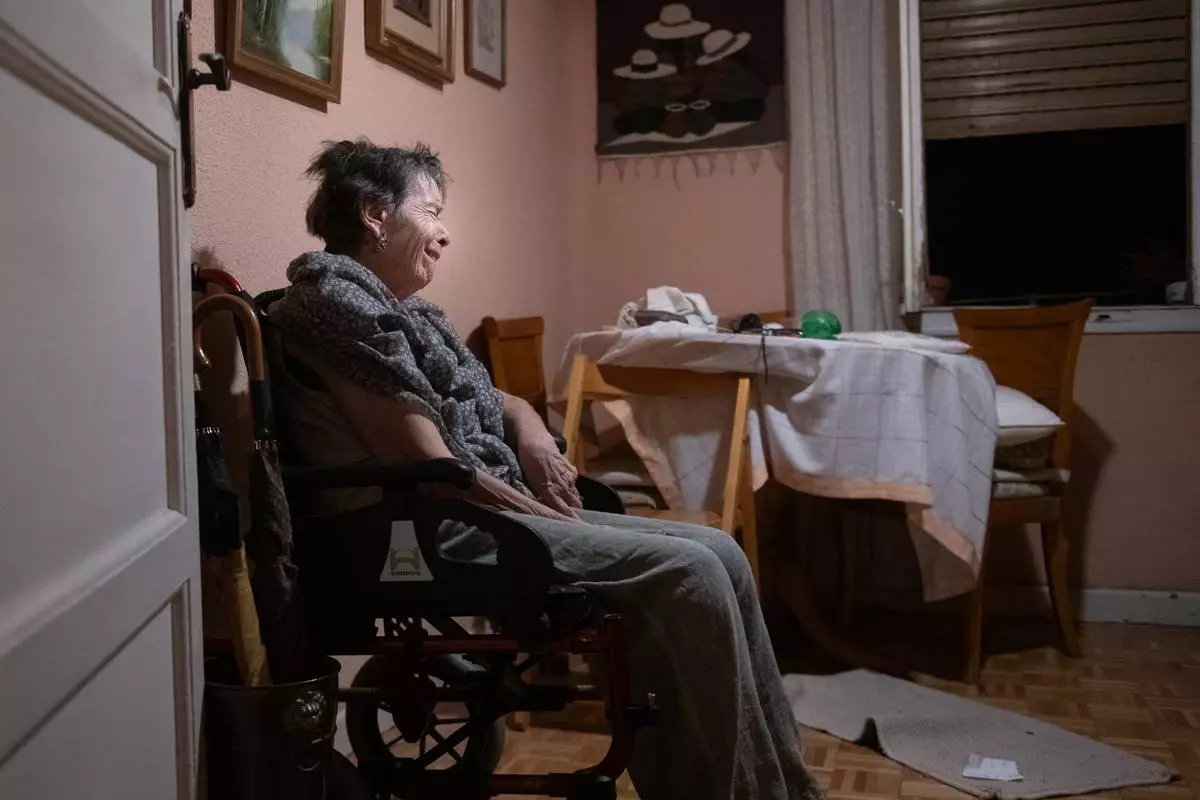
Maricarmen, 87, waits at home for police to arrive before being evicted from the home where she lived in Madrid, Spain, Wednesday, Sept. 23, 2026. (Fernando Sánchez/Europa Press via AP)