 |
For the 19th consecutive year, Ethisphere recognizes manufacturer's commitment to integrity and ethical business practices
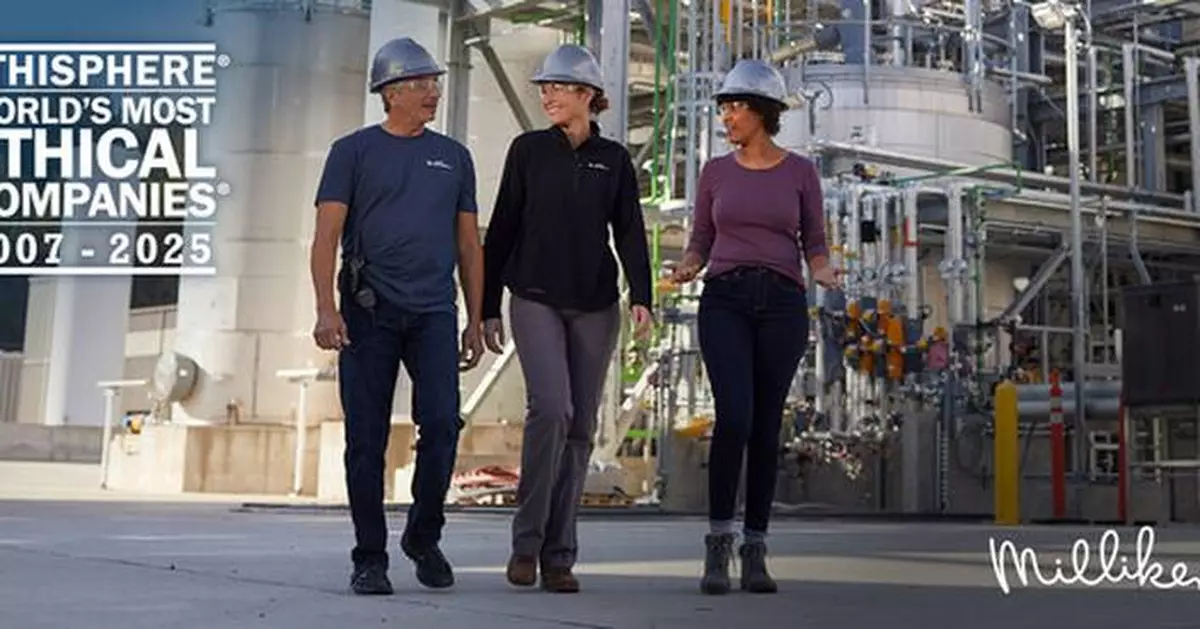
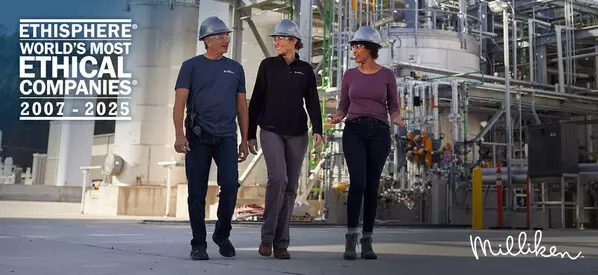
SPARTANBURG, S.C., March 11, 2025 /PRNewswire/ -- Milliken & Company is honored to be included on Ethisphere's 2025 World's Most Ethical Companies list for the 19th consecutive year, reflecting the diversified global manufacturer's ongoing commitment to integrity and ethical business practices. Milliken is one of only six honorees to make the list every year since the award was first created in 2006.
"Our consistent inclusion on the World's Most Ethical Companies list reflects the collective efforts of our associates worldwide who embody our core values," said Halsey Cook, President and CEO of Milliken & Company. "We are grateful to once again be recognized by Ethisphere and stand firm in our resolve to uphold the highest standards of ethics across our operations."
In 2024, Milliken continued to make strides in the areas of corporate governance, ethics, and compliance. Key initiatives include the implementation of updated policies on data protection, as well as the launch of new training programs and compliance courses for company associates. Milliken also achieved ISO 27001 certification, conducted a comprehensive third-party risk management audit, and maintained a Gold rating from EcoVadis.
"We strive to uphold a culture where doing the right thing is ingrained in our daily actions," said Kasel Knight, SVP, Chief Legal Officer and head of sustainability at Milliken. "Ethical business practices are fundamental to Milliken's role as a trusted partner and industry leader, and this recognition inspires us to continue to identify ways to enhance our standards."
The World's Most Ethical Companies assessment is grounded in Ethisphere's proprietary Ethics Quotient®, an extensive questionnaire that requires companies to provide more than 240 proof points on their culture of ethics, environmental, social and governance (ESG) practices, ethics and compliance program, diversity, equity and inclusion, and initiatives that support a strong value chain. In 2025, 136 honorees were recognized, spanning 19 countries and 44 industries.
"Recognizing Milliken as one of the World's Most Ethical Companies for the 19th time is an honor for Ethisphere. Our mission is to advance business integrity and the Milliken team's dedication to business ethics and continual improvement exemplifies the qualities that define a long-time honoree," said Erica Salmon Byrne, Ethisphere's chief strategy officer and executive chair. "Congratulations once again to Milliken for achieving this recognition."
To view the full list of this year's honorees, visit the World's Most Ethical Companies website (https://worldsmostethicalcompanies.com/honorees).
About Milliken
Milliken & Company is a global manufacturing leader whose focus on materials science delivers tomorrow's breakthroughs today. From industry-leading molecules to sustainable innovations, Milliken creates products that enhance people's lives and deliver solutions for its customers and communities. Drawing on thousands of patents and a portfolio with applications across the textile, specialty chemical, flooring and healthcare businesses, the company harnesses a shared sense of integrity and excellence to positively impact the world for generations. Discover more about Milliken's curious minds and inspired solutions at milliken.com and on Facebook, Instagram, and LinkedIn.
About Ethisphere
Ethisphere is the global leader in defining and advancing the standards of ethical business practices that strengthen corporate brands, build trust in the marketplace, and deliver business success. Ethisphere has deep expertise in measuring and defining core ethics standards using data-driven insights that help companies build strong cultures of ethics and integrity. Ethisphere honors superior achievement through its World's Most Ethical Companies® recognition program, provides a community of industry experts with the Business Ethics Leadership Alliance (BELA), and showcases trends and best practices in ethics with Ethisphere Magazine. Ethisphere also advances business performance through data-driven assessments, guidance, and benchmarking against its unparalleled data: the Culture Quotient dataset reflecting the ethical business practices of 3+ million employees around the world; and the Ethics Quotient dataset, featuring 240+ data points on the ethics, compliance, social, and governance practices of the World's Most Ethical Companies. For more information, visit https://ethisphere.com.
For the 19th consecutive year, Ethisphere recognizes manufacturer's commitment to integrity and ethical business practices
SPARTANBURG, S.C., March 11, 2025 /PRNewswire/ -- Milliken & Company is honored to be included on Ethisphere's 2025 World's Most Ethical Companies list for the 19th consecutive year, reflecting the diversified global manufacturer's ongoing commitment to integrity and ethical business practices. Milliken is one of only six honorees to make the list every year since the award was first created in 2006.
"Our consistent inclusion on the World's Most Ethical Companies list reflects the collective efforts of our associates worldwide who embody our core values," said Halsey Cook, President and CEO of Milliken & Company. "We are grateful to once again be recognized by Ethisphere and stand firm in our resolve to uphold the highest standards of ethics across our operations."
In 2024, Milliken continued to make strides in the areas of corporate governance, ethics, and compliance. Key initiatives include the implementation of updated policies on data protection, as well as the launch of new training programs and compliance courses for company associates. Milliken also achieved ISO 27001 certification, conducted a comprehensive third-party risk management audit, and maintained a Gold rating from EcoVadis.
"We strive to uphold a culture where doing the right thing is ingrained in our daily actions," said Kasel Knight, SVP, Chief Legal Officer and head of sustainability at Milliken. "Ethical business practices are fundamental to Milliken's role as a trusted partner and industry leader, and this recognition inspires us to continue to identify ways to enhance our standards."
The World's Most Ethical Companies assessment is grounded in Ethisphere's proprietary Ethics Quotient®, an extensive questionnaire that requires companies to provide more than 240 proof points on their culture of ethics, environmental, social and governance (ESG) practices, ethics and compliance program, diversity, equity and inclusion, and initiatives that support a strong value chain. In 2025, 136 honorees were recognized, spanning 19 countries and 44 industries.
"Recognizing Milliken as one of the World's Most Ethical Companies for the 19th time is an honor for Ethisphere. Our mission is to advance business integrity and the Milliken team's dedication to business ethics and continual improvement exemplifies the qualities that define a long-time honoree," said Erica Salmon Byrne, Ethisphere's chief strategy officer and executive chair. "Congratulations once again to Milliken for achieving this recognition."
To view the full list of this year's honorees, visit the World's Most Ethical Companies website (https://worldsmostethicalcompanies.com/honorees).
About Milliken
Milliken & Company is a global manufacturing leader whose focus on materials science delivers tomorrow's breakthroughs today. From industry-leading molecules to sustainable innovations, Milliken creates products that enhance people's lives and deliver solutions for its customers and communities. Drawing on thousands of patents and a portfolio with applications across the textile, specialty chemical, flooring and healthcare businesses, the company harnesses a shared sense of integrity and excellence to positively impact the world for generations. Discover more about Milliken's curious minds and inspired solutions at milliken.com and on Facebook, Instagram, and LinkedIn.
About Ethisphere
Ethisphere is the global leader in defining and advancing the standards of ethical business practices that strengthen corporate brands, build trust in the marketplace, and deliver business success. Ethisphere has deep expertise in measuring and defining core ethics standards using data-driven insights that help companies build strong cultures of ethics and integrity. Ethisphere honors superior achievement through its World's Most Ethical Companies® recognition program, provides a community of industry experts with the Business Ethics Leadership Alliance (BELA), and showcases trends and best practices in ethics with Ethisphere Magazine. Ethisphere also advances business performance through data-driven assessments, guidance, and benchmarking against its unparalleled data: the Culture Quotient dataset reflecting the ethical business practices of 3+ million employees around the world; and the Ethics Quotient dataset, featuring 240+ data points on the ethics, compliance, social, and governance practices of the World's Most Ethical Companies. For more information, visit https://ethisphere.com.
** The press release content is from PR Newswire. Bastille Post is not involved in its creation. **
Milliken & Company Named One of the 2025 World's Most Ethical Companies®
|
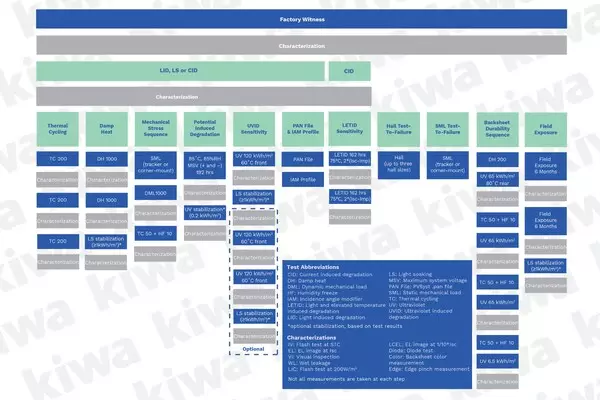
NAPA, Calif., April 16, 2026 /PRNewswire/ -- Kiwa PVEL, the independent lab for quality and reliability testing of solar photovoltaic (PV) modules, today announced a significant update to its photovoltaic (PV) module Product Qualification Program (PQP). The revisions directly address some of the fastest‑growing concerns for the global solar industry, including the rise of field failures related to spontaneous glass breakage, frame structural failures, and increasingly severe hail events.
"Across the industry, we continue to see increasing instances of spontaneous glass breakage in the field," said Tristan Erion-Lorico, Vice President of Sales and Marketing at Kiwa PVEL. "As manufacturers have pushed toward larger modules and thinner materials, these sudden breakage events have made it clear that more rigorous and statistically meaningful testing is needed. Our updated PQP now uses higher sample sizes and test‑to‑failure methodologies to better assess module durability."
New Test-to-Failure Methods Improve Module Breakage Insights
A key feature of the updated PQP is the introduction of test‑to‑failure (TTF) protocols for both static mechanical load (SML) and hail testing. The new SML-TTF complements the PQP's existing Mechanical Stress Sequences (MSS) by quantifying the dominant failure mode and achievable maximum load for each module design submitted for PQP testing. It also expands the test sample quantity to five additional SML-TTF samples, on top of the two MSS samples.
The Hail‑TTF protocol replaces the previous Hail Stress Sequence (HSS) in the PQP. The updated hail test increases the sample size to five modules and focuses on impact locations in the areas most prone to breakage, such as edges, corners, and junction box regions. Hail‑TTF greatly improves repeatability and comparability across manufacturers and glass suppliers, by escalating hail diameters until failure occurs, providing buyers with more quantifiable breakage thresholds.
Kiwa PVEL has also updated its PQP sample production witness process to more systematically verify critical frame and glass dimensions in factories, further reducing uncertainty related to material and assembly variability.
Updated Stabilization Processes
As n‑type technologies become dominant in the PV market, testing labs have encountered increased measurement uncertainty driven by metastability mechanisms. Kiwa PVEL's team spent the past years quantifying these effects and identified three distinct forms of metastability that can distort post‑test performance measurements:
- Slow dark‑storage degradation following Damp Heat testing
- Accelerated dark‑storage degradation following UV exposure and field exposure
- Potentially recoverable PID‑polarization degradation following voltage stress
To counter these effects, the updated PQP introduces final stabilization steps, including short doses of full‑spectrum light soaking and UV‑light soaking, after UVID, Field Exposure, Damp Heat, and PID testing. These steps ensure that post‑test flash measurements more accurately reflect true module behavior in the field.
Other PQP Updates
Several other refinements further enhance the PQP's relevance for modern day modules:
- Reduced LID sample size from 17 to 10 modules, justified by low and consistent LID values in recent years.
- Allowance for pre‑test current induced preconditioning (in addition to outdoor and indoor light‑soaking) to speed testing and improve scheduling flexibility.
- Streamlined UVID sequencing, eliminating the interim UV60 characterization in favor of a continuous 120 kWh/m2 exposure, with an option to extend up to 360 kWh/m2 for BOMs that show higher UVID susceptibility.
- Updated energy ratings following IEC61853-3/4 methodology, leveraging our high accuracy PAN and IAM testing data.
"Regularly iterating on the PQP makes it the most relevant test plan for today's module technologies and failure modes," said Kevin Gibson, Managing Director at Kiwa PVEL. "These updates allow module manufacturers to better showcase product reliability and performance on their current offerings. The new PQP also ensures that solar buyers receive meaningful, statistically robust and actionable data."
For more information, please visit kiwa.com/pvel/pqpv12.
About Kiwa PVEL
Kiwa PVEL is the leading reliability and performance testing lab for downstream solar project developers, financiers, and asset owners around the world. As part of the larger Kiwa Group, Kiwa PVEL's integrated services for the solar supply chain offer technical solutions for mitigating risk, optimizing financing and improving solar and energy storage systems performance throughout the project lifecycle.
Since 2012, Kiwa PVEL's Product Qualification Program (PQP) has been globally recognized for replacing assumptions about PV module performance with quantifiable metrics. Related data and consulting services offered by Kiwa PVEL provide vital procurement intelligence to a network of downstream solar buyers. Visit kiwa.com/pvel and kiwa.com/solar to learn more.
Contact:
Ashley Fallon
Head of Marketing
ashley.fallon@kiwa.com
NAPA, Calif., April 16, 2026 /PRNewswire/ -- Kiwa PVEL, the independent lab for quality and reliability testing of solar photovoltaic (PV) modules, today announced a significant update to its photovoltaic (PV) module Product Qualification Program (PQP). The revisions directly address some of the fastest‑growing concerns for the global solar industry, including the rise of field failures related to spontaneous glass breakage, frame structural failures, and increasingly severe hail events.
"Across the industry, we continue to see increasing instances of spontaneous glass breakage in the field," said Tristan Erion-Lorico, Vice President of Sales and Marketing at Kiwa PVEL. "As manufacturers have pushed toward larger modules and thinner materials, these sudden breakage events have made it clear that more rigorous and statistically meaningful testing is needed. Our updated PQP now uses higher sample sizes and test‑to‑failure methodologies to better assess module durability."
New Test-to-Failure Methods Improve Module Breakage Insights
A key feature of the updated PQP is the introduction of test‑to‑failure (TTF) protocols for both static mechanical load (SML) and hail testing. The new SML-TTF complements the PQP's existing Mechanical Stress Sequences (MSS) by quantifying the dominant failure mode and achievable maximum load for each module design submitted for PQP testing. It also expands the test sample quantity to five additional SML-TTF samples, on top of the two MSS samples.
The Hail‑TTF protocol replaces the previous Hail Stress Sequence (HSS) in the PQP. The updated hail test increases the sample size to five modules and focuses on impact locations in the areas most prone to breakage, such as edges, corners, and junction box regions. Hail‑TTF greatly improves repeatability and comparability across manufacturers and glass suppliers, by escalating hail diameters until failure occurs, providing buyers with more quantifiable breakage thresholds.
Kiwa PVEL has also updated its PQP sample production witness process to more systematically verify critical frame and glass dimensions in factories, further reducing uncertainty related to material and assembly variability.
Updated Stabilization Processes
As n‑type technologies become dominant in the PV market, testing labs have encountered increased measurement uncertainty driven by metastability mechanisms. Kiwa PVEL's team spent the past years quantifying these effects and identified three distinct forms of metastability that can distort post‑test performance measurements:
- Slow dark‑storage degradation following Damp Heat testing
- Accelerated dark‑storage degradation following UV exposure and field exposure
- Potentially recoverable PID‑polarization degradation following voltage stress
To counter these effects, the updated PQP introduces final stabilization steps, including short doses of full‑spectrum light soaking and UV‑light soaking, after UVID, Field Exposure, Damp Heat, and PID testing. These steps ensure that post‑test flash measurements more accurately reflect true module behavior in the field.
Other PQP Updates
Several other refinements further enhance the PQP's relevance for modern day modules:
- Reduced LID sample size from 17 to 10 modules, justified by low and consistent LID values in recent years.
- Allowance for pre‑test current induced preconditioning (in addition to outdoor and indoor light‑soaking) to speed testing and improve scheduling flexibility.
- Streamlined UVID sequencing, eliminating the interim UV60 characterization in favor of a continuous 120 kWh/m2 exposure, with an option to extend up to 360 kWh/m2 for BOMs that show higher UVID susceptibility.
- Updated energy ratings following IEC61853-3/4 methodology, leveraging our high accuracy PAN and IAM testing data.
"Regularly iterating on the PQP makes it the most relevant test plan for today's module technologies and failure modes," said Kevin Gibson, Managing Director at Kiwa PVEL. "These updates allow module manufacturers to better showcase product reliability and performance on their current offerings. The new PQP also ensures that solar buyers receive meaningful, statistically robust and actionable data."
For more information, please visit kiwa.com/pvel/pqpv12.
About Kiwa PVEL
Kiwa PVEL is the leading reliability and performance testing lab for downstream solar project developers, financiers, and asset owners around the world. As part of the larger Kiwa Group, Kiwa PVEL's integrated services for the solar supply chain offer technical solutions for mitigating risk, optimizing financing and improving solar and energy storage systems performance throughout the project lifecycle.
Since 2012, Kiwa PVEL's Product Qualification Program (PQP) has been globally recognized for replacing assumptions about PV module performance with quantifiable metrics. Related data and consulting services offered by Kiwa PVEL provide vital procurement intelligence to a network of downstream solar buyers. Visit kiwa.com/pvel and kiwa.com/solar to learn more.
Contact:
Ashley Fallon
Head of Marketing
ashley.fallon@kiwa.com
** This press release is distributed by PR Newswire through automated distribution system, for which the client assumes full responsibility. **
Kiwa PVEL Releases Major Update to PV Module Product Qualification Program to Better Address Module Breakage