China's animated blockbuster "Ne Zha 2" is evolving beyond its cinematic success into a high-value intellectual property (IP), not only driving its merchandise sales, but also stimulating a tourism frenzy and generating substantial consumer spending.
As a sequel to the 2019 hit "Ne Zha", the latest installment has already become the one of the top ten highest-grossing animated film of all time worldwide, now ranking the sixth on the global box office chart with a revenue of exceeding 14.9 billion yuan (about 2.06 billion U.S. dollars) as of Sunday.
Rooted in the Chinese legend of the demon child Ne Zha, the movie is now writing a legend of its own. While it creates waves in the cinematic world, its influence extends far beyond the big screen.
Thanks to its deep cultural ties to the Ne Zha myth, Yibin City in southwest China's Sichuan Province, a more seasonal tourist destination, has seen a significant tourism surge this year. The city's Cuiping Mountain, home to the Ne Zha Palace, is a key attraction.
According to local lore, after Ne Zha's tragic death, he appeared in his mother Lady Yin's dream, asking her to build him a palace atop the Cuiping Mountain. This myth has become the foundation for the shrine that stands there today.
"I come from Guangdong Province. I saw the movie, so I wanted to come visit this temple," said a tourist.
"Because of the huge popularity of the Ne Zha movie, I wanted to bring my child here to experience the Ne Zha atmosphere," said another.
Hotel bookings in Yibin spiked by over 30 to 50 percent year on year in the week following the film's release on Jan 29. Tourist traffic to the Ne Zha Palace reached 8,000 trips a day, three times the usual number.
"In Yibin, from folk traditions to ancient relics, attractions and cultural sites linked to Ne Zha can be traced back at least 1,000 years. There are more than 20 historical and cultural landmarks related to Ne Zha -- from 'The Divine Child's Descent' to 'The Havoc in the East Sea' -- including Ne Zha's Palace, Chentang Pass, Ne Zha's birthplace, and Rebirth Pavilion, all of which mirror the narratives found in the myth. As a result, many regard this city as the hometown of Ne Zha, viewing him as a child of Yibin. It's a sentiment deeply felt by the locals," said Huang Hao, deputy director of the Cuiping Mountain Scenic Area. Yibin was officially designated in 2019 the "Hometown of Ne Zha Culture" by China's Folk Literature and Art Association.
Meanwhile, an online debate has erupted over which city can claim as Ne Zha's true hometown. Tianjin, for example, has a subdistrict named "Chentangzhuang." According to local lore, it equates to Chentang Pass, the very area once garrisoned by Ne Zha's father.
Although some critics argue that Ne Zha, as a mythical figure, doesn't have a true hometown, experts suggest that the debate itself has positive values. It fosters cultural identity and drives consumer spending, benefiting all cities involved.
"Some places might not even have deep historical ties to Ne Zha, yet he belongs to all of China -- a shared cultural icon for every Chinese. That's why regions and organizations have every right to ride the Ne Zha wave and channel his energy to build their own cultural and tourism initiatives. It's a business strategy and it fuses local strengths with high-profile IP elements. It's a creative integration. In a sense, wherever there are Chinese communities, you'll see Ne Zha-inspired cultural tourism emerging. This isn't just a regional affair. It's a nationwide, pan-Chinese cultural tourism bonanza," said Cai Shangwei, director of the Cultural Industry Research Center at Sichuan University.
On the tourism front, the film has spurred travel in broader areas across China. Online travel platforms saw searches for Ne Zha-related attractions jumped by over 40 percent in February.
Ne Zha-themed toys have become new hot items in character-driven toy stores - the popular hangout hubs for China's Gen Z consumers. The figurines act as emotional anchors -- almost like owning a piece of the stories they love.
These toys are quick sales in the wake of the film's release, and some are now available only through pre-orders, with wait times stretching into the summer.
"It's really popular, completely sold out. If you want to buy it, you'll have to wait until June," a customer said at a toy store.
Ne Zha's IP journey is only beginning. To become a global franchise, it requires a fully developed commercial ecosystem.
"Only when China's film market grows in scale, with a mature industrial system in place, will market risks drop and development will gain steam. Ultimately, industries spawned from an IP should have no boundaries. It's limitless. Anything can be bolstered by an IP-plus approach. We all have basic needs -- clothing, food, shelter, transport, and our demands drive consumption, and consumption creates new markets," said Cai.
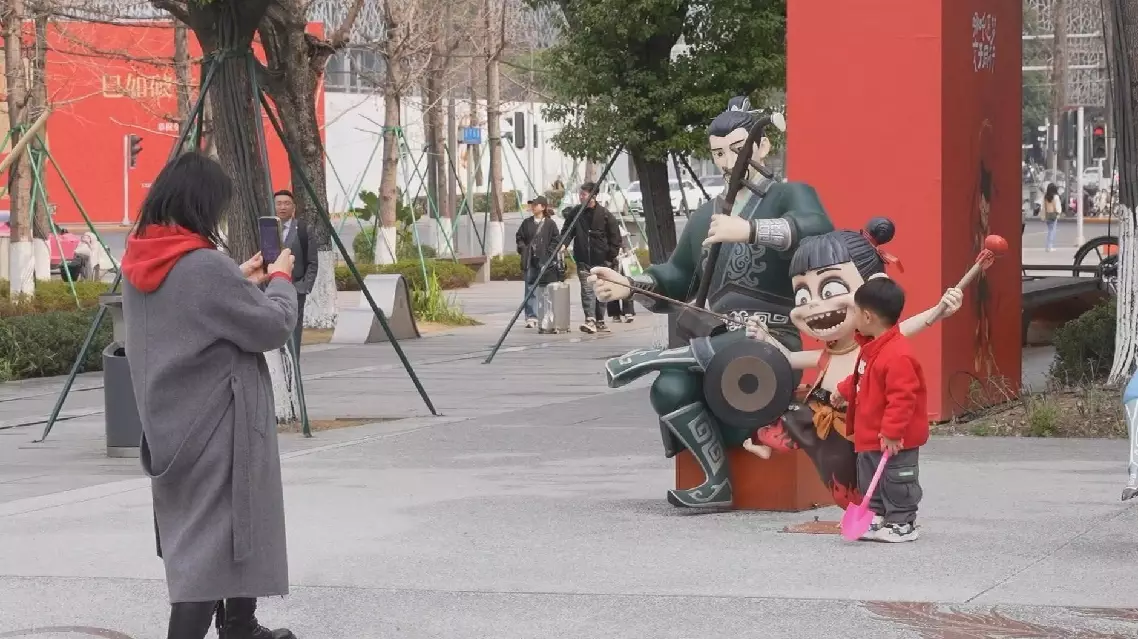
Chinese animated blockbuster "Ne Zha 2" evolves into high-value IP