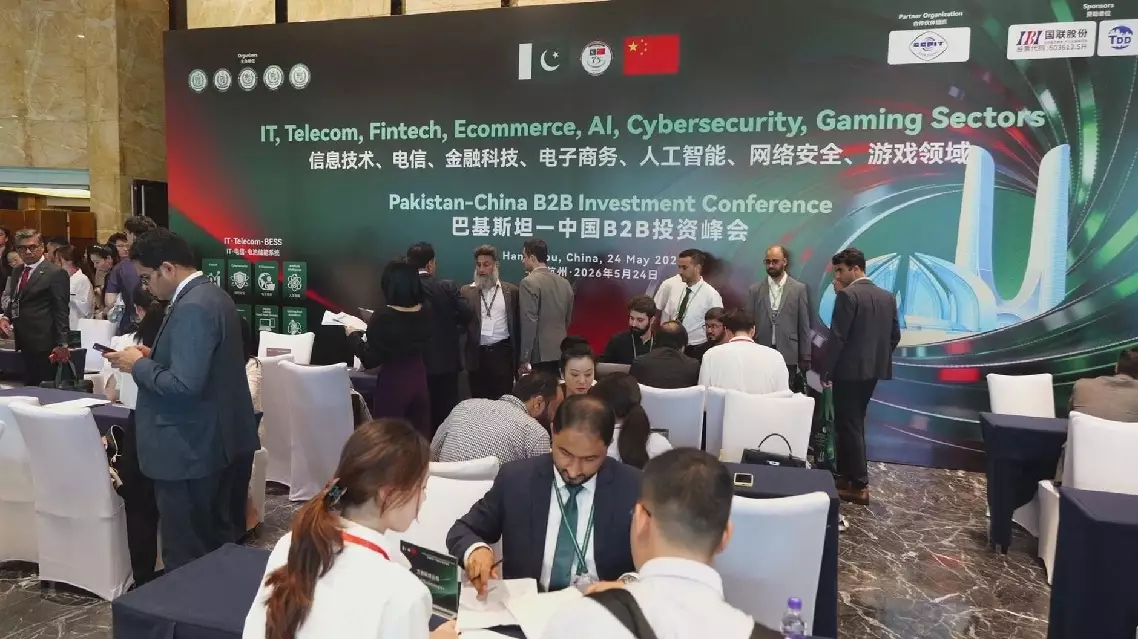
The Pakistan-China Business-to-Business (B2B) Investment Conference was held in the eastern Chinese technology hub of Hangzhou on Sunday morning, highlighting new trends of cooperation between China and Pakistan in information technology (IT) and other emerging industries.
The business event brought together over 500 leading enterprises from China and Pakistan, representing sectors such as e-commerce, financial technology, artificial intelligence, gaming and animation, agriculture and battery energy storage systems.
Pakistani Prime Minister Shehbaz Sharif attended the conference and delivered a keynote speech, expressing expectations for deeper bilateral cooperation in key areas including IT and the digital economy.
As one of the key events during Sharif's visit to China, the conference aims to enhance targeted business matchmaking between Chinese and Pakistani companies across key sectors and boost investment cooperation in industrial technologies.
"We have done, in Beijing, a big conference where MoUs (Memorandums of Understanding) of more than 8 billion dollars were signed. This time we have selected the four major sectors, including agriculture, IT, battery energy storage system and the computer mobile manufacturing, laptop et cetera," said Faiz Ahmed, chairman of the Trade Development Authority of Pakistan.
China has been a major investor in Pakistan, with the China-Pakistan Economic Corridor standing as the landmark achievement of their cooperation. The MoUs signed by Chinese and Pakistani enterprises at the investment conference bring new momentum as the countries work toward the "China-Pakistan Economic Corridor 2.0" and further strengthen their all-weather strategic partnership.
"By doing partnership, the business people can not only see opportunities in China and in Pakistan, but they can see opportunities in the other regions also. So if the Chinese partners and the Pakistani partners join hands together, with the technology, with know-how, with skill, I think they can go forward a lot," said Pakistani Minister for Commerce Jam Kamal Khan.
China and Pakistan have pledged to further expand cooperation in key sectors such as energy, infrastructure, telecommunications, IT, and wholesale and retail industries.
For Chinese companies, beyond the traditional areas like energy, mining, and agriculture, there are going to be huge opportunities in information technology and AI in Pakistan in the years ahead.
"From what we've seen in practice, Pakistan is really going all in on the digital economy, the IT industry and AI. The government is placing a very strong emphasis on these sectors," said Qian Xiaojun, founder and president of IBI Beijing United Technology, a B2B company.
Sharif arrived in Hangzhou on Saturday on the first leg of his four-day official visit to China. Known as China's Silicon Valley, Hangzhou was selected as the venue due to its reputation as a premier technological innovation hub in China.
On Sunday, he met with CEOs of leading Chinese companies, visited the headquarters of Alibaba and attended a ceremony for the signing of cooperation memorandums of understanding before departing for Beijing.
China-Pakistan investment conference in Hangzhou highlights emerging cooperation