China's robotics industry saw another a major breakthrough on Monday with the launch of the AgiBot GO-1, the first-ever universal embodied artificial intelligence (AI) large model which enables robots to learn new skills by simply observing actions or watching videos, much like humans do.
The latest achievement comes amid an unprecedented period of growth in China's tech sector, with agile humanoid robots becoming increasingly capable of a wide range of application scenarios, while the country's AI industry has also been energized by the emergence of a new cost-effective model released by Chinese start-up DeepSeek, which has made global waves since its release earlier this year.
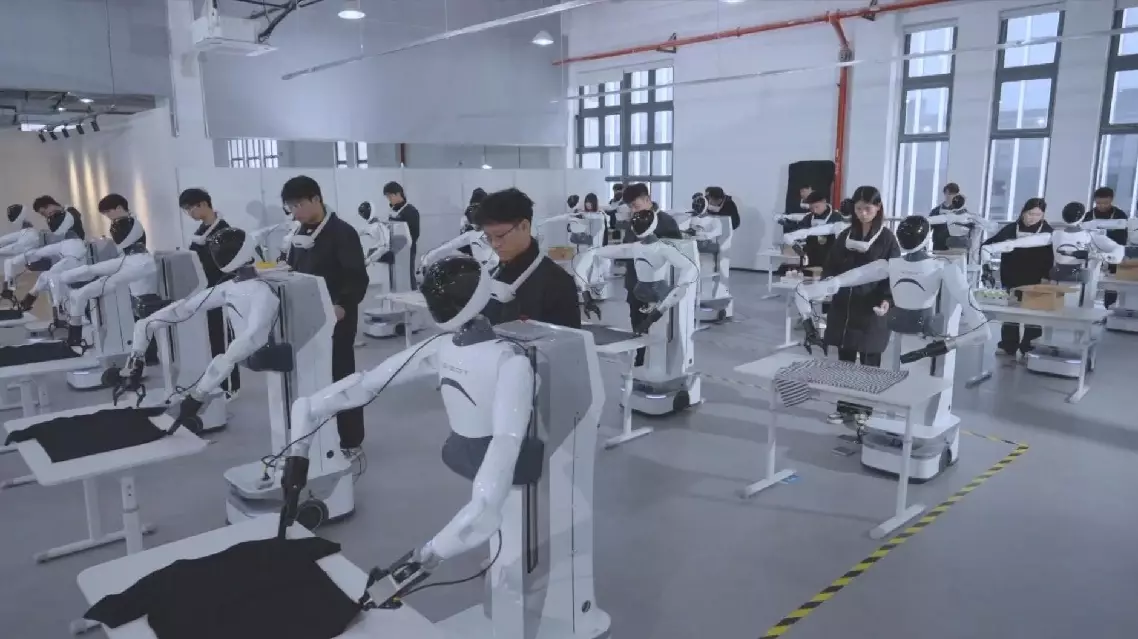
The groundbreaking model from the Shanghai-based robotics company AgiBot uses an innovative architecture enabling smart robots to learn and understand human actions with just a limited set of data. It looks to harness the advantages of "embodied AI", which refers to AI that is integrated into physical systems, which in this case enables a robot to fully interact with its surroundings.
By analyzing online videos or observing real-life demonstrations, the robot is able to replicate what it sees and apply this newfound knowledge to carry out new tasks or respond to new environments.
"For a new scenario or task, we only need a few hundred pieces of data to achieve the desired results. The data can be collected in just a single day. In the past, it typically needed tens of thousands of pieces of data," said Yao Maoqing, president of AgiBot's Embodied Intelligence Business Unit.
The GO-1 model offers continuous evolution, which means when faced with new challenges in real-world applications, the robot can autonomously understand a situation and optimize solutions based on its knowledge, without the need to start learning from scratch.
The model also features an impressive ability to share new information across its entire network, essentially meaning that once one robot acquires a set of skills, other related robots can quickly adopt the same capabilities.
"We can use various types of data, including data from one robot, other robots, and even human operation data. By using generative models, the system learns a unified motion representation. For a specific robot, we can then decode this unified representation into joint control commands using another module," explained Yao.
The release of the GO-1 marks another significant leap toward for embodied AI and for AgiBot, who already celebrated the production of its 1,000th universal embodiment robot back in January. The firm says they now expect to deliver thousands more units this year as interest around their product line grows.
Chinese firm's new AI model enables self-learning robots in major tech breakthrough