The International Energy Agency (IEA) on Wednesday lowered its forecast for global oil demand growth in 2025 to just over one million barrels per day, down by 70,000 from its previous estimate.
The Paris-based global energy watchdog attributed the revision to downside risks from U.S. tariff threats and broader macroeconomic uncertainties.
The agency now expects global oil demand to reach 103.9 million barrels per day in 2025, with Asia accounting for nearly 60 percent of the gains, driven by China's petrochemical sector.
Weaker-than-expected delivery data also led to slightly lower estimates for year-on-year demand growth in the fourth quarter of 2024 and the first quarter of 2025, now projected at 1.2 million barrels per day, the IEA said in its latest report.

IEA lowers 2025 global oil demand growth forecast amid economic uncertainty
Indonesian Navy's sail training ship Kri Bima Suci (945) is on a four-day friendly visit in China's Shanghai.
The ship arrived in Shanghai Monday afternoon and anchored at a military port accompanied by light frigate Tai'an (616) of the Chinese Navy.
During the visit, the Chinese and Indonesian sailors will pay cross-deck visits, hold deck receptions, and carry out cultural and sports exchanges, and the military band aboard Kri Bima Suci will perform at the Bund in Shanghai, according to the Chinese military.
This is the ship's third visit to Shanghai.
Kri Bima Suci is the largest sail training ship of the Indonesian Navy. It has a length of 111.2 meters, a width of 13.65 meters and displacement of 2,346 tons, with a total of 26 sails and a main mast at the height of 53 meters. Its sailing speed can reach 15 knots.
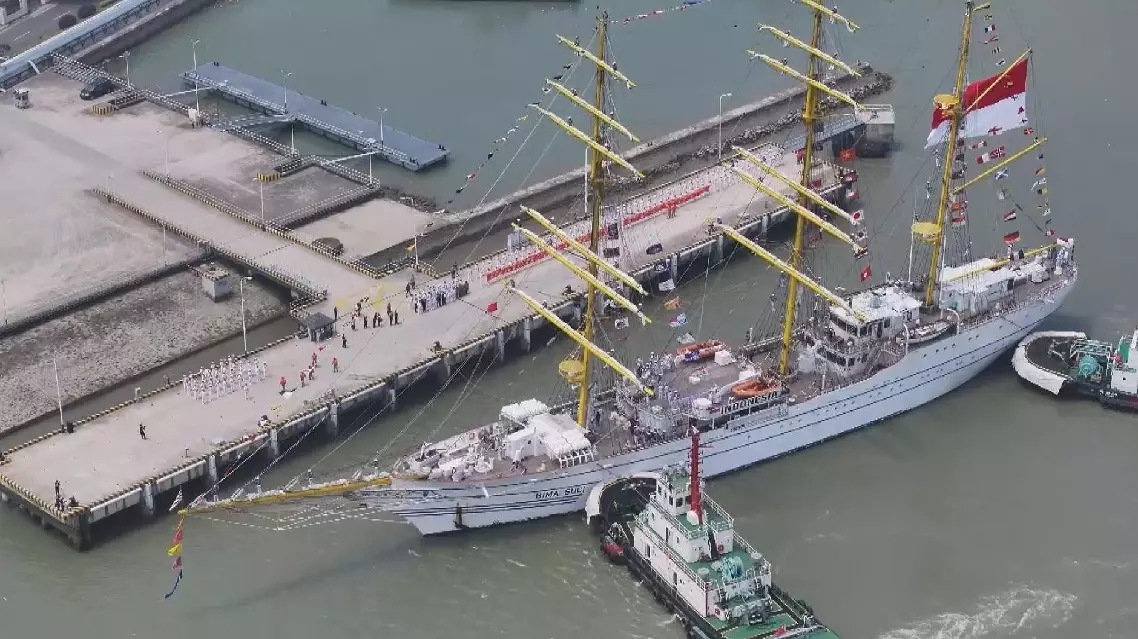
Indonesian Navy's sail training ship visits Shanghai