Indonesian Navy's sail training ship Kri Bima Suci (945) is on a four-day friendly visit in China's Shanghai.
The ship arrived in Shanghai Monday afternoon and anchored at a military port accompanied by light frigate Tai'an (616) of the Chinese Navy.
During the visit, the Chinese and Indonesian sailors will pay cross-deck visits, hold deck receptions, and carry out cultural and sports exchanges, and the military band aboard Kri Bima Suci will perform at the Bund in Shanghai, according to the Chinese military.
This is the ship's third visit to Shanghai.
Kri Bima Suci is the largest sail training ship of the Indonesian Navy. It has a length of 111.2 meters, a width of 13.65 meters and displacement of 2,346 tons, with a total of 26 sails and a main mast at the height of 53 meters. Its sailing speed can reach 15 knots.

Indonesian Navy's sail training ship visits Shanghai

Indonesian Navy's sail training ship visits Shanghai
Farmers in Gaza have been forced to find innovative ways to keep their livelihoods ticking over following the devastating conflict, with many now growing vegetables inside recycled tin cans after losing their land during the war.
Inside temporary greenhouses in southern Gaza, Palestinian farmers are growing mint and vegetables inside empty food cans recycled from aid supplies, after suffering severe shortages of essential agricultural materials.
Local farmers say they have been searching for simple alternatives to continue farming amid the widespread destruction, with many seeing their land and crop fields decimated.
"The idea came from the shortage of nylon in Gaza. We started using empty vegetable cans left behind by charity kitchens. We use them as an alternative to nylon and plant inside them," said Mohammad Zaarab, a Palestinian farmer.
Israel's designation of what Palestinians call the 'yellow zone' has swallowed up most of Gaza's available farmland, reducing usable agricultural land to only around six percent, while farmers continue to face the risk of Israeli fire during their work.
"We are exposed to gunfire in this area. Whenever they shoot at us, we hide until the firing stops. We work in fear and risk our lives while farming," said Shadi Zaarab, another farmer.
According to the United Nations, agriculture made up around 10 percent of Gaza's economy before the war, with more than 560,000 Palestinians relying on farming, livestock, or fishing for their livelihoods.
Gaza's Ministry of Agriculture says reusing empty food cans has become one of the few remaining ways for farmers to continue growing and providing food after the war that began in 2023 devastated much of the agricultural sector.
"Since October 7 [2023], about 86 percent of Gaza's agricultural land has been destroyed by the [Israeli] occupation. Farmers have turned to alternatives, especially for growing aromatic plants that Gaza's farmers traditionally relied on for production," said Ali Abu Amer, director of the Khan Younis Governorate under Palestine's Ministry of Agriculture.
The recycled can practice adopted by farmers also has some positive knock-on effect, as collecting and preparing empty food cans has also created limited work opportunities for unemployed youth amid the Israeli blockade.
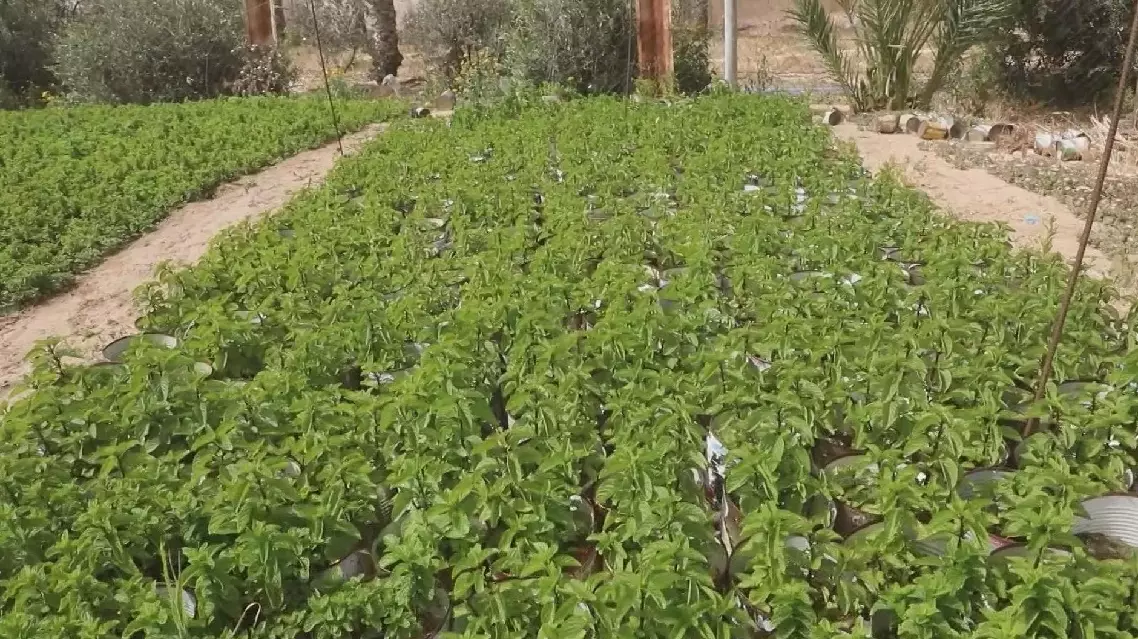
Gaza farmers turn to growing vegetables in recycled tin cans after losing land