Analysts have warned that the separatist statements made recently by leader of Taiwan region Lai Ching-te constitute a challenge to the bottom line and the red line of the mainland.
On Thursday, the eve of the 20th anniversary of the implementation of China's Anti-Secession Law, Lai held a meeting in which he portrayed the mainland as a "hostile external force" and outlined 17 strategies to counter the so-called threats facing the island.
"There is no doubt that the Lai Ching-te authorities' actions are an attempt to challenge the bottom line and the red line of the mainland, especially Article 8 of the Anti-Secession Law. His actions are indeed extremely dangerous," said Zhang Hua, a researcher at the Institute of Taiwan Studies, the Chinese Academy of Social Sciences.
"We must carefully analyze whether his actions have touched Article 8 of the Anti-Secession Law, that is, 'the state shall employ non-peaceful means and other necessary measures to protect China's sovereignty and territorial integrity.' The more rambunctious Lai Ching-te becomes, the faster we will see a solution of the Taiwan question and achieve unification," said Zhu Songling, a professor at the Institute of Taiwan Studies in Beijing Union University.
Article 8 of the law states that the state shall employ non-peaceful means and other necessary measures to protect China's sovereignty and territorial integrity in the event that the "Taiwan independence" secessionist forces should act under any name or by any means to cause the fact of Taiwan's secession from China, or that major incidents entailing Taiwan's secession from China should occur, or that possibilities for a peaceful reunification should be completely exhausted.
Analysts said Lai's separatist actions would push Taiwan closer to the brink of conflict.
His proposal to "reinstate military tribunals" is viewed as a strategic move to suppress political opponents on the island which further reveals his anxiety and insecurity, analysts said.
"Lai Ching-te's intensified incitement against the mainland cannot be ruled out as a strategic foreshadowing laid by him to suppress political dissidents on the island," said Chen Chao, deputy director of the Center for Taiwan Studies, Shanghai Jiao Tong University.
"Lai Ching-te is very anxious because his public support in the Taiwan region has continued to plunge. Polls conducted last month showed that public support for Lai was approaching a 'death cross' where the opposition outnumbers the support. So he resorted to provoking confrontation between the two sides of the Taiwan Strait," Zhang Hua said.
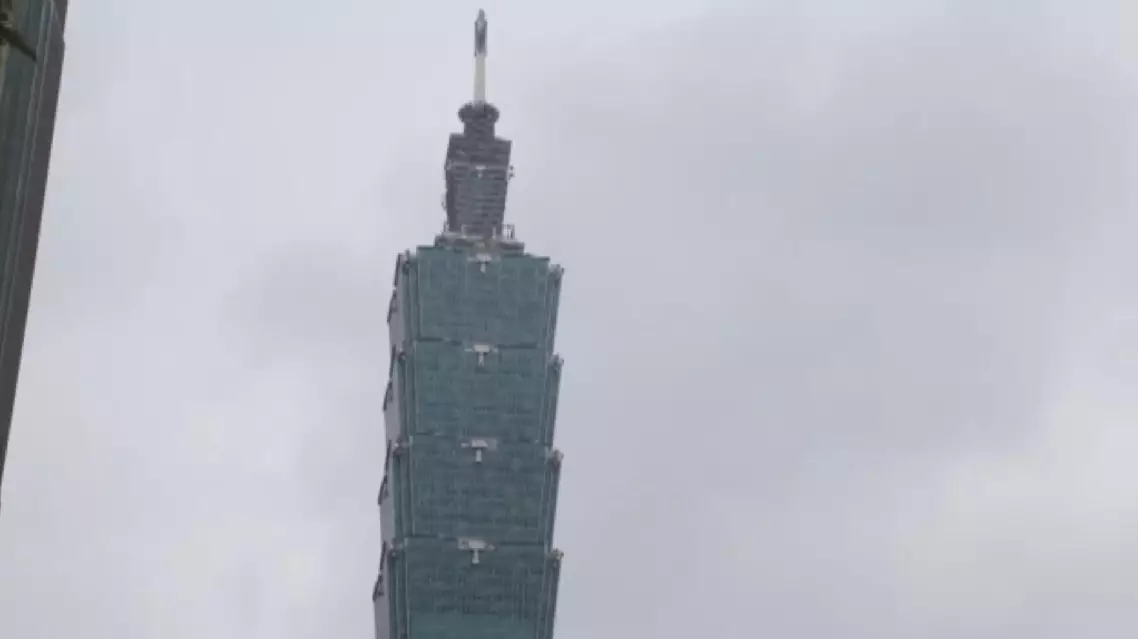
Analysts see Lai Ching-te's separatist statements as challenge to mainland's red line
The Exhibition Hall of Evidence of Crimes Committed by Unit 731 of the Japanese Imperial Army in northeast China's Harbin released on Thursday a 38-minute video of a former member of Unit 731, a notorious Japanese germ-warfare unit during World War II (WWII).
In the footage, former Unit 731 member Tsuruo Nishijima detailed how the unit used meteorological data to carry out bacterial dispersal and frostbite experiments.
The video was recorded in 1997 by Japanese scholar Fuyuko Nishisato and donated to the exhibition hall in 2019, according to the hall, which was built on the former site of the headquarters of Unit 731 in Harbin, capital city of Heilongjiang Province.
Nishijima joined Unit 731 in October 1938 and served in the unit's meteorological squad. The squad was not a simple observation section but rather an auxiliary force supporting the unit's human experiments in the field by measuring wind direction, wind speed and other conditions to ensure optimal experimental results.
Nishijima confirmed in the footage that "the meteorological squad had to be present at every field experiment." He testified to the "rainfall experiments" conducted by Unit 731, which involved aircraft releasing bacterial agents at extremely low altitudes.
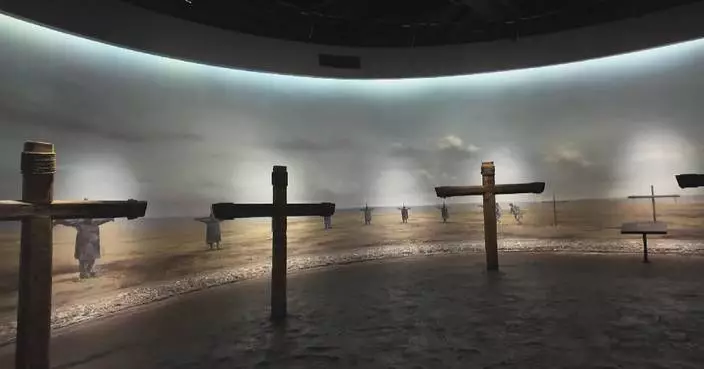
At a field-testing site in Anda City, Heilongjiang, Unit 731 aircraft descended to about 50 meters above the ground and sprayed bacterial culture liquids onto "maruta" -- human test subjects -- who were tied to wooden stakes. Each experiment involved about 30 people, spaced roughly 5 meters apart. After the experiments, the victims were loaded into sealed trucks and transported back to the unit, where their symptoms and disease progression were recorded over a period of several days.
Nishijima also revealed that a Japanese military doctor once died after removing the mask and becoming infected during an experiment, indirectly proving the extreme virulence of the bacterial agents.
The video further disclosed details of the meteorological squad's involvement in frostbite experiments. To study wartime needs in frigid regions, the invading Japanese army forced the victims to expose their bodies for five to ten minutes in temperatures ranging from minus 20 to minus 35 degrees Celsius and observed their physical reactions.
"For example, during frostbite experiments, we would be sent outside to observe the weather. They wouldn't bring many people out at once, only two or three, who would be forced to take off their upper garments or all their clothes. In fact, it was already quite tough to stay out there for five to ten minutes, because it was too cold," Nishijima said.
According to the exhibition hall, Unit 731 had a separate frostbite laboratory, with Hisato Yoshimura serving as the leader of the unit's frostbite study squad from 1938 to 1945.
In a paper on frostbite published in 1941, Yoshimura recorded data from live human experiments to study the occurrence of frostbite and pathological changes in the human body under different conditions.
"This is a form from the paper. Titled 'The Severity and Process of Frostbite,' it divides frostbite into three stages. The symptoms of the first-degree frostbite are redness and swelling. Blisters appear in the second stage. And the third-degree frostbite features necrosis and ulceration. It says here that, in the third stage, from the 50th to the 60th day, toes and fingers detached. There is no doubt that these data were obtained through numerous human experiments," said Tan Tian, a researcher of the exhibition hall.
Nishijima's video, a piece of oral history from a perpetrator's perspective, further reconstructs the criminal chain of Unit 731 and once again demonstrates that the invading Japanese army's biological warfare crime was systematic and inhumane, and was an undeniable historical truth, according to the exhibition hall.
"Unit 731's frostbite experiments were essentially conducted to prevent and treat frostbite during combat in cold environments. However, for the so-called prevention and treatment of frostbite, they caused frostbite on living people for experiments and data analysis. So in nature, it still serves the purpose of war," said Jin Shicheng, director of the Department of Publicity, Education and Exhibition at the hall.
Unit 731 was a top-secret biological and chemical warfare research base established in Harbin as the nerve center for Japanese biological warfare in China and Southeast Asia during WWII.
At least 3,000 people were used for human experiments by Unit 731, and more than 300,000 people in China were killed by Japan's biological weapons.
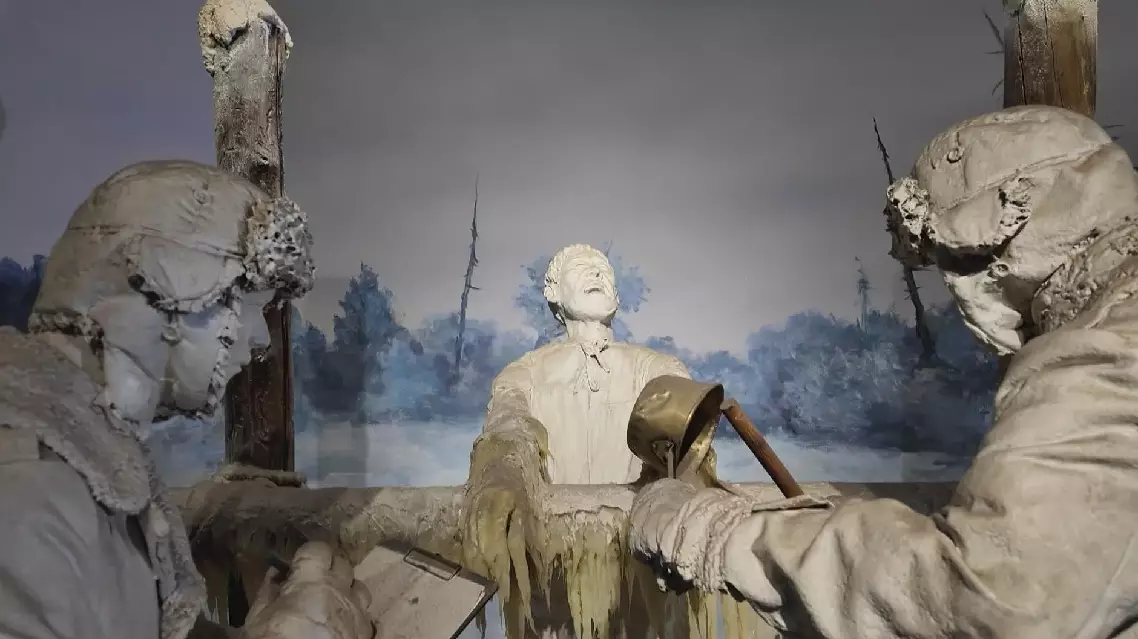
Video offers new evidence of Japan's wartime germ-warfare crimes in northeast China