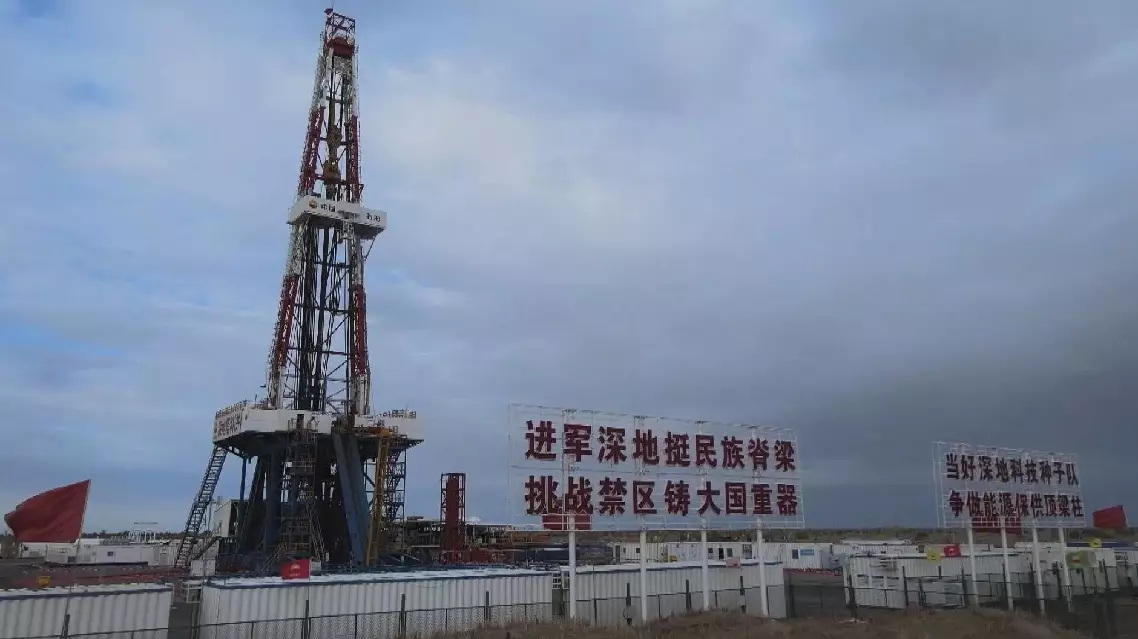
China's self-developed 12,000-meter automated drilling rig, the first of its kind the world, facilitated the drilling of the deepest vertical well in Asia, which is also the second deepest in the world.
Located in the heart of the Taklimakan Desert in the Tarim Basin, northwest China's Xinjiang Uygur Autonomous Region, the well, known as "Shenditake 1," was completed in Feburary, with a borehole reaching a depth of 10,910 meters.
Developed by China National Petroleum Corporation (CNPC), the 82-meter high automated drilling rig is equipped with a 6,000-horsepower drilling winch, the country's largest, realizing 900 tons of load capacity.
"Our self-developed super-large load lifting system can easily meet the ultra-deep and overweight challenges faced by ultra-deep well drilling. In addition, we have independently developed an intelligent control system of the rig, equipped with a full set of automatic wellhead operation equipment and other advanced equipment, thus realizing automatic and intelligent drilling operations," said Li Yahui, chief designer of the "Shenditake 1" drilling rig.
The rig is equipped with an automated string handling system, allowing the drill pipe to lift or drill down freely thanks to the collaboration of robotic arms and intelligent algorithms.
In addition, the rig's monitoring system can transmit 48 key parameters such as downhole temperature and pressure in real time, providing accurate data support for the decision-making system.
"The drilling rig has overcome the bottlenecks of core components such as 900 tons of load capacity and 70MPa ultra-high pressure drilling fluid circulation system, promoting the lifting capacity and drilling fluid pumping capacity to make major strides, and realizing the autonomous control of the entire process of high-end drilling rig design and manufacturing," said Sun Jinsheng, an academician of the Chinese Academy of Engineering (CAE).
Drilling began on May 30, 2023. It took over 580 days to complete the 10,910-meter drilling, with more than half of the time -- some 300 days --- spent on the final 910 meters, according to CNPC.
Beyond oil and gas exploration, "Shenditake 1" has provided Asia's first 10,000-meter-deep core samples, offering invaluable data for fundamental research in geology, geochemistry and geothermal studies
China's self-developed automated drilling rig sinks Asia's deepest vertical well
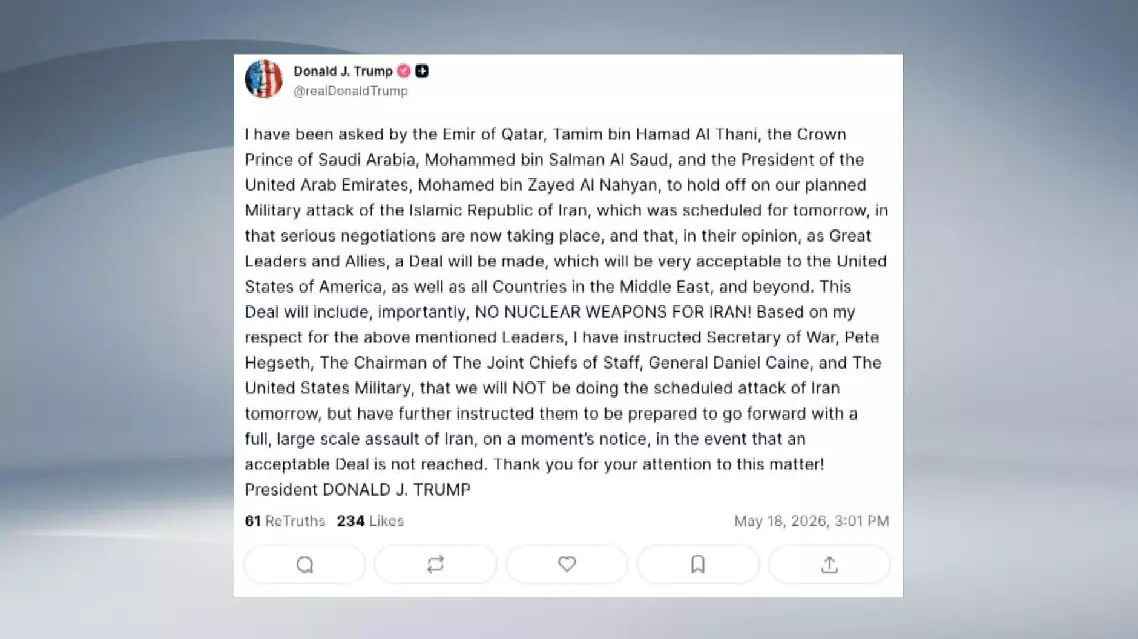
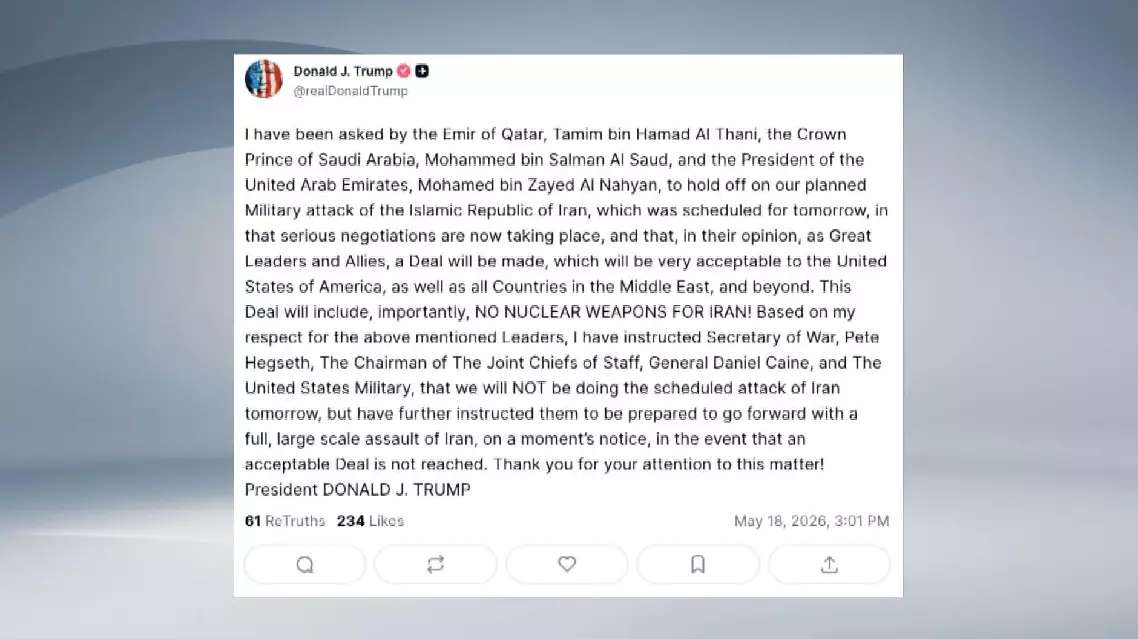
U.S. President Donald Trump said Monday that he has instructed the Pentagon not to launch military strikes on Iran Tuesday as U.S. allies in the Gulf are working to help reach an acceptable peace deal.
"We will NOT be doing the scheduled attack of Iran tomorrow," Trump wrote on Truth Social.
The president added that he has further instructed the Pentagon "to be prepared to go forward with a full, large scale assault of Iran, on a moment's notice, in the event that an acceptable Deal is not reached".
Trump said "serious negotiations" are taking place and that, in the opinion of Gulf leaders, a deal will be made, which will be "very acceptable" to the United States, all countries in the Middle East, and beyond.
"This Deal will include, importantly, NO NUCLEAR WEAPONS FOR IRAN!" he wrote.
Trump said he held off on the planned attacks at the request of leaders from Qatar, Saudi Arabia and the United Arab Emirates.
Also on Monday, Trump said he is "not open" to any Iranian concessions after receiving Tehran's updated response to a peace deal one day earlier.
Iran knows "what's going to be happening soon", he said in a phone interview with the New York Post.
Asked about his Friday remarks that he would be willing to accept a 20-year moratorium on Iranian uranium enrichment, Trump interjected: "I'm not open to anything right now."
The White House believes the latest offer from Iran is insufficient for a peace deal, U.S. online media Axios reported earlier on Monday, citing a senior U.S. official.
Iranian President Masoud Pezeshkian said on Monday that it is not correct to chant slogans against holding negotiations. "We negotiate with dignity and will never back down," according to a statement published on the website of his office.
Speaking at a meeting in Tehran, Pezeshkian said Iran is capable of defending its rights.
Iran has handed over its latest 14-point proposed plan for ending the war with the United States to mediator Pakistan, the semi-official Tasnim news agency reported on Monday.
Pakistan will convey the plan to the United States, the report said, citing a source close to Iran's negotiating team.
The new proposal was submitted after Tehran revised its earlier 14-point draft in response to a recent U.S. proposal, the source added.
According to the source, Iran's new draft focuses on negotiations to end the war, as well as on the U.S. "trust-building" measures.
Iran insists that the frozen overseas assets of Iran must also be "clearly and effectively" returned. Additionally, Iran is firm in demanding compensation from the United States.
In a separate report on Monday, Tasnim quoted another source close to the Iranian negotiating team as saying that, unlike previous U.S. drafts, Washington has agreed in its latest proposal to waive Iran's oil sanctions during the negotiation period.
Tasnim said Iran insists that the removal of all sanctions must be among the U.S. commitments. The United States, however, has proposed suspending sanctions imposed by the Office of Foreign Assets Control until a final agreement is reached, it said.
Iran, the United States and Israel reached a ceasefire on April 8 after 40 days of fighting that started with U.S. and Israeli attacks on Tehran and other Iranian cities on Feb 28.
Following the truce, Iranian and U.S. delegations held one round of peace talks in Pakistan's capital Islamabad on April 11 and 12, which failed to yield an agreement.
Over the past weeks, the two sides have reportedly exchanged several proposed plans outlining conditions for ending the conflict through Pakistan.
Trump says no US military strikes on Iran Tuesday as allies push for deal
Trump says no US military strikes on Iran Tuesday as allies push for deal