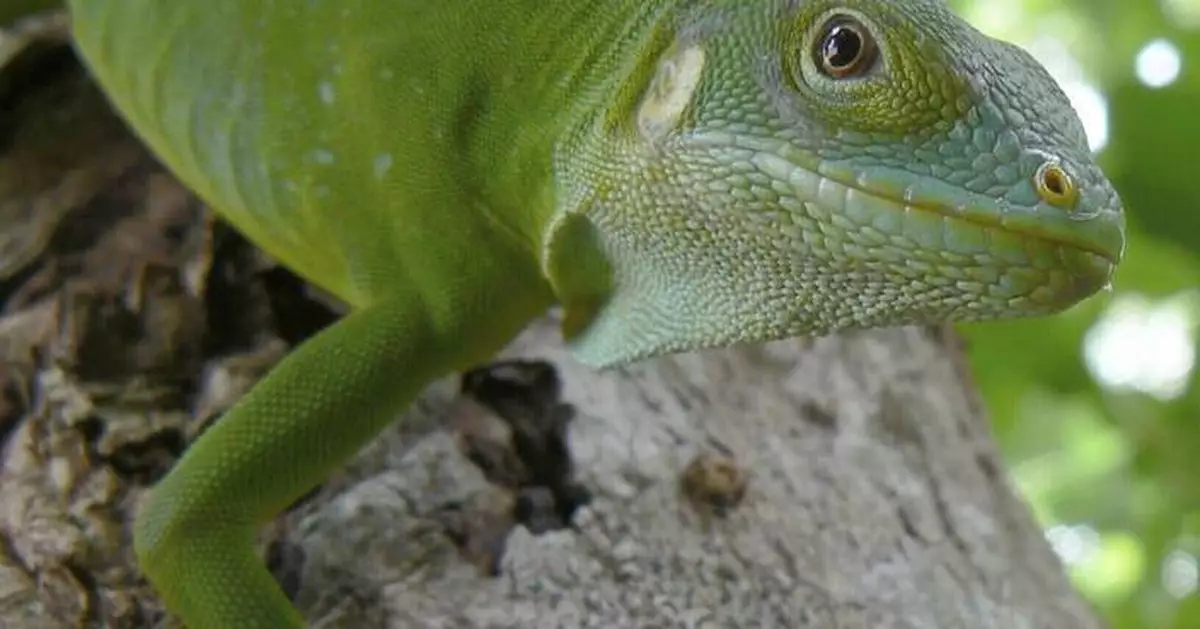
NEW YORK (AP) — Researchers have long wondered how iguanas got to Fiji, a collection of remote islands in the South Pacific. Most modern-day iguanas live in the Americas — thousands of miles and one giant ocean away.
They thought maybe they scurried there through Asia or Australia before volcanic activity pushed Fiji so far away.
But new research suggests that millions of years ago, iguanas pulled off the 5,000 mile (8,000 kilometer) odyssey on a raft of floating vegetation — masses of uprooted trees and small plants. That journey is thought to be a record — further than any other land-dwelling vertebrate has ever traveled on the ocean.
Scientists think that's how iguanas got to the Galapagos Islands off of Ecuador and between islands in the Caribbean. Initially they thought Fiji might be a bit too far for such a trip, but in a new study, researchers inspected the genes of 14 iguana species spanning the Americas, the Caribbean and Fiji. They discovered that Fijian iguanas were most closely related to desert iguanas from North America, and that the two groups split off around 31 million years ago.
The researchers created a statistical model using that information and other tidbits about where iguanas live today and how they may spread. It suggested that the iguanas most likely floated to Fiji from North America.
“Given what we know now, their result is by far the most strongly supported,” said Kevin de Queiroz, an evolutionary biologist at the Smithsonian National Museum of Natural History, who was not involved with the new study.
The research was published Monday in the journal Proceedings of the National Academy of Sciences.
The journey from North America to Fiji could have taken a few months, but these desert iguanas would have been ideal passengers because they were adept at resisting dehydration and could have snacked on the plants underfoot.
“If you had to pick a vertebrate to survive a long trip on a raft across an ocean, iguanas would be the one,” said study author Simon Scarpetta from the University of San Francisco, in an email.
Many Fijian iguana species are endangered, and an invasive green iguana roams the islands today, said study author Robert Fisher of the United States Geological Survey. Figuring out where these creatures came from can equip scientists with the tools to better protect them in the future.
—-
The Associated Press Health and Science Department receives support from the Howard Hughes Medical Institute’s Science and Educational Media Group and the Robert Wood Johnson Foundation. The AP is solely responsible for all content.
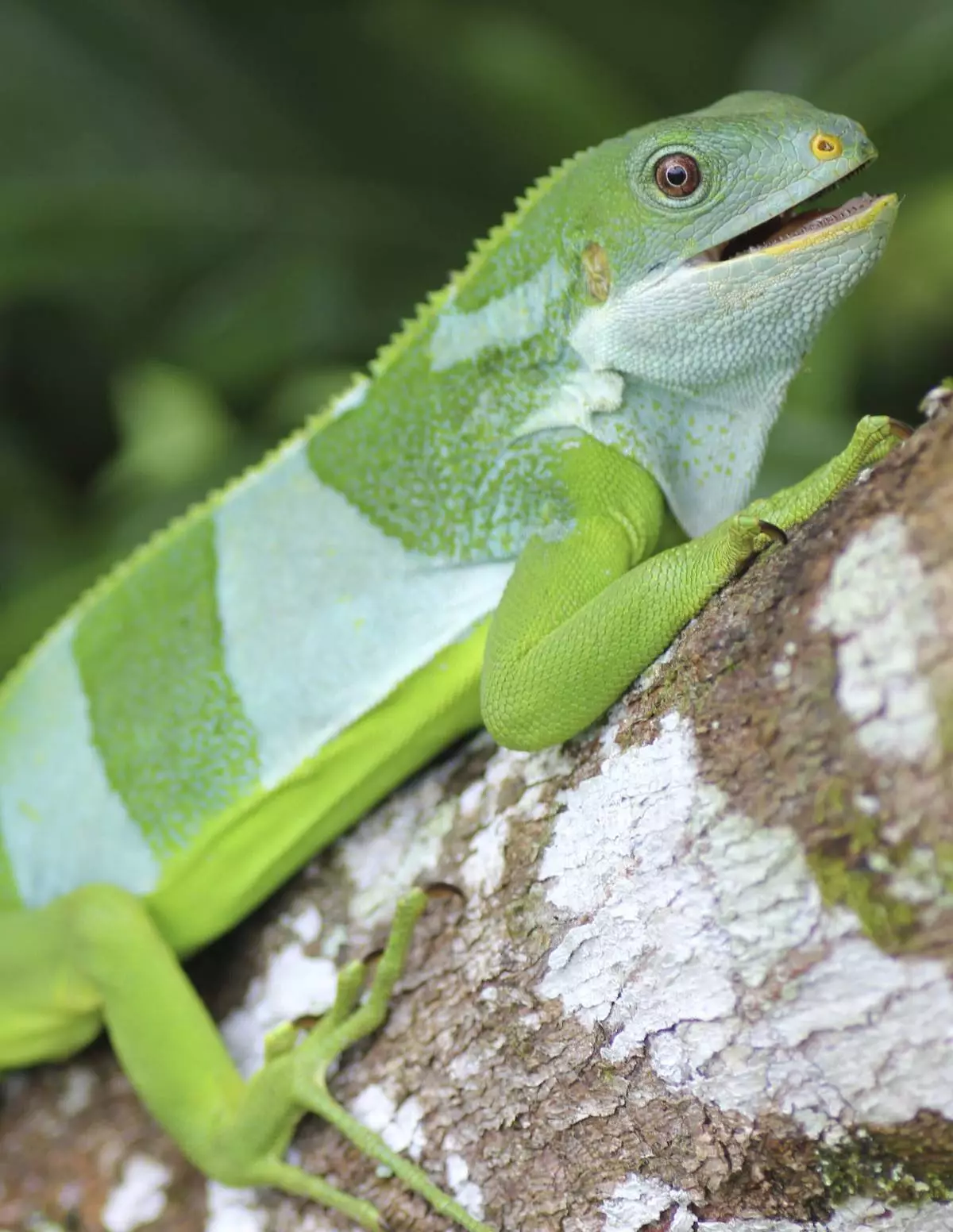
A green Central Fijian Banded Iguana is shown on Ovalau in Fiji. (Robert Fisher/U.S. Geological Survey via AP)
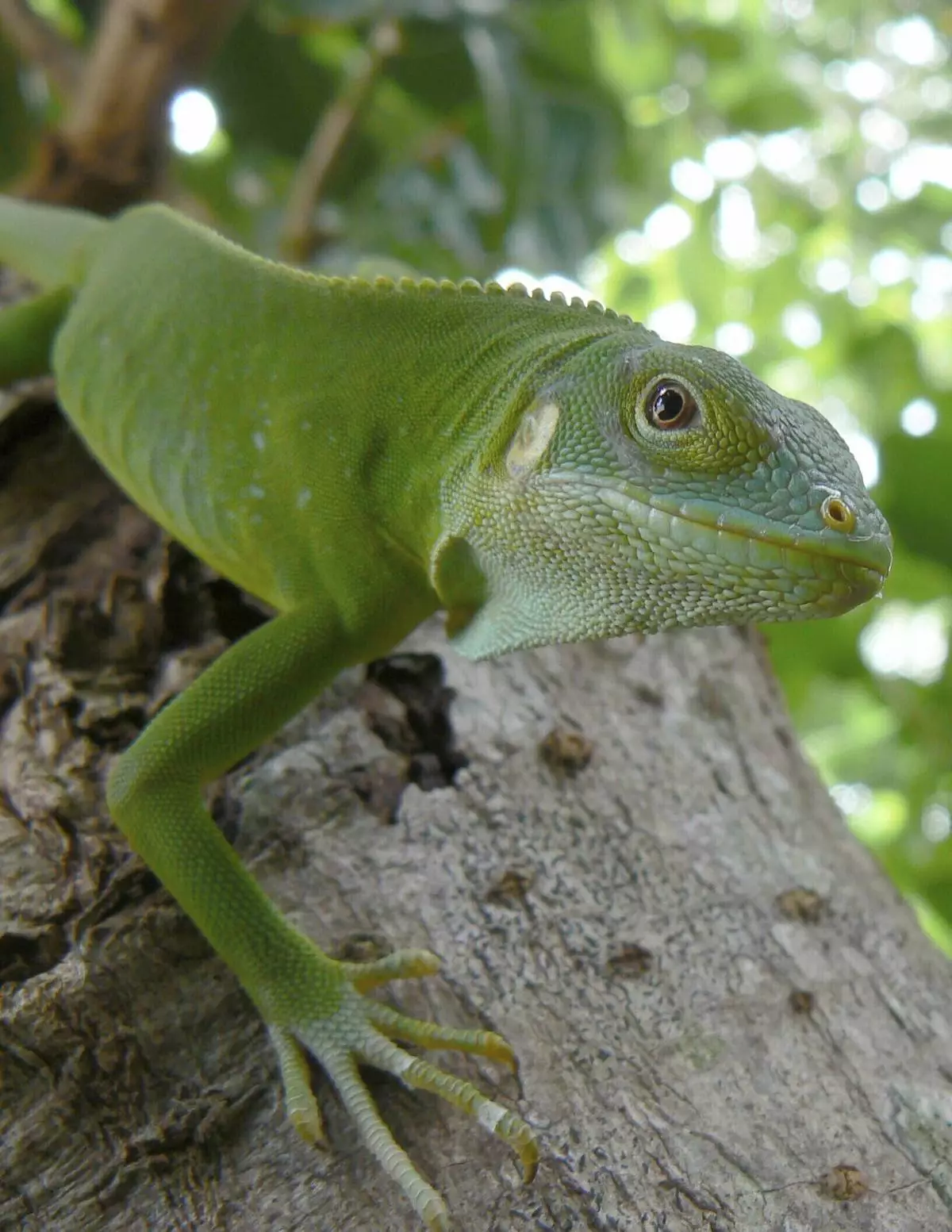
This photo provided by the United States Geological Survey shows a female Lau banded iguana in Fiji. (Robert Fisher/U.S. Geological Survey via AP)
HUNTSVILLE, Texas (AP) — A Texas man who once escaped from custody and was on the run for three days after being sentenced to death for fatally shooting his ex-girlfriend and her new boyfriend was scheduled Wednesday evening to be the first person executed in the U.S. this year.
Charles Victor Thompson was condemned for the April 1998 shooting deaths of his ex-girlfriend, Glenda Dennise Hayslip, 39; and her new boyfriend, Darren Keith Cain, 30, at her apartment in the Houston suburb of Tomball.
Thompson, 55, was scheduled to receive a lethal injection at the state penitentiary in Huntsville.
Prosecutors say Thompson and Hayslip had been romantically involved for a year but split after Thompson “became increasingly possessive, jealous and abusive.”
According to court records, Hayslip and Cain were dating when Thompson came to Hayslip’s apartment and began arguing with Cain around 3 a.m. the night of the killings. Police were called and told Thompson to leave the apartment complex. Thompson returned three hours later and shot both Hayslip and Cain, who died at the scene. Hayslip died in the hospital a week later.
“The Hayslip and Cain families have waited over twenty-five years for justice to occur,” prosecutors with the Harris County District Attorney’s Office said in court filings.
About an hour before the scheduled 6 p.m. CDT execution, the U.S. Supreme Court issued a brief order that rejected Thompson’s final appeal to block the execution from proceeding. No reason was given for rejecting the appeal.
Thompson’s attorneys had argued in court filings with the Supreme Court that he was not allowed to refute or confront the prosecution's evidence that concluded Hayslip died from a gunshot wound to the face. Thompson's attorneys have argued Hayslip actually died from flawed medical care she received after the shooting that resulted in severe brain damage sustained from oxygen deprivation following a failed intubation.
Earlier Wednesday, Thompson was brought to the small holding cell near the death chamber, a prison spokeswoman said. She added that he asked to see his attorney and was offered a meal from the day's prison menu that featured fried chicken, scrambled eggs and other items.
The Texas Board of Pardons and Paroles on Monday denied Thompson’s request to commute his death sentence to a lesser penalty.
“If he had been able to raise a reasonable doubt as to the cause of Ms. Hayslip’s death, he would not be guilty of capital murder,” Thompson’s attorneys said in court filings with the Supreme Court.
Prosecutors said a jury has already rejected the claim and, concluded under state law that Thompson was responsible for Hayslip’s death because it “would not have occurred but for his conduct.”
Hayslip’s family had filed a lawsuit against one of her doctors, alleging that medical negligence during her treatment left her brain-dead. A jury in 2002 found in favor of the doctor.
Thompson had his death sentence overturned and had a new punishment trial held in November 2005. A jury again ordered him to die by lethal injection.
Shortly after being resentenced, Thompson escaped from the Harris County Jail in Houston by walking out the front door virtually unchallenged by deputies. Thompson later told The Associated Press that after meeting with his attorney in a small interview cell, he slipped out of his handcuffs and orange jail jumpsuit and left the room, which was unlocked. Thompson waived an ID badge fashioned out of his prison ID card to get past several deputies.
“I got to smell the trees, feel the wind in my hair, grass under my feet, see the stars at night. It took me straight back to childhood being outside on a summer night,” Thompson said of his days on the run during a 2005 interview with the AP. He was arrested in Shreveport, Louisiana, while trying to arrange for wire transfers of money from overseas so he could make it to Canada.
If the execution is carried out, Thompson would be the first person put to death this year in the United States. Texas has historically held more executions than any other state, though Florida had the most executions in 2025, with 19.
Follow Juan A. Lozano: https://x.com/juanlozano70
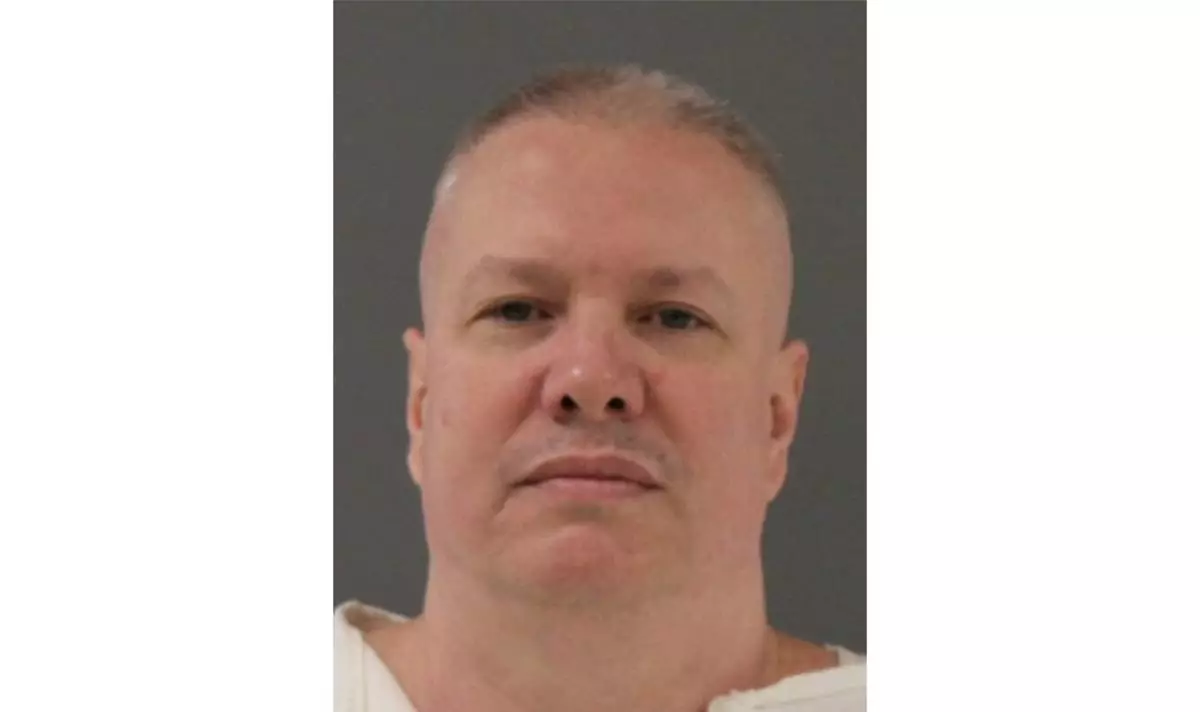
This photo provided by Texas Department of Criminal Justice. shows Texas death row inmate Charles Victor Thompson. (Texas Department of Criminal Justice via AP)