WASHINGTON (AP) — Bird flu has devastated poultry and dairy farms, and sent the price of eggs soaring in the United States since it was first detected in North America in late 2021.
But what has been the toll on wild birds? More than 170 species of North American wild birds – including ducks, geese, gulls, owls, eagles and others – have been infected with bird flu.
Take precautions around sick or dead wild birds, experts recommend. But you can keep your bird feeder up. Despite the spread in birds and other wild animals, scientists say the threat to the general population is currently low.
More than 12,000 individual birds have tested positive since the virus began spreading, according to the U.S. Agriculture Department.
The count is a "gross underestimate” because most dead birds are never taken to a lab for testing, said Bryan Richards at the U.S. Geological Survey's National Wildlife Health Center in in Madison, Wisconsin.
Dabbling ducks, such as mallards and blue-winged teal, can carry the virus with few symptoms because “these viruses co-evolved in waterfowl,” said Richards. But ducks can also shed the virus in their feces or saliva, sometimes infecting other birds or mammals like foxes.
Birds without natural immunity that migrate or roost together in large flocks, such as geese, are most likely to die in large numbers. A recent bird flu outbreak among migratory eared grebes in Utah killed between 15,000 and 25,000 birds near Great Salt Lake, state wildlife officials said in early February.
Seabirds, which tend to roost in large numbers, are also highly impacted.
Songbirds such as Northern cardinals, blue jays or chickadees — the kind of birds that might visit bird feeders — can also become infected and die, but their populations appear to fare better since they don't gather closely in large groups where the virus could spread, said Michael J. Parr, president of the American Bird Conservancy.
Symptoms vary, but may include lack of coordination, inability to fly and respiratory distress.
“If people see a wild bird acting weird, the best thing they can do is call their local wildlife rehabilitator” and avoid handling it directly, said Dr. Dana Franzen-Klein, a veterinarian and medical director at the University of Minnesota’s Raptor Center.
If you must handle an infected bird, it’s best to wear gloves and a mask as a precaution.
Experts say bird feeders are generally safe and aren't a notable source of spreading bird flu.
But if you also keep backyard chickens, Parr of the American Bird Conservancy recommends taking the bird feeder down to prevent possible transmission to poultry. Birdfeeders and nesting boxes should also be cleaned regularly.
The risk of spread to people from bird feeders "is very, very low,” he said.
In the case of critically endangered California condors, scientists organized a vaccination program after some birds became infected. But that’s not a realistic option for most wild bird species.
Instead, experts recommend giving wild birds the best chance by taking other steps to protect habitats and reduce various risks that species face, such as exposure to pesticides or lead ammo.
Bald eagles, which are federally protected but no longer endangered, are scavengers that will eat dead animals. “That first year, we lost a lot of eagles" likely from bald eagles eating infected ducks or bringing them to their nests, said Richards.
Scientists also documented an unusually high number of eagle chicks that didn't survive into adulthood during the first breeding season after the virus appeared in North America, likely because the chicks got the virus or sick parents weren't able to adequately feed and care for them.
But over time, the number of confirmed infections in eagles nationwide has declined from 427 in 2022 to 48 last year.
That may mean that eagles that survived the first year now have some acquired immunity, said Franzen-Klein. This past migration season, researchers counted a record number of bald eagles migrating through northern Minnesota.
“There are good signs of hope” that eagles in the region are rebounding, she said.
The Associated Press Health and Science Department receives support from the Howard Hughes Medical Institute’s Science and Educational Media Group and the Robert Wood Johnson Foundation. The AP is solely responsible for all content.

FILE - Municipal workers collect dead pelicans on Santa Maria beach in Lima, Peru, Tuesday, Nov. 30, 2022, as thousands of birds have died in November along the Pacific of Peru from bird flu, according to The National Forest and Wildlife Service (Serfor). (AP Photo/Guadalupe Pardo, File)

FILE - A mallard spreads his wings in the sun at the Capitol Reflecting Pool in Washington, Friday, Nov. 17, 2023. (AP Photo/J. Scott Applewhite, File)
PITTSBURGH (AP) — Lamar Jackson thought it was over. That the Baltimore Ravens' unwieldy season would end up in a familiar spot: the playoffs.
Then, rookie kicker Tyler Loop's potential game-winning field goal from 44 yards out drifted a little right. And then a little further right. And then a little further right still.
By the time it fluttered well wide of the goalposts, the playoffs were gone. So was Jackson's certainty after a 26-24 loss to Pittsburgh on Sunday night sent the Ravens into what could be a turbulent offseason.
“I'm definitely stunned, man,” Jackson said. “I thought we had it in the bag. ... I don't know what else we can do.”
Jackson, who never really seemed fully healthy during his eighth season as he battled one thing after another, did his part. The two-time NFL MVP passed for 238 yards and three touchdowns, including two long connections with Zay Flowers in the fourth quarter that put the Ravens (8-9) in front.
It just wasn't enough. Baltimore's defense, which played most of the second half without star safety Kyle Hamilton after Hamilton entered the concussion protocol, wilted against 42-year-old Steelers quarterback Aaron Rodgers.
Rodgers passed for a season-high 294 yards, including a 26-yard flip to a wide-open Calvin Austin with 55 seconds to go after a defender slipped, symbolic of a season in which Baltimore's defense only occasionally found its form.
Still, the Ravens had a chance when Jackson found Isaiah Likely for a 28-yard gain on fourth down from midfield. A couple of snaps later, the 24-year-old Loop walked on to try to lift Baltimore to its third straight division title.
Instead, the rookie said he “mishit” it. Whatever it was, it never threatened to sneak between the goalposts.
“It’s disappointing,” Loop said.
Loop was talking about the game. He might as well have been talking about his team's season.
The Ravens began 1-5 as Jackson dealt with injuries and the defense struggled to get stops. Baltimore found a way to briefly tie the Steelers for first in late November, only to then split its next four games, including a home loss to Pittsburgh.
Still, when Jackson and the Ravens walked onto the Acrisure Stadium turf on Sunday night in the 272nd and final game of the NFL regular season, Baltimore was confident. The Ravens drilled Pittsburgh in the opening round of the playoffs a year ago behind the ever-churning legs of running back Derrick Henry.
When Henry ripped off a gain of 40-plus yards on the game's first offensive snap, it looked like it was going to be more of the same. While Henry did rush for 126 yards and joined Hall of Famer Barry Sanders as the only running backs in NFL history to have five 1,500-yard seasons, he was less effective in the second half.
Even that first run was telling of what night it was going to be, as an illegal block by wide receiver Zay Flowers cost Baltimore some field position. The Ravens ended up scoring on the drive anyway, thanks to a 38-yard fourth-down flip from Jackson to a wide-open Devontez Walker, but it started a pattern that was hard to shake as several steps forward were met with one step back on a night the Ravens finished with nine penalties for 78 yards.
“We were having a lot of penalties, which kept stopping drives," Jackson said. “But I'm proud of my guys because we kept overcoming. We kept overcoming adversity and situations like this. Divisional games (can) be like that sometimes.”
Particularly when the Steelers are on the other side of the line of scrimmage. Pittsburgh has won 10 of the last 13 meetings. And while a handful of them have been in late-season matchups with the Ravens already assured of reaching the playoffs, the reality is the Steelers have been able to regularly do something that most others have not: found a way to beat Jackson.
“It comes down to situations like this,” Jackson said. “Two-point conversion one year. Field goal another year. And again this year. Just got to find a way to get that win here.”
And figure out who is going to be around to help get it.
Head coach John Harbaugh's 18th season in Baltimore ended with the Ravens missing the playoffs for just the second time in eight years. Jackson turns 29 this week and is still one of the most electric players in the league.
Yet Harbaugh and Jackson have yet to find a way to have that breakthrough season that Harbaugh enjoyed with Joe Flacco in 2013 when the Ravens won the Super Bowl.
There was hope when the season began that the roadblocks that have long been in the franchise's way — Kansas City and Patrick Mahomes chief among them — would be gone.
While the Ravens did get their way in a sense — the Chiefs will watch the playoffs from afar for the first time in a decade after a nightmarish season of their own — it never all came together.
Jackson declined to endorse Harbaugh returning for a 19th season, saying the loss was still too fresh to zoom out on what it might mean for the franchise going forward.
Harbaugh, for his part, certainly seems up for running it back in the fall.
“I love these guys,” he said afterward. “I love these guys.”
AP NFL: https://apnews.com/hub/nfl
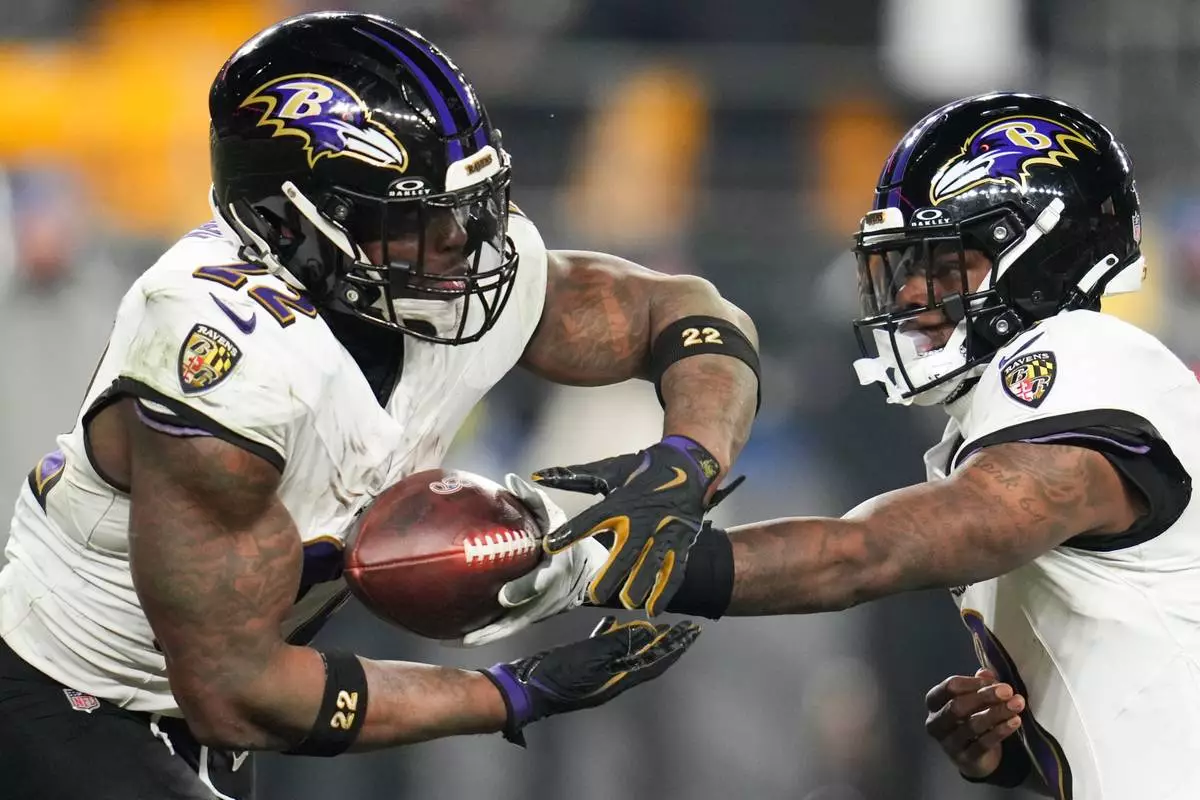
Baltimore Ravens quarterback Lamar Jackson, right, hands the ball off to running back Derrick Henry (22) during the first half of an NFL football game against the Pittsburgh Steelers, Sunday, Jan. 4, 2026, in Pittsburgh. (AP Photo/Gene J. Puskar)
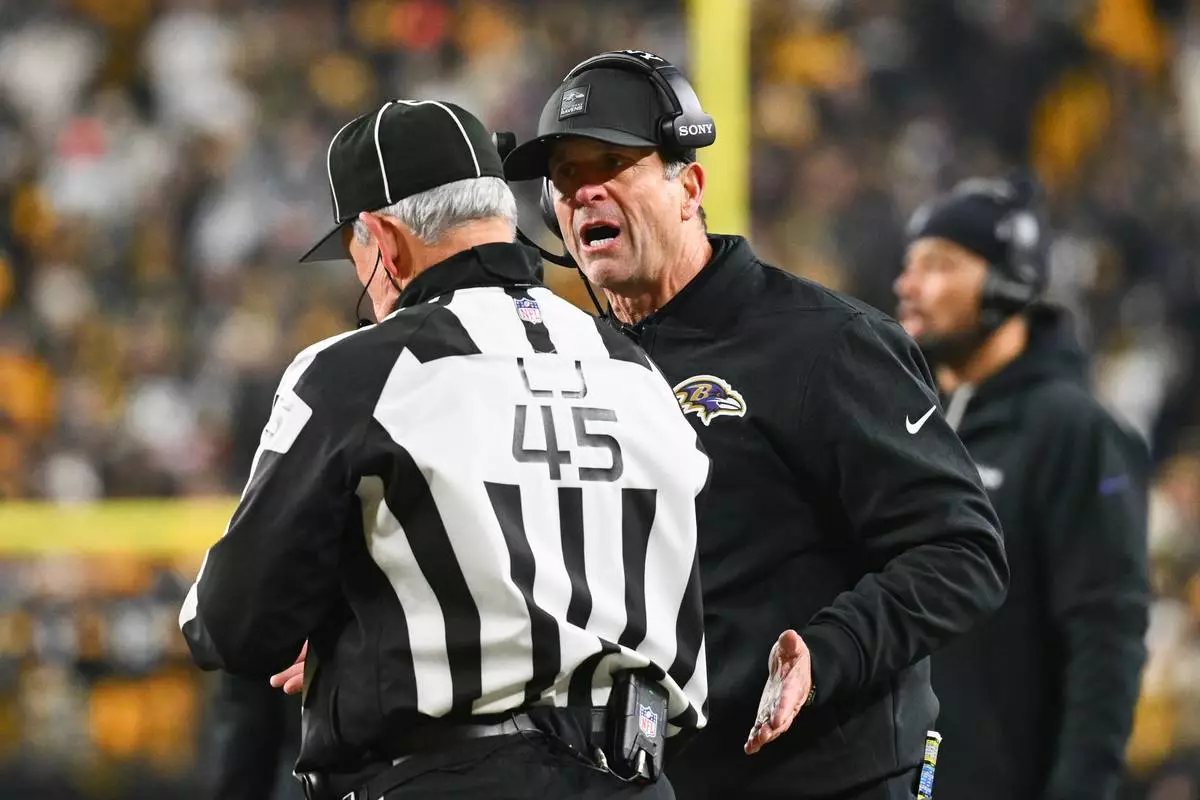
Baltimore Ravens head coach John Harbaugh talks with an offical during the second half of an NFL football game against the Pittsburgh Steelers, Sunday, Jan. 4, 2026, in Pittsburgh. (AP Photo/Justin Berl)
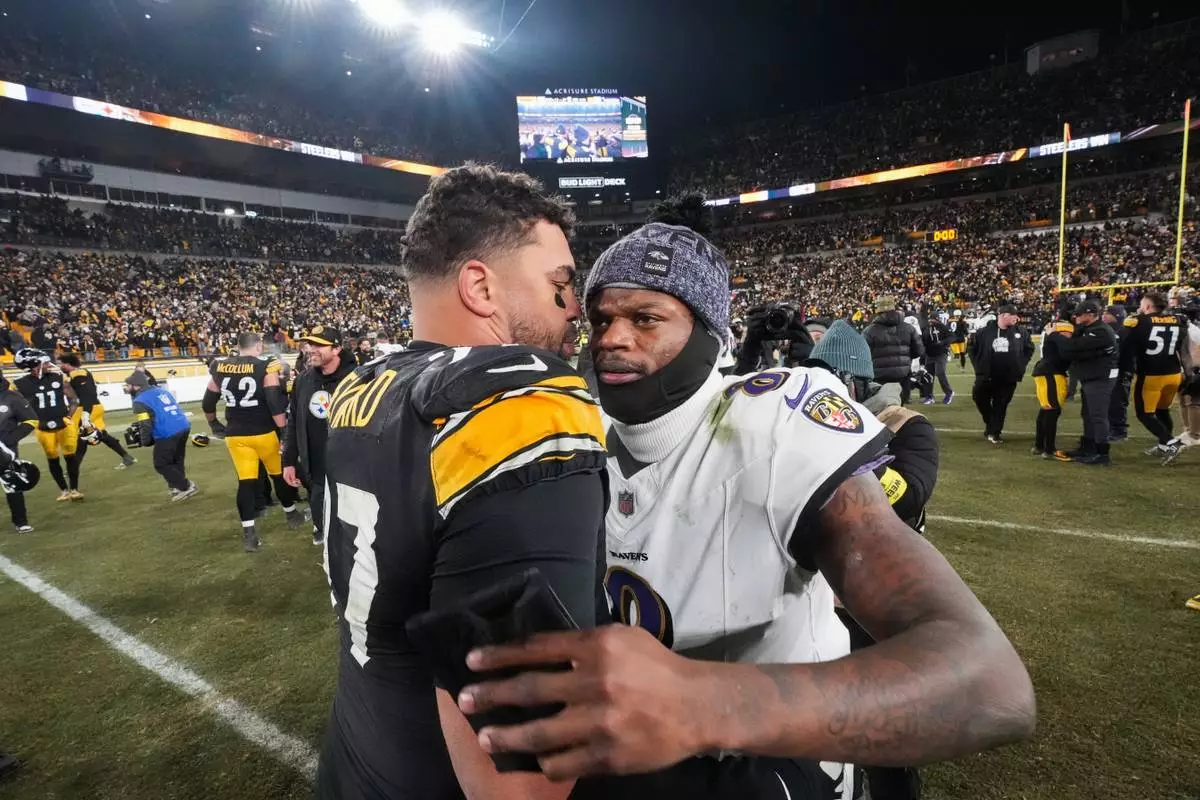
Pittsburgh Steelers defensive tackle Cameron Heyward, left, greets Baltimore Ravens quarterback Lamar Jackson (8) after an NFL football game Sunday, Jan. 4, 2026, in Pittsburgh. (AP Photo/Gene J. Puskar)
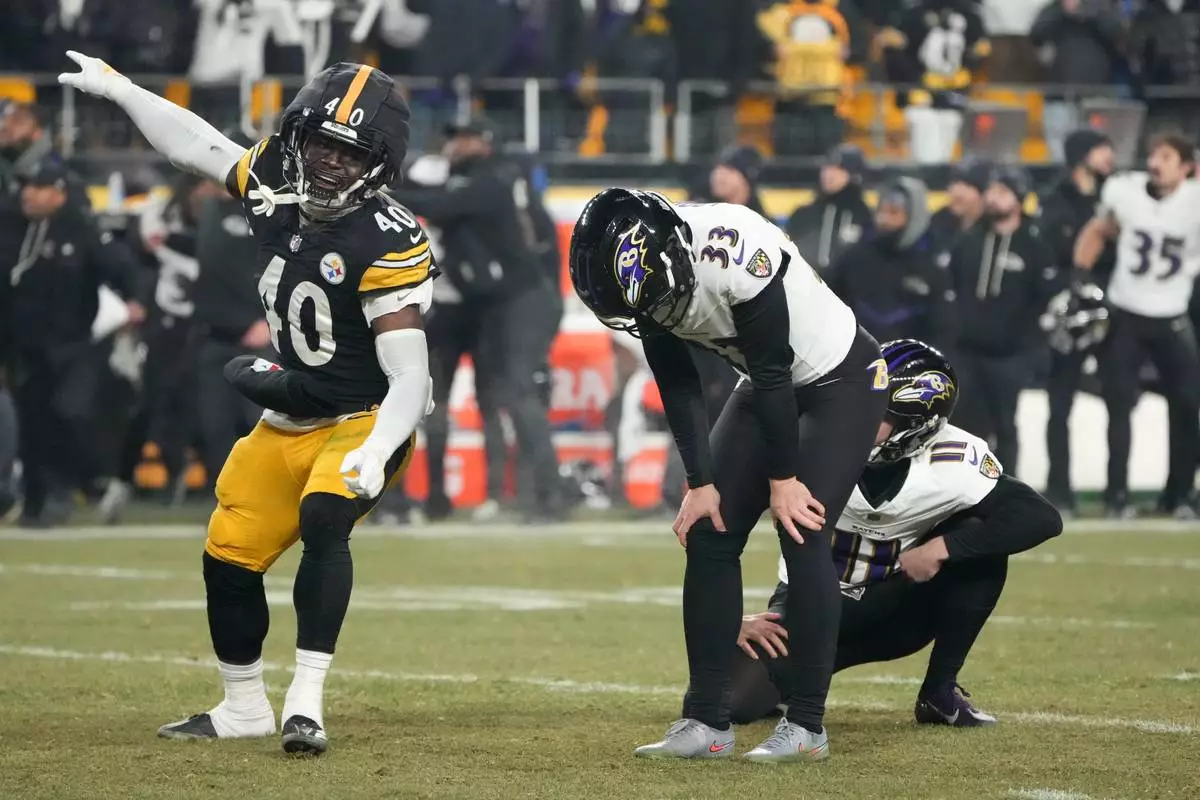
Pittsburgh Steelers safety Jabrill Peppers (40) reacts after Baltimore Ravens kicker Tyler Loop (33) missed a field goal attempt in the second half of an NFL football game against the Pittsburgh Steelers, Sunday, Jan. 4, 2026, in Pittsburgh. (AP Photo/Gene J. Puskar)