SAN FRANCISCO--(BUSINESS WIRE)--Mar 21, 2025--
OSARO, a pioneer in AI-driven robotics for e-commerce fulfillment, has been named to Fast Company ’s prestigious list of the World’s Most Innovative Companies of 2025. This year’s list shines a spotlight on businesses that are shaping industry and culture through their innovations to set new standards and achieve remarkable milestones in all sectors of the economy. Alongside the World’s 50 Most Innovative Companies, Fast Company recognizes 609 organizations across 58 sectors and regions.
This press release features multimedia. View the full release here: https://www.businesswire.com/news/home/20250321273128/en/
OSARO’s inclusion in the Top 10 robotics and engineering companies of Fast Company ’s 2025 list highlights the company’s transformative impact on warehouse automation. Among a diverse group of innovators tackling challenges from agricultural robotics to sea drones, OSARO stands out for its focus on solving a critical bottleneck in supply chain efficiency: the labor-intensive process of depalletization.
The company’s AI-powered Robotic Mixed-Case Depalletizing system, which can yield up to 40% cost savings compared to manual labor, exemplifies OSARO’s ability to deliver tangible, immediate improvements to existing warehouse operations. This recognition places OSARO at the forefront of the industry’s efforts to enhance productivity, reduce workplace injuries, and address ongoing labor shortages in the rapidly evolving and mission-critical world of e-commerce fulfillment.
“Being recognized by Fast Company as one of the World’s Most Innovative Companies is a testament to our team’s dedication to advancing artificial intelligence to equip robots with advanced perception skills,” said Derik Pridmore, CEO and co-founder of OSARO. “Our mission has always been to revolutionize warehouse operations, and this honor from the editors at Fast Company underscores our commitment to delivering transformative solutions for our partners and customers.”
Over the past 18 months, OSARO has achieved significant milestones:
The World’s Most Innovative Companies stands as Fast Company ’s hallmark franchise and one of its most anticipated editorial efforts of the year. To determine honorees, Fast Company ’s editors and writers review companies driving progress around the world and across industries, evaluating thousands of submissions through a competitive application process. The result is a globe-spanning guide to innovation today, from early-stage startups to some of the most valuable companies in the world.
“Our list of the Most Innovative Companies offers both a comprehensive look at innovation today and a playbook for the future,” said Fast Company editor-in-chief Brendan Vaughan. “This year, we recognize companies that are harnessing AI in deep and meaningful ways, brands that are turning customers into superfans by overdelivering for them, and challengers that are introducing bold ideas and vital competition to their industries. At a time when the world is rapidly shifting, these companies are charting the way forward.”
The complete list of Fast Company ’s Most Innovative Companies honorees is live at fastcompany.com, and will also be available on newsstands beginning March 25. Fast Company will host the Most Innovative Companies Summit and Gala for honorees on June 5. The summit features a day of inspiring content, followed by a creative black-tie gala including networking, a seated dinner, and an honoree presentation.
About Fast Company
Fast Company is the only media brand fully dedicated to the vital intersection of business, innovation, and design, engaging the most influential leaders, companies, and thinkers on the future of business. Headquartered in New York City, Fast Company is published by Mansueto Ventures LLC, along with fellow business publication Inc. For more information, please visit fastcompany.com.
About OSARO
OSARO is a leading provider of AI-powered robotics solutions for e-commerce, logistics, and manufacturing. The company's advanced machine-learning software enables industrial robots to perceive, grasp, and manipulate a wide variety of objects, streamlining complex tasks like piece-picking, kitting, and autobagging. OSARO's solutions are designed to improve efficiency, reduce costs, and enhance productivity in high-volume fulfillment centers. In the rapidly evolving world of logistics technology, OSARO offers smarter automation, low-risk adoption, and its signature Hypercare support — from concept exploration to onsite installation. OSARO’s intelligent robots enable goods-to-robot (G2R) use cases, where the greatest gains are yet to be made on the automated warehouse floor. For more information, visit osaro.com.

Fast Company has recognized OSARO, a leader in AI-driven robotics, as one of the World’s Most Innovative Companies of 2025 for its advancements in warehouse automation. Over the past 18 months, OSARO has expanded multi-SKU robotic bagging deployments, including in Asia, helping e-commerce retailers improve order fulfillment efficiency. The company’s solutions have also driven a 50% increase in fulfillment throughput for Zenni Optical while reducing misplacements by nearly 90%. Additionally, OSARO has enhanced its Robotic Depalletization System with advanced AI-powered perception software, allowing for more precise handling of mixed-case pallets, reducing labor costs, and improving warehouse safety. This recognition from Fast Company underscores OSARO’s commitment to transforming logistics with intelligent automation.
WASHINGTON (AP) — Secretary of State Marco Rubio suggested Sunday that the United States would not govern Venezuela day-to-day other than enforcing an existing “oil quarantine” on the country, a turnaround after President Donald Trump has insisted that the U.S. would be running Venezuela following its ouster of leader Nicolás Maduro.
Rubio's statements seemed designed to temper concerns that the assertive action to achieve regime change in Venezuela might lead the U.S. into another prolonged foreign intervention or failed attempt at nation-building.
They stood in contrast to Trump’s broad but vague claims that the U.S. would at least temporarily “run” the oil-rich nation, comments that suggested some sort of governing structure under which Caracas would be controlled by Washington.
Rubio offered a more nuanced take, saying the U.S. would continue to enforce an oil quarantine that was already in place on sanctioned tankers before Maduro was removed from power early Saturday and use that leverage as a means to press policy changes in Venezuela.
“And so that’s the sort of control the president is pointing to when he says that," Rubio said on CBS’ “Face the Nation.” "We continue with that quarantine, and we expect to see that there will be changes, not just in the way the oil industry is run for the benefit of the people, but also so that they stop the drug trafficking.”
The blockade on sanctioned oil tankers — some of which have been seized by the U.S. — “remains in place, and that’s a tremendous amount of leverage that will continue to be in place until we see changes that not just further the national interest of the United States, which is number one, but also that lead to a better future for the people of Venezuela,” he added.
Leaders in Venezuela have so far pushed back, calling on the Trump administration to release Maduro.
Even before the operation that nabbed Maduro, experts questioned the legality of aspects of the Trump administration’s pressure campaign on Maduro, including the deadly bombing of boats accused of trafficking drugs that some scholars said stretched the boundaries of international law.
Cuba on Sunday night announced that 32 Cuban security officers were killed in the U.S. operation in Venezuela, which Trump acknowledged: “You know, a lot of Cubans were killed yesterday.”
“There was a lot of death on the other side," Trump said aboard Air Force One as he flew back to Washington from his Mar-a-Lago estate in Florida. "No death on our side.”
The president's vow, repeated more than half a dozen times at a Florida news conference on Saturday, sparked concerns among some Democrats. It also drew unease from parts of his own Republican coalition, including an “America First” base that is opposed to foreign interventions, and from observers who recalled past nation-building efforts in Iraq and Afghanistan.
Rubio dismissed such criticism, saying Trump’s intent had been misunderstood.
“The whole foreign policy apparatus thinks everything is Libya, everything is Iraq, everything is Afghanistan,” Rubio said. "This is not the Middle East. And our mission here is very different. This is the Western Hemisphere.”
He also suggested the U.S. would give Maduro’s subordinates now in charge time to govern, saying, “We’re going to judge everything by what they do.” Though he did not rule out boots on the ground in Venezuela, Rubio said the U.S., which has built up its presence in the region, was already capable of stopping alleged drug boats and sanctioned tankers.
A day earlier, Trump had told reporters, “We’re going to run the country until such time as we can do a safe, proper and judicious transition.” He later pointed to his national security team with him, including Rubio and Defense Secretary Pete Hegseth, and said it would be done for a period of time by “the people that are standing right behind me. We’re gonna be running it, we’re gonna be bringing it back."
Despite Rubio's seeking to tamp down that notion, Trump reiterated Sunday that the U.S. would control Venezuela, saying, “We’re going to run everything."
“We’re going to run it, fix it,” he said Sunday. He added, "We’ll have elections at the right time” but didn't say when that might be.
A middle-of-the-night operation extracted Maduro and his wife, Cilia Flores, from their home in a military base in the capital city of Caracas — an act Maduro’s government called “imperialist.” The couple faces U.S. charges of participating in a narco-terrorism conspiracy.
The dramatic seizure capped an intensive Trump administration pressure campaign on Venezuela’s autocratic leader and months of secret planning, resulting in the most assertive American action to achieve regime change since the 2003 invasion of Iraq. Legal experts raised questions about the lawfulness of the operation, which was done without congressional approval.
Venezuela’s vice president, Delcy Rodríguez, has called Maduro the country’s rightful leader, even as her nation’s high court named her interim president. So did Defense Minister Vladimir Padrino López, who sai the country's armed forces “categorically reject the cowardly kidnapping" and will “maintain internal order and peace.”
Asked about Rodríguez comments in which she stands by Maduro, Trump said, “I don’t think it’s pushback" and suggested her calling what occurred a kidnapping of Maduro wasn't "a bad term.”
Maduro is due to make his first appearance Monday in Manhattan's federal court.
He and other Venezuelan officials were indicted in 2020 on narco-terrorism conspiracy charges, and the Justice Department released a new indictment Saturday of Maduro and his wife that painted his administration as a “corrupt, illegitimate government” fueled by a drug-trafficking operation that flooded the U.S with cocaine. The U.S. government does not recognize Maduro as the country’s leader.
Venezuela’s government kept operating as usual over the weekend as ministers remained in their posts.
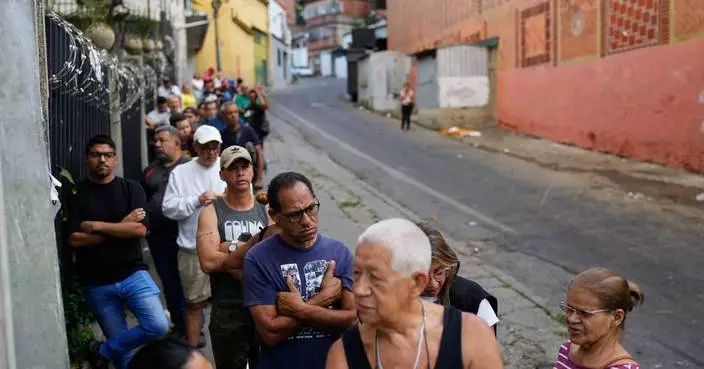
The capital was unusually quiet Sunday with few vehicles moving around and convenience stores, gas stations and other businesses closed.
Maduro’s son, lawmaker Nicolás Ernesto Guerra, has not appeared in public since the attack. On Saturday, he posted on Instagram a government statement repudiating the capture of his father and stepmother.
The country’s incoming National Assembly is set to be sworn in at the legislative palace in Caracas. The unicameral assembly will remain under control of the ruling party.
Under Venezuelan law, Rodríguez would take over from Maduro. Rodriguez stressed during a Saturday appearance on state television that she did not plan to assume power, before Venezuela’s high court ordered that she assume the interim role.
Trump told The Atlantic in an interview Sunday that Rodríguez could “pay a very big price” if she doesn’t do what he thinks is right for Venezuela. Speaking to reporters later, Trump said Rodríguez is “cooperating” but reiterated the threat. He said he wanted her to provide “total access,” from major oil operations to basic infrastructure like roads, so all can be rebuilt.
His warning contrasted with his comments about Rodríguez on Saturday when he said Rubio had spoken with her and she was willing to do what the U.S. thinks is needed to improve the standard of living in Venezuela.
Garcia Cano reported from Caracas, Venezuela. Associated Press writers Darlene Superville aboard Air Force One and Jorge Rueda in Caracas, Venezuela, contributed to this report.
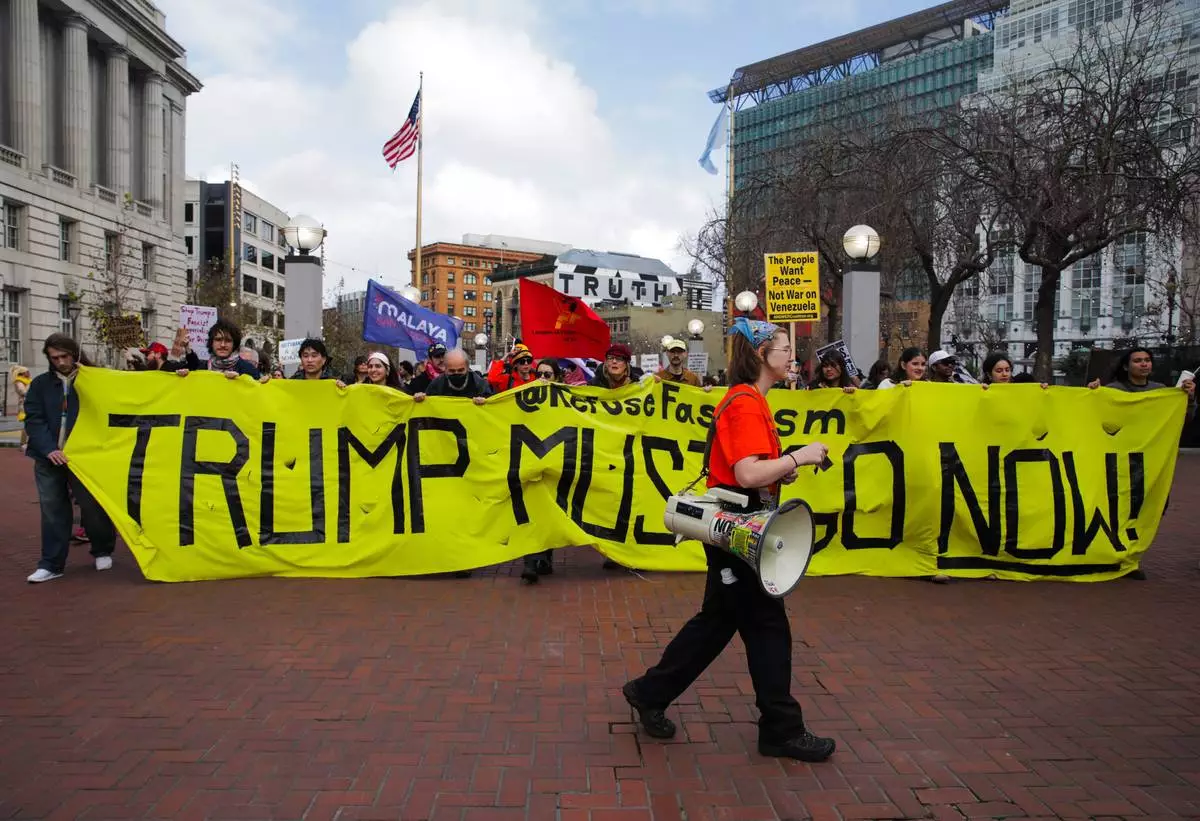
Protestors hold a banner stating "Trump Must Go Now" as they gather outside the UN Plaza during a demonstration against the U.S. bombing of Venezuela and seizure of Venezuelan President Nicolás Maduro, in San Francisco on Saturday, Jan. 3, 2026. (Yalonda M. James/San Francisco Chronicle via AP)
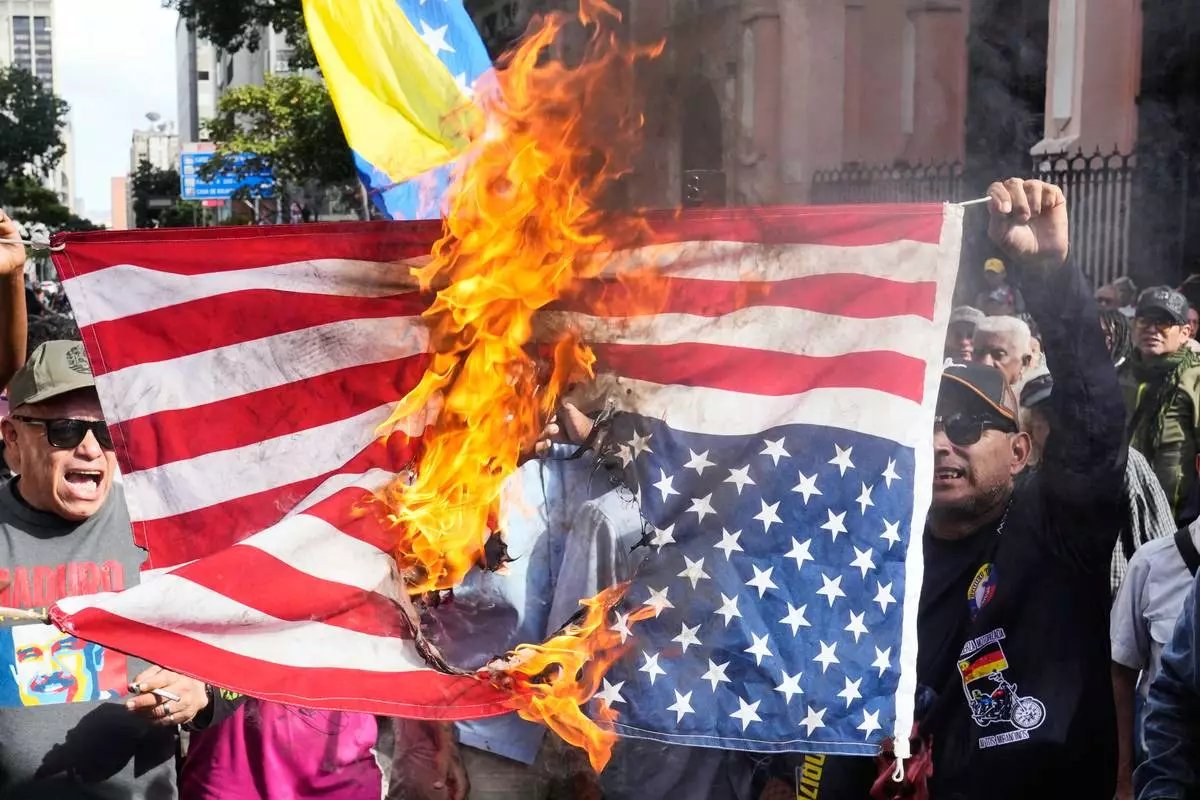
Government supporters burn a U.S. flag in Caracas, Venezuela, Saturday, Jan. 3, 2026, after U.S. President Donald Trump announced that U.S. forces had captured Venezuelan President Nicolás Maduro and his wife. (AP Photo/Ariana Cubillos)
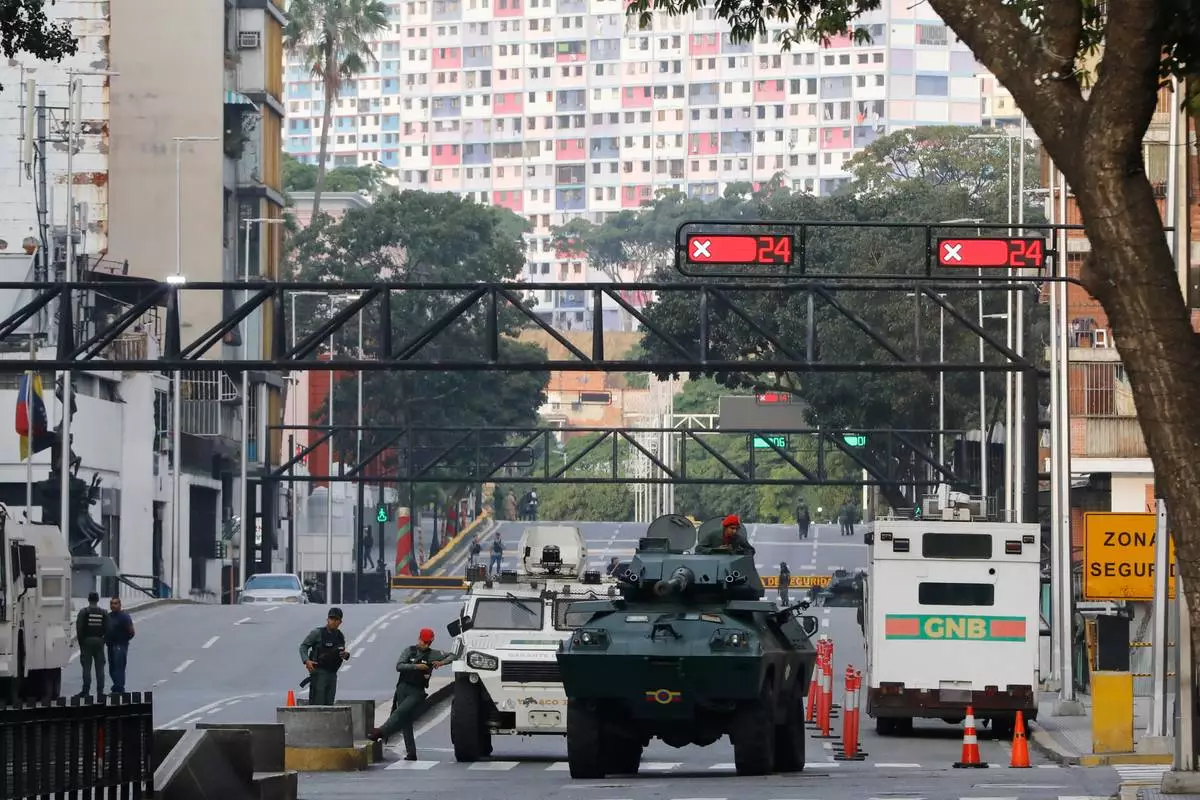
National Guard armored vehicles block an avenue leading to Miraflores presidential palace in Caracas, Venezuela, Saturday, Jan. 3, 2026. (AP Photo/Cristian Hernandez)
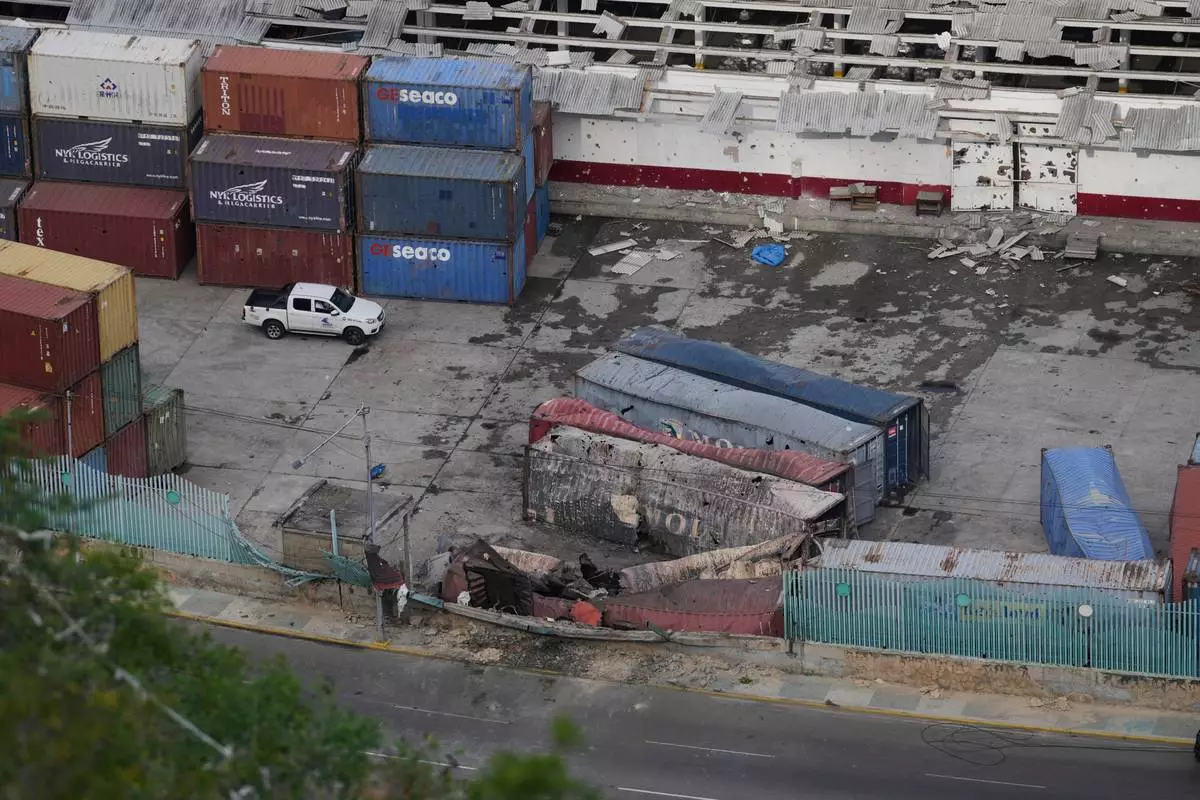
Destroyed containers lay at La Guaira port after explosions were heard in Venezuela, Saturday, Jan. 3, 2026. (AP Photo/Matias Delacroix)
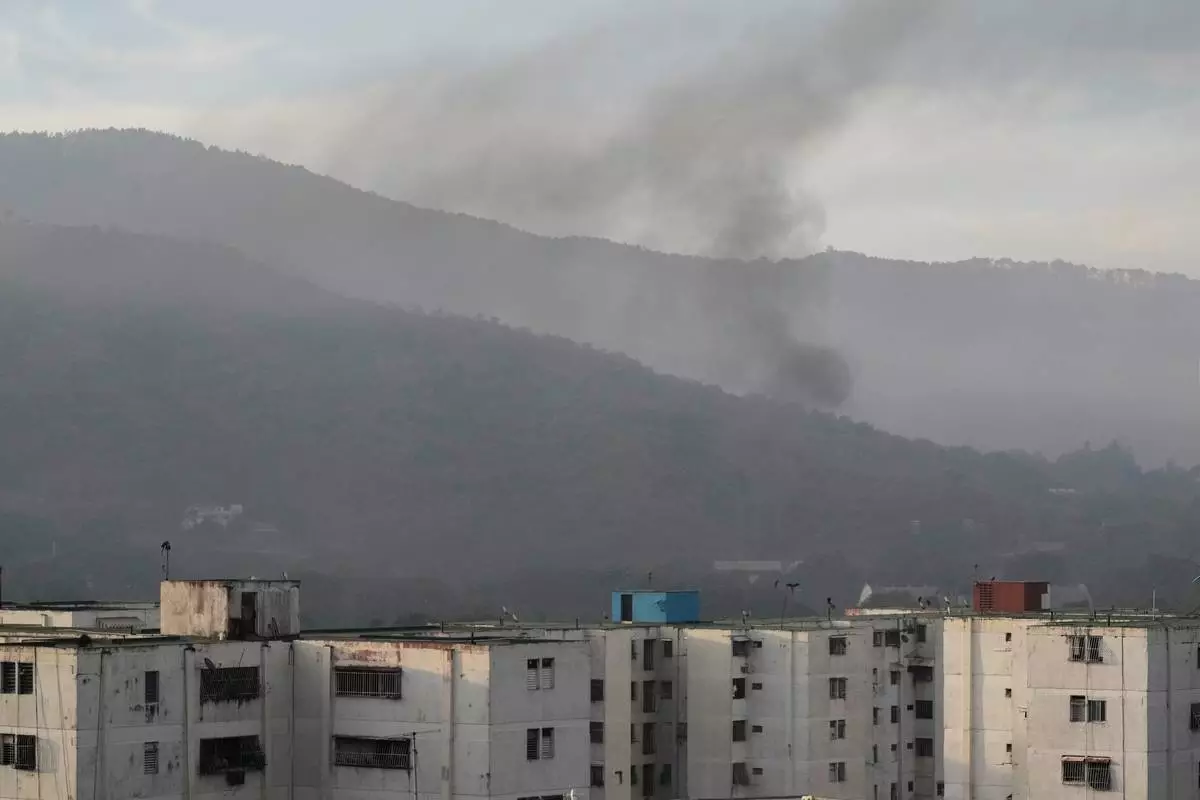
Smoke rises from Fort Tiuna, the main military garrison in Caracas, Venezuela, after multiple explosions were heard and aircraft swept through the area, Saturday, Jan. 3, 2026. (AP Photo/Matias Delacroix)
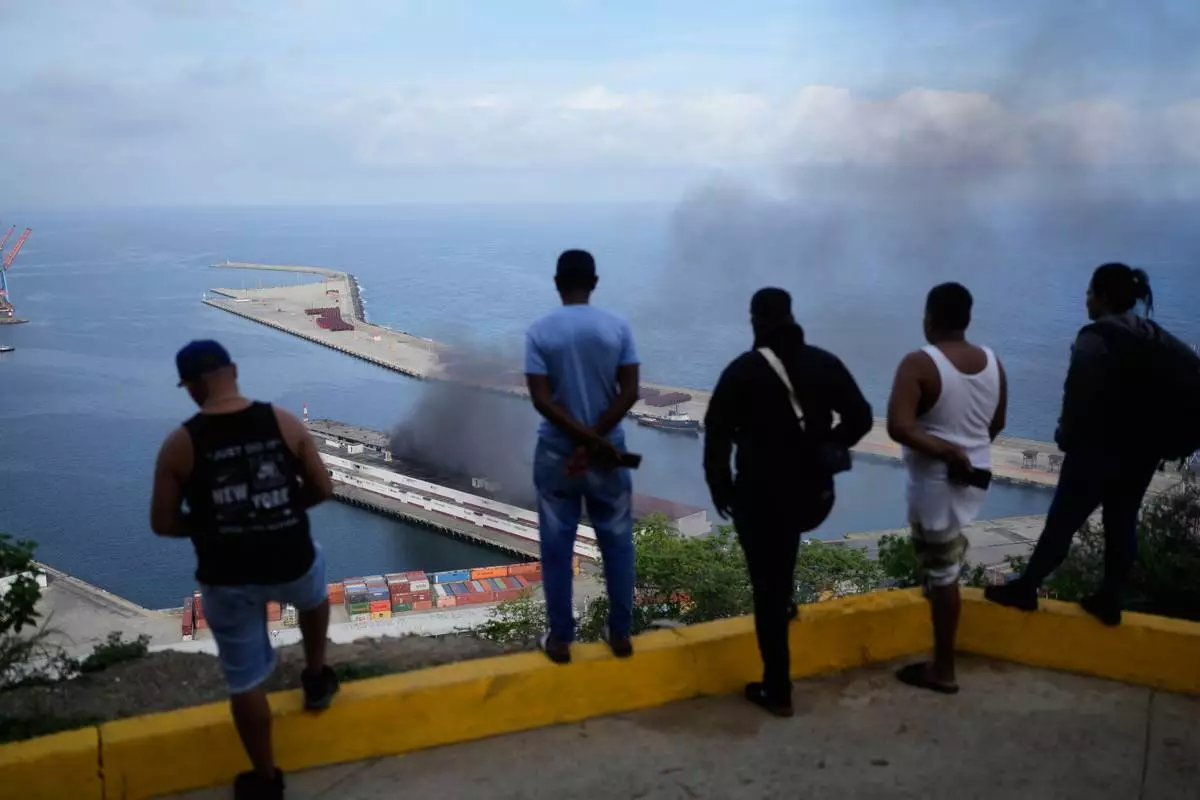
Men watch smoke rising from a dock after explosions were heard at La Guaira port, Venezuela, Saturday, Jan. 3, 2026. (AP Photo/Matias Delacroix)
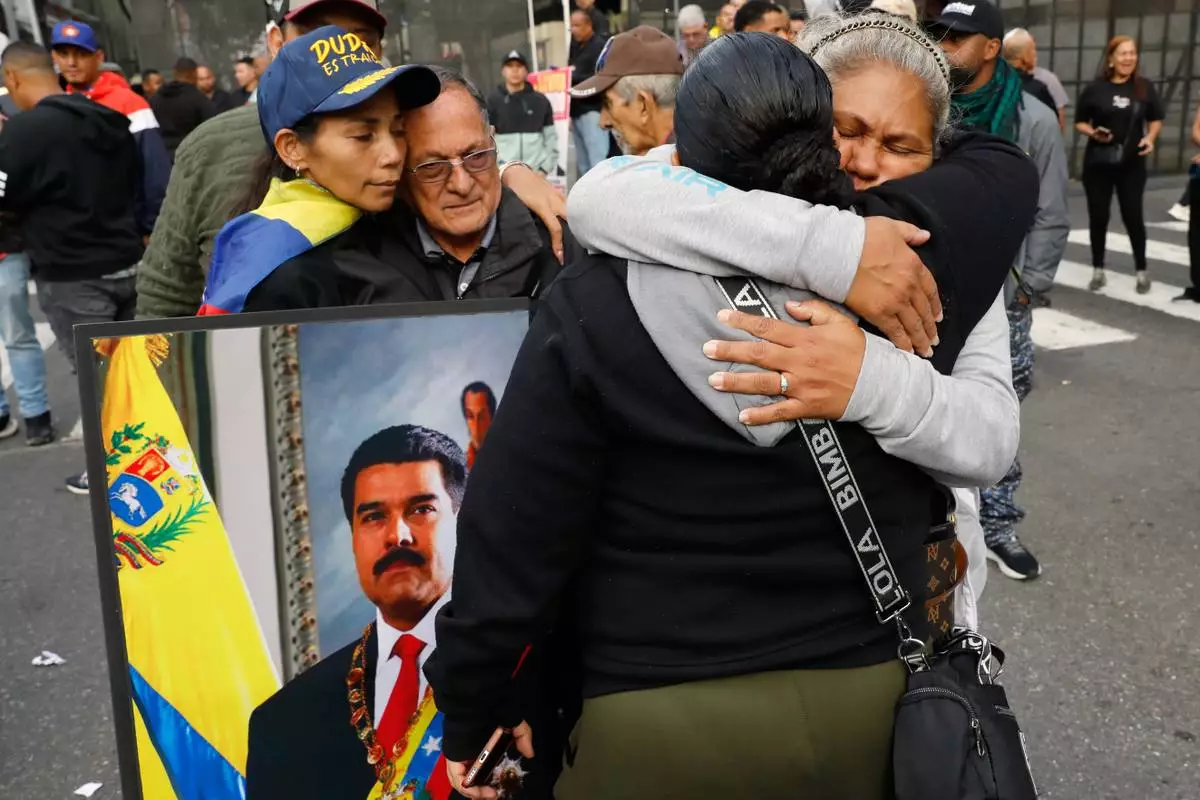
Supporters of Venezuelan President Nicolás Maduro embrace in downtown Caracas, Venezuela, Saturday, Jan. 3, 2026, after U.S. President Donald Trump announced that Maduro had been captured and flown out of the country. (AP Photo/Cristian Hernandez)