Skip to Content Facebook Feature Image

Photos show record-breaking $3.2M bluefin tuna sold at Tokyo's first fish auction of 2026

News

Photos show record-breaking $3.2M bluefin tuna sold at Tokyo's first fish auction of 2026
News

News

Photos show record-breaking $3.2M bluefin tuna sold at Tokyo's first fish auction of 2026

2026-01-05 10:39 Last Updated At:13:37

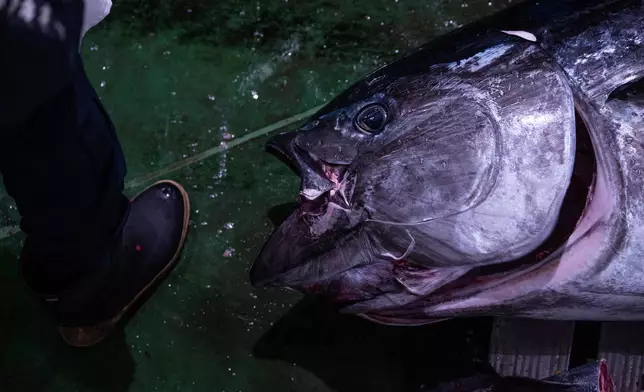
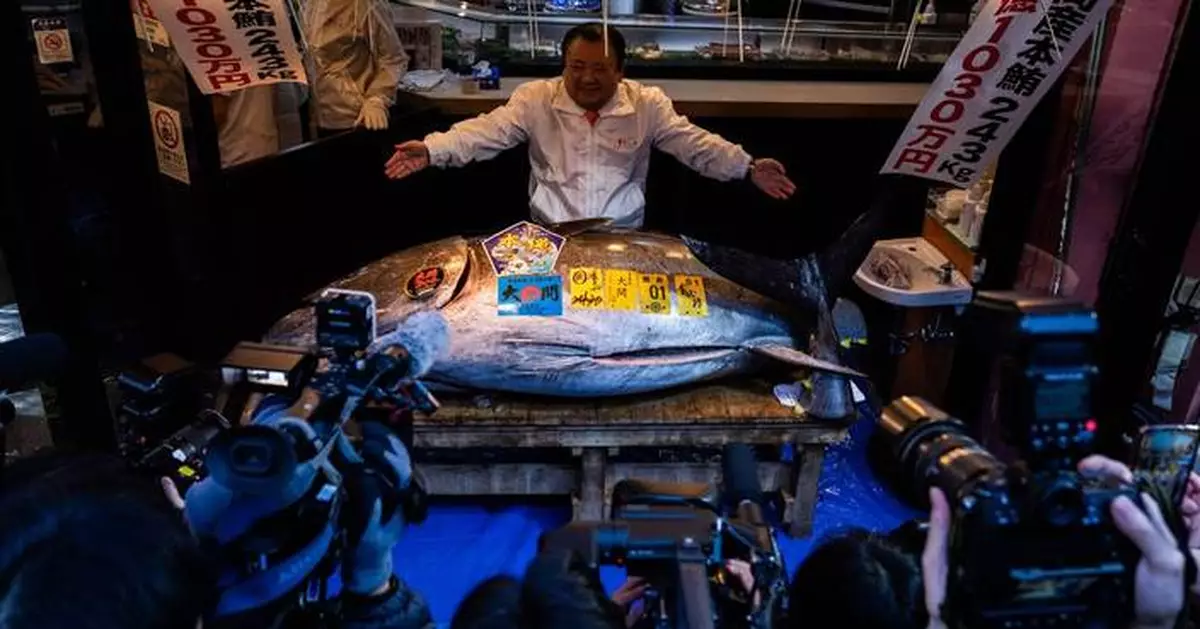
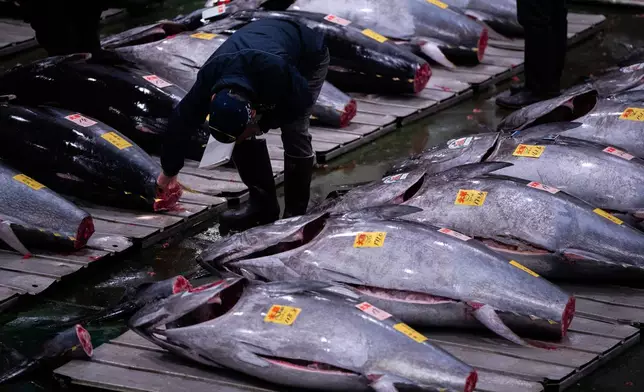
TOKYO (AP) — A massive 243-kilogram (535-pound) bluefin tuna fetched a record-setting 510 million yen ($3.2 million) during Tokyo’s first fish auction of 2026 at the Toyosu fish market.

The winning bid at the early-morning sale on Monday came from Kiyomura Corp., operator of the Sushi Zanmai restaurant chain, owned by Kiyoshi Kimura, who broke his previous record of 334 million yen ($2.1 million) paid in 2019.

More Images
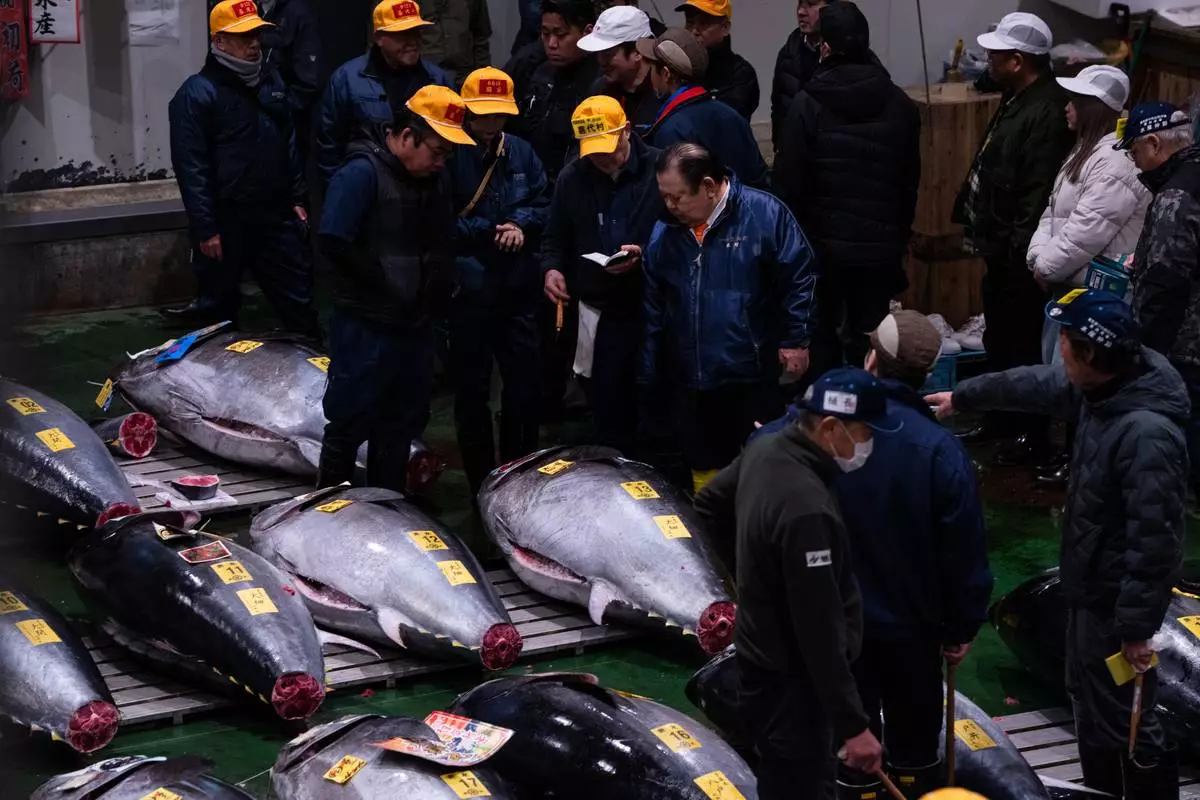
Wholesalers inspect bluefin tuna at the New Year's tuna auction at Toyosu fish market in Tokyo, Monday, Jan. 5, 2026. (AP Photo/Louise Delmotte)
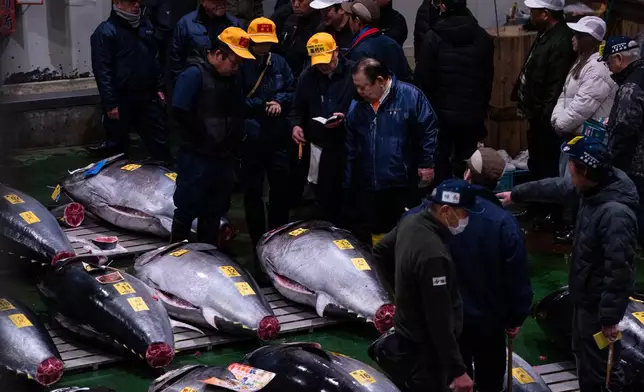
Wholesalers inspect bluefin tuna at the New Year's tuna auction at Toyosu fish market in Tokyo, Monday, Jan. 5, 2026. (AP Photo/Louise Delmotte)

Members of the press take photographs of a bluefin tuna that won the highest bid at the annual New Year auction displayed at Sushi Zanmai restaurant in Tokyo, Monday, Jan. 5, 2026. (AP Photo/Louise Delmotte)
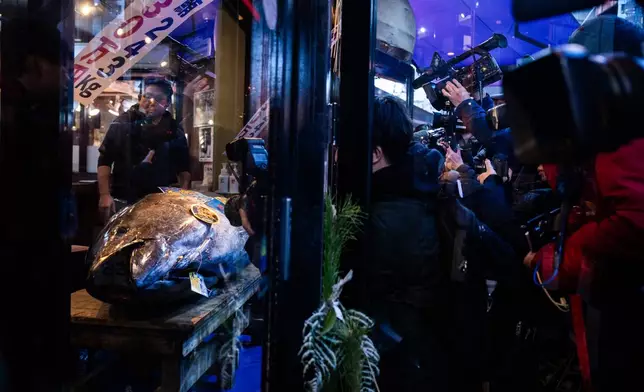
Members of the press take photographs of a bluefin tuna that won the highest bid at the annual New Year auction displayed at Sushi Zanmai restaurant in Tokyo, Monday, Jan. 5, 2026. (AP Photo/Louise Delmotte)

Kiyoshi Kimura, center right, president of Kiyomura Co. attend the New Year's tuna auction at Toyosu fish market in Tokyo, Monday, Jan. 5, 2026. (AP Photo/Louise Delmotte)
Kiyoshi Kimura, center right, president of Kiyomura Co. attend the New Year's tuna auction at Toyosu fish market in Tokyo, Monday, Jan. 5, 2026. (AP Photo/Louise Delmotte)
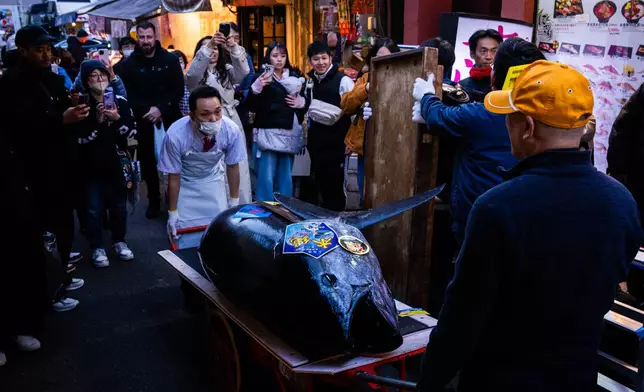
Wholesalers inspect bluefin tuna at the New Year's tuna auction at Toyosu fish market in Tokyo, Monday, Jan. 5, 2026. (AP Photo/Louise Delmotte)

Wholesalers inspect bluefin tuna at the New Year's tuna auction at Toyosu fish market in Tokyo, Monday, Jan. 5, 2026. (AP Photo/Louise Delmotte)

A bluefin tuna that won the highest bid at the annual New Year auction is carried to a Sushi Zanmai restaurant in Tokyo, Monday, Jan. 5, 2026. (AP Photo/Louise Delmotte)
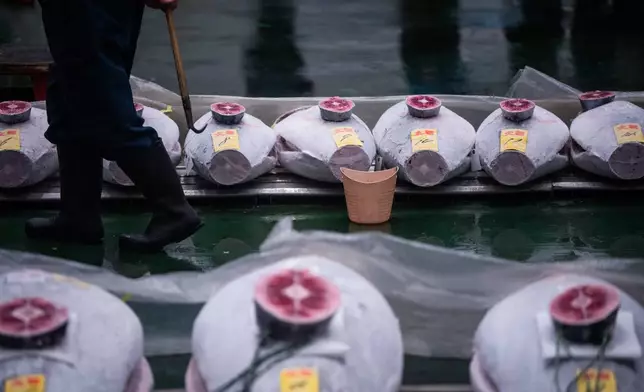
A bluefin tuna that won the highest bid at the annual New Year auction is carried to a Sushi Zanmai restaurant in Tokyo, Monday, Jan. 5, 2026. (AP Photo/Louise Delmotte)

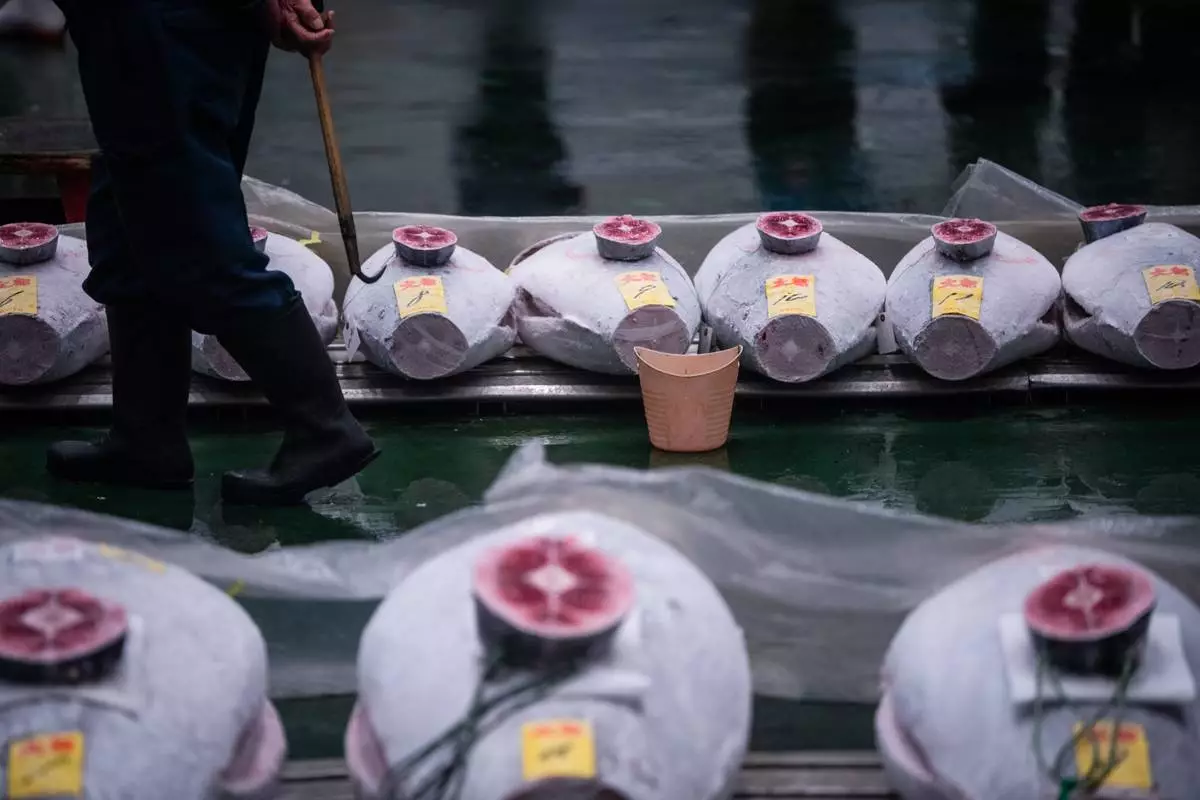
Wholesalers inspect frozen tuna at the New Year's tuna auction at Toyosu fish market in Tokyo, Monday, Jan. 5, 2026. (AP Photo/Louise Delmotte)
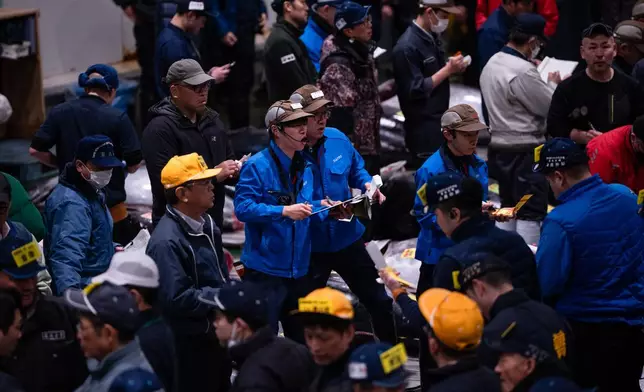
Wholesalers inspect frozen tuna at the New Year's tuna auction at Toyosu fish market in Tokyo, Monday, Jan. 5, 2026. (AP Photo/Louise Delmotte)
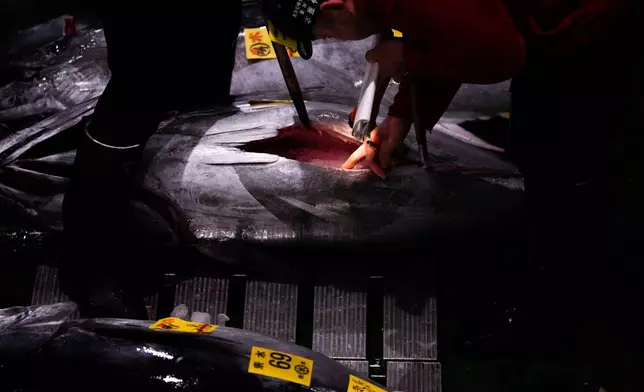
Wholesalers and buyers take part in the New Year's tuna auction at Toyosu fish market in Tokyo, Monday, Jan. 5, 2026. (AP Photo/Louise Delmotte)
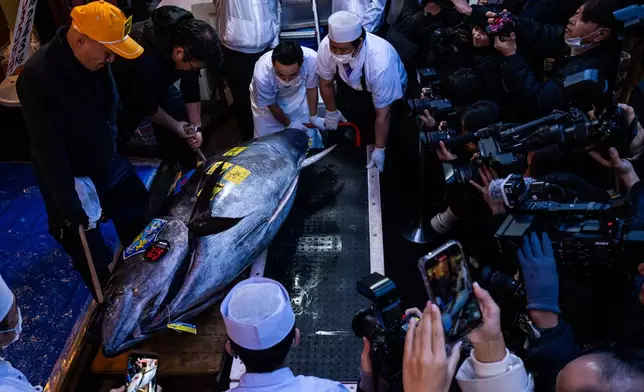
Wholesalers and buyers take part in the New Year's tuna auction at Toyosu fish market in Tokyo, Monday, Jan. 5, 2026. (AP Photo/Louise Delmotte)

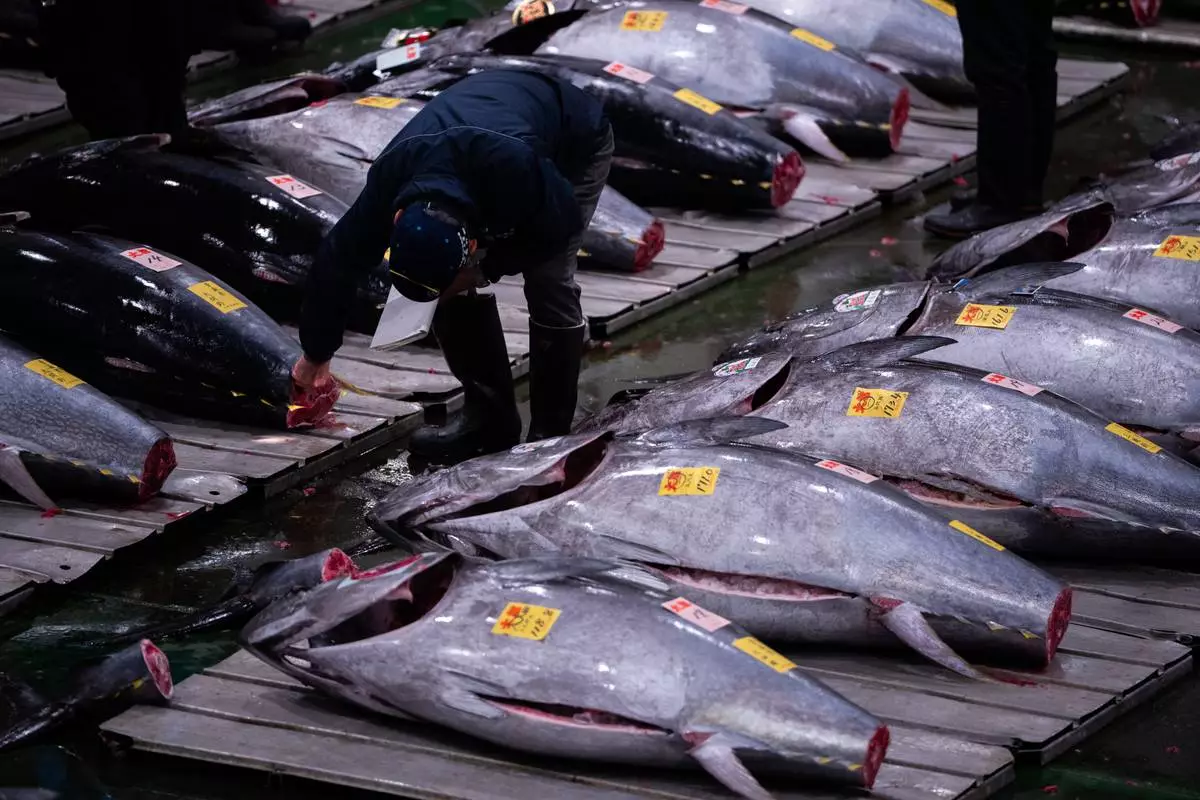
Wholesalers inspect bluefin tuna at the New Year's tuna auction at Toyosu fish market in Tokyo, Monday, Jan. 5, 2026. (AP Photo/Louise Delmotte)

Wholesalers inspect bluefin tuna at the New Year's tuna auction at Toyosu fish market in Tokyo, Monday, Jan. 5, 2026. (AP Photo/Louise Delmotte)

A bluefin tuna that won the highest bid at the annual New Year auction is carried to a Sushi Zanmai restaurant in Tokyo, Monday, Jan. 5, 2026. (AP Photo/Louise Delmotte)
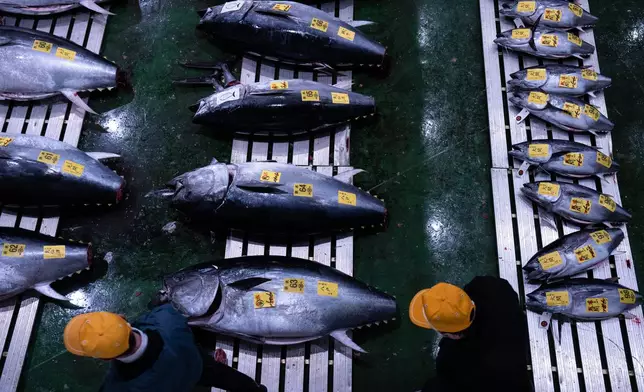
A bluefin tuna that won the highest bid at the annual New Year auction is carried to a Sushi Zanmai restaurant in Tokyo, Monday, Jan. 5, 2026. (AP Photo/Louise Delmotte)

Wholesalers inspect bluefin tuna at the New Year's tuna auction at Toyosu fish market in Tokyo, Monday, Jan. 5, 2026. (AP Photo/Louise Delmotte)
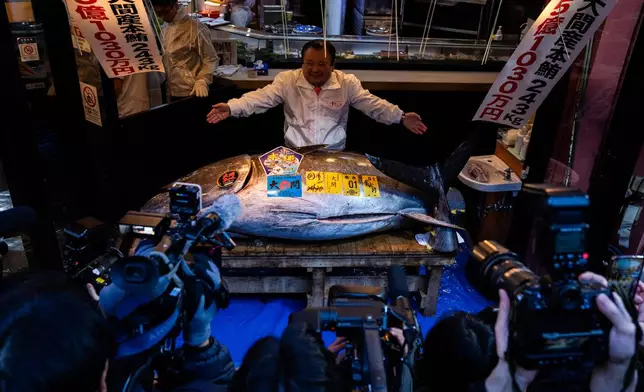
Wholesalers inspect bluefin tuna at the New Year's tuna auction at Toyosu fish market in Tokyo, Monday, Jan. 5, 2026. (AP Photo/Louise Delmotte)

Kiyoshi Kimura, president of Kiyomura Co., poses with the bluefin tuna that won the highest bid at the annual New Year auction in Tokyo, Monday, Jan. 5, 2026. (AP Photo/Louise Delmotte)

Kiyoshi Kimura, president of Kiyomura Co., poses with the bluefin tuna that won the highest bid at the annual New Year auction in Tokyo, Monday, Jan. 5, 2026. (AP Photo/Louise Delmotte)

The tuna was caught off Oma in northern Japan, a region widely regarded for producing some of the country’s finest tuna.

This is a photo gallery curated by AP photo editors.
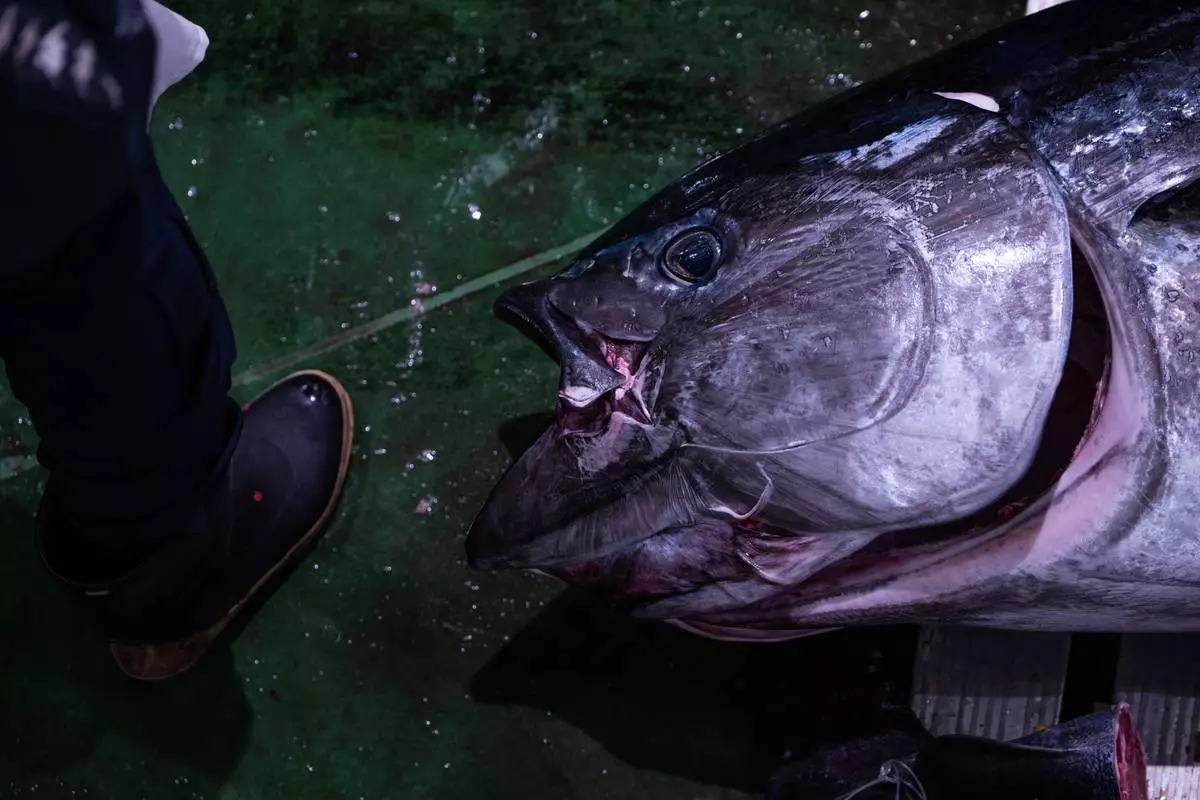
Wholesalers inspect bluefin tuna at the New Year's tuna auction at Toyosu fish market in Tokyo, Monday, Jan. 5, 2026. (AP Photo/Louise Delmotte)
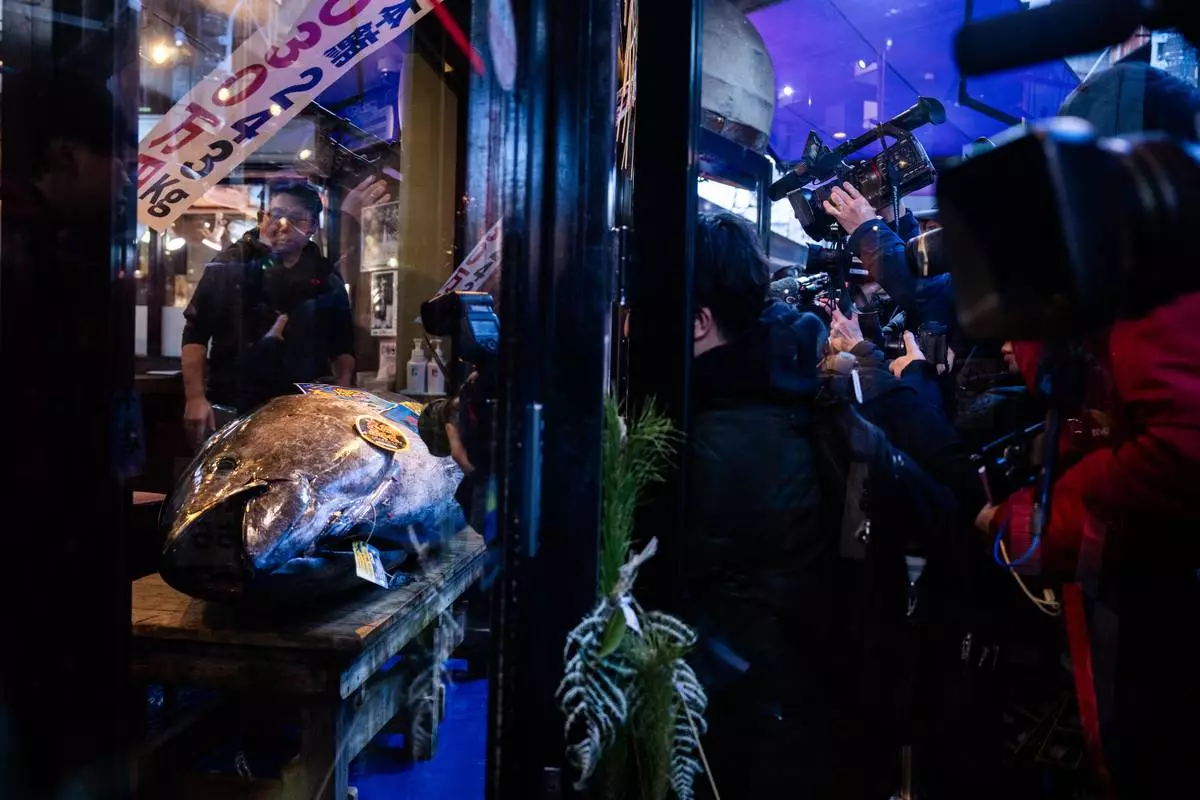
Wholesalers inspect bluefin tuna at the New Year's tuna auction at Toyosu fish market in Tokyo, Monday, Jan. 5, 2026. (AP Photo/Louise Delmotte)

Members of the press take photographs of a bluefin tuna that won the highest bid at the annual New Year auction displayed at Sushi Zanmai restaurant in Tokyo, Monday, Jan. 5, 2026. (AP Photo/Louise Delmotte)
Members of the press take photographs of a bluefin tuna that won the highest bid at the annual New Year auction displayed at Sushi Zanmai restaurant in Tokyo, Monday, Jan. 5, 2026. (AP Photo/Louise Delmotte)

Kiyoshi Kimura, center right, president of Kiyomura Co. attend the New Year's tuna auction at Toyosu fish market in Tokyo, Monday, Jan. 5, 2026. (AP Photo/Louise Delmotte)
Kiyoshi Kimura, center right, president of Kiyomura Co. attend the New Year's tuna auction at Toyosu fish market in Tokyo, Monday, Jan. 5, 2026. (AP Photo/Louise Delmotte)
Wholesalers inspect bluefin tuna at the New Year's tuna auction at Toyosu fish market in Tokyo, Monday, Jan. 5, 2026. (AP Photo/Louise Delmotte)

Wholesalers inspect bluefin tuna at the New Year's tuna auction at Toyosu fish market in Tokyo, Monday, Jan. 5, 2026. (AP Photo/Louise Delmotte)

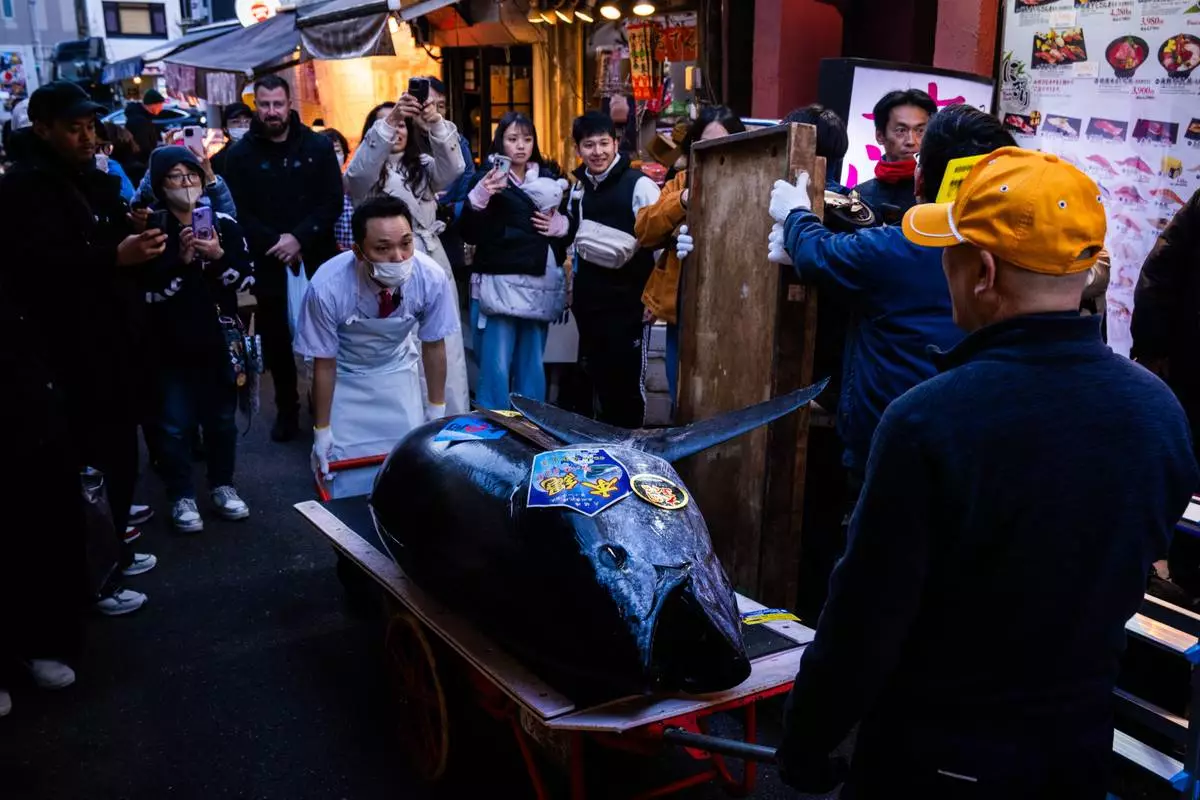
A bluefin tuna that won the highest bid at the annual New Year auction is carried to a Sushi Zanmai restaurant in Tokyo, Monday, Jan. 5, 2026. (AP Photo/Louise Delmotte)
A bluefin tuna that won the highest bid at the annual New Year auction is carried to a Sushi Zanmai restaurant in Tokyo, Monday, Jan. 5, 2026. (AP Photo/Louise Delmotte)

Wholesalers inspect frozen tuna at the New Year's tuna auction at Toyosu fish market in Tokyo, Monday, Jan. 5, 2026. (AP Photo/Louise Delmotte)
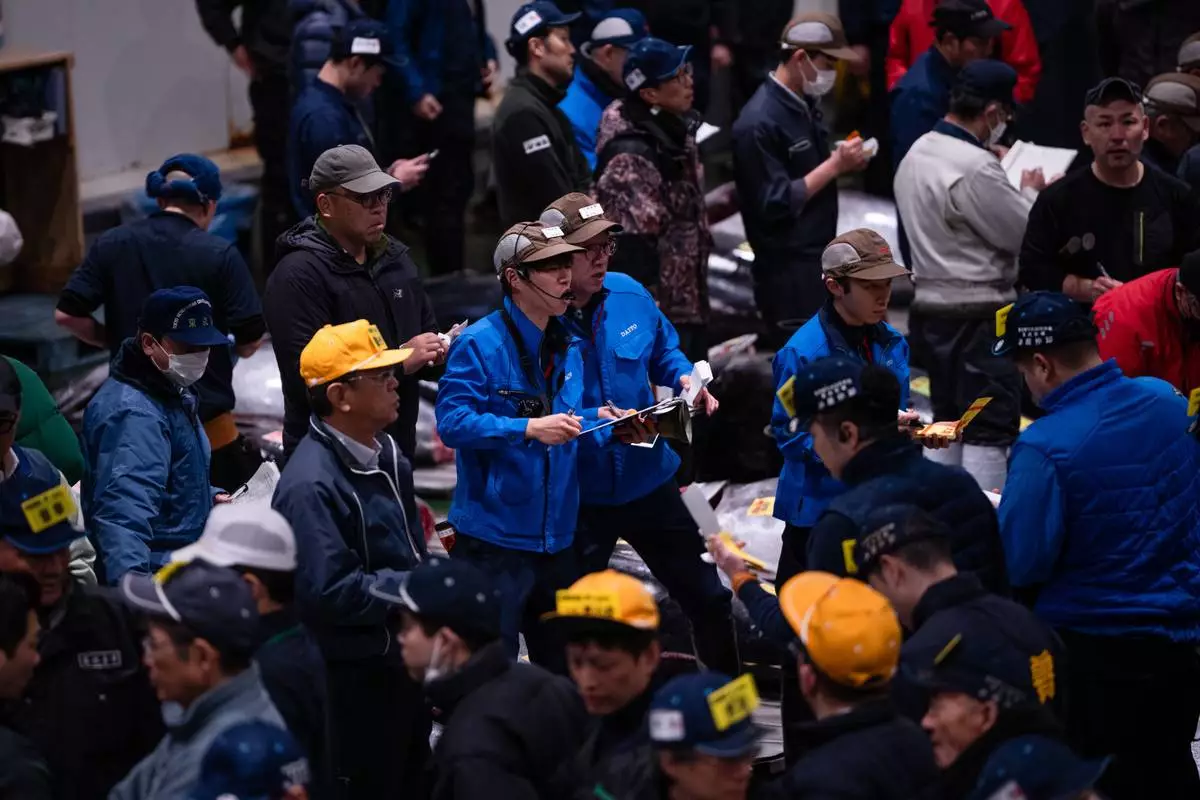
Wholesalers inspect frozen tuna at the New Year's tuna auction at Toyosu fish market in Tokyo, Monday, Jan. 5, 2026. (AP Photo/Louise Delmotte)
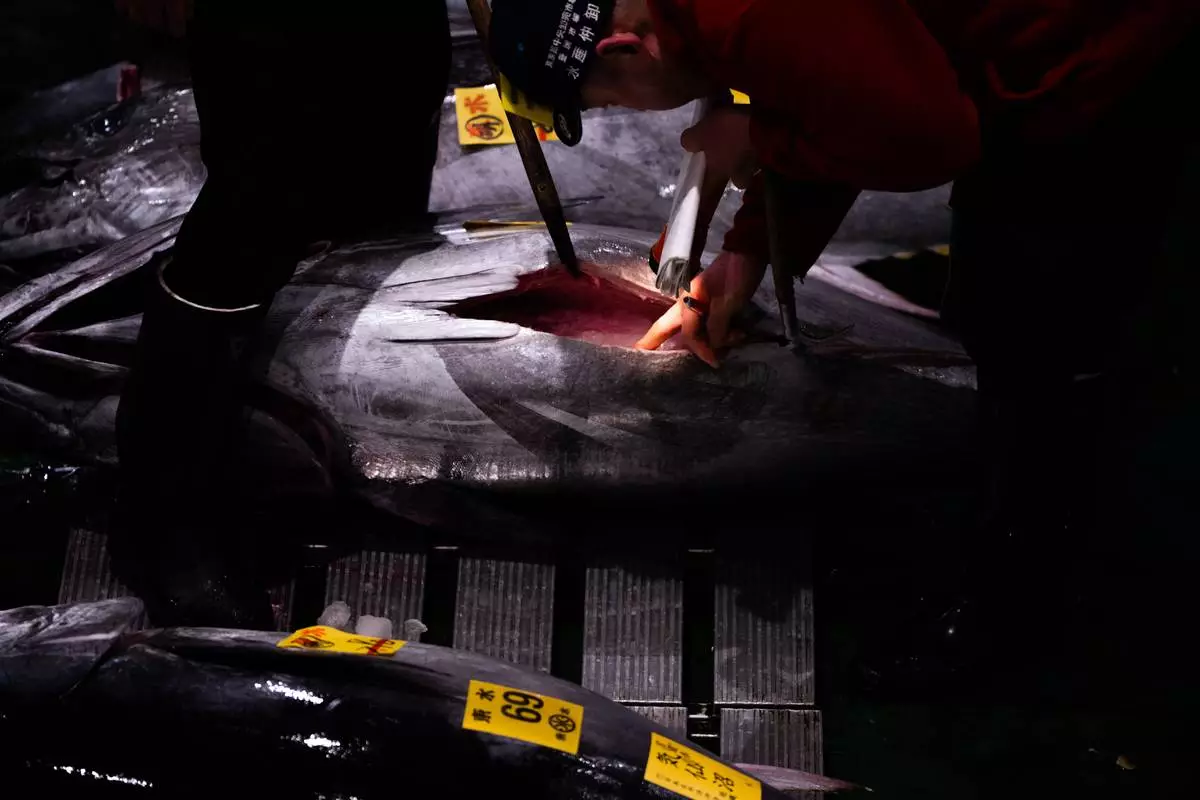
Wholesalers and buyers take part in the New Year's tuna auction at Toyosu fish market in Tokyo, Monday, Jan. 5, 2026. (AP Photo/Louise Delmotte)
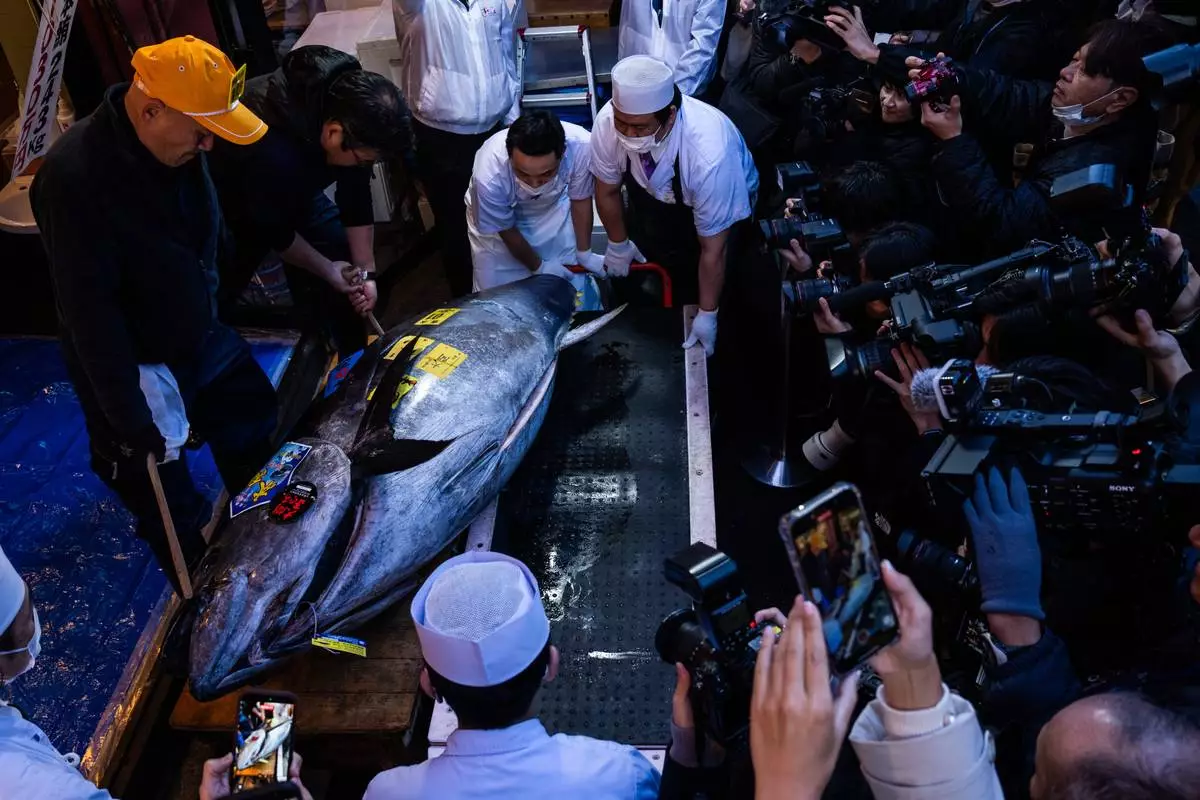
Wholesalers and buyers take part in the New Year's tuna auction at Toyosu fish market in Tokyo, Monday, Jan. 5, 2026. (AP Photo/Louise Delmotte)

Wholesalers inspect bluefin tuna at the New Year's tuna auction at Toyosu fish market in Tokyo, Monday, Jan. 5, 2026. (AP Photo/Louise Delmotte)

Wholesalers inspect bluefin tuna at the New Year's tuna auction at Toyosu fish market in Tokyo, Monday, Jan. 5, 2026. (AP Photo/Louise Delmotte)

A bluefin tuna that won the highest bid at the annual New Year auction is carried to a Sushi Zanmai restaurant in Tokyo, Monday, Jan. 5, 2026. (AP Photo/Louise Delmotte)
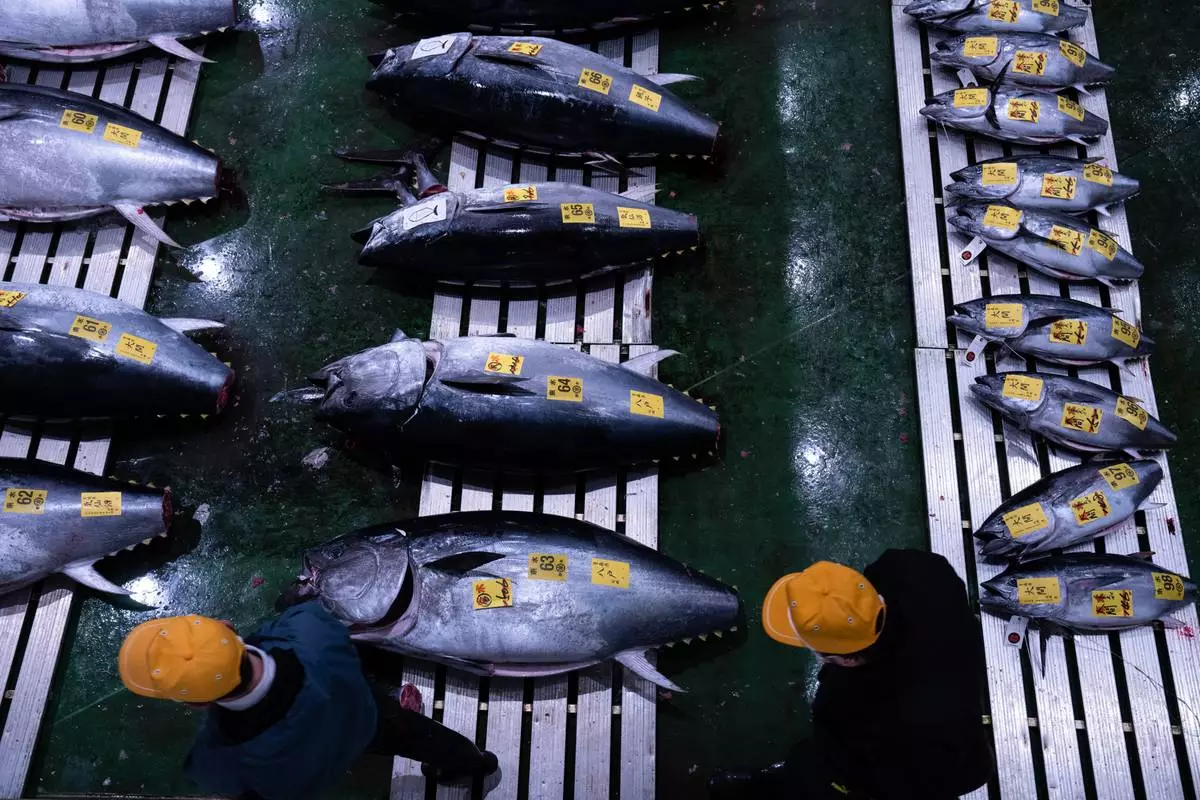
A bluefin tuna that won the highest bid at the annual New Year auction is carried to a Sushi Zanmai restaurant in Tokyo, Monday, Jan. 5, 2026. (AP Photo/Louise Delmotte)

Wholesalers inspect bluefin tuna at the New Year's tuna auction at Toyosu fish market in Tokyo, Monday, Jan. 5, 2026. (AP Photo/Louise Delmotte)
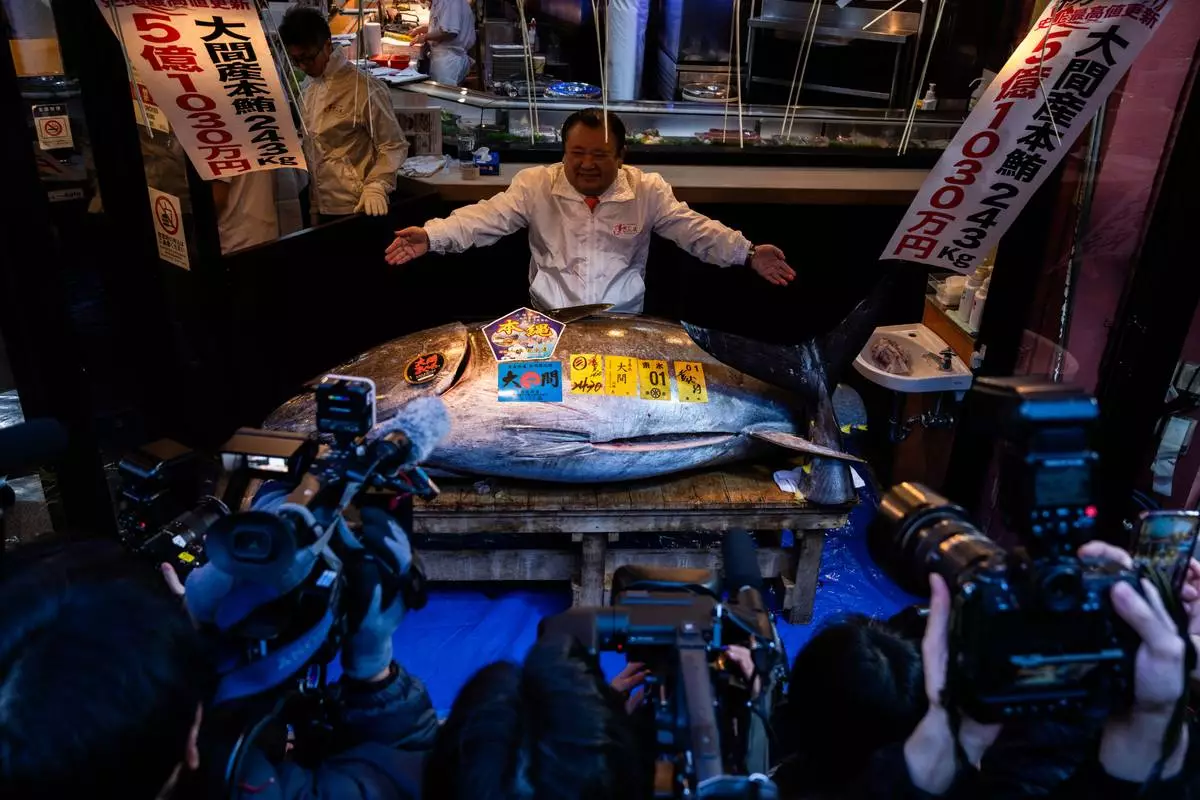
Wholesalers inspect bluefin tuna at the New Year's tuna auction at Toyosu fish market in Tokyo, Monday, Jan. 5, 2026. (AP Photo/Louise Delmotte)

Kiyoshi Kimura, president of Kiyomura Co., poses with the bluefin tuna that won the highest bid at the annual New Year auction in Tokyo, Monday, Jan. 5, 2026. (AP Photo/Louise Delmotte)
Kiyoshi Kimura, president of Kiyomura Co., poses with the bluefin tuna that won the highest bid at the annual New Year auction in Tokyo, Monday, Jan. 5, 2026. (AP Photo/Louise Delmotte)
Deposed Venezuelan President Nicolás Maduro is making his first appearance Monday in an American courtroom on the narco-terrorism charges the Trump administration used to justify capturing him and bringing him to New York.

Maduro and his wife are appearing before a judge for a brief, but required, legal proceeding that will likely kick off a prolonged legal fight over whether he can be put on trial in the U.S.

His lawyers are expected to contest the legality of his arrest, arguing that he is immune from prosecution as a sovereign head of a foreign state. But the U.S. doesn’t recognize him as Venezuela’s legitimate leader.

Maduro, along with his wife, son and three others, is accused of working with drug cartels to facilitate the shipment of thousands of tons of cocaine into the U.S. They could face life in prison if convicted.

Here's the latest:

Following Maduro’s plea, Hellerstein turned to Maduro’s wife and asked her to confirm her identity.

After confirming her name, Cilia Flores said in Spanish, through an interpreter: “I am first lady of the Republic of Venezuela.”

Asked to enter a plea, she responded: “Not guilty. Completely innocent.”

At one point, Maduro said he had not yet read the indictment against him and had not been informed of his rights.

“I did not know of these rights,” he said through the interpreter. “Your honor is informing me of them now.”

The judge responded to Maduro: “A plea of not guilty will be entered on behalf of Mr. Maduro.”

A second time, Maduro was asked for his plea and he said: “I am innocent. I am not guilty of anything that is mentioned here.”

The allegations Hellerstein listed included a “narco-terrorism conspiracy.”

The judge referred to Maduro’s wife, Cilia Adela Flores de Maduro, as “Mrs. Flores.”

Defense attorneys and prosecutors announced their appearances.

The judge, who could not be seen on courtroom monitors shown in overflow rooms, quipped: “Modern electronic equipment hides the judge.”

Once the proceeding began, Hellerstein, a Clinton appointee, announced that he had been assigned to the case.

“It’s my job to assure this is a fair trial,” Hellerstein said, “That’s my job, and that’s what I intend.”

No television cameras or recording devices are allowed inside the courtroom itself, but reporters and members of the public are allowed to watch in overflow rooms.

Maduro was led into the courtroom at 12:01 p.m. He shook hands with his lawyer and sat down. He wore his prison blue uniform.

Maduro’s wife was led to her seat immediately afterward. Both put on headsets to hear the proceeding as it is translated.

Judge Alvin K. Hellerstein took the bench at 12:03 p.m.

Maduro’s son and Venezuelan congressman Nicolás Maduro Guerra railed on the Trump administration on Monday and warned that the capture of his father in an American operation could set a dangerous precedent globally.

The speech in front of Venezuela’s parliament, his first appearance since the Saturday escalation, comes as the Trump administration has pushed Venezuela’s government to fall in line with its vision for the oil-rich nation.

Maduro Guerra, also known as “Nicolasito,” demanded that his parents be returned by American authorities and called on international support.

Maduro Guerra also denounced his name appearing in the New York indictment of his parents, in which he was named as a co-conspirator.

“If we normalize the kidnapping of a head of state, no country is safe. Today it’s Venezuela. Tomorrow it could be any nation that refuses to submit. This is not a regional problem. It is a direct threat to global political stability,” Maduro Guerra said.

Christina Markus Lassen, Danish ambassador to the U.N., carefully denounced U.S. prospects for taking over Greenland without mentioning the fellow NATO ally by name. “The inviolability of borders is not up for negotiation,” she said during a Security Council meeting on Venezuela.

The U.S. operation in Venezuela to seize Maduro, as well as Trump’s repeated threats to annex Greenland heightened concerns in Denmark, which has jurisdiction over the vast mineral-rich island of Greenland.

Lassen also defended Venezuela’s sovereignty, saying “no state should seek to influence political outcomes in Venezuela through the use of threat of force or through other means inconsistent with international law.”

Security was as tight as it has ever been outside the Manhattan federal courthouse in the hours before Nicolás Maduro was to be arraigned.

But inside the courthouse, it was relaxed and orderly and seemingly a day like any other.

There were nearly twice as many journalists as the three-dozen members of the public who were kept in a line in the hallway prior to the opening of the courtroom where Maduro and his wife were to make their initial appearance.

Five “overflow” courtrooms where spectators would be able to watch the proceedings on large screens were set up to be filled as needed after the actual courtroom was filled.

Speaking for Panama — where strongman Manuel Noriega was ousted by a U.S. invasion and drug trafficking arrest in 1989 — U.N. Ambassador Eloy Alfaro de Alba expressed “concern” about the events in Venezuela.

But the envoy focused on criticizing Maduro’s government, which Panama doesn’t recognize as legitimate. Maduro was widely accused of stealing last year’s election.

“As a country that recovered its democracy and sovereignty, Panama can state clearly that there can be no peace without legitimacy,” the ambassador told the Security Council.

And Petro said he firmly rejects any plans by the U.S. to launch strikes against drug traffickers in the South American country.

In a message on X, Petro said his government has conducted record amounts of cocaine seizures and warned the Trump administration that it would kill children if it conducts strikes against drug trafficking groups and rebels in Colombia.

Petro, who was a member of a left wing guerrilla group in his youth, said he will “return to arms” if the U.S. government stages attacks in Colombian territory. The Colombian leader said he recently fired Colombian intelligence officers who are feeding the U.S. administration with “false information” on his government.

As U.N. officials and U.S. adversaries criticized America’s intervention in Venezuela, U.S. ambassador Mike Waltz defended the military action as a justified “surgical law enforcement operation.”

“If the United Nations in this body confers legitimacy on an illegitimate narco-terrorist with the same treatment in this charter of a democratically elected president or head of state, what kind of organization is this?” Waltz said.

The son of deposed Venezuelan President Nicolás Maduro appeared in Venezuela’s National Assembly on Monday where the country’s lawmakers elected in parliamentary elections last May are set to be sworn in.

His son and congressman Nicolás Maduro Guerra, also known as “Nicolasito”, had not been seen publicly since his father was captured Saturday in an American military operation.

At the emergency U.N. Security Council meeting, Colombian Ambassador Leonor Zalabata said the raid in Venezuela was reminiscent of “the worst interference in our area in the past.”

“Democracy cannot be defended or promoted through violence and coercion, and it cannot be superseded, either, by economic interests,” said Zalabata, whose country requested the meeting.

But her carefully calibrated remarks mentioned the U.S. only obliquely and shied from the type of fiery criticism Colombian President Gustavo Petro lobbed at the U.S. last fall during the U.N.’s biggest annual meeting.

Vasily Nebenzya, the Russian ambassador to the U.N., blasted the U.S. military action in Venezuela, saying the intervention and capture of Maduro is “a turn back to the era of lawlessness” by America. During the U.N. Security Council’s emergency meeting, he called on the 15-member panel to “unite and to definitively reject the methods and tools of U.S. military foreign policy.”

“We cannot allow the United States to proclaim itself as some kind of a supreme judge, which alone bears the right to invade any country, to label culprits, to hand down and to enforce punishments irrespective of notions of international law, sovereignty and nonintervention,” Nebenzya said.

Maduro has retained Barry J. Pollack, a Washington, D.C.-based lawyer known for securing Assange’s release from prison and winning an acquittal for former Enron accountant Michael Krautz.

Pollack, a partner at the law firm Harris, St. Laurent & Wechsler, negotiated Assange’s 2024 plea agreement — allowing him to go free immediately after he pleaded guilty to an Espionage Act charge for obtaining and publishing U.S. military secrets.

Krautz, acquitted of federal fraud charges in 2006 after a hung jury the year before, was one of the only Enron executives whose case ended in a not-guilty verdict. Nearly two-dozen other executives were convicted of wrongdoing in connection with the energy trading giant’s collapse.

Pollack also helped secure the exoneration of Martin Tankleff, a Long Island man who spent 17 years in prison for the murders of his parents before his conviction was overturned.

The top United Nations official warns America may have violated international law with its unilateral action.

In a statement, U.N. Secretary General Antonio Guterres said he remains “deeply concerned that rules of international law have not been respected with regard to the 3 January military action.”

He added that that the “grave” action by the U.S. could set a precedent for how future relations between and among states are conducted.

Hungarian Prime Minister Viktor Orbán on Monday said he believes the U.S. military operation in Venezuela would lead to the country’s vast oil reserves becoming available on global energy markets, something he said was “good news” for Hungary.

Speaking at a news conference in Hungary’s capital Budapest, Orbán, a close Trump ally, said he sees “a serious chance that as a result of Venezuela being brought under (U.S.) control, a more favorable position for Hungary will be created on the world energy market.”

“We think the Americans will be able to bring Venezuelan oil wealth into world trade,” he continued. “That means that supply will increase, and the increase in supply will lead to cheaper prices.”

When asked about the implications of the U.S. action for international legal frameworks, Orbán spoke disparagingly about the role international law plays in regulating countries’ behavior, saying such rules “do not govern the decisions of many great powers, this is completely obvious.”

The small but growing group of about 50 protesters across the street from Manhattan federal court were separated by New York Police Department community service officers from about a dozen pro-intervention demonstrators.

The officers used bicycle rack-style metal barricades to separate the two groups.

“No War For Venezuelan Oil,” “No To Criminal Trump Invasion” and “No Blood For Oil” were among the signs. One man among a small group of about a dozen pro-intervention individuals pulled a Venezuelan flag away from those protesting the U.S. action.

Demonstrators were observed, recorded and interviewed by some of the more than 100 members of the media who had reserved their places outside hours earlier.

U.S. stocks are rising at the open led by technology and energy stocks.

The S&P 500 rose 0.6% early Monday and the Nasdaq composite added 0.7%. The Dow gained 330 points, or 0.7%.

The price of U.S. crude oil gained 1% after U.S. forces captured Venezuelan President Nicolás Maduro in a weekend raid. Shares of Chevron and ConocoPhillips jumped after President Trump floated a plan for U.S. oil companies to help rebuild Venezuela’s oil industry.

Gold gained 2.4% and the price of silver soared 7.6%. Nvidia, Intel and other tech shares rose as the industry kicks off its annual CES trade show in Las Vegas.

▶ Read more about the financial markets

Mexico President Claudia Sheinbaum restated her opposition to the U.S. military intervention in Venezuela and defended her administration’s efforts to address drug trafficking from Mexico to the United States.

“We categorically reject the intervention in the internal affairs of other countries,” Sheinbaum said during her daily news briefing Monday. “Latin American history is clear and overwhelming. Intervention has never brought democracy, never has generated wellbeing, nor lasting stability.”

The president noted 300 tons of drugs seized by Mexican authorities and a drop in homicides during her presidency, but added that the U.S. has a responsibility to address its demand for drugs.

Sheinbaum said her administration had previously agreed with the Trump administration to collaborate and coordinate while respecting each country’s sovereignty. She said regional economic integration was the path forward.

Rubio and other top Trump administration officials will be discussing the Venezuela situation Monday evening with House and Senate leadership of the “gang of eight,” which includes top members of the Intelligence committees. The chairmen and ranking leaders of the other national security committees are also invited.

The Democratic leaders in Congress, Sen. Chuck Schumer and Rep. Hakeem Jeffries, had publicly called for the briefing after leadership was largely kept in the dark about the surprise weekend operation capturing Maduro — despite Congress’s role in approving or rejecting certain military actions.

A war powers resolution that would prohibit further US military involvement in Venezuela without congressional approval is headed toward a vote this week in the Senate.

That includes the right to a trial by a jury of regular New Yorkers. But he’ll also be nearly — but not quite — unique.

Maduro’s lawyers are expected to contest the legality of his arrest, arguing that he’s immune from prosecution as a sovereign head of state.

Panamanian strongman Manuel Noriega unsuccessfully tried the same defense after the U.S. captured him in a similar military invasion in 1990. But the U.S. doesn’t recognize Maduro as Venezuela’s legitimate head of state — particularly after a much-disputed 2024 reelection.

But he declined to criticize the American raid that seized President Nicolas Maduro and his wife.

Starmer, who’s worked hard to forge a strong relationship with U.S. President Donald Trump, said Monday that the U.K. supports international law. But he wouldn’t say whether he thought the U.S. strike on Caracas had breached it.

“It’s for the U.S. to set out its justifications for the actions that it’s taken,” Starmer said. “But it is a complicated situation. It remains a complicated situation. The most important thing is stability and that peaceful transition to democracy.”

Starmer did, however, join calls for Trump to cease his threats to take over Greenland.

Starmer told British broadcasters that Danish Prime Minister Mette Frederiksen was right to say Trump has no claim on the Arctic island, which is Danish territory, and “I stand with her.” Starmer added that “Greenland and the Kingdom of Denmark are to decide the future of Greenland — and only Greenland and the Kingdom of Denmark.”

Patel said in an interview on “Fox & Friends” on Monday morning that the FBI is going to continue its “law enforcement mission” to find “anyone responsible or part of” drug-related activities he said are linked to the Tren de Aragua gang, which U.S. authorities allege worked with the Venezuelan government.

A U.S. intelligence assessment last year found no coordination between the gang and the Venezuelan government.

Patel said the FBI’s hostage rescue team, a tactical unit, was embedded with the U.S. forces in the mission to capture Maduro.

U.S. District Judge Alvin Hellerstein has handled numerous weighty cases in his nearly three decades on the bench, including matters involving Trump, the 9/11 attacks and Sudanese genocide.

Now, the 92-year-old Manhattan jurist is presiding over what could be his biggest case yet. Hellerstein is set to arraign Maduro and Maduro’s wife, Cilia Flores, at noon Monday, kickstarting a judicial assignment that was on hold for six years as Maduro eluded arrest after U.S. prosecutors first indicted him.

In the meantime, Hellerstein has been presiding over cases involving some of Maduro’s co-defendants.

In April 2024, the judge sentenced retired Venezuelan army general Cliver Alcalá to more than 21 years in prison. On Feb. 23, he’s scheduled to sentence a former Venezuelan spymaster, Retired Maj. Gen. Hugo Carvajal.

The trip across Lower Manhattan to the courthouse was swift. The vehicle carrying Maduro backed into a garage in the courthouse complex at around 7:40 am. From there, he will be out of public view until he appears in court, which is expected at around noon.

Bicycle-rack style barricades are lining both sides of the street for several blocks around the main entrance on Worth Street, while police officers on foot and in marked cars patrol the area.

Behind the courthouse, near where inmates are brought in, Pearl Street is closed to foot traffic.

Inside the courthouse, men in U.S. Marshals Service windbreakers and tactical gear roamed the lobby. Outside, dozens of people are lined up, including reporters and paid line-sitters, looking to get a spot inside the courtroom. Some people have tents, seats and hand warmers to deal with the long wait and bitter cold.

A stand is set up with microphones from various news outlets in anticipation that someone connected to the case will speak.

Across the street, more than a dozen TV crews are set up to broadcast live, while all around, a few citizen journalists deliver their own updates into cell phones via YouTube and TikTok.

Maduro’s arraignment is set for noon before U.S. District Judge Alvin Hellerstein at the federal courthouse in Manhattan.

As uncertainty simmers in Venezuela, interim President Delcy Rodríguez has taken the place of her ally Maduro, captured by the United States in a nighttime military operation, and offered “to collaborate” with the Trump administration in what could be a seismic shift in relations between the adversary governments.

Rodríguez served as Maduro’s vice president since 2018, overseeing much of Venezuela’s oil-dependent economy and its feared intelligence service, and was next in the presidential line of succession.

She’s part of a band of senior officials in Maduro’s administration that now appears to control Venezuela, even as U.S. President Donald Trump and other officials say they will pressure the government to fall in line with its vision for the oil-rich nation.

On Saturday, Venezuela’s high court ordered her to assume the role of interim president, and the leader was backed by Venezuela’s military.

▶ Read more about Rodríguez

In his celebratory news conference, Trump set out an extraordinarily forthright view of the use of U.S. power in Latin America that exposed political divisions from Mexico to Argentina as Trump-friendly leaders rise across the region.

“American dominance in the Western Hemisphere will never be questioned again,” Trump proclaimed just hours before Maduro was perp-walked through the offices of the U.S. Drug Enforcement Administration in New York.

The scene marked a stunning culmination of months of escalation in Washington’s confrontation with Caracas that has reawakened memories of a past era of blatant U.S. interventionism in the region.

The new, aggressive foreign policy — which Trump now calls the “Donroe Doctrine,” in reference to 19th-century President James Monroe’s belief that the U.S. should dominate its sphere of influence — has carved the hemisphere into allies and foes.

Saturday’s dramatic events — including Trump’s vow that Washington would “run” Venezuela and seize control of its oil sector — galvanized opposite sides of the polarized continent.

▶ Read more about the division of a changed region

People gather to celebrate the deposing of Venezuelan President Nicolás Maduro, Sunday, Jan. 4, 2026, in Katy, Texas. (Elizabeth Conley/Houston Chronicle via AP)

People gather to celebrate the deposing of Venezuelan President Nicolás Maduro, Sunday, Jan. 4, 2026, in Katy, Texas. (Elizabeth Conley/Houston Chronicle via AP)

FILE - Venezuela's President Nicolas Maduro places his hand over his heart while talking to high-ranking officers during a military ceremony on his inauguration day for a third term, in Caracas, Venezuela, Jan. 10, 2025. (AP Photo/Ariana Cubillos, File)

FILE - Venezuela's President Nicolas Maduro places his hand over his heart while talking to high-ranking officers during a military ceremony on his inauguration day for a third term, in Caracas, Venezuela, Jan. 10, 2025. (AP Photo/Ariana Cubillos, File)

Recommended Articles