Skip to Content Facebook Feature Image

Maduro says 'I was captured' as he pleads not guilty to drug trafficking charges

News

Maduro says 'I was captured' as he pleads not guilty to drug trafficking charges
News

News

Maduro says 'I was captured' as he pleads not guilty to drug trafficking charges

2026-01-06 11:22 Last Updated At:11:30

NEW YORK (AP) — A defiant Nicolás Maduro declared himself "the president of my country” as he protested his capture and pleaded not guilty Monday to federal drug trafficking charges that the Trump administration used to justify removing him from power in Venezuela.

“I was captured,” Maduro said in Spanish as translated by a courtroom interpreter before being cut off by the judge. Asked later for his plea to the charges, he stated: "I am innocent. I am not guilty. I am a decent man, the constitutional president of my country.”

More Images
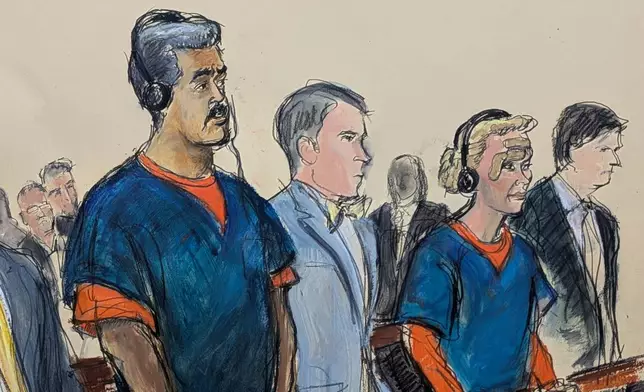
In this courtroom sketch, Venezuelan President Nicolas Maduro, left, and his wife, Cilia Flores, second from right, appear in Manhattan federal court with their defense attorneys Mark Donnelly, second from left, and Andres Sanchez, Monday, Jan. 5, 2026, in New York. (Elizabeth Williams via AP)
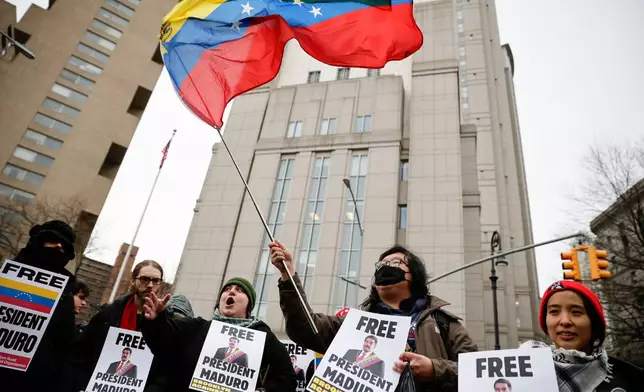
In this courtroom sketch, Venezuelan President Nicolas Maduro, left, and his wife, Cilia Flores, second from right, appear in Manhattan federal court with their defense attorneys Mark Donnelly, second from left, and Andres Sanchez, Monday, Jan. 5, 2026, in New York. (Elizabeth Williams via AP)

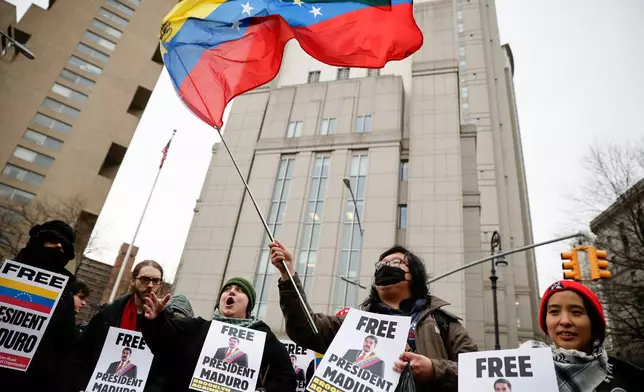
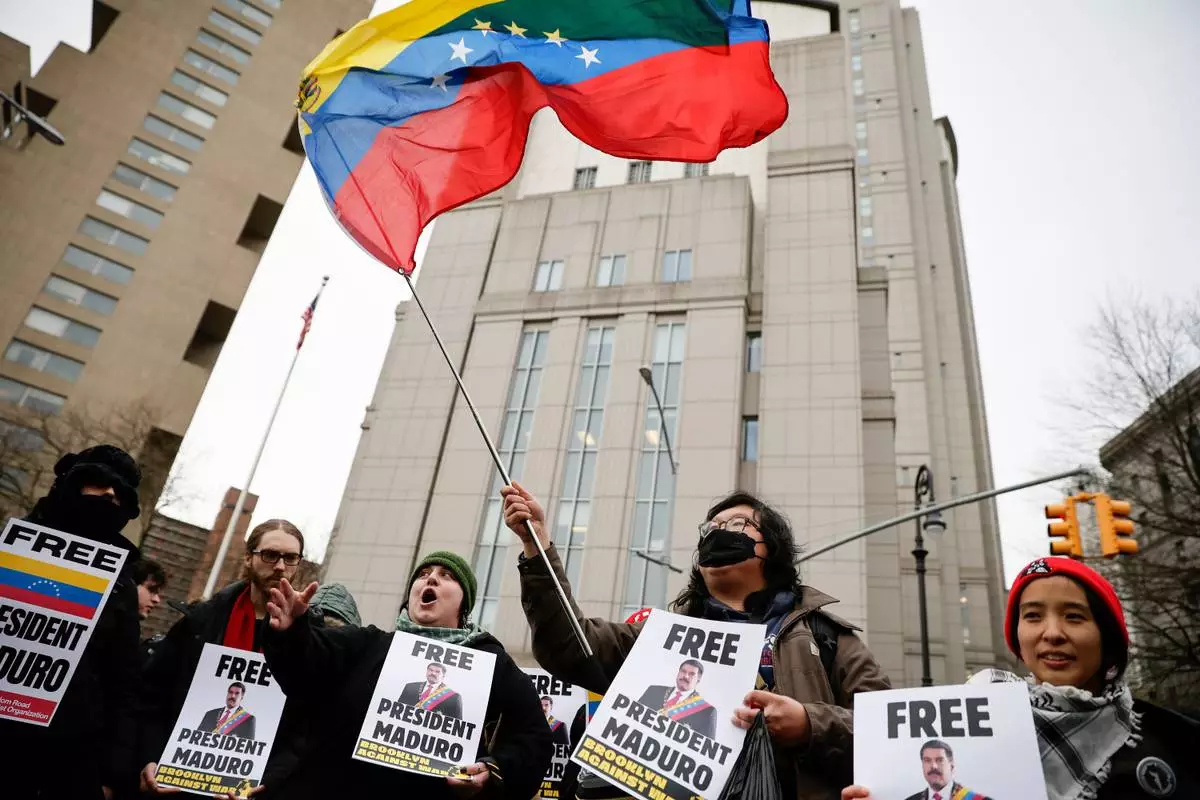
Protesters hold signs calling for the release of Venezuelan President Nicolas Maduro outside Manhattan Federal Court before his arraignment in New York, Monday, Jan. 5, 2026. (AP Photo/Stefan Jeremiah)
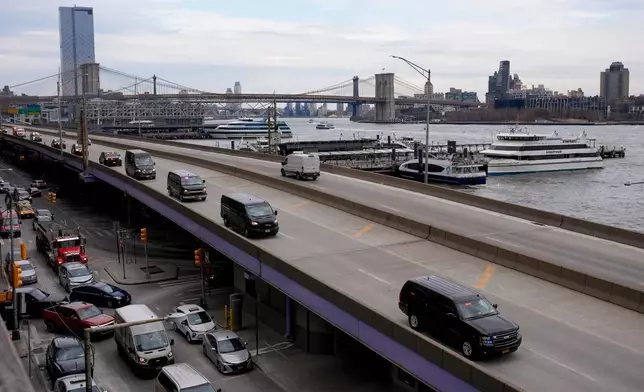
Protesters hold signs calling for the release of Venezuelan President Nicolas Maduro outside Manhattan Federal Court before his arraignment in New York, Monday, Jan. 5, 2026. (AP Photo/Stefan Jeremiah)

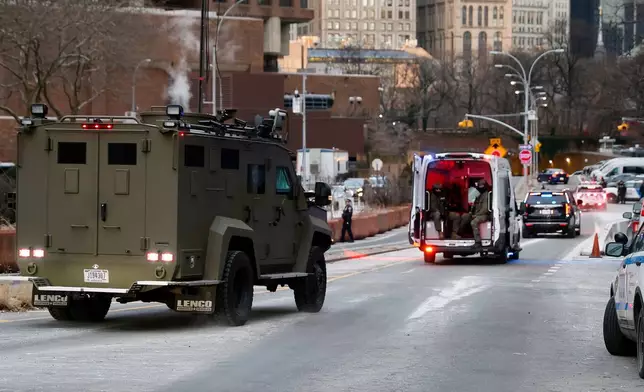
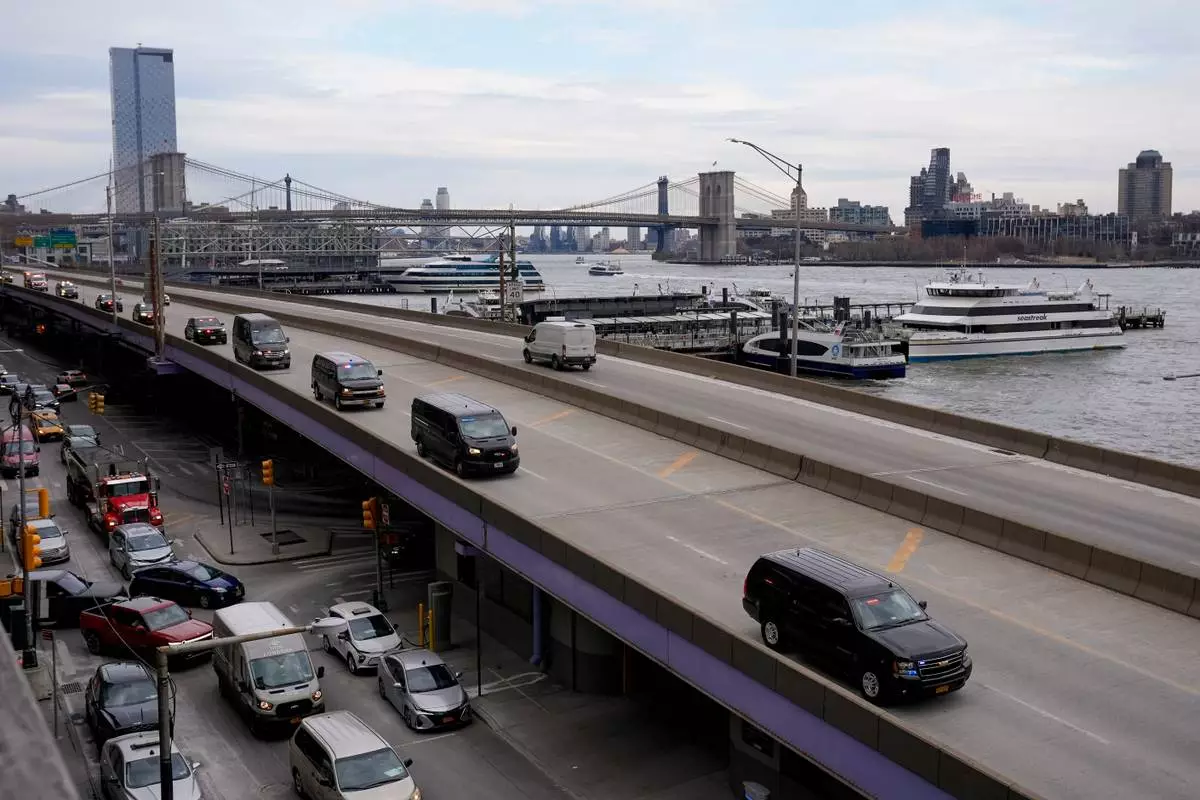
A motorcade makes its way down the FDR Drive after leaving Manhattan Federal Court where Venezuelan President Nicolas Maduro was arraigned with his wife Cilia Flores, Monday, Jan. 5, 2026, in New York. (AP Photo/Seth Wenig)
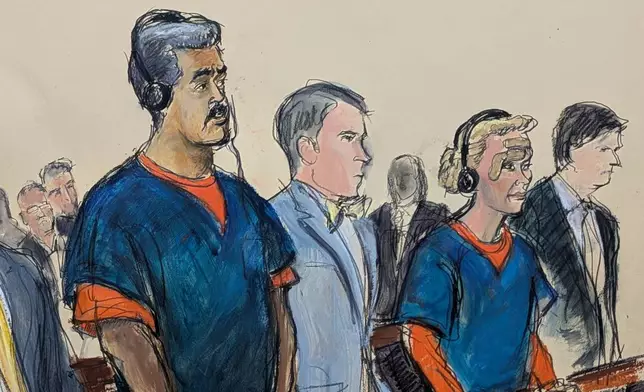
A motorcade makes its way down the FDR Drive after leaving Manhattan Federal Court where Venezuelan President Nicolas Maduro was arraigned with his wife Cilia Flores, Monday, Jan. 5, 2026, in New York. (AP Photo/Seth Wenig)

Venezuelan President Nicolas Maduro, left, and his wife, Cilia Flores, second from right, appear in Manhattan federal court with their defense attorneys Mark Donnelly, second from left, and Andres Sanchez, Monday, Jan. 5, 2026, in New York. (Elizabeth Williams via AP)
Venezuelan President Nicolas Maduro, left, and his wife, Cilia Flores, second from right, appear in Manhattan federal court with their defense attorneys Mark Donnelly, second from left, and Andres Sanchez, Monday, Jan. 5, 2026, in New York. (Elizabeth Williams via AP)

People protest outside Manhattan Federal Court before the arraignment of Venezuelan President Nicolas Maduro, Monday, Jan. 5, 2026, in New York. (AP Photo/Stefan Jeremiah)
People protest outside Manhattan Federal Court before the arraignment of Venezuelan President Nicolas Maduro, Monday, Jan. 5, 2026, in New York. (AP Photo/Stefan Jeremiah)

An armored vehicle carrying Venezuelan President Nicolas Maduro and his wife Cilia Flores arrives at Manhattan Federal Court, Monday, Jan. 5, 2026, in New York. (AP Photo/Stefan Jeremiah)
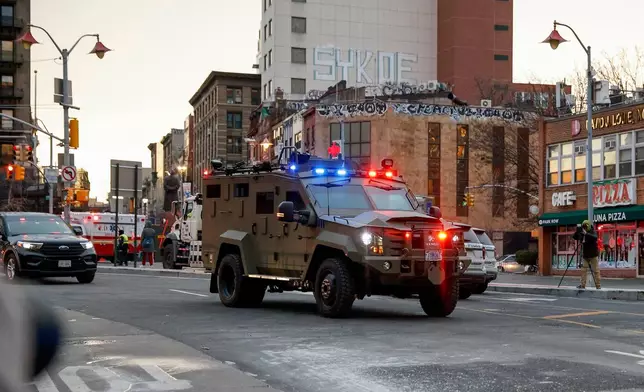
An armored vehicle carrying Venezuelan President Nicolas Maduro and his wife Cilia Flores arrives at Manhattan Federal Court, Monday, Jan. 5, 2026, in New York. (AP Photo/Stefan Jeremiah)
An armored vehicle carrying Venezuelan President Nicolas Maduro and his wife Cilia Flores arrives at Manhattan Federal Court, Monday, Jan. 5, 2026, in New York. (AP Photo/Stefan Jeremiah)

An armored vehicle carrying Venezuelan President Nicolas Maduro and his wife Cilia Flores arrives at Manhattan Federal Court, Monday, Jan. 5, 2026, in New York. (AP Photo/Stefan Jeremiah)

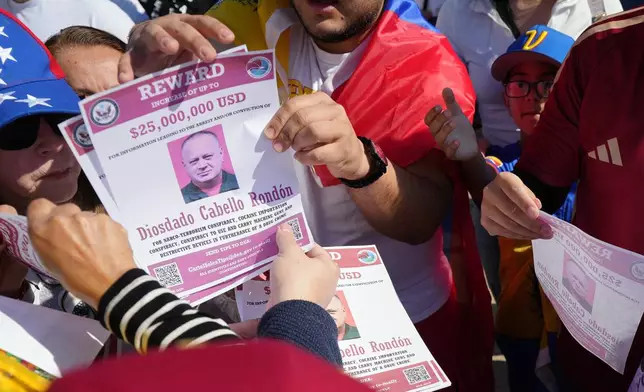
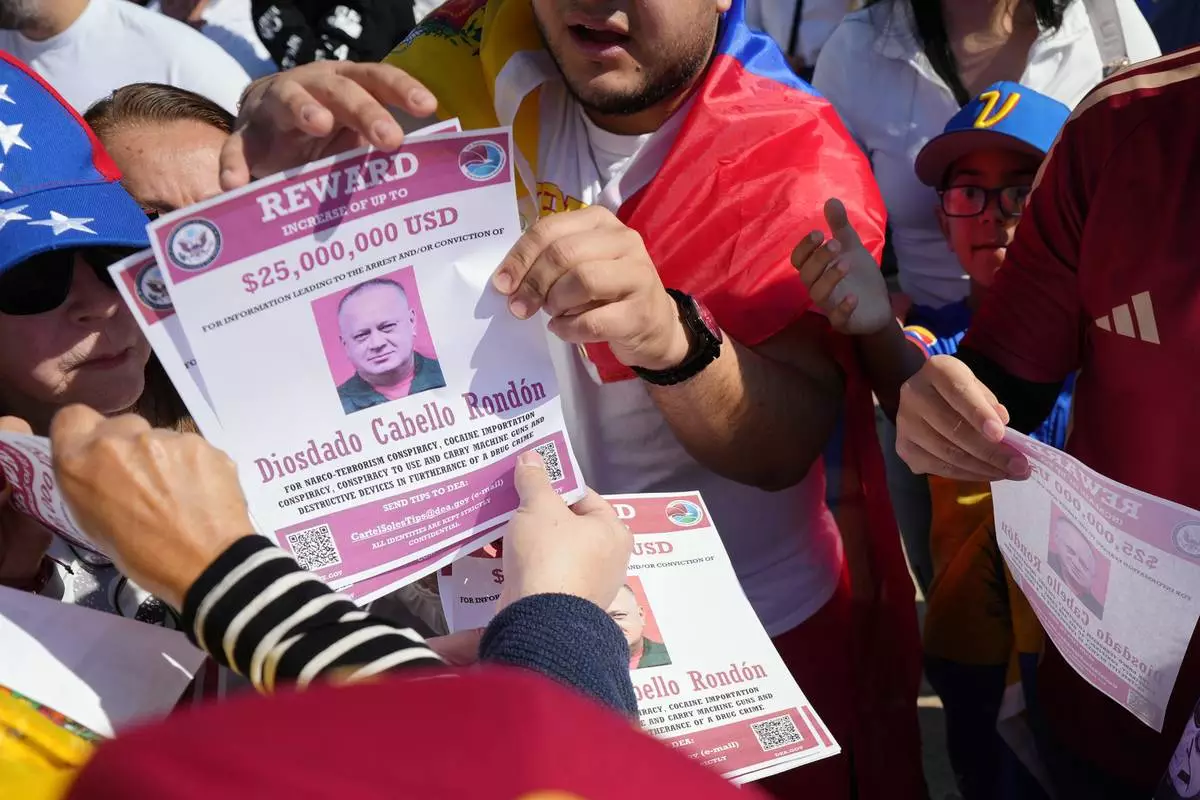
Reward posters are passed out at a gathering celebrating the deposing of Venezuelan President Nicolás Maduro, Sunday, Jan. 4, 2026, in Katy, Texas. (Elizabeth Conley/Houston Chronicle via AP)
Reward posters are passed out at a gathering celebrating the deposing of Venezuelan President Nicolás Maduro, Sunday, Jan. 4, 2026, in Katy, Texas. (Elizabeth Conley/Houston Chronicle via AP)

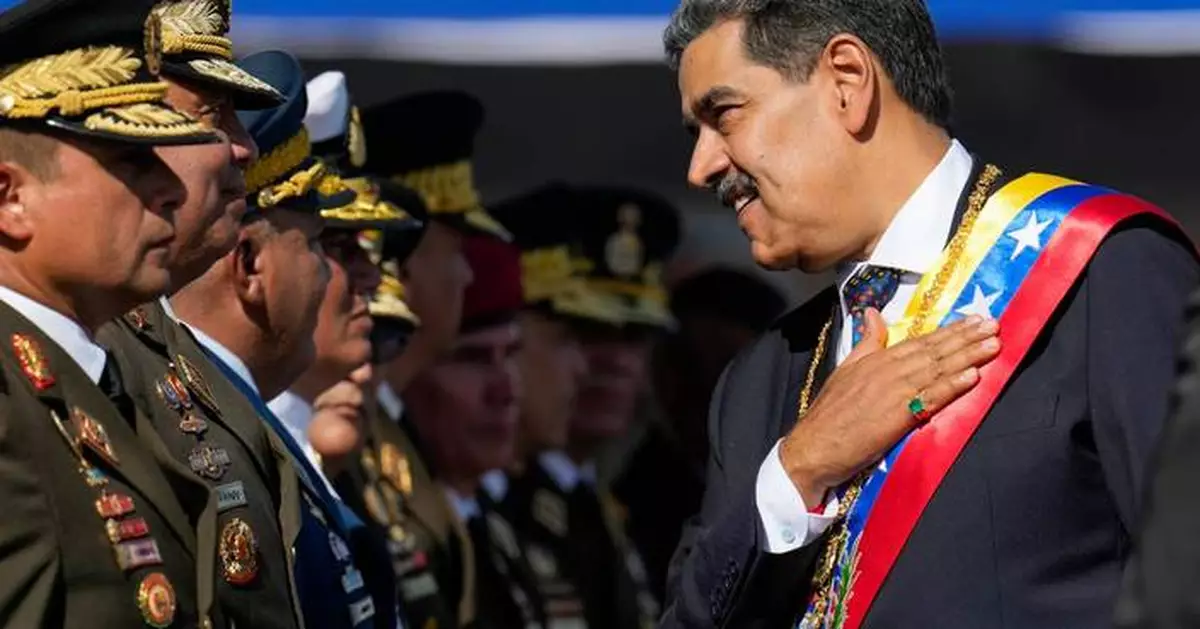
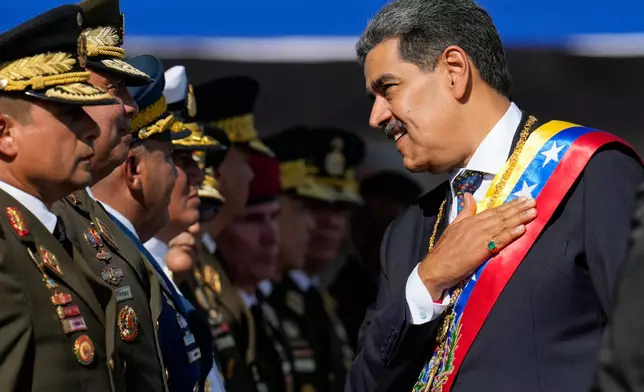
FILE - Venezuela's President Nicolas Maduro places his hand over his hear while talking to high-ranking officers during a military ceremony on his inauguration day for a third term, in Caracas, Venezuela, Jan. 10, 2025. (AP Photo/Ariana Cubillos, File)

FILE - Venezuela's President Nicolas Maduro places his hand over his hear while talking to high-ranking officers during a military ceremony on his inauguration day for a third term, in Caracas, Venezuela, Jan. 10, 2025. (AP Photo/Ariana Cubillos, File)

Maduro’s court appearance in Manhattan, his first since he and his wife, Cilia Flores, were seized from their Caracas home Saturday in a stunning middle-of-the-night military operation, kicked off the U.S. government’s most consequential prosecution in decades of a foreign head of state. She also pleaded not guilty.

The criminal case is unfolding against a broader diplomatic backdrop of an audacious U.S.-engineered regime change that President Donald Trump has said will enable his administration to “run” the South American country.

Maduro, 63, was brought to court under heavy security early Monday — flown by helicopter to Manhattan from Brooklyn, where he is jailed, and then driven to the courthouse in an armored vehicle. He and Flores were led into court just before noon. Both were in leg shackles and jail-issued garb, and both put on headsets to hear the English-language proceeding as it was translated into Spanish.

As Maduro left the courtroom, a man in the audience denounced him as an “illegitimate” president.

As a criminal defendant in the U.S. legal system, Maduro will have the same rights as any other person charged with a crime in the country — including the right to jury trial. But, given the circumstances of his arrest and the geopolitical stakes at play, he’ll also be nearly — but not quite — unique.

That was made clear from the outset as Maduro, who took copious notes throughout the proceedings and wished Happy New Year to reporters as he entered the courtroom, repeatedly pressed his case that he had been unlawfully abducted.

“I am here kidnapped since Jan. 3, Saturday," Maduro said, standing and leaning his tall frame toward a tabletop microphone. “I was captured at my home in Caracas.”

U.S. District Judge Alvin Hellerstein, a 92-year-old jurist who was appointed to the federal bench in 1998 by Bill Clinton, interrupted him, saying: “There will be a time and place to go into all of this." Hellerstein added that Maduro’s lawyer could do so later.

“At this point in time, I only want to know one thing," the judge said. "Are you Nicolás Maduro Moros?”

“I am Nicolás Maduro Moros,” the defendant responded.

Maduro’s lawyer, Barry Pollack, said he expects to contest the legality of his “military abduction."

Pollack, a prominent Washington lawyer whose clients have included WikiLeaks founder Julian Assange, said Maduro is “head of a sovereign state and is entitled to the privileges and immunities that go with that office.”

Panamanian strongman Manuel Noriega unsuccessfully tried the same immunity defense after the U.S. captured him in a similar military invasion in 1990. But the U.S. doesn’t recognize Maduro as Venezuela’s legitimate head of state — particularly after a much-disputed 2024 reelection.

Flores, who identified herself to the judge as “first lady of the Republic of Venezuela,” had bandages on her forehead and right temple. Her lawyer, Mark Donnelly, said she suffered “significant injuries” during her capture.

A 25-page indictment accuses Maduro and others of working with drug cartels to facilitate the shipment of thousands of tons of cocaine into the U.S. They could face life in prison if convicted.

Among other things, the indictment accuses Maduro and his wife of ordering kidnappings, beatings and murders of those who owed them drug money or undermined their drug trafficking operation. That included the killing of a local drug boss in Caracas, the indictment said.

Outside the courthouse, police separated those protesting the U.S. military action from pro-intervention demonstrators. Inside the courtroom, as the proceeding wrapped up and Maduro prepared to leave, 33-year-old Pedro Rojas stood up and began speaking forcefully at him in Spanish.

Rojas said later that he had been imprisoned by the Venezuelan regime. As deputy U.S. marshals led Maduro from the courtroom, the deposed leader looked directly at the man and shot back in Spanish: “I am a kidnapped president. I am a prisoner of war.”

Trump said Saturday the U.S. would “run” Venezuela temporarily and reiterated Sunday night that “we're in charge,” telling reporters “we're going to run it, fix it.”

Secretary of State Marco Rubio tried to strike a more cautious tone, telling Sunday morning talk shows that the U.S. would not govern the country day-to-day other than enforcing an existing ” oil quarantine.”

Before his capture, Maduro and his allies claimed U.S. hostility was motivated by lust for Venezuela’s rich oil and mineral resources.

Trump has suggested that removing Maduro would enable more oil to flow out of Venezuela, but oil prices rose 1.7% on Monday. There are uncertainties about how fast oil production can be ramped up in Venezuela after years of neglect, as well as questions about governance and oversight of the sector.

Venezuela’s new interim leader, Delcy Rodríguez, has demanded that the U.S. return Maduro, who long denied any involvement in drug trafficking — although late Sunday she struck a more conciliatory tone in a social media post, inviting collaboration with Trump and “respectful relations” with the U.S.

Rodríguez was sworn in on Monday by her brother, National Assembly leader Jorge Rodríguez.

“I come with sorrow for the suffering inflicted upon the Venezuelan people following an illegitimate military aggression against our homeland,” she said with her right hand up. “I come with sorrow for the kidnapping of two heroes."

Maduro’s son and Venezuelan congressman Nicolás Maduro Guerra warned on Monday that his father's capture could set a dangerous precedent globally and demanded that his parents be returned.

“If we normalize the kidnapping of a head of state, no country is safe. Today it’s Venezuela. Tomorrow it could be any nation that refuses to submit. This is not a regional problem. It is a direct threat to global political stability,” Maduro Guerra said

Also Monday, the United Nations Security Council held an emergency meeting, with the top U.N. official warning that America may have violated international law with its unilateral action. The world body also spotlighted the profound humanitarian needs in Venezuela. Its people have endured a yearslong, complex economic crisis.

Tucker reported from Washington. Associated Press writers Regina Garcia Cano in Caracas, John Hanna in Topeka, Kansas, Megan Janetsky in Mexico City, Farnoush Amiri and Jennifer Peltz at the United Nations, Josh Boak in Baltimore, Maryland, Darlene Superville aboard Air Force One and Joshua Goodman in Miami contributed to this report.
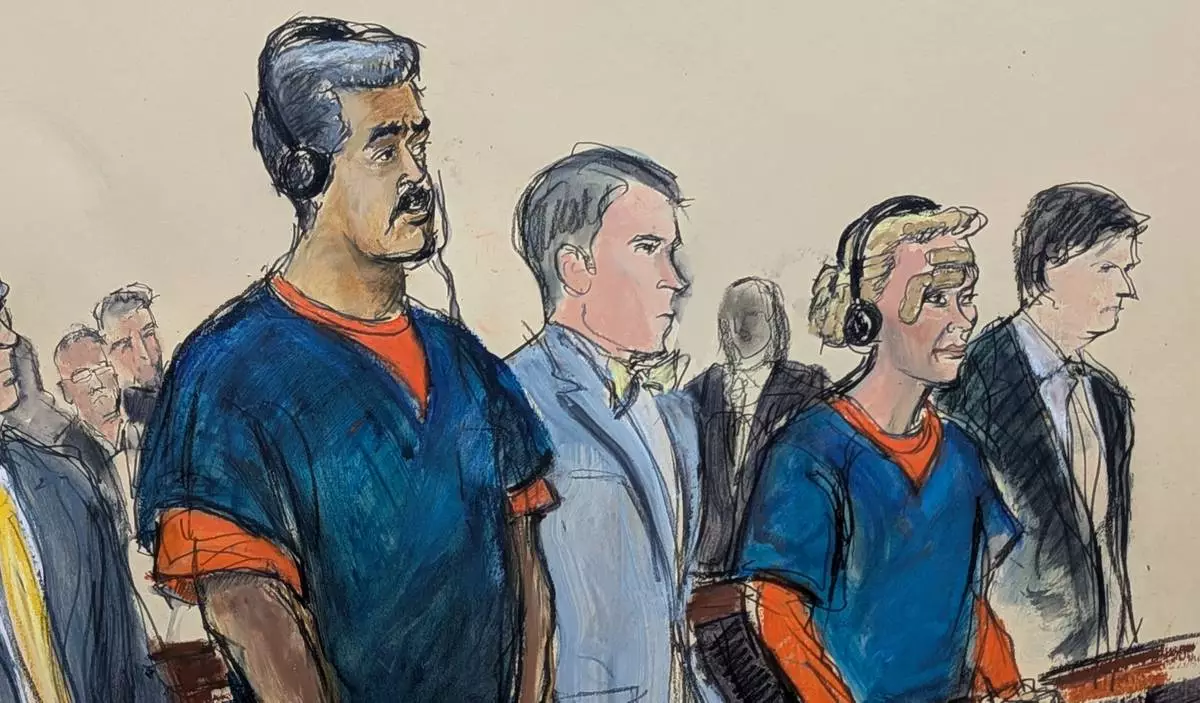
In this courtroom sketch, Venezuelan President Nicolas Maduro, left, and his wife, Cilia Flores, second from right, appear in Manhattan federal court with their defense attorneys Mark Donnelly, second from left, and Andres Sanchez, Monday, Jan. 5, 2026, in New York. (Elizabeth Williams via AP)
In this courtroom sketch, Venezuelan President Nicolas Maduro, left, and his wife, Cilia Flores, second from right, appear in Manhattan federal court with their defense attorneys Mark Donnelly, second from left, and Andres Sanchez, Monday, Jan. 5, 2026, in New York. (Elizabeth Williams via AP)

Protesters hold signs calling for the release of Venezuelan President Nicolas Maduro outside Manhattan Federal Court before his arraignment in New York, Monday, Jan. 5, 2026. (AP Photo/Stefan Jeremiah)
Protesters hold signs calling for the release of Venezuelan President Nicolas Maduro outside Manhattan Federal Court before his arraignment in New York, Monday, Jan. 5, 2026. (AP Photo/Stefan Jeremiah)

A motorcade makes its way down the FDR Drive after leaving Manhattan Federal Court where Venezuelan President Nicolas Maduro was arraigned with his wife Cilia Flores, Monday, Jan. 5, 2026, in New York. (AP Photo/Seth Wenig)
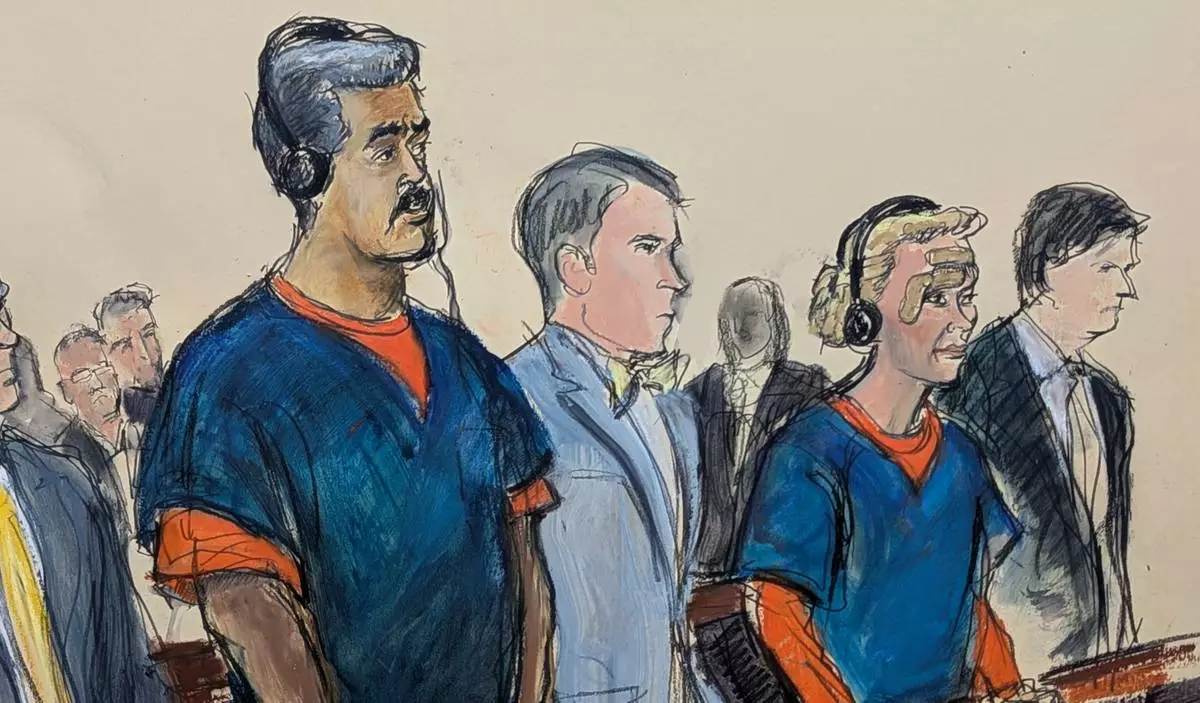
A motorcade makes its way down the FDR Drive after leaving Manhattan Federal Court where Venezuelan President Nicolas Maduro was arraigned with his wife Cilia Flores, Monday, Jan. 5, 2026, in New York. (AP Photo/Seth Wenig)

Venezuelan President Nicolas Maduro, left, and his wife, Cilia Flores, second from right, appear in Manhattan federal court with their defense attorneys Mark Donnelly, second from left, and Andres Sanchez, Monday, Jan. 5, 2026, in New York. (Elizabeth Williams via AP)
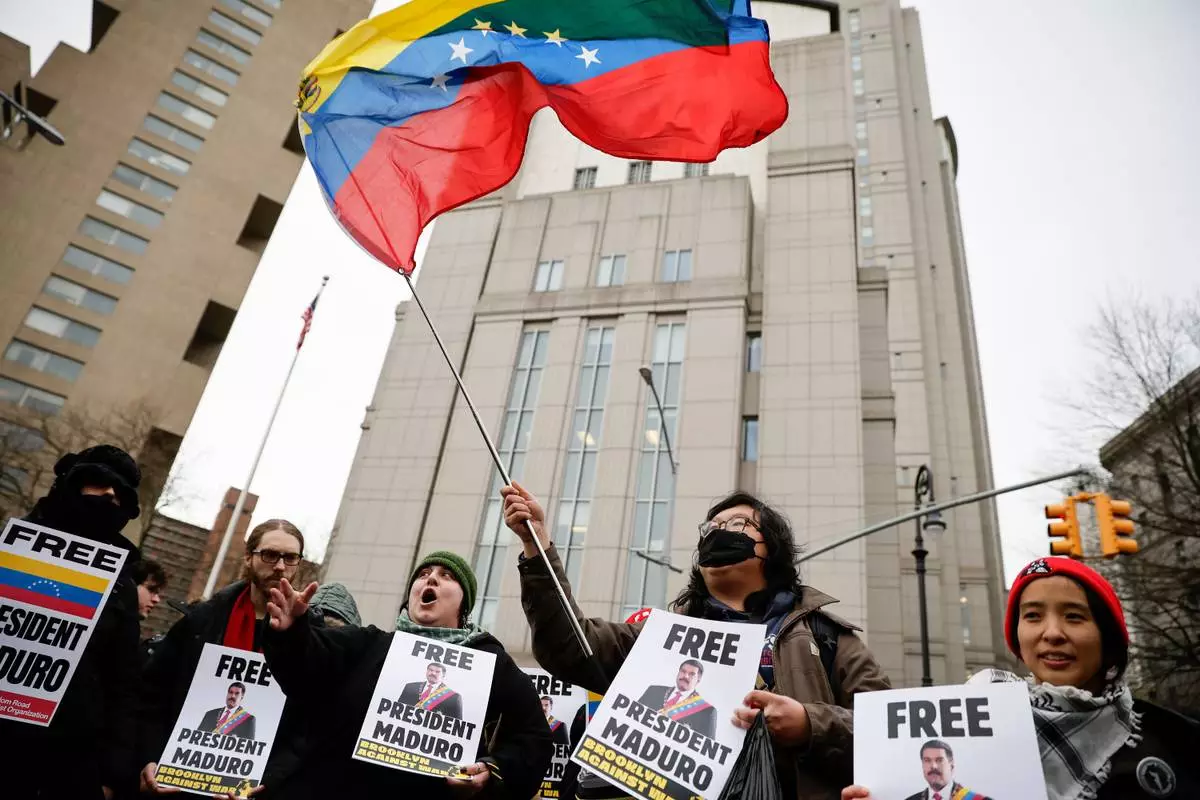
Venezuelan President Nicolas Maduro, left, and his wife, Cilia Flores, second from right, appear in Manhattan federal court with their defense attorneys Mark Donnelly, second from left, and Andres Sanchez, Monday, Jan. 5, 2026, in New York. (Elizabeth Williams via AP)

People protest outside Manhattan Federal Court before the arraignment of Venezuelan President Nicolas Maduro, Monday, Jan. 5, 2026, in New York. (AP Photo/Stefan Jeremiah)
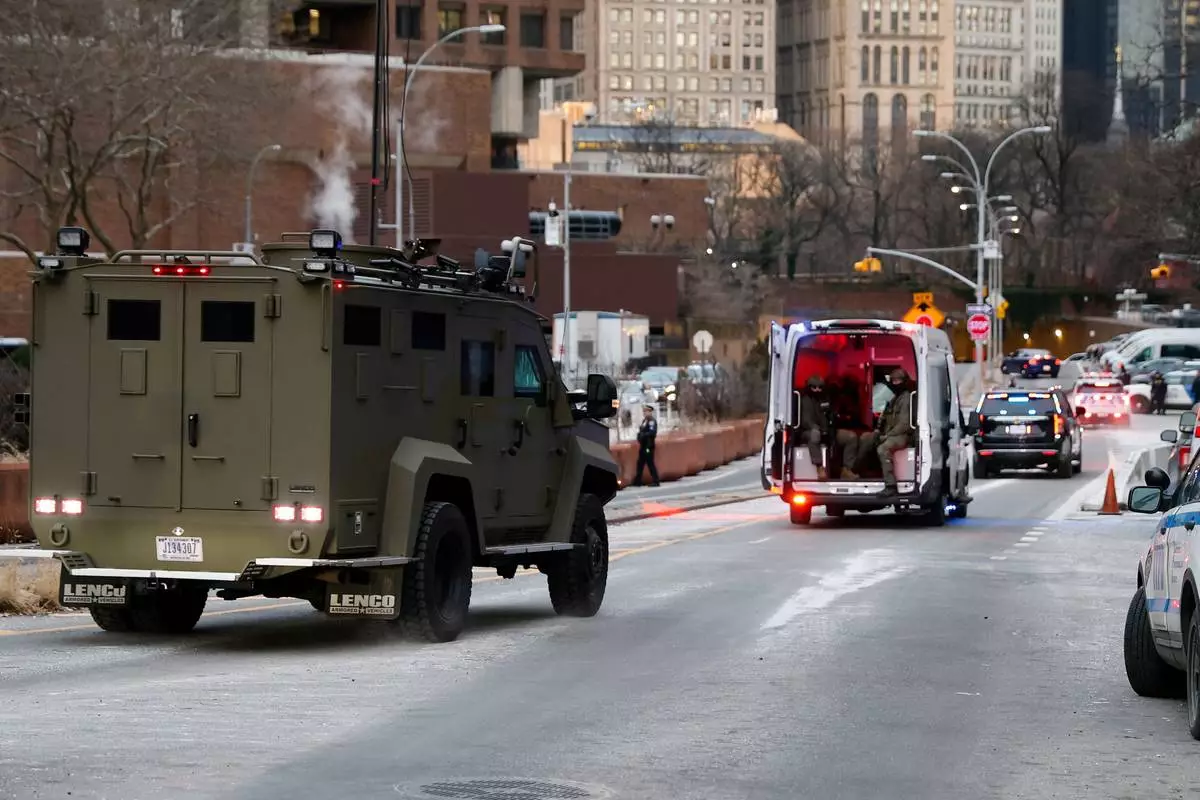
People protest outside Manhattan Federal Court before the arraignment of Venezuelan President Nicolas Maduro, Monday, Jan. 5, 2026, in New York. (AP Photo/Stefan Jeremiah)

An armored vehicle carrying Venezuelan President Nicolas Maduro and his wife Cilia Flores arrives at Manhattan Federal Court, Monday, Jan. 5, 2026, in New York. (AP Photo/Stefan Jeremiah)
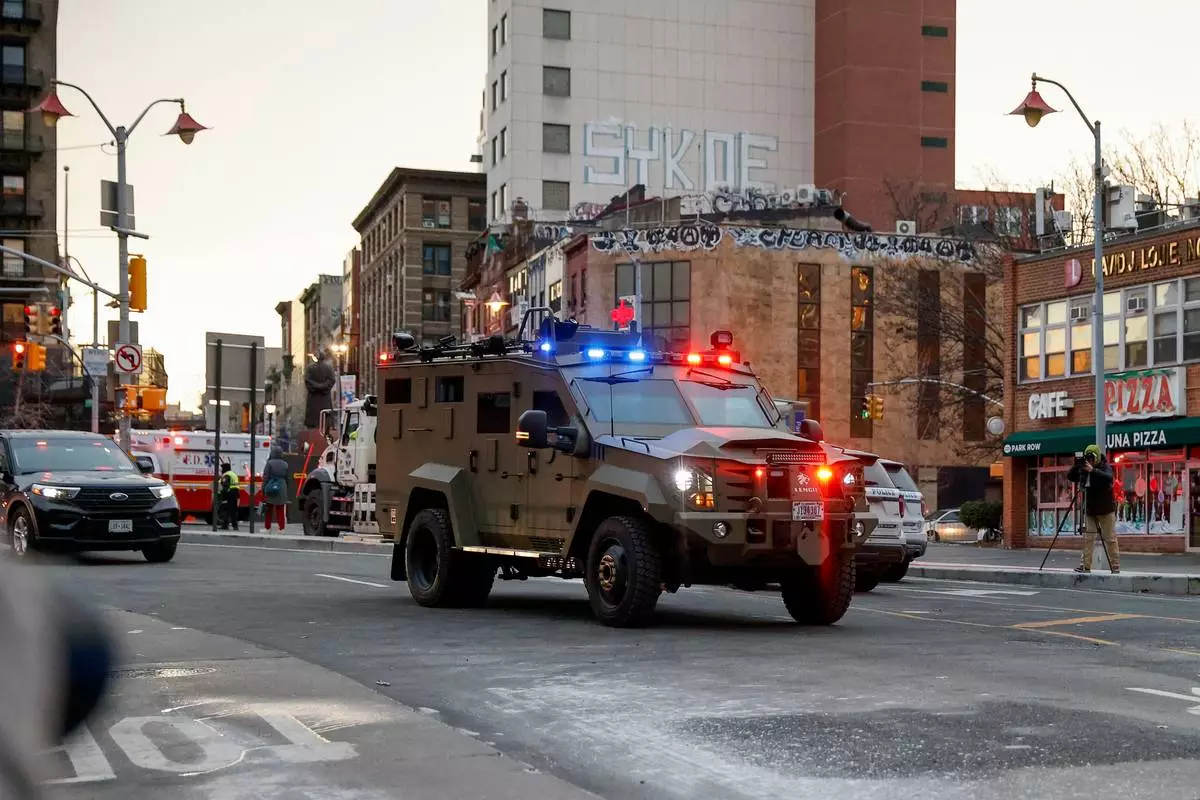
An armored vehicle carrying Venezuelan President Nicolas Maduro and his wife Cilia Flores arrives at Manhattan Federal Court, Monday, Jan. 5, 2026, in New York. (AP Photo/Stefan Jeremiah)
An armored vehicle carrying Venezuelan President Nicolas Maduro and his wife Cilia Flores arrives at Manhattan Federal Court, Monday, Jan. 5, 2026, in New York. (AP Photo/Stefan Jeremiah)

An armored vehicle carrying Venezuelan President Nicolas Maduro and his wife Cilia Flores arrives at Manhattan Federal Court, Monday, Jan. 5, 2026, in New York. (AP Photo/Stefan Jeremiah)

Reward posters are passed out at a gathering celebrating the deposing of Venezuelan President Nicolás Maduro, Sunday, Jan. 4, 2026, in Katy, Texas. (Elizabeth Conley/Houston Chronicle via AP)

Reward posters are passed out at a gathering celebrating the deposing of Venezuelan President Nicolás Maduro, Sunday, Jan. 4, 2026, in Katy, Texas. (Elizabeth Conley/Houston Chronicle via AP)

FILE - Venezuela's President Nicolas Maduro places his hand over his hear while talking to high-ranking officers during a military ceremony on his inauguration day for a third term, in Caracas, Venezuela, Jan. 10, 2025. (AP Photo/Ariana Cubillos, File)
FILE - Venezuela's President Nicolas Maduro places his hand over his hear while talking to high-ranking officers during a military ceremony on his inauguration day for a third term, in Caracas, Venezuela, Jan. 10, 2025. (AP Photo/Ariana Cubillos, File)
WASHINGTON (AP) — President Donald Trump has made broad but vague assertions that the United States is going to “run” Venezuela after the ouster of Nicolás Maduro but has offered almost no details about how it will do so, raising questions among some lawmakers and former officials about the administration’s level of planning for the country after Maduro was gone.

Seemingly contradictory statements from Trump and Secretary of State Marco Rubio have suggested at once that the U.S. now controls the levers of Venezuelan power or that the U.S. has no intention of assuming day-to-day governance and will allow Maduro’s subordinates to remain in leadership positions for now.

Rubio said the U.S. would rely on existing sanctions on Venezuela’s oil sector and criminal gangs to wield leverage with Maduro’s successors.

The uncertainty on definitive next steps in Venezuela contrasts with the years of discussions and planning that went into U.S. military interventions that deposed other autocratic leaders, notably in Iraq in 2003, which still did not often lead to the hoped-for outcomes.

The discrepancy between what Trump and Rubio have said publicly has not sat well with some former diplomats.

“It strikes me that we have no idea whatsoever as to what’s next,” said Dan Fried, a retired career diplomat, former assistant secretary of state and sanctions coordinator who served under both Democratic and Republican administrations.

“For good operational reasons, there were very few people who knew about the raid, but Trump’s remarks about running the country and Rubio’s uncomfortable walk back suggests that even within that small group of people, there is disagreement about how to proceed,” said Fried who is now with the Atlantic Council think tank.

Supporters of the operation, meanwhile, believe there is little confusion over the U.S. goal.

“The president speaks in big headlines and euphemisms,” said Rich Goldberg, a sanctions proponent who worked in the National Energy Dominance Council at the White House until last year and is now a senior adviser to the Foundation for Defense of Democracies, a hawkish think tank.

Goldberg does not see Rubio becoming “the superintendent of schools” but “effectively, the U.S. will be calling the shots.”

“There are people at the top who can make what we want happen or not, and we right now control their purse strings and their lives,” he said. “The president thinks it’s enough and the secretary thinks it’s enough, and if it’s not enough, we’ll know very soon and we’ll deal with it.”

If planning for the U.S. “to run” Venezuela existed prior to Maduro’s arrest and extradition to face federal drug charges, it was confined to a small group of Trump political allies, according to current U.S. officials, who note that Trump relies on a very small circle of advisers and has tossed aside much of the traditional decision-making apparatus.

These officials, who spoke on condition of anonymity to discuss their understanding of internal deliberations, said they were not aware of any preparations for either a military occupation or an interim civilian governing authority, which has been a priority for previous administrations when they contemplated going to war to oust a specific leader or government. The White House and the State Department's press office did not return messages seeking comment.

Previous military actions that deposed autocratic leaders, notably in Panama in 1989 and Iraq in 2003, were preceded by months, if not years, of interagency discussion and debate over how best to deal with power vacuums caused by the ousters of their leaders. The State Department, White House National Security Council, the Pentagon and the intelligence community all participated in that planning.

In Panama, the George H.W. Bush administration had nearly a full year of preparations to launch the invasion that ousted Panama's leader Manuel Noriega. Panama, however, is exponentially smaller than Venezuela, it had long experience as a de facto American territory, and the U.S. occupation was never intended to retake territory or natural resources.

By contrast, Venezuela is vastly larger in size and population and has a decadeslong history of animosity toward the United States.

“Panama was not successful because it was supported internationally because it wasn’t,” Fried said. “It was a success because it led to a quick, smooth transfer to a democratic government. That would be a success here, but on the first day out, we trashed someone who had those credentials, and that strikes me as daft.”

He was referring to Trump’s apparent dismissal of opposition leader Maria Corina Machado, whose party is widely believed to have won elections in 2024, results that Maduro refused to accept. Trump said Saturday that Machado “doesn’t have the support within or the respect within the country” to be a credible leader and suggested he would be OK with Maduro’s No. 2, Delcy Rodríguez, remaining in power as long as she works with the U.S.

Meanwhile, best-case scenarios like those predicted by the George W. Bush administration for a post-Saddam Hussein Iraq that it would be a beacon of democracy in the Middle East and hopes for a democratic and stable Afghanistan following the ouster of the Taliban died painfully slow deaths at the tremendous expense of American money and lives after initial euphoria over military victories.

“Venezuela looks nothing like Libya, it looks nothing like Iraq, it looks nothing like Afghanistan. It looks nothing like the Middle East,” Rubio said this weekend of Venezuela and its neighbors. “These are Western countries with long traditions at a people-to-people and cultural level, and ties to the United States, so it’s nothing like that.”

The lack of clarity on Venezuela has been even more pronounced because Trump campaigned on a platform of extricating the U.S. from foreign wars and entanglements, a position backed by his “Make America Great Again” supporters, many of whom are seeking explanations about what the president has in mind for Venezuela.

“Wake up MAGA,” Republican Rep. Thomas Massie of Kentucky, who has bucked much of his party’s lockstep agreement with Trump, posted on X after the operation. “VENEZUELA is not about drugs; it’s about OIL and REGIME CHANGE. This is not what we voted for.”

Sen. Rand Paul, also a Kentucky Republican, who often criticizes military interventions, said “time will tell if regime change in Venezuela is successful without significant monetary or human cost.”

“Easy enough to argue such policy when the action is short, swift and effective but glaringly less so when that unitary power drains of us trillions of dollars and thousands of lives, such as occurred in Afghanistan, Iraq, and Vietnam,” he wrote on social media.

In addition to the Venezuela operation, Trump is preparing to take the helm of an as-yet unformed Board of Peace to run postwar Gaza, involving the United States in yet another Mideast engagement for possibly decades to come.

And yet, as both the Iraq and Afghanistan experiences ultimately proved, no amount of planning guarantees success.

President Donald Trump listens to a question during a news conference at Mar-a-Lago, Saturday, Jan. 3, 2026, in Palm Beach, Fla., as Secretary of State Marco Rubio watches. (AP Photo/Alex Brandon)

President Donald Trump listens to a question during a news conference at Mar-a-Lago, Saturday, Jan. 3, 2026, in Palm Beach, Fla., as Secretary of State Marco Rubio watches. (AP Photo/Alex Brandon)

In this photo released by the White House, President Donald Trump monitors U.S. military operations in Venezuela, with Secretary of State Marco Rubio at Mar-a-Lago in Palm Beach, Fla., Saturday, Jan. 3, 2026. (Molly Riley/The White House via AP)

In this photo released by the White House, President Donald Trump monitors U.S. military operations in Venezuela, with Secretary of State Marco Rubio at Mar-a-Lago in Palm Beach, Fla., Saturday, Jan. 3, 2026. (Molly Riley/The White House via AP)

Secretary of State Marco Rubio arrives at the U.S. Capitol Monday, Jan. 5, 2026, for a closed-door briefing with top lawmakers after President Donald Trump ordered U.S. forces to capture Venezuelan President Nicolas Maduro and bring him to New York to face federal drug trafficking charges. (AP Photo/J. Scott Applewhite)

Secretary of State Marco Rubio arrives at the U.S. Capitol Monday, Jan. 5, 2026, for a closed-door briefing with top lawmakers after President Donald Trump ordered U.S. forces to capture Venezuelan President Nicolas Maduro and bring him to New York to face federal drug trafficking charges. (AP Photo/J. Scott Applewhite)

Recommended Articles