The Shenzhou-19 crew is preparing for their third series of extravehicular activities (EVAs), a mission that requires intensive training of astronauts to master the skills needed for spacewalks.
The Shenzhou-19 crew members on board China's Tiangong space station will conduct their third EVA within the next few days, the China Manned Space Agency (CMSA) announced on Thursday.
Experts said that from simulated weightlessness to physical conditioning, every aspect of the astronauts' preparation is meticulously designed to ensure success in the challenging environment of space.
Astronauts are undergoing comprehensive technical training, including theoretical knowledge, operational skills, EVA procedures, and mission-specific tasks. Since each spacewalk has unique objectives, the training content is tailored accordingly. Advanced simulators, such as the EVA procedure training simulator, replicate the conditions of the spacesuit and airlock equipment, providing a realistic environment for practice.
One of the most critical training tools is the neutral buoyancy pool, which simulates the microgravity environment of space. This underwater training is essential for practicing tasks like spacewalking, equipment assembly, and repairs.
"This allows you to experience the sensation of floating in space to a great extent. In the absence of gravity, performing various tasks feels completely different from what we are accustomed to on Earth, and it comes with many challenges. This underwater training is extremely physically demanding," said Yang Yuguang, chairman of the Space Transportation Committee at the International Astronautical Federation.
In addition to technical and simulated training, astronauts must build exceptional physical strength, particularly in their upper bodies and core muscles.
Pang Zhihao, a space science popularization expert, said that mastering movement and control in space requires astronauts to maintain their position in a weightless environment, often relying on handholds and railings, which makes wrist and arm endurance crucial.
The Shenzhou-19 astronauts entered the orbiting space station for a six-month spaceflight on Oct 30 last year.
On Dec 17 last year, the Shenzhou-19 crew members conducted their first series of EVAs, which lasted nine hours, setting a world record for the duration of such single operation.
During the mission, the three astronauts worked closely together with the support of the space station's robotic arm and ground researchers. They completed tasks such as the installation of space debris protection devices on the space station, inspection and disposal of extravehicular equipment and facilities.
This mission marks the first time in two years that astronaut Cai Xuzhe has walked in space again, and Song Lingdong has become China's first astronaut born in the 1990s to conduct an extravehicular activity.
The crew successfully completed their second series of EVAs from Jan 20 to Jan 21 this year. During the 8.5-hour mission, Cai and Song worked outside the space station while Wang Haoze provided assistance in the space station's core module Tianhe.
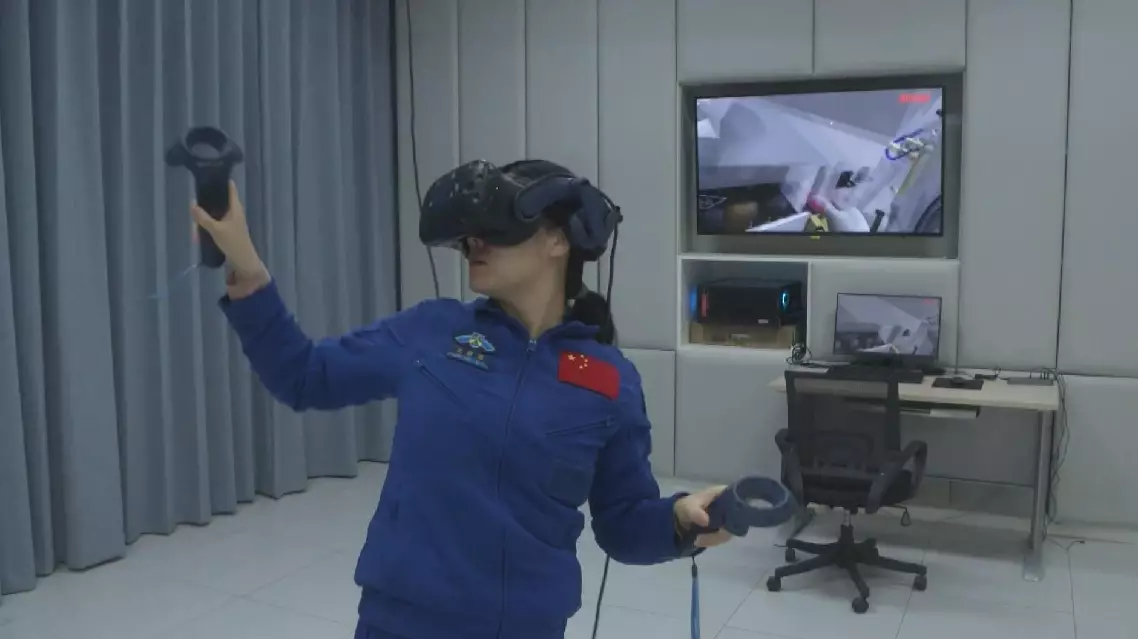
China's Shenzhou-19 crew prepare for third series of EVAs with intensive training