China Media Group (CMG) on Wednesday held a dialog in Doha, Qatar, gathering nearly 100 guests and media representatives to discuss what opportunities China's development and opening up will bring to Qatar and how to advance practical bilateral cooperation.
The event is part of CMG's "China in Spring Time: Sharing Opportunities with the World" Global Dialog series.
During the dialog, Chinese representatives reaffirmed China's commitment as a builder of global common development to further expanding high-level opening up and sharing the enormous opportunities created by China's modernization progress.
Over the past few years, China-Qatar relations have achieved leapfrog development and have been elevated to a new level of strategic partnership, with bilateral cooperation expanded in economic cooperation and people-to-people exchanges.
Bachar Chebaro, general secretary of the Arab Publishers Association, said activities like CMG's Global Dialog series can help further deepen mutual understanding and explore opportunities in bilateral cooperation. "I have been to China at least five times and visited a lot of Chinese cities. I have witnessed the vigorous development of China's world-class industrial system. I deeply understand that dialog and exchanges are of great value in learning from China's development experience, not only for Arab countries but also for countries around the world," he said on the sidelines of the dialog.
At the event, a dozen Chinese and Qatari youths, including representatives from the Qatari government and universities and Chinese students and representatives of Chinese companies in Qatar, delved into such topics as artificial intelligence empowering technological innovation in both countries and the rising craze of China and the Chinese language in Qatar.
CMG's documentary "China: Race to the Future," Chinese animated blockbuster "Ne Zha 2," and the promotional video for the "China travel with Chinese films" program were played during the event.
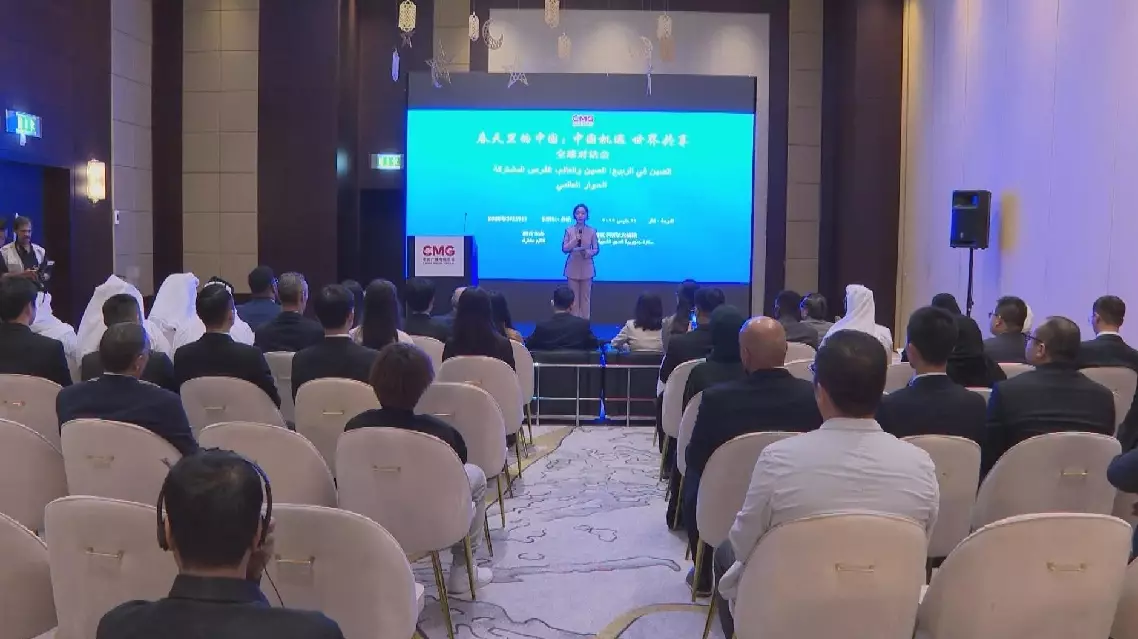
CMG holds dialog in Qatar on opportunities from China's development

The Houthis in Yemen are ready to coordinate countermeasures with Iran in response to a U.S. blockade on the Strait of Hormuz, a top adviser said on Tuesday, warning that the Bab al-Mandab Strait could also be blocked if red lines are crossed.
The United States imposed a blockade on the Strait of Hormuz to prevent ships from accessing Iranian ports, which took effect after the Iran-U.S. peace talks, held in Pakistan's capital Islamabad late last week, failed to yield a deal to end the war that the Unite States and Israel launched against Iran on Feb. 28. A two-week ceasefire is set to expire next week.
In an interview with China Global Television Network (CGTN) in Sanaa on Tuesday, Mohammed Taher Anam, an advisor to Yemen's Houthi Supreme Political Council, said these unilateral American actions must be rejected and confronted, so that the United States does not later impose blockades on other countries.
"We reject this blockade and call for confronting it through various means. We are also waiting for Iranian measures and are ready to take similar steps in our region," said Anam.
He said that the Bab al-Mandab Strait and nearby areas can be blocked at any time if red lines are crossed. They are coordinating with their Iranian allies and closely monitoring developments he said, and, at the right moment, they are ready to expand the confrontation against the U.S. and its allies.
The Bab el-Mandeb Strait, a strategic chokepoint linking the Suez Canal and the Red Sea with the Gulf of Aden, serves as a vital corridor for global trade, particularly oil and gas shipments between Europe and Asia.
"We remain ready to take any measures. We are coordinating with our allies in Iran and with friendly countries around the world if needed. One possible step is imposing a blockade against the American blockade. The Americans think they can impose a blockade on the Strait of Hormuz, but this is very difficult. We know Iranian missiles can reach up to 1,000 kilometers to target American ships, keeping them far from the Strait of Hormuz. If the U.S. continues on this path, we in Yemen can take similar steps to Iran, and the Americans will suffer greatly," said Mohammed.
The Houthi group, which has controlled Yemen's capital Sanaa and most northern provinces since late 2014, has voiced full solidarity with Iran since the U.S.-Israeli strikes against the Islamic Republic started.
Houthi official warns of possible key Red Sea strait closure as U.S. continues Hormuz blockade