A team of researchers from Beihang University, in collaboration with the Institute of Deep-sea Science and Engineering under the Chinese Academy of Sciences and Zhejiang University, has developed a miniature deep-sea morphable robot, marking a significant milestone in China's deep-sea exploration and robotics.
According to the experts, this pressure-resistant robot, by repurposing its legs and fins, has already successfully performed swimming, gliding, morphing, and crawling in the Haima Cold Seep and the Mariana Trench at the depths of 1,384 meters and 10,666 meters, respectively.
"We've figured out how to make its movement in the deep sea just as good as, or even better than it performs on land under normal temperature and pressure," said Wen Li, a professor from the Department of Mechanical Engineering and Automation at Beihang University.
He introduced that the pressure at a depth of 10,000 meters in the deep sea is equivalent to the weight of a small iceberg and the extreme condition poses a major challenge to the key components and driving parts of the miniature deep-sea robot, which is less than 50 centimeters in length and weighs only 1.5 kilograms.
"We utilized the bistable chiral structure. The chiral barrier would protrude to the other side, if we apply a slight force. This mechanism proves to be highly effective in the deep sea. The reason is that the pressure in the deep sea will make this soft and flexible material harder," said Wen.
He also said that the team members during the six-year development process, also solved numerous challenges such as the movement patterns, automatic control, and overall structural design in deep-sea environments, and completed the prototype development of the deep-sea robot.
Currently, the team is actively pursuing research in the field of deep-sea morphable robotics combined with artificial intelligence, aiming to create more extensive opportunities for intelligent operations in deep-sea environments.
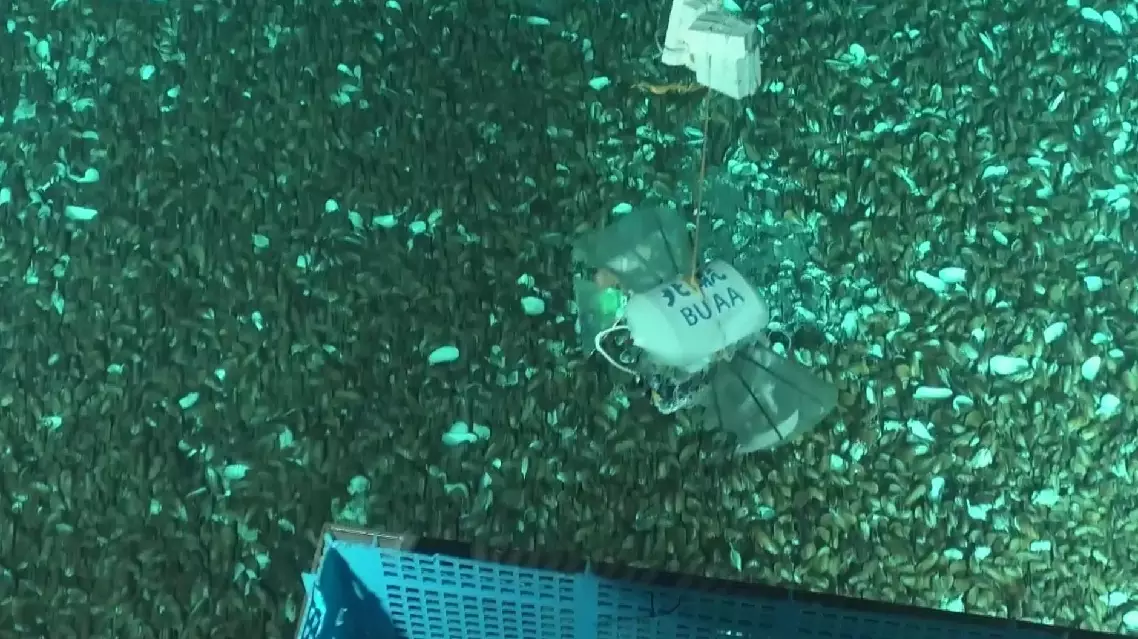
Chinese scientists make big strides in developing miniature deep-sea robot
A new round of trade-in subsidy program is energizing China's consumer market these days, with provinces across the country seeing a surge in demand for cars, home appliances and digital devices.
In north China's Shanxi Province, the new trade-in subsidy program, which started on January 9, has further helped boost sales in home appliances and digital devices which are covered by the new round of subsidies.
To enjoy the subsidies, six types of home appliances, including refrigerators and washing machines, must meet national Level 1 energy-efficiency or water-efficiency standards. Digital and smart products include four types, such as mobile phones and tablets, with a sales price cap of 6,000 yuan (about 800 U.S. dollars) per item.
In both categories, subsidies are set at 15 percent of the final transaction price. For home appliances, the maximum subsidy is 1,500 yuan per item. For digital products, the cap is 500 yuan per item. Each consumer can receive a subsidy for one unit in each category.
Neighboring Shanxi, Hebei Province kicked off the year of 2026 with the new round of trade-in subsidy program starting on January 1.
The subsidies cover automobiles, home appliances, and digital products. Individual consumers who purchase designated Level 1 energy-efficiency appliances or eligible digital products priced at no more than 6,000 yuan can receive subsidies equal to 15 percent of the transaction price. The maximum subsidy is 1,500 yuan per appliance and 500 yuan per digital or smart device, with each person limited to one subsidized item in each category.
Data showed that from Jan 1 to 9, Hebei's home appliance trade-in program alone disbursed more than 130 million yuan in subsidies, driving sales of over 920 million yuan.
In east China's Jiangsu Province, the new trade-in subsidy program, taking effect for two weeks, has brought the province a boom in trade-in.
At a local 4S store in Jiangsu's Suqian City, showroom traffic has spiked as salespeople walked customers through the new benefits from the trade-in subsidy program.
"Under the scrappage-and-replacement scheme, customers who buy a new energy vehicle (NEV) can receive a subsidy worth 12 percent of the vehicle price, capped at 20,000 yuan (about 2,860 U.S. dollars). For combustion-engine cars, the subsidy is 10 percent, with an upper limit of 15,000 yuan. For trade-ins, NEVs are able to receive a subsidy worth 8 percent of the vehicle price, up to 15,000 yuan, while combustion-engine cars will receive a 6-percent subsidy, with a cap of 13,000 yuan," said Sun Yue, a saleswoman at the store.
In the home appliance sector, Jiangsu's policy this year stipulates that only products that meet China's Level 1 energy-efficiency standard are eligible for subsidies. The scheme covers six major categories, including refrigerators and washing machines.
Consumers who purchase qualifying appliances can receive a subsidy equal to 15 percent of the final retail price, up to a maximum of 1,500 yuan per item. Each person is limited to one subsidized unit per product category.
Four types of digital and smart products, such as mobile phones and tablets, are eligible for a 15-percent subsidy capped at 500 yuan per unit, with a retail price no more than 6,000 yuan.
"With the national subsidy policy back in place this year, I went to the store to check what discounts I could get. It knocked 500 yuan off the price. [The discounted price is] very reasonable," said Wang Kang, a resident of Jiangsu's Xuzhou Province.
To enhance the shopping experience for consumers, many retailers are pairing subsidies with "one-stop" services that combine the delivery of new products with on-site collection of old ones.
"After consumers place an order for new home appliances, our staff will schedule a time to pick up the old units. Recycling the old appliance can also further offset the purchase price of the new one," said Yang Jie, a sales supervisor at a major home appliance company.
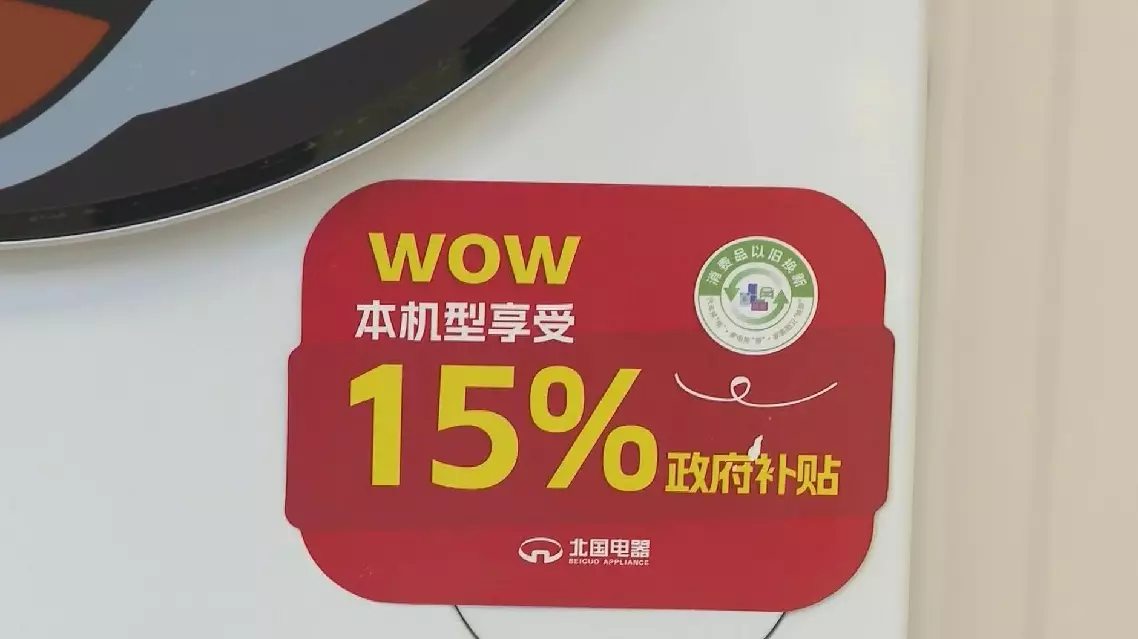
China's new trade-in program sparks consumption boom