China launched "GeWu" on Friday -- an innovative simulation platform designed to drive robotics industrialization by enabling the development of various robots using a single code, enhancing training efficiency, and accelerating the transition from research to commercial applications.
Developed through a collaboration between Shanghai University, Tsinghua University, and the National and Local Co-built Embodied Artificial Intelligence Robotics Innovation Center, "GeWu" integrates advanced reinforcement learning frameworks and multi-modal motion control technologies, offering a high-performance simulation environment.
The platform eliminates the need to reprogram new robots, allowing them to be trained immediately upon import.
"The platform allows a single codebase to be adapted across hundreds of heterogeneous robots, effectively reducing the need for redundant code development. Reinforcement learning technology enables the robots to learn in a way that mimics human behavior -- progressing from simply knowing what to do to actually performing it after training, thereby greatly accelerating the learning process," said Ye Linqi, associate professor at Shanghai University.
By offering a modular, open-source solution, "GeWu" is designed to lower barriers to robot development and facilitate the transition of robotics technology from the lab to real-world industrial applications. The platform supports universities, research institutions, enterprises, and developers, aiming to strengthen China’s leadership in global robotics.
"Current simulation platforms generally have high entry barriers and require extensive coding. A user-friendly, easy-to-use, low-code simulation platform like this allows people to use humanoid robot development tools in a much simpler and more streamlined way," explained Jiang Lei, chief scientist at the National and Local Co-built Embodied Artificial Intelligence Robotics Innovation Center.
At the core of "GeWu" is feedforward-guided reinforcement learning, a technology that significantly improves learning efficiency.
"A core technology is feedforward-guided reinforcement learning, which reshapes the traditional reinforcement learning approach, significantly improving learning efficiency. Compared to previous methods, the number of training steps has been reduced from tens of millions to just a few million, greatly accelerating the training process," Ye Linqi explained.
As China’s first national public platform for humanoid robots, "GeWu" serves as key infrastructure to promote the widespread adoption and industrialization of robotics technology. The platform’s generalized datasets facilitate collaborative development among research groups, empowering the broader robotics industry.
"As an innovation center, our mission is to support the development of the humanoid robotics industry. What we need most is data with strong generalization capabilities to build large-scale datasets that will empower the entire industry," said Yang Zhengye, director of Market Systems at the National and Local Co-built Embodied Artificial Intelligence Robotics Innovation Center.
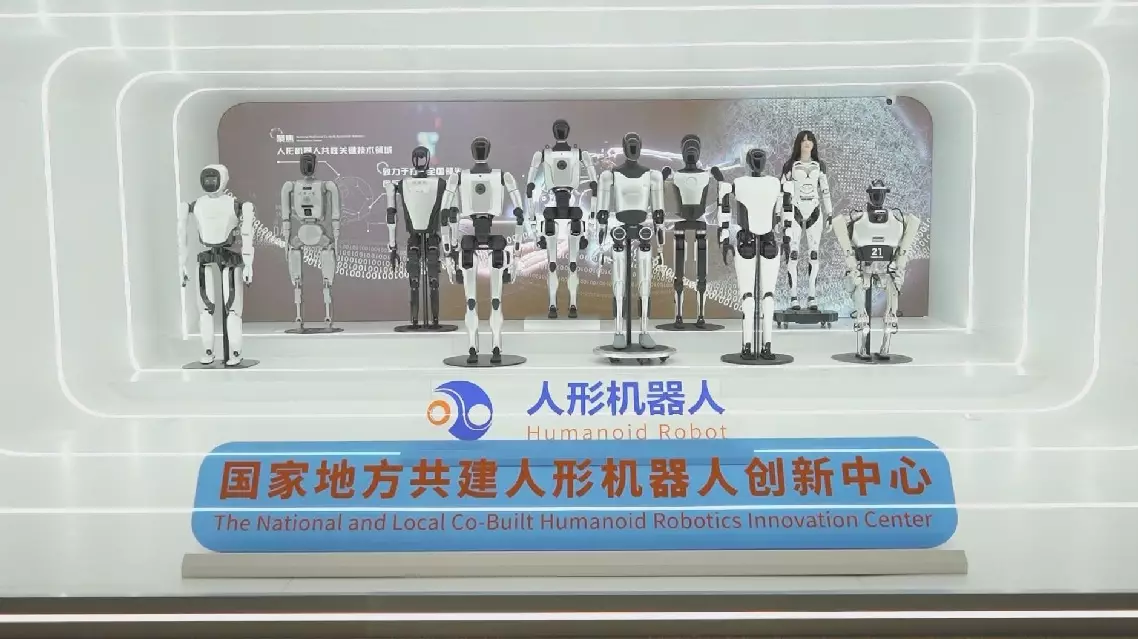
China launches GeWu simulation platform to advance robotics development