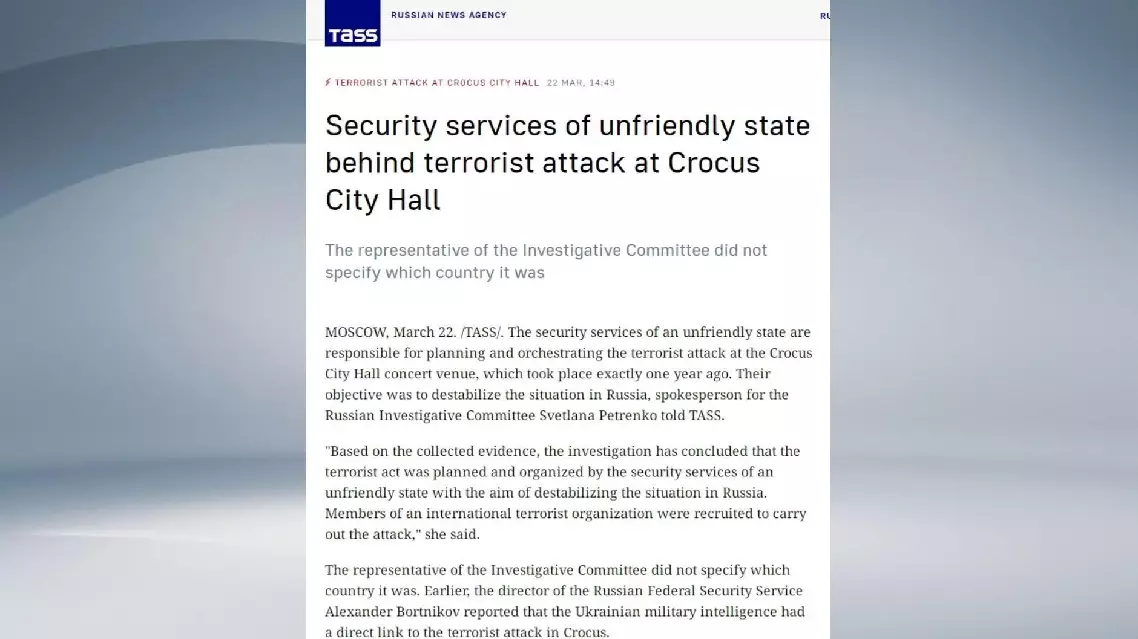
The terrorist attack at the Crocus City Hall concert venue near Moscow, which killed 144 people and injured over 500 one year ago, was planned and organized by intelligence agencies of an "unfriendly state" aiming to destabilize Russia, according to spokesperson for the Russian Investigative Committee.
In an interview with Russian news agency TASS published on Saturday, Svetlana Petrenko, the spokesperson, said that the deadly terrorist attack was orchestrated by "security services of an unfriendly state" and "members of an international terrorist organization were recruited to carry out the attack."
Petrenko stressed that the primary goal of the attack was to destabilize Russia, though she did not specify which country was involved. She also revealed that six citizens of Central Asian countries, directly involved in organizing the attack, have been placed on Russia's wanted list.
On March 22, 2024, a terrorist attack at Moscow's Crocus City Hall concert venue, followed by a massive fire, resulted in at least 144 deaths and 551 injuries, according to official statistics.
The attack remains one of the deadliest acts of terrorism in Russia in recent years, prompting heightened security measures and international scrutiny. Russian authorities continue to investigate the incident, with a focus on identifying and holding all perpetrators accountable.
Russia accuses "unfriendly state" of orchestrating Moscow concert hall terror attack
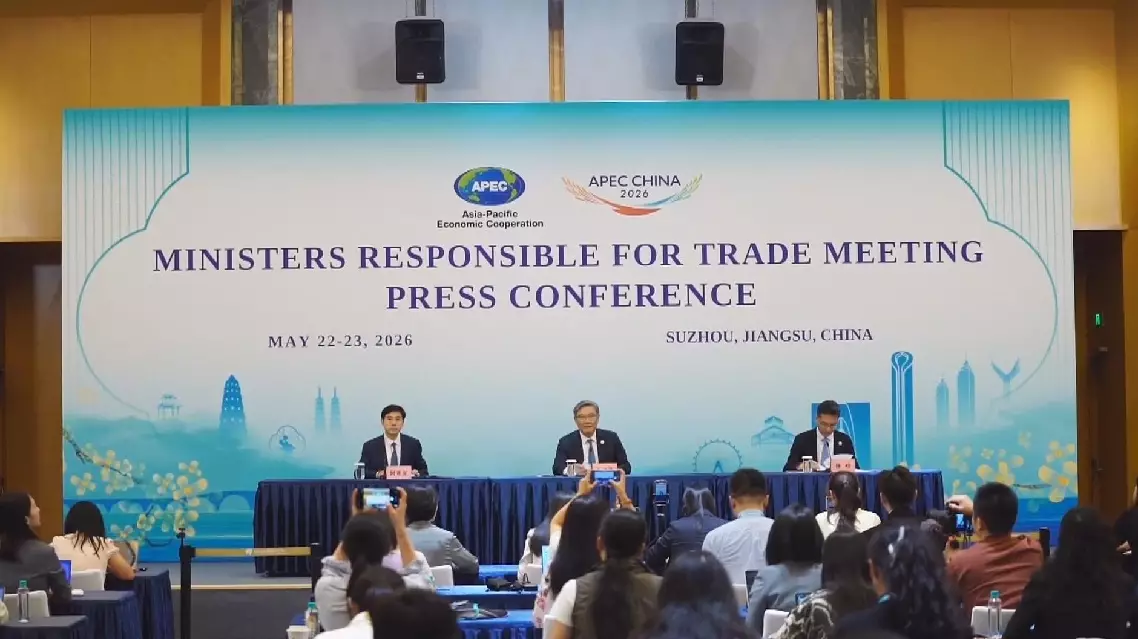
The 32nd Asia-Pacific Economic Cooperation (APEC) Ministers Responsible for Trade Meeting concluded in east China's Suzhou on Saturday, yielding fruitful results and laying significant groundwork for the APEC Economic Leaders' Meeting in November.
The trade ministers' meeting focused on "building an open and predictable regional and multilateral economic and trade order" and "fostering new engines of innovative and dynamic trade and investment cooperation."
Chinese Commerce Minister Wang Wentao briefed the media on the meeting's outcomes at a press conference.
Wang said the meeting issued a joint statement titled the Suzhou Statement, and approved the latest edition of the APEC Roadmap for Innovative, Competitive and Resilient Services.
All parties agreed to advance policy innovation and reform in services trade, build an open and predictable investment environment, improve regional trade facilitation and supply chain resilience, strengthen standards coordination, and enhance intellectual property protection, Wang told the media.
He also said that substantial progress was made on a framework document for regional digital trade cooperation and the ministers emphasized promoting inclusive AI development, strengthening AI-related trade, and bridging the digital divide to ensure shared benefits from digital transformation.
The minister noted that the outcomes of the meeting demonstrated strong cooperation willingness, highlighted an innovation-oriented approach, and reflected inclusiveness and shared benefits. "The fact that Asia-Pacific economies can come together, uphold the original aspiration of promoting trade and investment liberalization and facilitation while supporting economic growth and prosperity, and engage in in-depth discussions on the important issue of 'where multilateral and regional economic and trade cooperation is headed,' fully demonstrates that open regionalism and true multilateralism enjoy broad support, and that mutual success and shared development serve the fundamental interests of all economies," Wang said.
2026 APEC trade ministers' meeting concludes with fruitful results