Skip to Content Facebook Feature Image

China's metro stations showcase unique cultural elements

China

China

China

China's metro stations showcase unique cultural elements

2025-03-23 16:58 Last Updated At:18:07

Metro stations across China are combining elements of local heritage into their designs and decorations, providing passengers a window into the unique traditional cultures of their cities.

A spokesperson from China's Ministry of Foreign Affairs has posted a video on social media highlighting 13 metro stations across China and inviting global visitors to discover their unique charm.

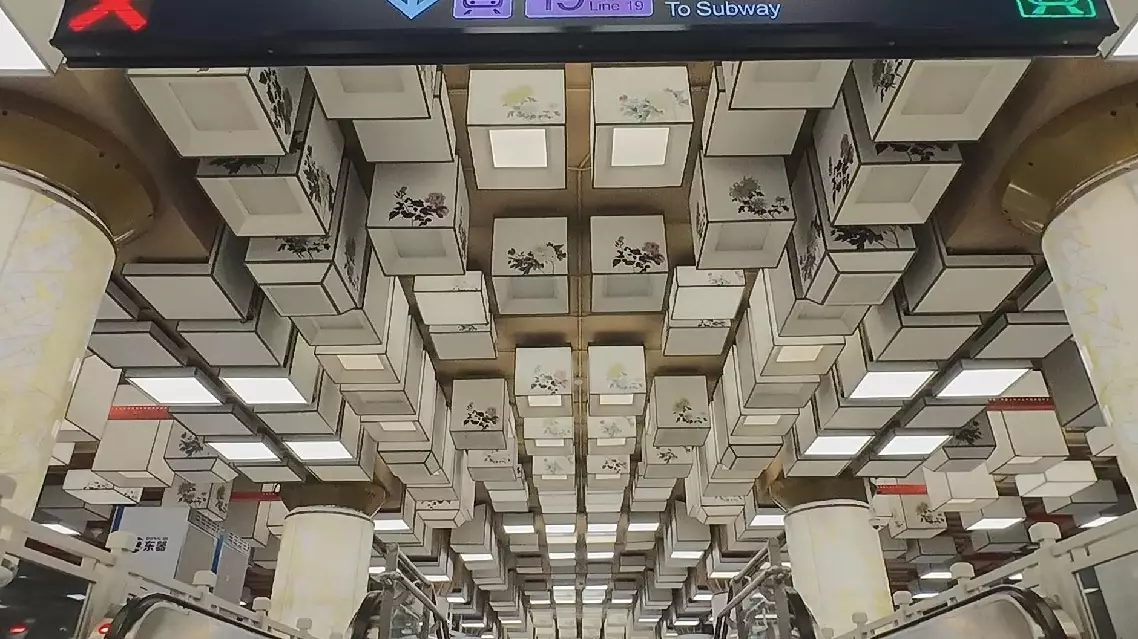
In Beijing, the capital city of China, Ping'anli Station on Subway Line 19 has seamlessly incorporated traditional Chinese cultural elements, such as lantern art and shadow puppetry, into its design.

The station's ceiling is adorned with over 1,000 lanterns, each decorated with vibrant flowers to symbolize good wishes.

Inside the metro hall, the pillars are embellished with square-sided lanterns featuring shadow puppetry figures, all handcrafted by inheritors of intangible cultural heritage and reflecting the traditional practices of the country's Lantern Festival holiday.

A large mural in the station corridor, inspired by the famous Ming Dynasty (1368-1644) painting "Shangyuan Lantern Picture", vividly depicts a festive scene of people enjoying the lantern displays during the Lantern Festival, capturing the attention of passersby.

In Xi'an City of northwest China's Shaanxi Province, Hanyao Station of Subway Line 8, which was opened last year, demonstrates a combination of traditional culture and modern technology.

The station took its name from the famous Qinqiang Opera "Wudianpo," which originates from the region and tells a tale of love, endurance and hope between a military leader and the daughter of a wealthy family.

The station features a dome design and is constructed without a single pillar, providing an expansive public space for passengers. The lighting inside can shift between different colors, enhancing the station's modern, tech-inspired atmosphere.

"The design of Hanyao Station was conceived with the idea that it would not just be a metro station, but an underground space that blends culture and technology, serving as a business card [for Xi'an]. When passengers enter the station, they can experience both the ancient charm of Xi'an and its technological advancements," said Sun Lijuan, the stationmaster of Xi'an Metro Hanyao Station.

In Chengdu City of southwest China's Sichuan Province, strolling through the Jinsha Site Museum Station feels like stepping into a vibrant tapestry of ancient Shu civilization.

With a history spanning approximately 3,000 years, the Jinsha Site was the ancient Shu Kingdom's capital and a cradle of ancient civilization nestled along the upper Yangtze River in China.

The design and decorations inside the Jinsha Site Museum Station incorporate numerous symbols from the Jinsha Site.

The decorations on the ceiling embody the image of a sun-and-immortal-birds gold ornament, one of China's esteemed ancient treasures, unearthed in 2001 from the Jinsha Site.

Two large murals in the hall further showcase the unique characteristics of the ancient Shu civilization, depicting scenes of sun worship, fishing, hunting, and the daily life of the ancient Shu people.
China's metro stations showcase unique cultural elements


China's metro stations showcase unique cultural elements

From cutting-edge technology exhibitions to retail stores thousands of kilometers away from Europe and Southeast Asia, China-made robot vacuum cleaners are increasingly becoming a popular choice among consumers worldwide.

At electronics retailers in Berlin, Germany, Chinese brands such as Roborock and Dreame occupy prominent positions in dedicated robot vacuum sections, offering a wide range of products priced between 200 and 2,000 euros.

Many local consumers said that when purchasing smart home appliances including robot vacuum cleaners, they tend to give priority to Chinese-made products.

"It's a good price and good quality. It's also the innovation. I have a feeling that the European brands are not innovating enough," said one customer.

"I think they're always on top of the other technologies. They are getting them out faster. A lot of us are switching to the Chinese technology," another consumer said.

Germany is one of the most important overseas markets for China's floor-cleaning robots.

According to data from market research firm GfK, from January to November 2025, more than six out of 10 robot vacuum cleaners sold in Western Europe were Chinese brands.

Industry data also point to a strong global momentum.

According to the International Data Corporation (IDC), global shipments of smart robot vacuum cleaners reached 17.424 million units in the first three quarters of 2025, representing a year-on-year increase of 18.7 percent.

Chinese brands including Roborock, Ecovacs, Dreame, Xiaomi and Narwal ranked among the world's top five in terms of shipment volume, with a combined share of nearly 70 percent of the global market.

At a robot vacuum cleaner manufacturing plant in Huizhou, south China's Guangdong Province, workers were seen stepping up production of newly launched models that recently debuted at the Consumer Electronics Show in the United States, which concluded Friday in Las Vegas, Nevada.

The factory adjusted its production lines as early as December 2025 and stocked inventory in advance for overseas markets to ensure that new products could be delivered to global consumers at the earliest possible time.

"In 2025, Roborock's global shipments exceeded 7.2 million units. Since 2024, overseas revenue has accounted for more than 50 percent of our total revenue. Our products have now been sold to more than 170 countries and regions, serving more than 20 million households worldwide," said Quan Gang, president of Roborock.

At another robot vacuum cleaner manufacturing facility in Dongguan, Guangdong, rising overseas orders have prompted the company to upgrade its production lines with intelligent technologies to further boost capacity. The factory is currently operating at full load to meet a growing demand.

"For 2026, we have already obtained overseas orders worth at least 300 million to 400 million yuan (around 43 million to 57.3 million U.S. dollars). In addition, we've engaged in strategic cooperation with European home appliance group Cebos Group, and our total confirmed orders have exceeded 600 million yuan (around 86 million U.S. dollars)," said Zhang Junbin, founder and CEO of Narwal Robotics.

Chinese robot vacuum brands gain strong global traction

Chinese robot vacuum brands gain strong global traction

Recommended Articles