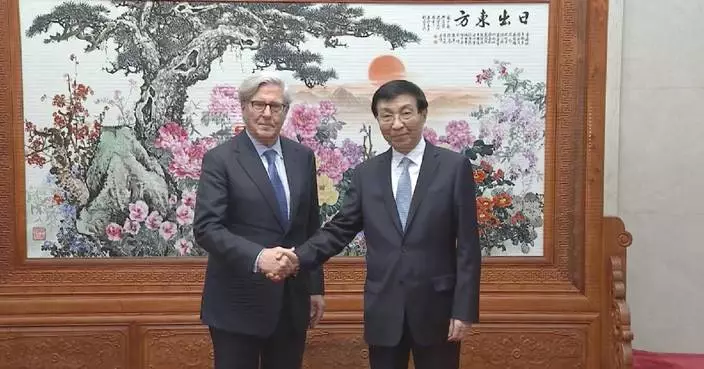
Skip to Content Facebook Feature Image

Development forum attendees highlight China's role in providing certainty for global economy

China

China

China

Development forum attendees highlight China's role in providing certainty for global economy

2025-03-23 21:39 Last Updated At:03-24 10:49

Global business and academic leaders at the China Development Forum 2025 held in Beijing on Sunday expressed their optimism about China's role in providing much-needed economic certainty amid an increasingly uncertain global landscape.

Ian Goldin, a professor of Globalization and Development at the University of Oxford, emphasized the importance of China's economic strength in the current global context.

"I think very positively about the Chinese market. It is a source and engine for the world, of global growth, global growth elsewhere slowing, so China's strength is very important for the global economy," he said.

John Quelch, executive vice chancellor of Duke Kunshan University noted the consistent and clear messaging from China.

"I think the mood is cautiously optimistic. China is staying very firmly on specific messaging and providing a measure of clarity and consistency in the global economy at the moment that is not necessarily coming from other capital cities," he said.

Corporate leaders also shared their perspectives on China's role in ensuring stability, highlighting their willingness to invest in the country as a result.

"The certainty is quite important that we will give people, give the world the confidence to grow. We already announced that we will expand our investment in Shenyang and Shanghai, so we already started," said Wu Junyi, Vice President of Corporate Strategy Development and Supply Chain Logistics at Michelin China.

Martin Sorrell, founder and executive chairman of the digital advertising and marketing services provider S4 Capital, pointed to China's strong domestic economy as a key driver of global growth.

"The domestic economy, I think, is improving, outbound global expansion of Chinese manufacturers in various areas. The biggest examples, probably EVs, and solar panels and like that, the opportunities are huge," he said.

While there are concerns about global economic challenges, particularly rising tariffs and inflation, the overall tone at the forum was one of confidence in China's ability to navigate these obstacles.

"You hear this morning from the premier about how important domestic consumption is and how powerful potentially this domestic consumption is, and that the government will use fiscal and monetary policy to stimulate the economy and that the government will exercise, from a foreign policy point of view, try and unify rather than fragment, so all interesting messages, and I think also all send positive signals to everybody here," Sorrell said.

"Tariffs are inflationary, and they are potentially recessionary as well, so they do pose challenges in the short term. The biggest problem for our clients is they create greater uncertainty and risk and people don't like uncertainty. Ask the CEOs here, what would they prefer? Certainty or uncertainty? They always say certainty," he said.
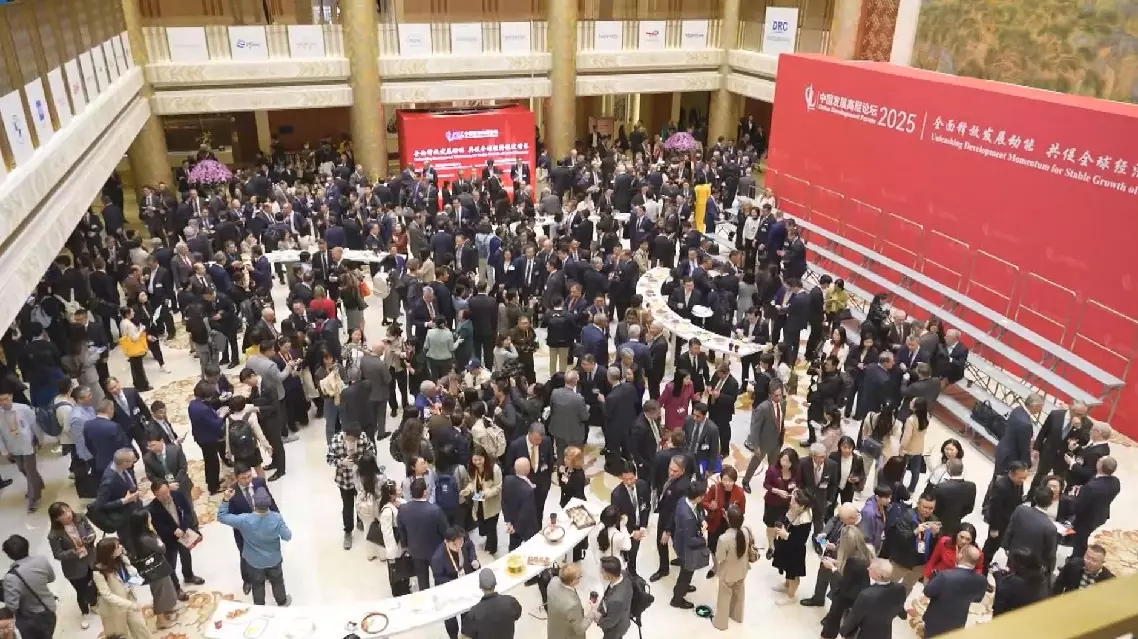
Development forum attendees highlight China's role in providing certainty for global economy

Development forum attendees highlight China's role in providing certainty for global economy

A new round of trade-in subsidy program is energizing China's consumer market these days, with provinces across the country seeing a surge in demand for cars, home appliances and digital devices.

In north China's Shanxi Province, the new trade-in subsidy program, which started on January 9, has further helped boost sales in home appliances and digital devices which are covered by the new round of subsidies.

To enjoy the subsidies, six types of home appliances, including refrigerators and washing machines, must meet national Level 1 energy-efficiency or water-efficiency standards. Digital and smart products include four types, such as mobile phones and tablets, with a sales price cap of 6,000 yuan (about 800 U.S. dollars) per item.

In both categories, subsidies are set at 15 percent of the final transaction price. For home appliances, the maximum subsidy is 1,500 yuan per item. For digital products, the cap is 500 yuan per item. Each consumer can receive a subsidy for one unit in each category.

Neighboring Shanxi, Hebei Province kicked off the year of 2026 with the new round of trade-in subsidy program starting on January 1.

The subsidies cover automobiles, home appliances, and digital products. Individual consumers who purchase designated Level 1 energy-efficiency appliances or eligible digital products priced at no more than 6,000 yuan can receive subsidies equal to 15 percent of the transaction price. The maximum subsidy is 1,500 yuan per appliance and 500 yuan per digital or smart device, with each person limited to one subsidized item in each category.

Data showed that from Jan 1 to 9, Hebei's home appliance trade-in program alone disbursed more than 130 million yuan in subsidies, driving sales of over 920 million yuan.

In east China's Jiangsu Province, the new trade-in subsidy program, taking effect for two weeks, has brought the province a boom in trade-in.

At a local 4S store in Jiangsu's Suqian City, showroom traffic has spiked as salespeople walked customers through the new benefits from the trade-in subsidy program.

"Under the scrappage-and-replacement scheme, customers who buy a new energy vehicle (NEV) can receive a subsidy worth 12 percent of the vehicle price, capped at 20,000 yuan (about 2,860 U.S. dollars). For combustion-engine cars, the subsidy is 10 percent, with an upper limit of 15,000 yuan. For trade-ins, NEVs are able to receive a subsidy worth 8 percent of the vehicle price, up to 15,000 yuan, while combustion-engine cars will receive a 6-percent subsidy, with a cap of 13,000 yuan," said Sun Yue, a saleswoman at the store.

In the home appliance sector, Jiangsu's policy this year stipulates that only products that meet China's Level 1 energy-efficiency standard are eligible for subsidies. The scheme covers six major categories, including refrigerators and washing machines.

Consumers who purchase qualifying appliances can receive a subsidy equal to 15 percent of the final retail price, up to a maximum of 1,500 yuan per item. Each person is limited to one subsidized unit per product category.

Four types of digital and smart products, such as mobile phones and tablets, are eligible for a 15-percent subsidy capped at 500 yuan per unit, with a retail price no more than 6,000 yuan.

"With the national subsidy policy back in place this year, I went to the store to check what discounts I could get. It knocked 500 yuan off the price. [The discounted price is] very reasonable," said Wang Kang, a resident of Jiangsu's Xuzhou Province.

To enhance the shopping experience for consumers, many retailers are pairing subsidies with "one-stop" services that combine the delivery of new products with on-site collection of old ones.

"After consumers place an order for new home appliances, our staff will schedule a time to pick up the old units. Recycling the old appliance can also further offset the purchase price of the new one," said Yang Jie, a sales supervisor at a major home appliance company.

China's new trade-in program sparks consumption boom

China's new trade-in program sparks consumption boom

Recommended Articles