Following the viral spread of a video by a Chinese Foreign Ministry spokeswoman showcasing the beauty of subway stations in China, numerous tourists have flocked to these stunning locations to admire their architectural charm.
On March 14, Foreign Ministry spokeswoman Mao Ning released a video titled "The Most Beautiful Subway Stations in China" on international social media, which featured 13 stunning subway stations across the country. The video, which invites foreign tourists to visit China, has garnered widespread attention and sparked heated discussions both domestically and internationally.
By the end of last year, China had opened and operated 325 urban rail transit lines across 54 cities, covering more than 10,000 kilometers and serving over 6,000 stations. In 2024, these rail transit lines have handled over 30 billion passenger trips. The design of subway stations in several cities stands out for its unique and innovative features, blending cultural heritage, modernity, and natural beauty.
Gangxia North Station is a subway interchange in Shenzhen in Guangdong Province, southern China, and it is renowned for its distinctive design. Featuring a spiral ceiling in the atrium with circular glass windows that allow natural light to flood the concourse, the station has become a popular attraction, drawing numerous tourists after its opening.
As an important hub for transfers between four subway lines, this station has 21 exits and handles 350,000 passenger trips every day.
"It's my first time here. I'm from Xinjiang. The station is stunning, and it's really impressive," said a tourist surnamed Feng.
"It's very modern. It's not just a subway station, but also an urban complex. Everyone passing by can look at it and feel the vitality and life of the city," said a passenger surnamed Zhou.
Among the subway stations promoted by Mao, Caihongqiao Station, also known as Rainbow Bridge Station, in Guangzhou, the capital of Guangdong Province, stands out as one of the iconic stations representing China's subway charm to the world.
Located at the border of Liwan and Yuexiu districts, the station serves as a transfer hub for two subway lines, with plans for future connectivity to another line. More than just a transportation nexus, it also functions as a meticulously designed cultural and artistic space. Its architectural elegance and functional sophistication make it a symbol of urban innovation and aesthetic excellence within Guangzhou's metro network.
"In fact, this area is an important location in the western part of our city. At that time, a bridge was built to facilitate citizens' travel. The span of the bridge is relatively large, so it resembles a rainbow, which is why it was named Rainbow Bridge. Therefore, the design concept of the entire station is based on the Rainbow Bridge as a design element," said Zhou Haicheng, vice president of the Architectural Planning and Design Institute of Guangzhou Metro Design and Research Institute Co., Ltd.
In addition, the Wuhan Business District Station in Wuhan, the capital of Hubei Province in central China, is renowned for its concourse, which looks like a starry sky. The dome of the concourse is composed of 954 pieces of tempered glass, featuring seven different shades of blue and purple, arranged from top to bottom. As the outdoor light changes throughout the day, the dome displays a stunning array of colors, creating a dynamic visual experience 24 hours a day.
"I feel like I'm looking up at the starry sky. It is magnificent. I made a special trip to this place here and check it out today," said a passenger surnamed Huang.
In Southwest China's Chongqing Municipality, known as the "mountainous city," taking a photo at Liziba subway station is a must-do for tourists.
The Liziba Station, part of light-rail Line 2, is uniquely situated on the sixth to eighth floors of a 19-story residential building. Since its completion in March 2004, it has become a popular landmark.
"It's a unique symbol of Chongqing, so we've got to come and visit," said Li Zhongyuanqi, a tourist.
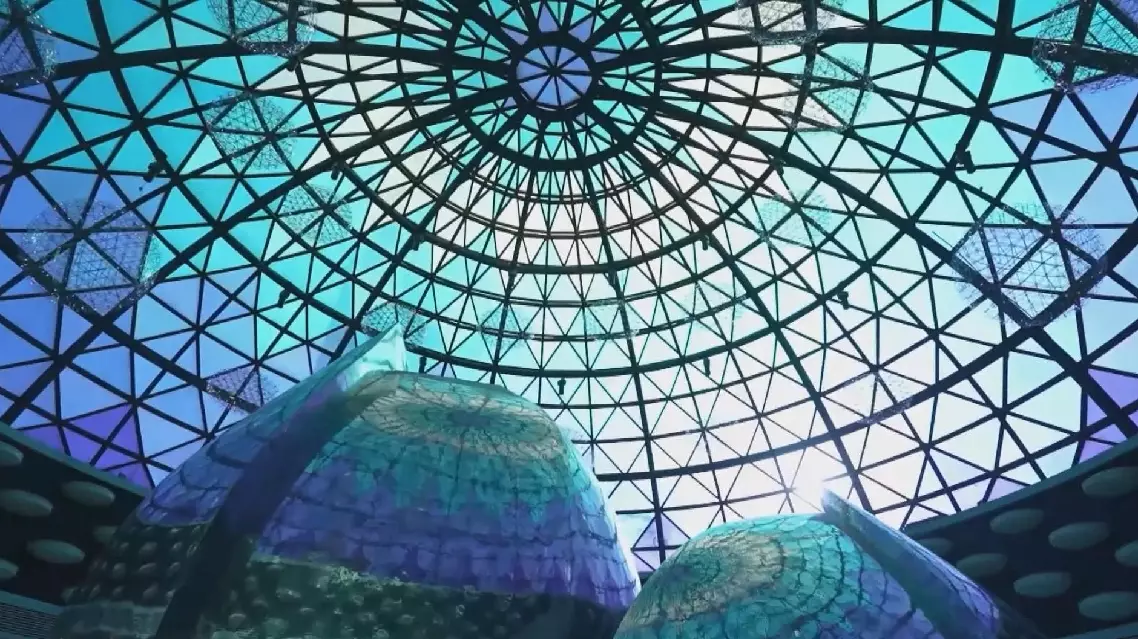
Stunning subway stations across China draw admirers to appreciate architectural charms