Chinese architect Liu Jiakun, who won the 2025 Pritzker Architecture Prize in early March, shared his thoughts on the people-centered design philosophy he has followed and put into practice, as well as the life lessons he has learned over his decades-long career.
Liu, from Chengdu City in southwestern China, is the second Chinese architect to win the prize which is regarded internationally as architecture's highest honor, following Wang Shu.
The West Village Basis Yard, located in the Qingyang District of Chengdu, is one of Liu's signature works.
It is a maxi-courtyard that adopts an atypical design when compared to other commercial complexes in that its centrifugal layout encircles the entire block to maximize the inner area of sports and green like a park, echoing the form of a basin and encompassing a diverse public life. Smaller bamboo courtyards exist within bigger ones. They are open to the public and visitors are welcome to walk through freely.
Aligned with Liu's architectural idea that prioritizes the needs and comfort of ordinary people, the West Village Basis Yard has become a unique urban "utopia" for local residents. It offers a peaceful environment where people of all ages and professions can enjoy leisure and find happiness amidst the hustle and bustle of city life.
"Architecture is created to meet people's needs. When I designed this building, I asked myself, 'What is its ultimate purpose?' It's because people need it. Throughout the design process, I thought a lot and I knew that my approach didn't follow typical commercial practices. We didn't calculate for profit when building it. People can play basketball here, though they may need to pay a bit of money renting a court. They can also run or simply relax here. If people love the place, everything will naturally come together," said Liu.
Over the course of his more than 40-year career, Liu has gradually brought to life the idea that architecture should be designed to serve and benefit people.
In 1984, while Liu was working at the Chengdu Architectural Design and Research Institute, he participated in an infrastructure project in Nagqu, in southwest China's Xizang Autonomous Region.
During the design process, Liu envisioned creating an entertainment space for locals with facilities like a fitness room and dance room. However, he failed to consider the actual needs of the local herders, and as a result, the project ended up only serving as a shelter for the herders' livestock. This experience taught Liu that architecture must be designed with consideration for local contexts.
"You need to understand the local people's way of life, their behaviors, and their mindsets. This was a great inspiration for me," said Liu.
Liu believes his journey into architecture came about almost by accident. As a young man, he was mainly interested in literature, not architecture. But after visiting an exhibition about architecture, his perspective shifted, and his true passion for the field was aroused.
"After the exhibition, I felt like my perception had been opened. I started noticing things like the rural houses I could see through the train window. Things I would had completely overlooked before seemed so interesting. It was a kind of indescribable feeling. Many people have asked me about it, and eventually, I realized that life finds its own way," Liu said.
Now, Liu runs his own architectural design company in his hometown Chengdu, with more than 20 employees, most of whom are young people.
Although using computers to create design drafts has become so common today, Liu takes a traditional approach of creating physical models of his projects, which, in his mind, offers a hands-on, tangible and more real understanding of space and design.
"The design drafts on computer screen are flat, which means that you can only see virtual three-dimensional aspects presented on a flat screen. However, physical models exist in the same three-dimensional space as I do. Without physical models, I lose certain perspectives. Although others may not notice, I can sense it internally," said the seasoned architect.
Over his four-decade career, Liu has worked on more than 30 projects across China, ranging from academic and cultural institutions to civic spaces, commercial buildings, and urban planning.
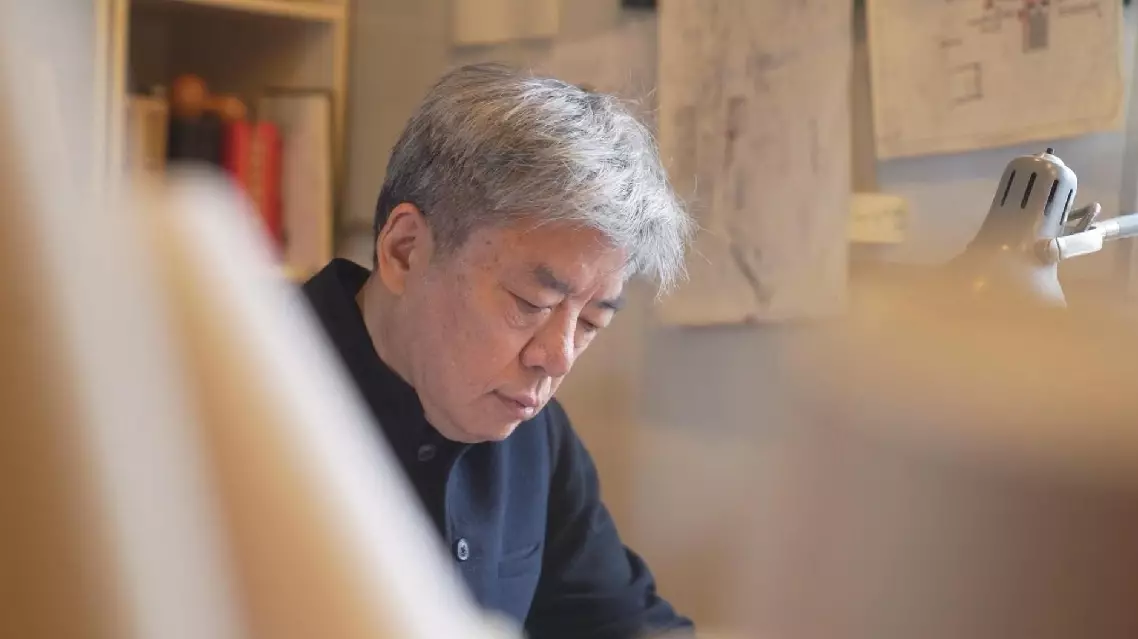
Pritzker Architecture Prize winner Liu Jiakun on people-oriented design philosophy