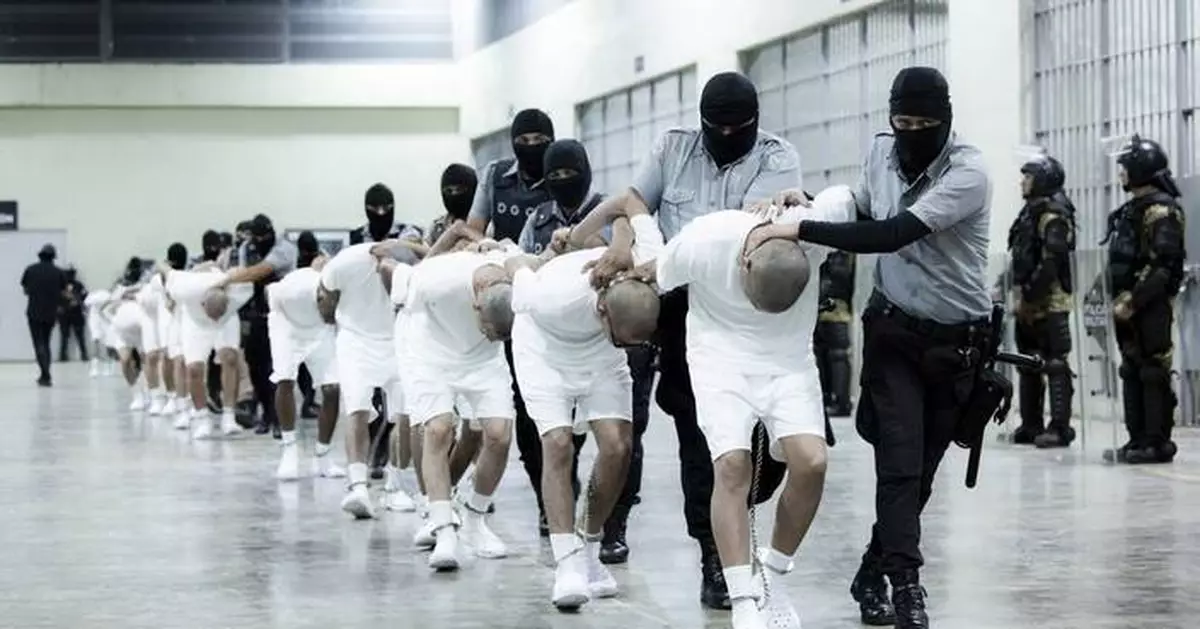
WASHINGTON (AP) — The Trump administration on Monday invoked a “state secrets privilege” and refused to give a federal judge any additional information about the deportation of Venezuelan migrants to El Salvador under an 18th century wartime law — a case that has become a flashpoint amid escalating tension with the federal courts.
The declaration comes as U.S. District Judge James Boasberg weighs whether the government defied his order to turn around planes carrying migrants after he blocked deportations of people alleged to be gang members without due process.
Boasberg, the chief judge of the federal district court in Washington, has asked for details about when the planes landed and who was on board, information that the Trump administration asserts would harm “diplomatic and national security concerns."
Government attorneys also asked an appeals court on Monday to lift Boasberg's order and allow deportations to continue, a push that appeared to divide the judges.
Circuit Court Judge Patricia Millett said Nazis detained in the U.S. during World World II received better legal treatment than Venezuelan immigrants who were were deported to El Salvador this month under the same statute.
“We certainly dispute the Nazi analogy,” Justice Department attorney Drew Ensign responded during a hearing of the U.S. Court of Appeals for the District of Columbia Circuit.
Millett is one of three appellate judges who will decide whether to lift a March 15 order temporarily prohibiting deportations under the Alien Enemies Act of 1798. They didn't rule from the bench Monday.
A second judge appeared open to the administration’s argument that the migrants should be challenging their detention in Texas rather than the nation’s capital. The third judge on the panel didn’t ask any questions.
The administration has transferred hundreds of Venezuelan immigrants to El Salvador, invoking the Alien Enemies Act for the first time since World War II.
Also on Monday, attorneys representing the Venezuelan government filed a legal action in El Salvador to free 238 Venezuelans who are being held in a Salvadoran maximum-security prison after the U.S. deported them.
President Donald Trump's administration appealed after Boasberg blocked those deportations and ordered planeloads of Venezuelan immigrants to return to the U.S. That did not happen.
The Alien Enemies Act allows noncitizens to be deported without the opportunity to go before an immigration or federal court judge. Trump issued a proclamation calling the Tren de Aragua gang an invading force.
Ensign argued that Boasberg’s ruling was an “unprecedented and enormous intrusion upon the powers of the executive branch.”
“The president has to comply with the Constitution and the laws like anyone else,” said MiIlett, who was nominated by Democratic President Barack Obama in 2013.
Judge Justin Walker, whom Trump nominated in 2020, seemed to be more receptive to the administration’s arguments based on his line of questioning. Walker pointed to the government’s arguments that the plaintiffs should have filed their lawsuit in Texas, where the immigrants were detained.
“You could have filed the exact same complaint you filed here in Texas district court,” Walker told American Civil Liberties Union attorney Lee Gelernt.
“We have no idea if everyone is in Texas,” Gelernt said.
Walker also pressed the plaintiffs’ lawyer to cite any prior case in which a judicial order blocking “a national security operation with foreign implications” survived appellate review.
Gelernt accused the administration of trying to use the law to “short circuit” immigration proceedings. Plaintiffs’ attorneys had no way to individually challenge all the deportations before planeloads of Venezuelans took off on March 15, he added.
“This has all been done in secret,” Gelernt said.
Judge Karen LeCraft Henderson, who was nominated by Republican President George H.W. Bush in 1990, was the third judge on the panel. She didn’t ask any questions during a hearing that lasted roughly two hours.
Boasberg, an Obama nominee, ruled that immigrants facing deportation must get an opportunity to challenge their designations as alleged gang members. He said there is “a strong public interest in preventing the mistaken deportation of people based on categories they have no right to challenge.”
“The public also has a significant stake in the Government’s compliance with the law,” the judge wrote.
Trump and his allies have called for impeaching Boasberg. In a rare statement, Supreme Court Chief Justice John Roberts said “impeachment is not an appropriate response to disagreement concerning a judicial decision.”
Just after midnight Monday, Trump posted a social media message questioning Boasberg's impartiality and calling for him to be disbarred.
During a hearing Friday, Boasberg vowed to determine whether the government defied his oral order from the bench to turn planes around. The Justice Department has said that the judge’s oral directions did not count, that only his written order needed to be followed and that it couldn’t apply to flights that had already left the U.S.
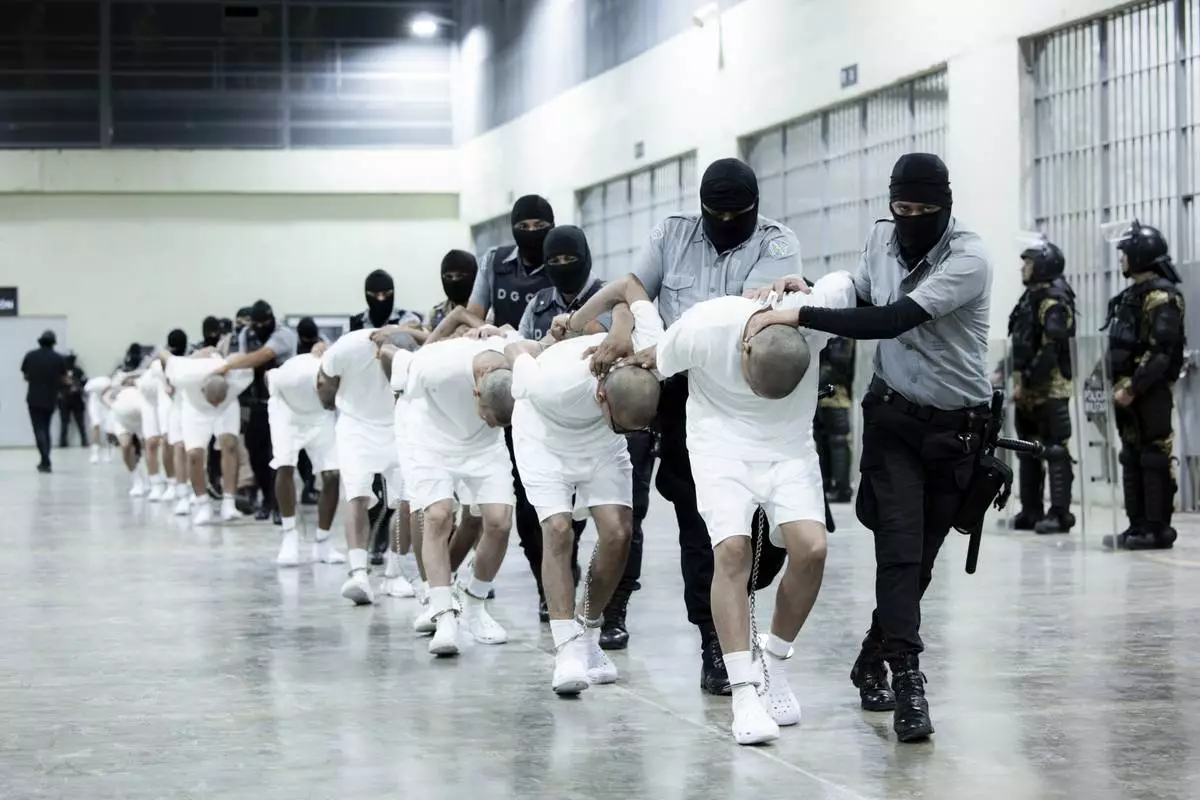
In this photo provided by El Salvador's presidential press office, prison guards transfer deportees from the U.S., alleged to be Venezuelan gang members, to the Terrorism Confinement Center in Tecoluca, El Salvador, Sunday, March 16, 2025. (El Salvador presidential press office via AP)

WASHINGTON (AP) — Becky Pepper-Jackson finished third in the discus throw in West Virginia last year though she was in just her first year of high school. Now a 15-year-old sophomore, Pepper-Jackson is aware that her upcoming season could be her last.
West Virginia has banned transgender girls like Pepper-Jackson from competing in girls and women's sports, and is among the more than two dozen states with similar laws. Though the West Virginia law has been blocked by lower courts, the outcome could be different at the conservative-dominated Supreme Court, which has allowed multiple restrictions on transgender people to be enforced in the past year.
The justices are hearing arguments Tuesday in two cases over whether the sports bans violate the Constitution or the landmark federal law known as Title IX that prohibits sex discrimination in education. The second case comes from Idaho, where college student Lindsay Hecox challenged that state's law.
Decisions are expected by early summer.
President Donald Trump's Republican administration has targeted transgender Americans from the first day of his second term, including ousting transgender people from the military and declaring that gender is immutable and determined at birth.
Pepper-Jackson has become the face of the nationwide battle over the participation of transgender girls in athletics that has played out at both the state and federal levels as Republicans have leveraged the issue as a fight for athletic fairness for women and girls.
“I think it’s something that needs to be done,” Pepper-Jackson said in an interview with The Associated Press that was conducted over Zoom. “It’s something I’m here to do because ... this is important to me. I know it’s important to other people. So, like, I’m here for it.”
She sat alongside her mother, Heather Jackson, on a sofa in their home just outside Bridgeport, a rural West Virginia community about 40 miles southwest of Morgantown, to talk about a legal fight that began when she was a middle schooler who finished near the back of the pack in cross-country races.
Pepper-Jackson has grown into a competitive discus and shot put thrower. In addition to the bronze medal in the discus, she finished eighth among shot putters.
She attributes her success to hard work, practicing at school and in her backyard, and lifting weights. Pepper-Jackson has been taking puberty-blocking medication and has publicly identified as a girl since she was in the third grade, though the Supreme Court's decision in June upholding state bans on gender-affirming medical treatment for minors has forced her to go out of state for care.
Her very improvement as an athlete has been cited as a reason she should not be allowed to compete against girls.
“There are immutable physical and biological characteristic differences between men and women that make men bigger, stronger, and faster than women. And if we allow biological males to play sports against biological females, those differences will erode the ability and the places for women in these sports which we have fought so hard for over the last 50 years,” West Virginia's attorney general, JB McCuskey, said in an AP interview. McCuskey said he is not aware of any other transgender athlete in the state who has competed or is trying to compete in girls or women’s sports.
Despite the small numbers of transgender athletes, the issue has taken on outsize importance. The NCAA and the U.S. Olympic and Paralympic Committees banned transgender women from women's sports after Trump signed an executive order aimed at barring their participation.
The public generally is supportive of the limits. An Associated Press-NORC Center for Public Affairs Research poll conducted in October 2025 found that about 6 in 10 U.S. adults “strongly” or “somewhat” favored requiring transgender children and teenagers to only compete on sports teams that match the sex they were assigned at birth, not the gender they identify with, while about 2 in 10 were “strongly” or “somewhat” opposed and about one-quarter did not have an opinion.
About 2.1 million adults, or 0.8%, and 724,000 people age 13 to 17, or 3.3%, identify as transgender in the U.S., according to the Williams Institute at the UCLA School of Law.
Those allied with the administration on the issue paint it in broader terms than just sports, pointing to state laws, Trump administration policies and court rulings against transgender people.
"I think there are cultural, political, legal headwinds all supporting this notion that it’s just a lie that a man can be a woman," said John Bursch, a lawyer with the conservative Christian law firm Alliance Defending Freedom that has led the legal campaign against transgender people. “And if we want a society that respects women and girls, then we need to come to terms with that truth. And the sooner that we do that, the better it will be for women everywhere, whether that be in high school sports teams, high school locker rooms and showers, abused women’s shelters, women’s prisons.”
But Heather Jackson offered different terms to describe the effort to keep her daughter off West Virginia's playing fields.
“Hatred. It’s nothing but hatred,” she said. "This community is the community du jour. We have a long history of isolating marginalized parts of the community.”
Pepper-Jackson has seen some of the uglier side of the debate on display, including when a competitor wore a T-shirt at the championship meet that said, “Men Don't Belong in Women's Sports.”
“I wish these people would educate themselves. Just so they would know that I’m just there to have a good time. That’s it. But it just, it hurts sometimes, like, it gets to me sometimes, but I try to brush it off,” she said.
One schoolmate, identified as A.C. in court papers, said Pepper-Jackson has herself used graphic language in sexually bullying her teammates.
Asked whether she said any of what is alleged, Pepper-Jackson said, “I did not. And the school ruled that there was no evidence to prove that it was true.”
The legal fight will turn on whether the Constitution's equal protection clause or the Title IX anti-discrimination law protects transgender people.
The court ruled in 2020 that workplace discrimination against transgender people is sex discrimination, but refused to extend the logic of that decision to the case over health care for transgender minors.
The court has been deluged by dueling legal briefs from Republican- and Democratic-led states, members of Congress, athletes, doctors, scientists and scholars.
The outcome also could influence separate legal efforts seeking to bar transgender athletes in states that have continued to allow them to compete.
If Pepper-Jackson is forced to stop competing, she said she will still be able to lift weights and continue playing trumpet in the school concert and jazz bands.
“It will hurt a lot, and I know it will, but that’s what I’ll have to do,” she said.
Heather Jackson, left, and Becky Pepper-Jackson pose for a photograph outside of the U.S. Supreme Court in Washington, Sunday, Jan. 11, 2026. (AP Photo/Jose Luis Magana)
Becky Pepper-Jackson poses for a photograph outside of the U.S. Supreme Court in Washington, Sunday, Jan. 11, 2026. (AP Photo/Jose Luis Magana)
The Supreme Court stands is Washington, Friday, Jan. 9, 2026. (AP Photo/J. Scott Applewhite)
FILE - Protestors hold signs during a rally at the state capitol in Charleston, W.Va., on March 9, 2023. (AP Photo/Chris Jackson, file)