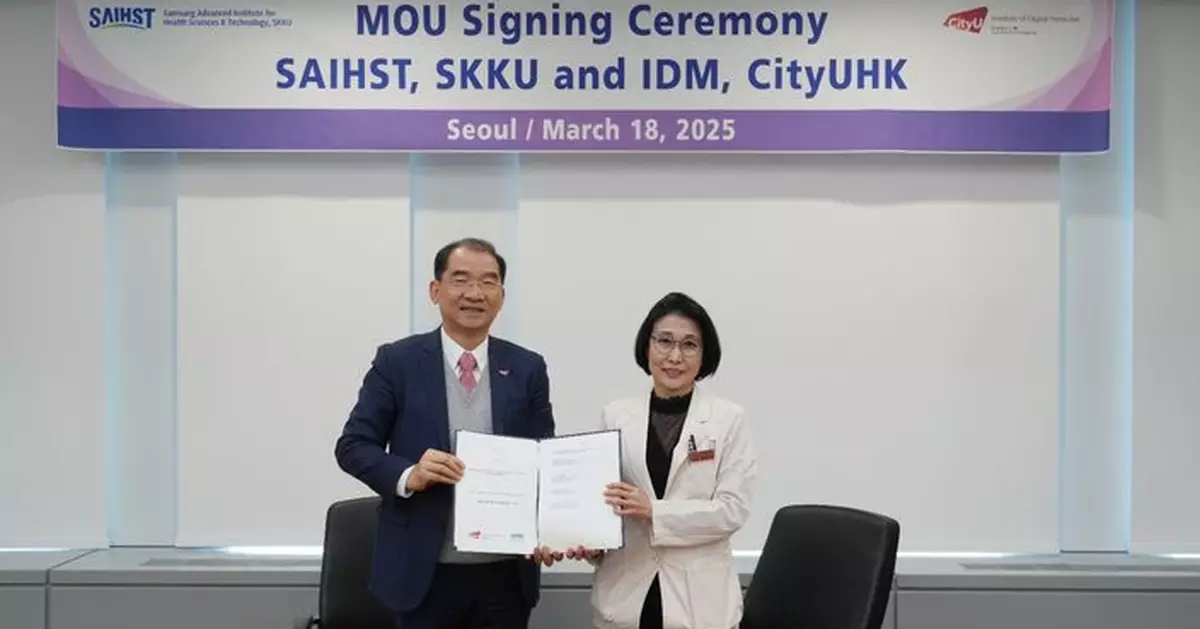
The Institute of Digital Medicine (IDM) of City University of Hong Kong (CityUHK) andthe Samsung Advanced Institute for Health Sciences & Technology (SAIHST), in Korea,signed a Memorandum of Understanding (MoU) in Seoul on 18 March 2025. It aims to establish collaboration on health-related research, particularly in cell and gene therapy,bioinformatics and biomedical engineering, as well as talent development and commercialising digital health solutions to benefit society.
The MoU was signed by Professor Michael Yang Mengsu, Senior Vice-President (Innovation and Enterprise) at CityUHK, and Professor Chang Yun Sil, Director of SAIHST.
SAIHST is a leading institute, jointly established by industry – Samsung Group, a hospital – Samsung Medical Center and academia –Sungkyunkwan University (SKKU) to advance research and develop professional experts to lead the future of biomedical sciences.SAIHST is Korea’s first graduate school of interdisciplinary convergence medical science to conduct healthcare-focused research and education. The institute partnered with universities and research institutes in more than 10 countries, such as the Unite States,Canada, the United Kingdom, France, and partnership with domestic and global pharmaceutical companies, large corporations and biotech firms.
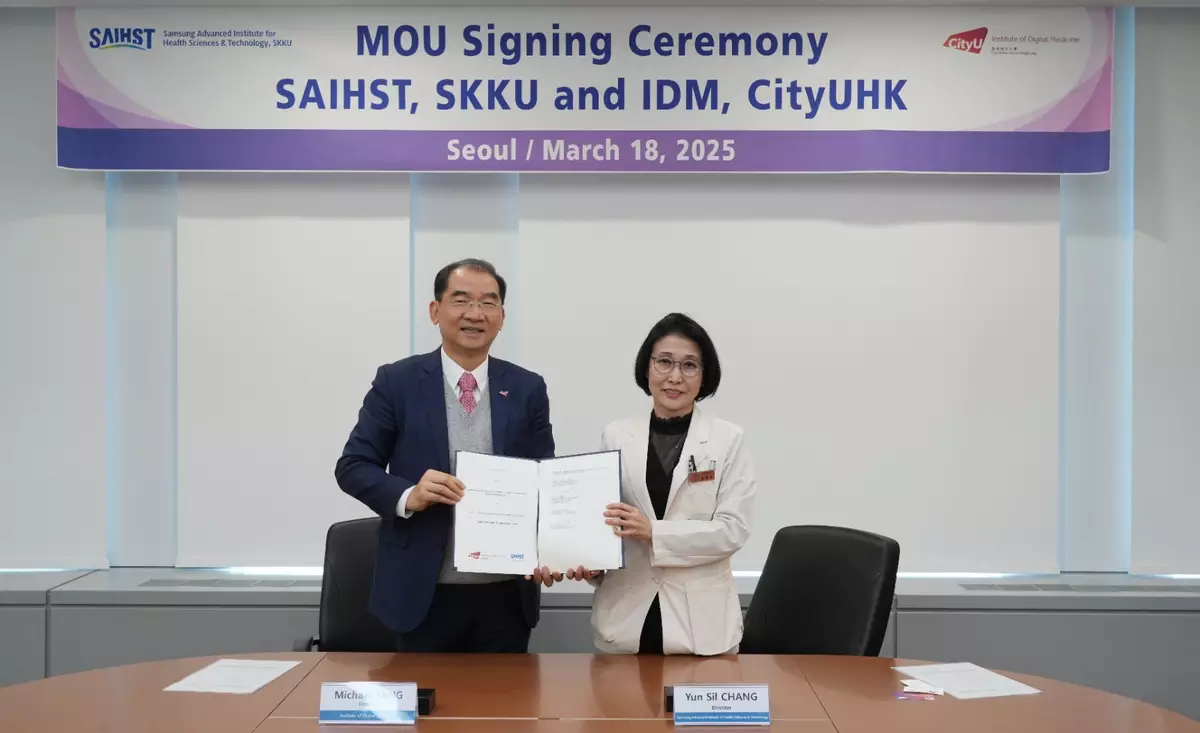
Caption: The MoU is signed by Professor Michael Yang Meng-su, Senior Vice-President(Innovation and Enterprise) (left) of City University of Hong Kong, and Professor Chang Yun Sil, Director of SAIHST in Seoul, Korea. (Credit: City University of Hong Kong)
IDM was established in April 2024. In collaboration with renowned universities and medical schools around the world, as well as clinical and industry partners and health tech investors, IDM utilises CityUHK’s research strengths in engineering, data science and life science to develop innovative technologies to explore digital health solutions, for the long-term benefit of doctors and patients.
“Global collaboration is crucial for the development of digital medicine,” said Professor Freddy Boey, President of CityUHK. “The partnership between IDM and SAIHST marks a significant milestone in advancing health technology innovation. With CityUHK’s dynamic innovation and entrepreneurial ecosystem, I am confident that our joint efforts will empower our future leaders on the global stage and create a positive impact on Hong Kong, Korea,and beyond.”
IDM and SAIHST will establish talent-nurturing collaboration with an international perspective. SAIHST will support eligible top-tier researchers and scientists by facilitating their visits to Hong Kong, participating in programmes offered by the CityUHK Academy of Innovation, and providing internship opportunities for CityUHK students.
The two parties will strengthen their partnership in health-related innovations through CityUHK’s HK Tech 300 programme, jointly transforming innovative ideas into practical applications and promoting the development of deep-tech start-ups.
Following the signing ceremony, the CityUHK IDM delegation held discussions with
professors from four SAIHST departments: Health Sciences and Technology, Digital Health, Medical Device Management and Research, and Clinical Research Design and Evaluation, and shared the development of CityUHK IDM.
City University of Hong Kong (CityUHK) and National Facility for Translational Medicine (Shanghai) established the “National Center for Translational Medicine (Shanghai) Greater Bay Area Branch Center” (the “GBA Branch Center”) with a plaque unveiling ceremony held on 16 July. The Center aims to extend the national facility’s technologies and industrial resources to the GBA, promoting the real-world application of digital medicine across the region, while advancing the research, talent incubation, and the industrialisation of healthcare innovations in both Shanghai and Hong Kong.
Witnessed by Ms Lillian Cheong, Acting Secretary for Innovation, Technology and Industry; Professor Chun-sing Lee, CityUHK Acting President; Professor Ruan Yongbin, Academician of the Chinese Academy of Sciences; Ms Lu Wen, Vice-President of Shanghai State-owned Capital Investment Co.,Ltd.; the ceremony was officiated by Professor Michael Yang Mengsu, CityUHK Senior Vice-President (Innovation and Enterprise), and Professor Fan Chunhai, Executive Director of the Institute of Translational Medicine of Shanghai Jiao Tong University (SJTU) and Academician of the Chinese Academy of Sciences.
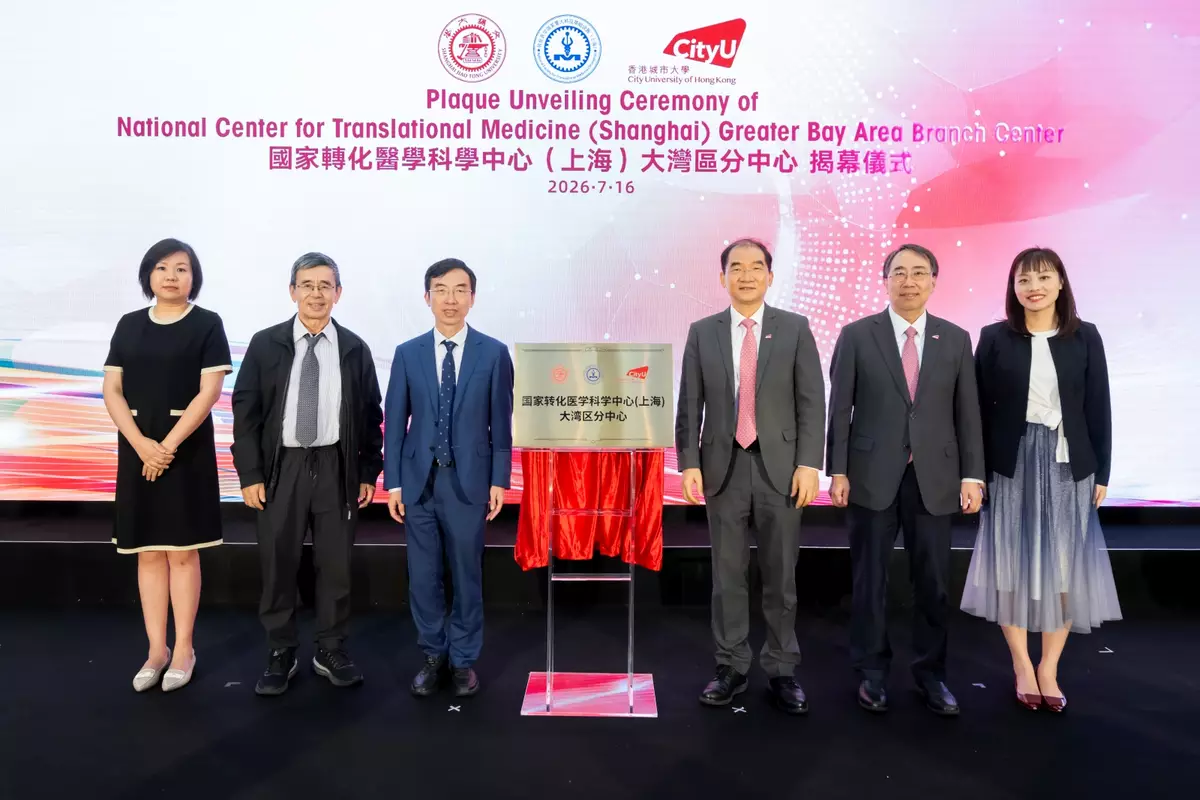
The plaque unveiling ceremony on 16 July was witnessed by Ms Lillian Cheong, Acting Secretary for Innovation, Technology and Industry (1st from right); Professor Chun-sing Lee,CityUHK Acting President (2nd from right); Professor Ruan Yongbin, Academician of the Chinese Academy of Sciences (2nd from left); Ms Lu Wen, Vice-President of Shanghai State owned Capital Investment Co.Ltd. (1st from left); the ceremony was officiated by Professor Fan Chunhai, Executive Director of the Institute of Translational Medicine of Shanghai Jiao Tong University and Academician of the Chinese Academy of Sciences (3rd from left), and Professor Michael Yang Mengsu, CityUHK Senior Vice-President (Innovation and Enterprise) (3rd from right).Credit: City University of Hong Kong
The National Facility for Translational Medicine (Shanghai), one of the five key national facilities for Translational Medicine, is hosted by Shanghai Jiao Tong University. The facility focuses on translational research in oncology, metabolic, cardiovascular and cerebrovascular diseases. It also supports efficacy validation for drugs, diagnostics reagents and biomaterials, as well as the application of innovative technologies in advanced medical devices.
The GBA Branch Center will bring the national facility’s technologies, resources and expertise to the Greater Bay Area, supporting R&D, clinical validation, and industry translation. It will accelerate the development of innovative drugs, novel therapies and advanced medical devices. Leveraging CityUHK’s strengths, HK Tech 300’s global innovation and entrepreneurship ecosystem, and Hong Kong’s international connectivity, together with the Chinese Mainland’s industrial and clinical resources, the Center will further strengthen the GBA’s role as a leading global hub for life and health technology.
Professor Fan noted that both SJTU and CityUHK possess unique strengths in translational medicine. “SJTU's extensive clinical resources provide strong support for translational research at the interface of medicine and engineering. The establishment of the GBA Branch Center will integrate the clinical resources of both cities, connect the innovation ecosystems of the Yangtze River Delta and the GBA, and further advance the national innovation-driven development strategy,” he said.
Professor Yang said that since the establishment of the IDM in 2024, CityUHK has continued to foster cross-disciplinary, cross-industry and cross-regional collaboration in life and health technologies, while expanding its research, talent and industry networks. “CityUHK's partnership with the National Facility for Translational Medicine marks a significant milestone in aligning with the National 15th Five-Year Plan. This collaboration will drive innovation in life and health sciences, accelerate the translation of innovative healthcare technologies into real-world applications, and contribute to the long-term well-being of society,” he added.