TEL AVIV, Israel (AP) — Israel’s parliament on Tuesday passed a state budget, a move that shores up Prime Minister Benjamin Netanyahu’s governing coalition even as the embattled leader faces mounting public pressure over the war in Gaza and the hostage crisis.
The budget vote was seen as a key test for Netanyahu’s coalition, which is made up of ultranationalist and ultra-Orthodox parties that had demanded and largely received hefty allocations for their constituents in exchange for supporting the funding package.
Click to Gallery

Police officers remove people as they block a road for the Israeli parliament during an anti-government protest after the Israeli cabinet passed a no-confidence vote against the country's attorney general, taking a first step toward her dismissal, in Jerusalem, Tuesday, March 25, 2025. (AP Photo/Ohad Zwigenberg)

Israeli servicemen remove people as they block a road for the Israeli parliament during an anti-government protest after the Israeli cabinet passed a no-confidence vote against the country's attorney general, taking a first step toward her dismissal, in Jerusalem, Tuesday, March 25, 2025. (AP Photo/Ohad Zwigenberg)

Israeli police officers disperse demonstrators as they block a road leading to the Israeli parliament during an anti-government protest ahead of a key vote on the state budget in Jerusalem, Tuesday, March 25, 2025. (AP Photo/Ohad Zwigenberg)

Israeli police officers disperse demonstrators as they block a road leading to the Israeli parliament during an anti-government protest ahead of a key vote on the state budget in Jerusalem, Tuesday, March 25, 2025. (AP Photo/Ohad Zwigenberg)

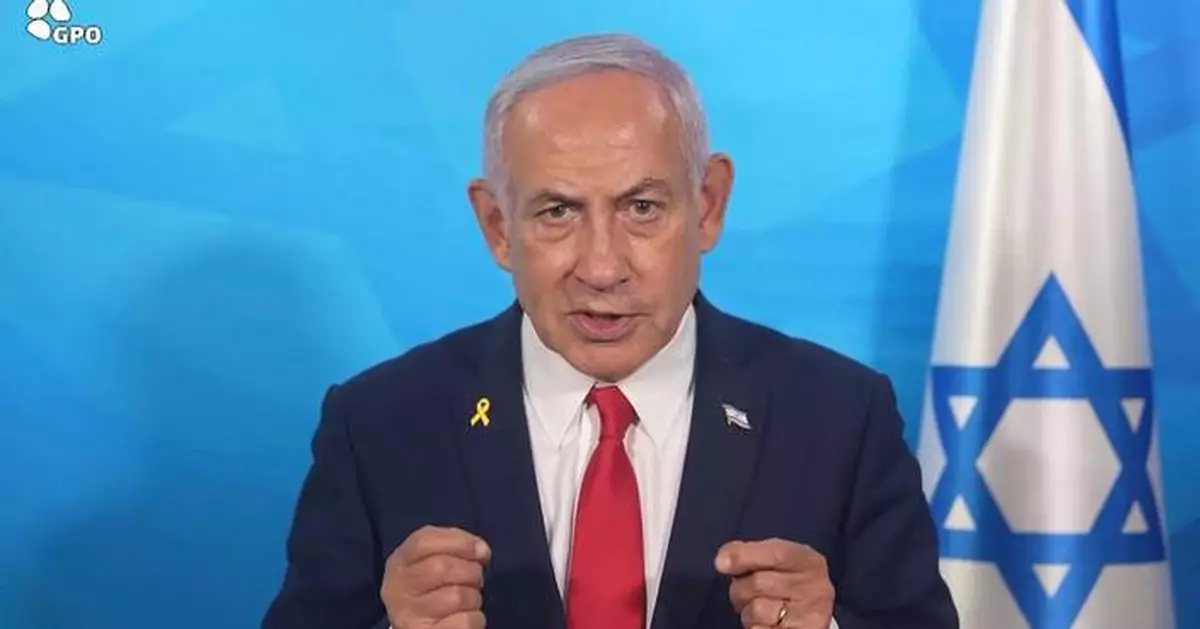
In this image made from a video released by the Israeli Government Press Office, Prime Minister Benjamin Netanyahu gives a statement Tuesday, March 18, 2025, in Tel Aviv, Israel. (Israeli Government Press Office via AP)
Failure to pass a budget by March 31 would have triggered early elections, potentially threatening Netanyahu's nearly unbroken 15-year rule.
Critics say the budget lacks much needed wartime funding for secular education, health and welfare. They accuse Netanyahu of channeling funding to his political allies to ensure his survival rather than thinking of the country’s best interests.
“The greatest theft in the country’s history officially begins,” opposition leader Yair Lapid said Monday, ahead of an hours-long, marathon debate in parliament on the budget. He said the middle class, including many reservists who have been fighting in Gaza, was being trampled for the sake of the coalition’s survival.
Israel's far-right Finance Minister Bezalel Smotrich, a key Netanyahu ally, said the budget had “everything needed to win on the front and at home.”
With its passing, Netanyahu's government is more likely to survive to the end of its term in October 2026, a rarity in Israel's fractious politics. It’s a political win for Netanyahu, who faces mass protests over his decision to resume the war in Gaza while hostages are still held by Hamas, and over his government’s recent moves to fire top legal and security chiefs.
In theory, Netanyahu now has more freedom to negotiate a lasting ceasefire with Hamas in the Gaza Strip. His allies, who want to continue the war, have little incentive to trigger new elections while their polling numbers are down, said Gayil Talshir, a political scientist at the Hebrew University of Jerusalem.
But she expects Netanyahu to stick with his coalition partners and further their ultranationalist agenda to galvanize the right ahead of any future vote.
“Netanyahu is always thinking about the next elections,” Talshir said. “His goal is to make sure the extreme right will be in his government now and in the future.”
Netanyahu, who is on trial for alleged corruption, faces mass protests in Israel over his return to war, with 59 captives, 24 of whom are said to be alive, still in Gaza.
Demonstrators are also angry over Netanyahu’s firing of the head of the internal Shin Bet security agency and his government’s push to fire the attorney general. Both moves are seen by opponents as part of the government’s attempt to undermine state institutions and as part of Netanyahu’s crusade against a “deep state” that he says is out to get him.
Ahead of the budget vote, anti-government protests erupted outside the Knesset and police scuffled with demonstrators who blocked the entrances to the parliament.
Follow AP’s war coverage at https://apnews.com/hub/israel-hamas-war

Police officers remove people as they block a road for the Israeli parliament during an anti-government protest after the Israeli cabinet passed a no-confidence vote against the country's attorney general, taking a first step toward her dismissal, in Jerusalem, Tuesday, March 25, 2025. (AP Photo/Ohad Zwigenberg)

Israeli servicemen remove people as they block a road for the Israeli parliament during an anti-government protest after the Israeli cabinet passed a no-confidence vote against the country's attorney general, taking a first step toward her dismissal, in Jerusalem, Tuesday, March 25, 2025. (AP Photo/Ohad Zwigenberg)

Israeli police officers disperse demonstrators as they block a road leading to the Israeli parliament during an anti-government protest ahead of a key vote on the state budget in Jerusalem, Tuesday, March 25, 2025. (AP Photo/Ohad Zwigenberg)

Israeli police officers disperse demonstrators as they block a road leading to the Israeli parliament during an anti-government protest ahead of a key vote on the state budget in Jerusalem, Tuesday, March 25, 2025. (AP Photo/Ohad Zwigenberg)

In this image made from a video released by the Israeli Government Press Office, Prime Minister Benjamin Netanyahu gives a statement Tuesday, March 18, 2025, in Tel Aviv, Israel. (Israeli Government Press Office via AP)