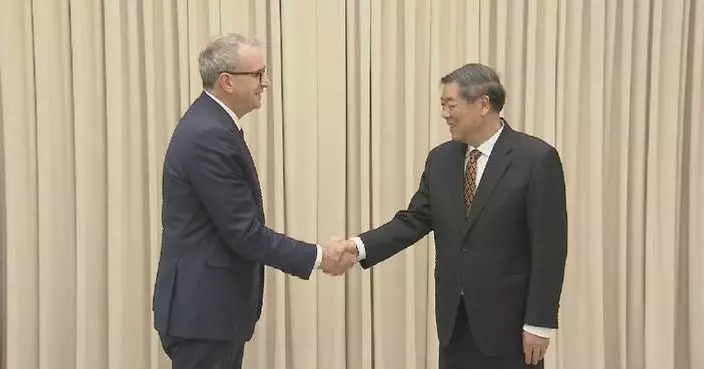
CEO of Germany's industrial and technology giant ThyssenKrupp has said the company is committed to expanding investments in China, highlighting confidence in the country's manufacturing sector.
In an exclusive interview with CGTN on the sidelines of the just-concluded China Development Forum, Miguel Angel Lopez Borrego, the CEO, praised China's manufacturing advancements, and highlighted the conglomerate's investment of 1 billion yuan (about 137.8 million U.S. dollars) in China.
"I show the movies from our Chinese factories to our colleagues in other parts of the world. Because of the high level of automation, the high level of standardization, the high level of robotization,so this development in China for the last five, six, seven years has been outstanding in terms of introduction of technology to manufacturing places. Of course, we are adding manufacturing capacity, as we speak, every year. We have been investing for the last years, one billion yuan in manufacturing capacities in China. And we will continue to do so," said the CEO.
In the automobile sector, the company had made an annual investment of over 100 million yuan over the past three years as of 2024.
As for wind power, ThyssenKrupp has been accelerating the implementation of projects, investing about three billion yuan since more than a decade ago. In July 2023, a production line dedicated to manufacturing bearing products for large-megawatt wind turbines was put into operation, doubling production capacity.
In 2023, Thyssenkrupp signed agreements with a number of China's centrally administered state-owned enterprises, to promote cooperation between the upstream and downstream of the hydrogen energy industrial chain.
Apart from investment in China, Borrego addressed the broader economic relationship between Germany and China, emphasizing the potential for continued collaboration between the two countries.
"I expect, on the base of what you just mentioned,of this really impressive high-tech development here in China, where we can combine with all the knowledge that we have in Europe, specifically in Germany, on many different technology areas that we can expand on this path together in the future. European and German companies are very much invested in China. More and more Chinese companies are also coming to Europe investing in Europe as well, so that the relationship, I think, will be even more strengthened," Borrego said.
On the topic of tariffs, Borrego acknowledged the challenges that tariffs have posed to multinational corporations and noted that there should be a solution for relevant parties with win-win results.
"We of course want to make sure that in China we are producing with the Chinese supply chain, our Chinese customers. And that's the reason why in these areas where you have local for local businesses, tariffs are not playing a fundamental role. There are other areas where tariffs will play a role. I see personally that as very critical, because it increases pricing, it may also drive inflation. So, I believe we should come to solutions where both parties can be in a win-win instead of a lose-lose situation," said Borrego.
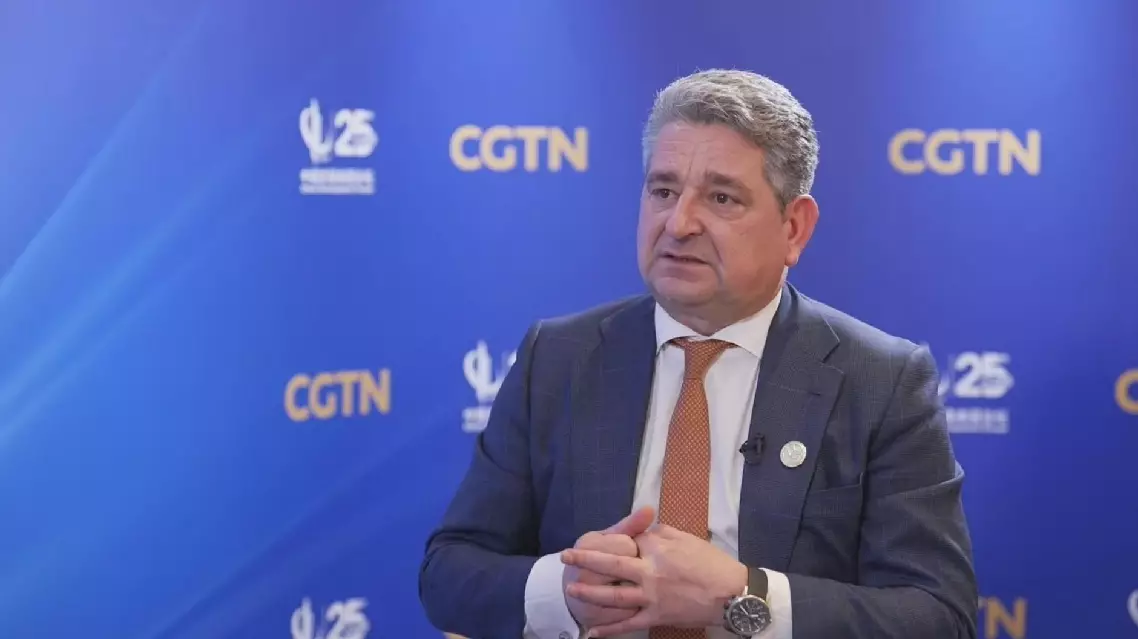
German industrial giant ThyssenKrupp looks to expand investment in China