U.S. President Donald Trump's latest round of tariffs, which has sent jitters around the world, is threatening economic growth in Africa.
While most nations face a minimum tax of 10 percent to do business with the U.S., many others, including 20 African countries, have been penalized with reciprocal tariffs for running large trade deficits with the U.S.
Lesotho was hardest hit, fetching the highest rate of 50 percent, while goods from other African countries could cost the American consumer between 30 and 47 percent more.
The move has been met with astonishment across much of Africa.
"This is a fundamentally nonsensical, counter-historic step. It's a defensive one. If you want, the previous hegemon who created a free trade world order saying, this is not working for us, so we're going to de-leverage, if you want. We're going to shut down and we're going to re-industrialize. The fact of the matter is that that's not likely to happen, the cost will be much, much higher than the benefit," said Claude de Baissac, founder and CEO of Eunomix, an advisory firm that focuses on investment in Africa.
The harsh measures effectively nullify the protection of the African Growth and Opportunity Act (AGOA), a trade program that allows eligible sub-Saharan African countries to export hundreds of products to the U.S. duty-free since its establishment in the year 2000.
AGOA has underpinned growth in high-value products such as vehicles, agricultural produce and textiles.
Losing the agreement will have catastrophic consequences for countries that have come to depend on it.
"It will be detrimental to employment opportunities and whatever effects in the economy. But even in the long term, if the value and supply chains leave your economy, it takes more than just the labor away. It also takes innovation and technology and all the other factors that come with it. It's also being determinedly impacted," said Piet Croucamp, an associate professor with North-West University's Business School in South Africa.
However, AGOA isn't completely off the table just yet, as African leaders are confident they will be able to still strike a deal.
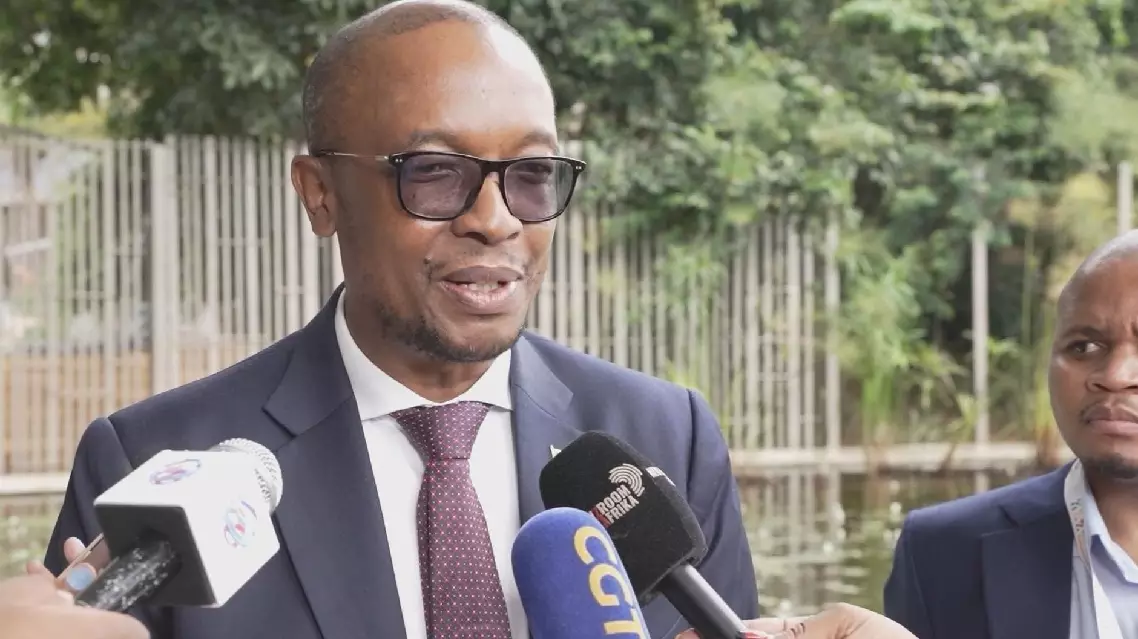
"The trade ministers are meeting sometime this month in the DRC at which AGOA would be on our agenda and the intention would be that we would also be able to formulate an approach collectively as we go and engage on AGOA," said Mpho Parks Tau, South African Minister of Trade, Industry and Competition.
AGOA comes up for renewal in September but there is no telling on whether it will last till then.
In the absence of the agreement, many African countries that already battle high debt rates may not be able to compete in the U.S. market, which could be a huge setback to trade and economic growth.
Africa's trade with US hangs in doubt with new round of tariffs
International guests who have dedicated their lives to historical truth joined China's 12th national memorial event honoring the hundreds of thousands of victims killed by Japanese troops in the Nanjing Massacre during World War II.
The memorial was held on Saturday at the public square of the Memorial Hall of the Victims in Nanjing Massacre by Japanese Invaders in Nanjing, capital of east China's Jiangsu Province. China's national flag was flown at half-mast in the presence the crowd that included survivors of the massacre, local students, and international guests.
In one of the most barbaric episodes during WWII, the Nanjing Massacre took place when Japanese troops captured the then-Chinese capital Nanjing on Dec 13, 1937. Over the course of six weeks, they proceeded to kill approximately 300,000 Chinese civilians and unarmed soldiers.
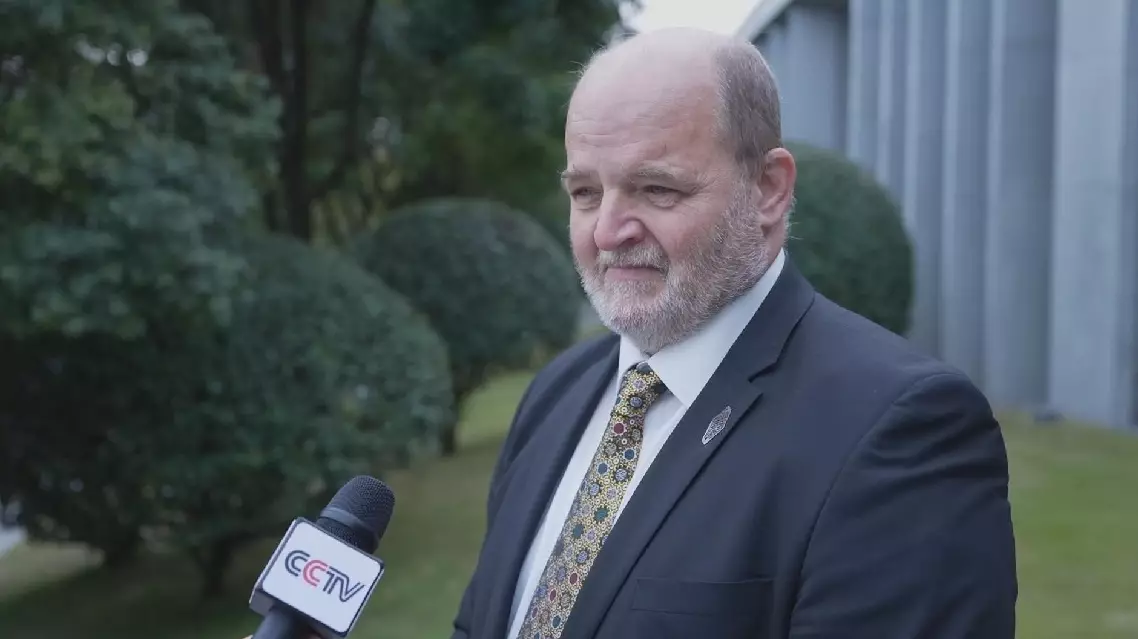
Joining the crowd was Christoph Reinhardt, the great-grandson of John Rabe (1882-1950) who was then a representative of German conglomerate Siemens in the war-ravaged Nanjing. During the Nanjing Massacre, Rabe set up an international safety zone with other foreigners, and they together saved the lives of around 250,000 Chinese people between 1937 and 1938 from the Japanese invaders.
Throughout the massacre, Rabe continued to keep a diary. To this day, all his pages remain one of the most comprehensive historical records of the atrocities committed by the Japanese aggressors.
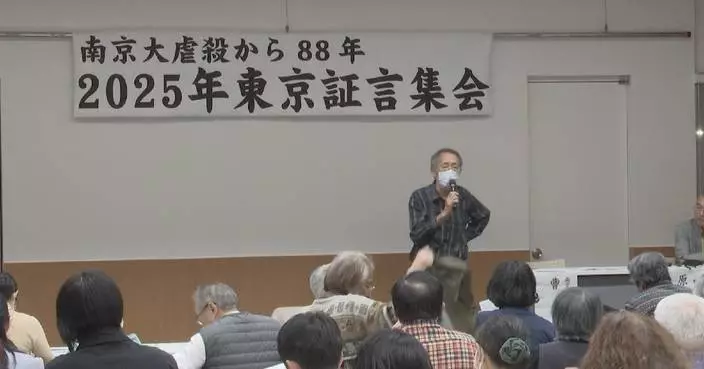
Sayoko Yamauchi, who was also in the crowd of mourners, arrived in Nanjing on Friday from Japan's Osaka to attend Saturday's ceremony, just as she has done almost every year since China designated Dec 13 as the National Memorial Day for the Victims of the Nanjing Massacre in 2014.
Yamauchi's grandfather was one of the Japanese soldiers who invaded Nanjing in January 1938. However, since first setting foot in Nanjing in 1987, she has dedicated herself to uncovering and spreading the truth about Japan's history of aggression and enlightening the Japanese public about their country's wartime atrocities.
In 2014, ahead of China's first National Memorial Day for the Victims of the Nanjing Massacre, Yamauchi, along with 10 other individuals, received an award for her special contribution to the Memorial Hall of the Victims in the Nanjing Massacre by Japanese Invaders.
By attending the grand memorial event, Reinhardt and Yamauchi both said they hope to convey a message of remembering history and cherishing peace.
"This is my fifth visit to China, and Nanjing, and the third times I visited the ceremony. I have a wish that these survivors survive again and again and again. But my other wish is that the families of the survivors, that they transport the information, the right intention like their ancestors, because anyone must hold a hand (during) this remembering," Reinhardt told China Central Television (CCTV) in an interview before the event began on Saturday.
"Our delegation is on its 20th visit to China, coming to Nanjing to express our heartfelt condolences to those who perished 88 years ago, to remember this history, and to reflect on what we can do for a new future. That's why we are here," Yamauchi told CCTV on board the bus that took her to a local hotel in Nanjing on Friday evening.
Int'l guests call for remembering history at China's national event honoring Nanjing Massacre victims