UNITED NATIONS (AP) — The Israeli military backtracked on its account of the killing of 15 Palestinian medics by its forces last month after phone video appeared to contradict its claims that their vehicles did not have emergency signals on when troops opened fire on them in the Gaza Strip.
The military initially said it opened fire because the vehicles were “advancing suspiciously” on nearby troops without headlights or emergency signals. An Israeli military official, speaking late Saturday on condition of anonymity in line with regulations, said that account was “mistaken.”
The footage shows the Red Crescent and Civil Defense teams driving slowly with their emergency vehicles’ lights flashing, logos visible, as they pulled up to help an ambulance that had come under fire earlier. The teams do not appear to be acting unusually or in a threatening manner as three medics emerge and head toward the stricken ambulance.
Their vehicles immediately come under a barrage of gunfire, which goes on for more than five minutes with brief pauses. The owner of the phone can be heard praying.
“Forgive me, mother. This is the path I chose, mother, to help people,” he cries, his voice weak.
Eight Red Crescent personnel, six Civil Defense workers and a U.N. staffer were killed in the shooting before dawn on March 23 by Israeli troops conducting operations in Tel al-Sultan, a district of the southern Gaza city of Rafah. Troops then bulldozed over the bodies along with their mangled vehicles, burying them in a mass grave. U.N. and rescue workers were only able to reach the site a week later to dig out the bodies.
The Palestinian Red Crescent Society's vice president, Marwan Jilani, said the phone with the footage was found in the pocket of one of its slain staffers. The Palestinian ambassador to the United Nations distributed the video to the U.N. Security Council. The Associated Press obtained the video from a U.N. diplomat on condition of anonymity because it has not been made public.
One paramedic who survived, Munzer Abed, confirmed the veracity of the video to the AP. Two block-shaped concrete structures visible in the video are also seen in a U.N. video released Sunday showing the recovery of the bodies from the site — a sign they are in the same location.
Asked about the video, the Israeli military said Saturday that the incident was “under thorough examination.”
The head of the Palestinian Red Crescent Society, Younes Al-Khatib, called for an independent investigation. "We don’t trust any of the army investigations,” he told a briefing at the U.N. on Friday.
One medic, Assaad al-Nassasra, is still missing, the Red Crescent says. Abed said he saw al-Nassasra being led away blindfolded by Israeli troops. Al-Khatib said the organization has asked the military where it is holding the staffer.
Al-Khatib said the slain men had been “targeted at close range” and that a forensic autopsy report would be released soon.
Israel has accused Hamas of moving and hiding its fighters inside ambulances and emergency vehicles, as well as in hospitals and other civilian infrastructure, arguing that justifies strikes on them. Medical personnel largely deny the accusations.
Israeli strikes have killed more than 150 emergency responders from the Red Crescent and Civil Defense, most of them while on duty, as well as over 1,000 health workers, according to the U.N. The Israeli military rarely investigates such incidents.
Ambulances started heading to Tel al-Sultan at around 3:50 a.m. on March 23, responding to reports of wounded, Jilani said. The first ambulance returned safely with at least one casualty, he said. But, he said, subsequent ambulances came under fire.
His hands trembling, Abed told the AP on Saturday that as his ambulance entered the area, its siren lights were on. “All of a sudden, I am telling you, there was direct shooting at us,” so intense that the vehicle ground to a stop, he said.
A 10-year veteran of the Red Crescent, Abed said he was sitting in the back seat and ducked to the floor. He said he could hear nothing from his two colleagues in the front seat — the only others in the vehicle. They appear to have been killed instantly.
Israeli troops, some with night goggles, dragged Abed out of the ambulance and onto the ground, he said. They made him strip to his underwear, beat him all over his body with their rifle butts, then tied his hands behind his back, he said.
They interrogated him, asking him about his paramedic training and how many people were in the ambulance with him, he said. One soldier pressed the muzzle of his automatic rifle into his neck. Another pressed his knife blade into Abed’s palm, almost cutting it, until a third soldier pulled them away and warned Abed, “They’re crazy.”
Abed said he witnessed them opening fire on the next vehicles to arrive. Soldiers forced him onto his stomach and pressed a gun into his back, he said, and amid the shooting in the darkness, so he could only see two Civil Defense vehicles.
The phone video shows a rescue convoy of Red Crescent and Civil Defense vehicles that was sent out after contact was lost with the stricken ambulance. Taken from the dashboard of one vehicle, it shows several ambulances and a fire truck moving down a road through a barren area in the darkness. The emergency lights on their roofs are flashing the entire way.
They arrive at an ambulance on the side of the road and stop next to it, their lights still flashing. No Israeli troops are visible.
“Lord, let them be OK,” a man in the car says. Then he cries out, “They’re tossed around on the ground!” — apparently referring to bodies. Three men in orange Civil Defense clothing can be seen getting out of the vehicles and walking toward the stopped ambulance.
A shot rings out and one of the men appears to fall. Gunfire erupts.
The man holding the phone appears to scramble out of the car and onto the ground, but the screen goes black, though the audio continues. The gunfire goes on for nearly five and a half minutes, with long, heavy barrages followed by silences punctuated by individual shots and shouts and screams.
Throughout, the man with the phone says over and over, “There is no God but God and Muhammad is God’s prophet” — the profession of faith that Muslims say when they fear they are about to die. Near the end of the six-minute, 40-second video, voices can be heard shouting in Hebrew. “The Jews are coming,” the man said, referring to Israeli soldiers, before the video cuts off.
The Israeli military official asserted there was “no mistreatment,” and said he didn’t know why the vehicles had been buried. He had no information about the medic who remained missing.
The Israeli military says that after the shooting, troops determined they had killed a Hamas figure named Mohammed Amin Shobaki and eight other militants. However, none of the 15 slain medics has that name, and no other bodies are known to have been found at the site.
The military has not said what happened to Shobaki's body or released the names of the other alleged militants. The Israeli military official said Israel was “working to bring evidence” that Hamas operatives were killed.
Jonathan Whittall, interim head in Gaza of the U.N. humanitarian office OCHA, dismissed allegations that the slain medics were Hamas militants, saying staff had worked with the same medics previously in evacuating patients from hospitals and other tasks.
“These are paramedic crews that I personally have met before," he said. “They were buried in their uniforms with their gloves on. They were ready to save lives.”
Shurafa reported from Deir al-Balah, Gaza Strip; Keath from Cairo. Associated Press writers Farnoush Amiri at the United Nations, Sarah El Deeb in Cairo, Natalie Melzer in Tel Aviv, Israel, and Areej Hazboun contributed to this report.
Follow AP’s war coverage at https://apnews.com/hub/israel-hamas-war
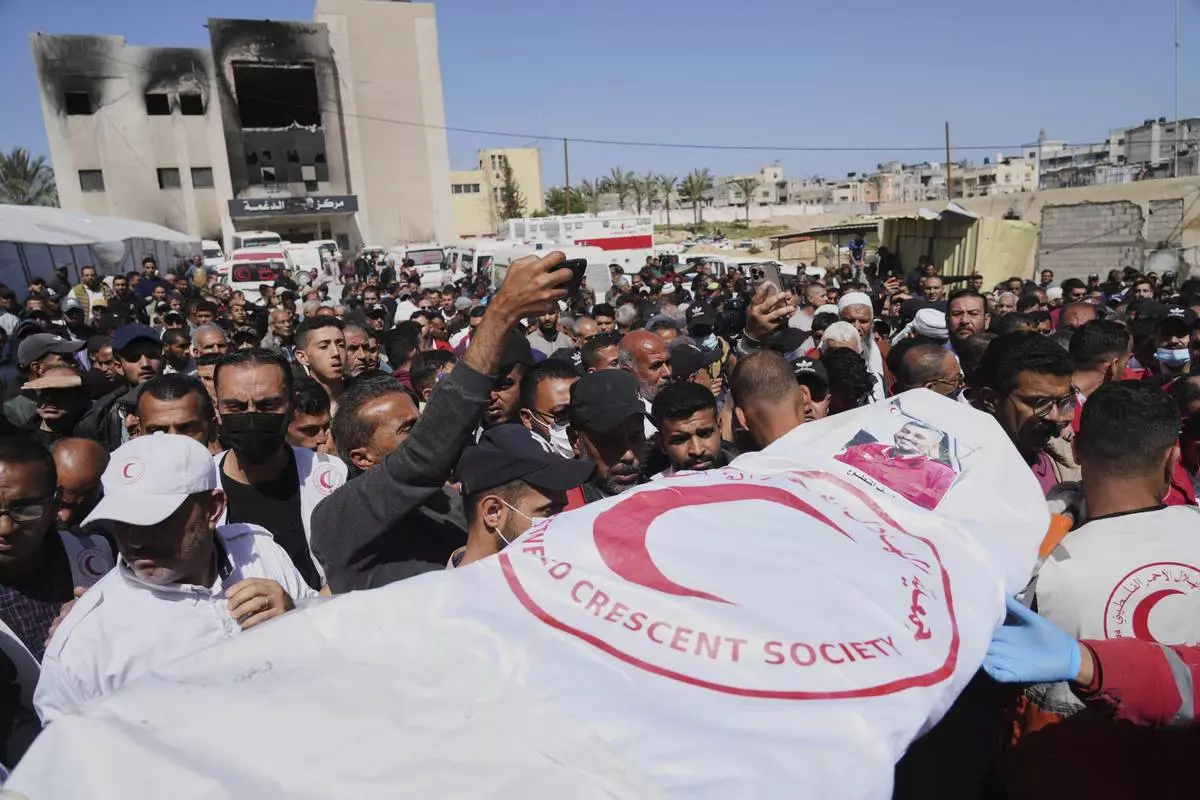
FILE.- Mourners carry the bodies of 8 Red Crescent emergency responders, recovered in Rafah a week after an Israeli attack, as they are transported for burial from a hospital in Deir al-Balah, Gaza Strip, on Monday, March 31, 2025. (AP Photo/Abdel Kareem Hana,File)
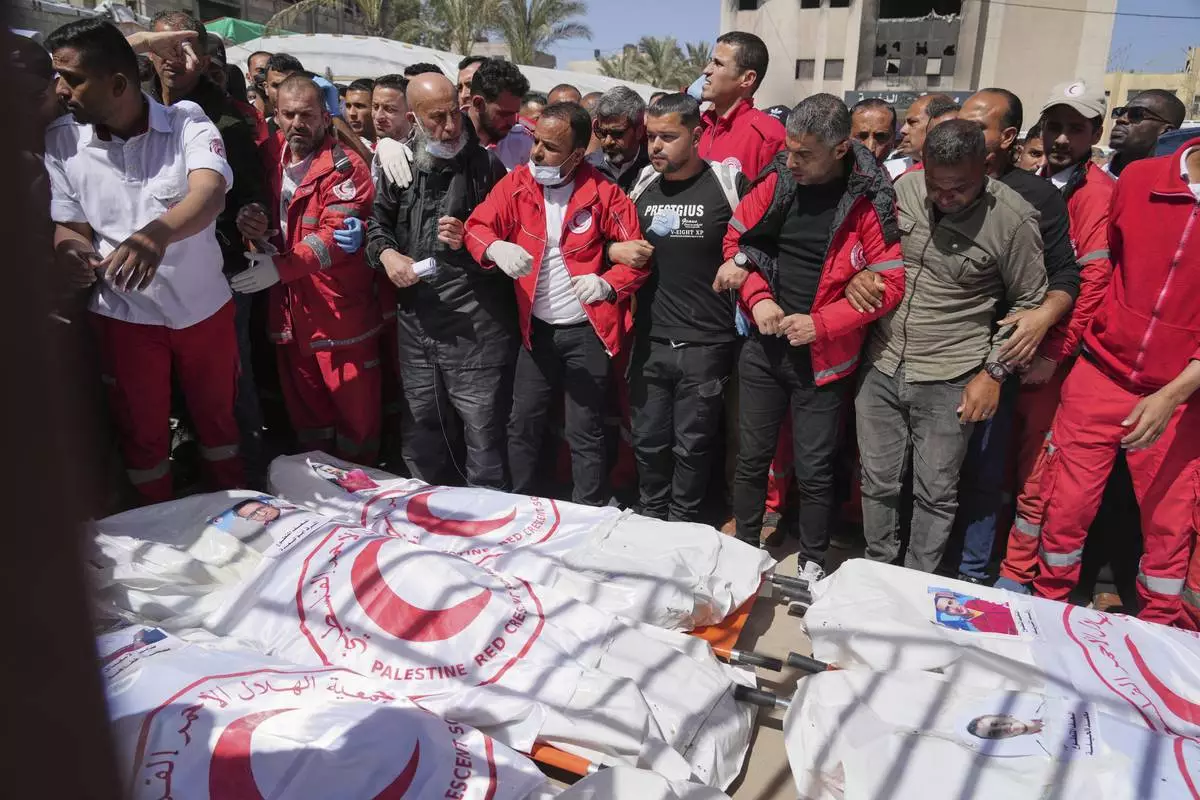
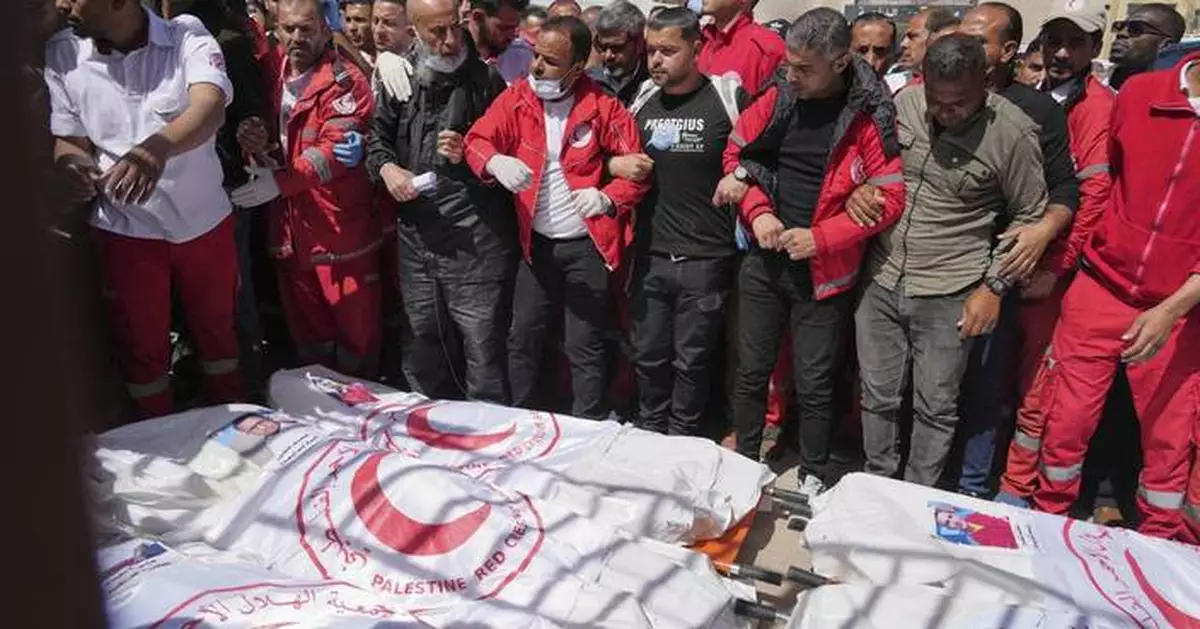
FILE.- Mourners gather around the bodies of 8 Red Crescent emergency responders, recovered in Rafah a week after an Israeli attack, as they are transported for burial from a hospital in Deir al-Balah, Gaza Strip, on Monday, March 31, 2025. (AP Photo/Abdel Kareem Hana,File)