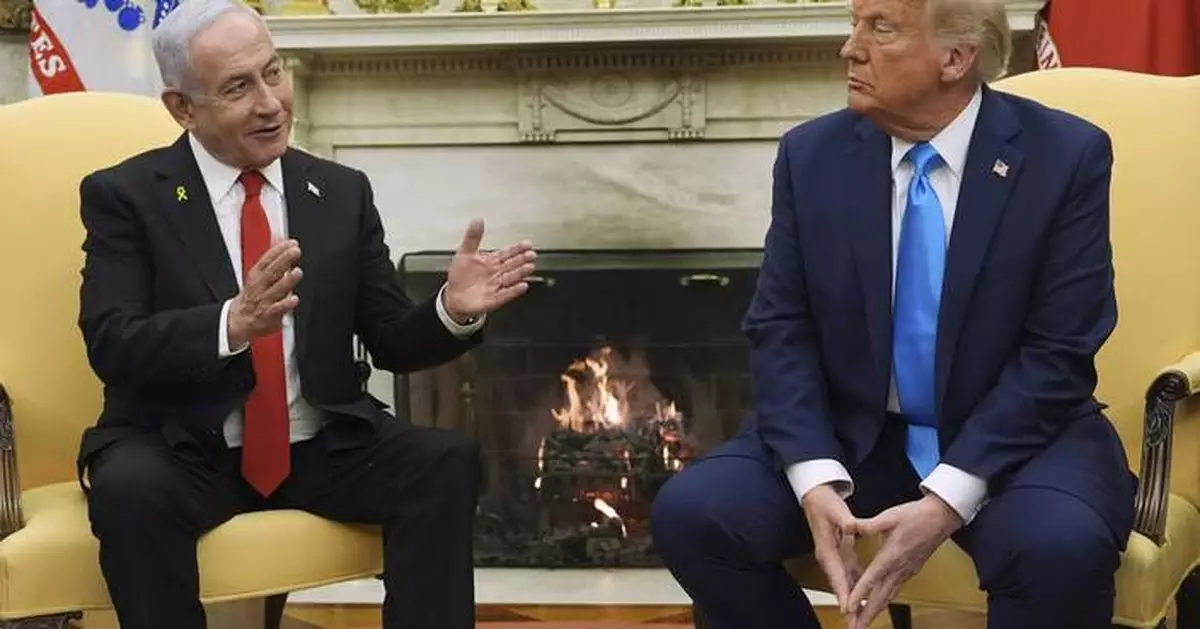
PALM BEACH GARDENS, Fla. (AP) — President Donald Trump plans to meet with Israeli Prime Minister Benjamin Netanyahu on Monday in what would be their second White House sit-down since Trump's return to office.
The visit, confirmed by a White House official and Netanyahu's office Saturday, comes as Israel deploys troops in a new security corridor across Gaza to pressure the Hamas militant group. Netanyahu's defense minister has said Israel will seize large areas of the territory and add them to its so-called security zones.
Last month, Israel shattered the ceasefire with a surprise bombardment in Gaza after trying to pressure Hamas to accept proposed new terms for the ceasefire, a move supported by the White House. Hundreds of Palestinians have since been killed.
Israel has pledged to escalate the war in Gaza until Hamas returns the remaining hostages seized in the Oct. 7, 2023, attack that sparked the war, disarms and leaves the territory. Israel also has halted all supplies of food, fuel and humanitarian aid into Gaza.
Netanyahu's office in a statement on social media said he and Trump would discuss “the tariff issue, the efforts to return our hostages, Israel-Turkey relations, the Iranian threat and the battle against the International Criminal Court.” Israel faces a 17% tariff.
Netanyahu is wanted by the court for alleged crimes against humanity in Gaza. The U.S. is not a member of the court.
In February, Netanyahu became the first foreign leader invited to the White House during Trump's second term. Their meeting focused on Israel’s war with Hamas and the next steps as a ceasefire deal took hold.
At a joint news conference afterward, Trump made the surprise proposal that displaced Palestinians in Gaza be permanently resettled outside the territory and the United States take “ownership” in redeveloping the area into “the Riviera of the Middle East.” Palestinians objected to leaving their homeland, and Arab nations and rights groups sharply criticized the idea.
That February meeting gave Netanyahu a chance to remind the world of the Trump administration’s support for Israel, defend the conduct of the war and distract from political pressures back home.
Those pressures have only grown as Israelis protest both the lack of a deal to bring remaining hostages home from Gaza and Netanyahu’s moves to fire the head of the country’s domestic security agency and its attorney general. He also faces calls to accept responsibility for his role in failing to prevent the Oct. 7. attack.
In a statement Saturday, relatives of hostages held in Gaza pleaded with Trump to “please use all your power to pressure Netanyahu to end this war and bring our hostages back now.”
“We are addressing President Trump: Netanyahu is lying when he says that military pressure will bring back the abductees. The only way to quickly return all the abductees is to end the war and return them all in one fell swoop,” Ifat Calderon, aunt of hostage Ofer Calderon, said in Tel Aviv, Israel.
Hamas says it will only release the remaining 59 hostages — 24 of whom are believed to be alive — in exchange for the release of more Palestinian prisoners, a lasting ceasefire and an Israeli pullout from Gaza.
The Oct. 7 attack on southern Israel killed about 1,200 people, mostly civilians. Some 251 hostages were taken, most of them since released in ceasefire agreements and other deals.
More than 50,000 Palestinians have been killed in Gaza as part of Israel’s offensive, according to Gaza’s Health Ministry, which doesn’t say whether those killed are civilians or combatants. Israel says it has killed around 20,000 militants, without providing evidence.
Meanwhile, police arrested two of Netanyahu's close associates this week on suspicion of accepting money from Qatar to promote a positive image of the Gulf Arab state in Israel. Qatar is a key mediator for Hamas in its negotiations with Israel but denies backing the militant group. Netanyahu says the case is baseless.
The prime minister is also the subject of a long-running corruption trial and regularly rails against a “deep state” that he alleges is out to get him.
Trump says the first foreign trip of his second administration will include stops in Saudi Arabia, Qatar and possibly the United Arab Emirates, and “other places.” The trip could come as soon as May. Trump has said he wants to reward Saudi Arabia for its investment in the U.S. and that all three Gulf countries would be making commitments to creating jobs in the U.S. during his trip.
Associated Press writers Natalie Melzer in Jerusalem, Darlene Superville in Washington and Cara Anna contributed to this report.
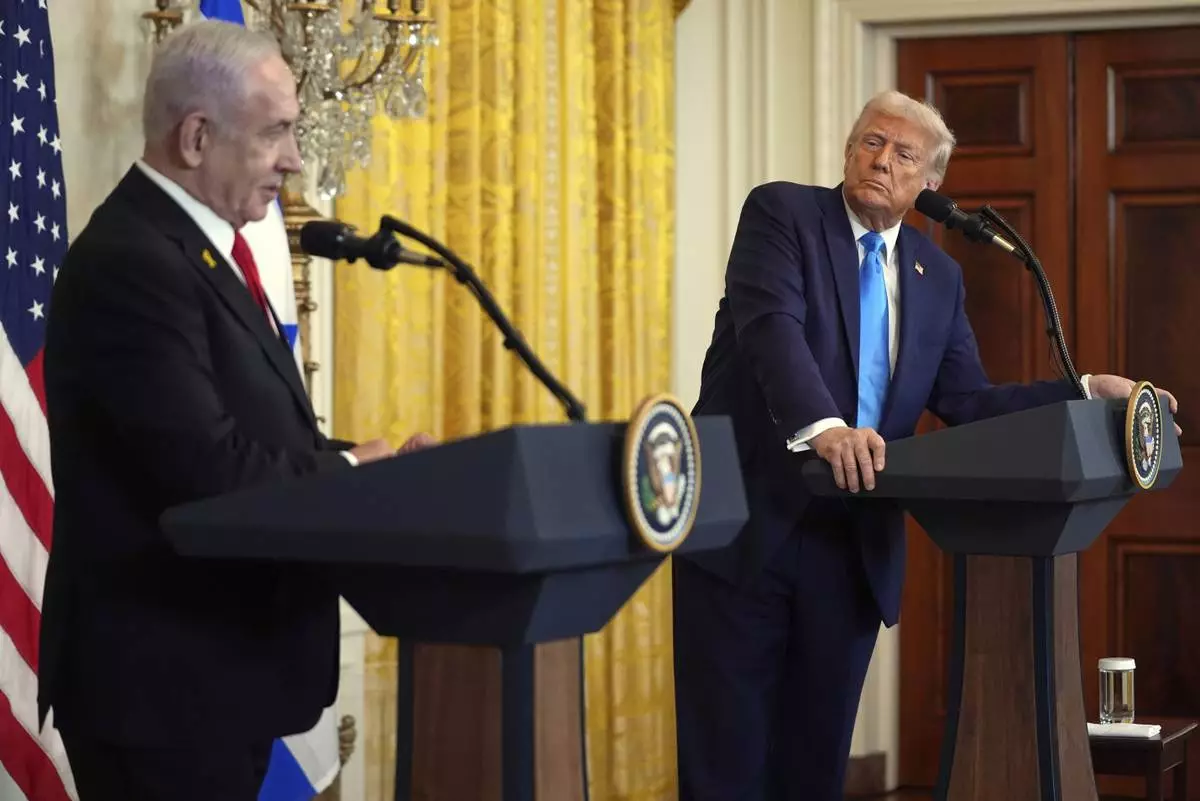
FILE - President Donald Trump listens as Israel's Prime Minister Benjamin Netanyahu speaks during a news conference in the East Room of the White House, Feb. 4, 2025, in Washington. (AP Photo/Evan Vucci, File)
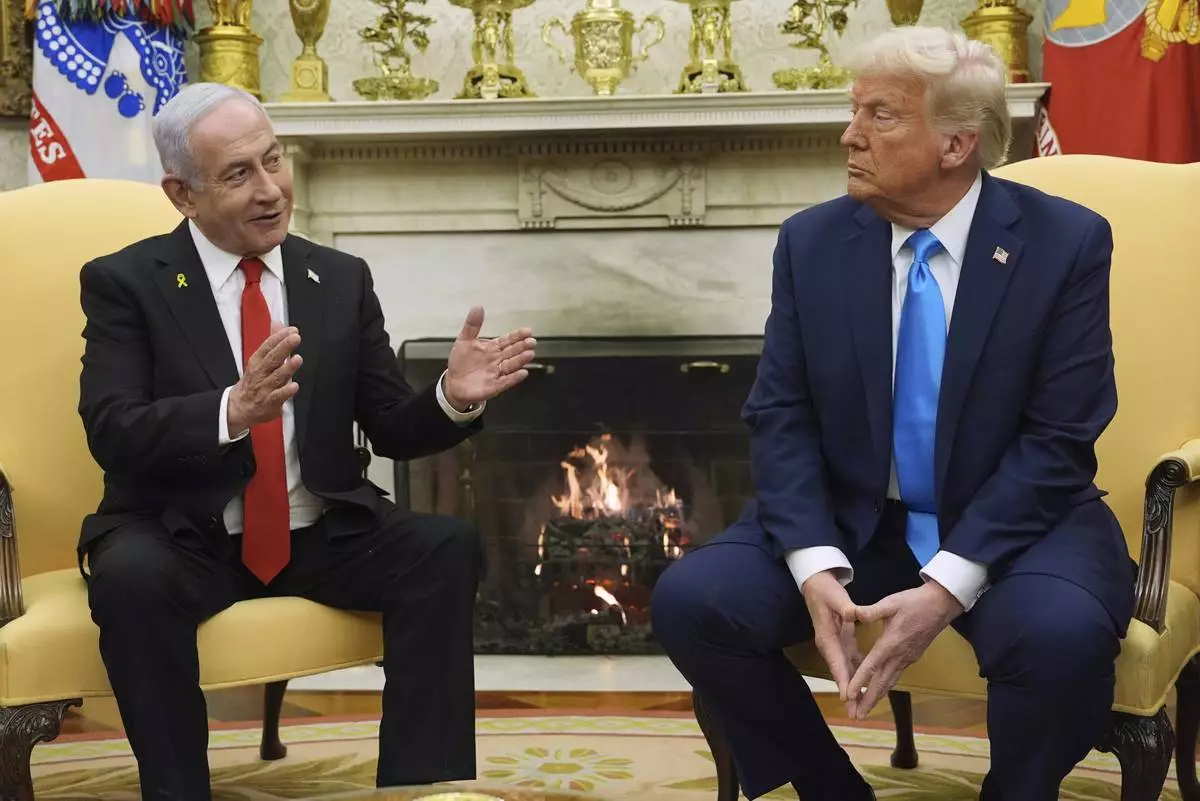
FILE - President Donald Trump meets with Israel's Prime Minister Benjamin Netanyahu in the Oval Office of the White House, Feb. 4, 2025, in Washington. (AP Photo/Evan Vucci, File)
CONAKRY, Guinea (AP) — Guineans are voting Sunday to elect a new president in the country’s first election since a 2021 coup, as analysts say a weakened opposition will result in a likely win for junta leader Gen. Mamadi Doumbouya.
Sunday’s election is the culmination of a transition process that began four years ago after Doumbouya ousted President Alpha Condé. The junta leader has proceeded to clamp down on the main opposition and dissent, critics say, leaving him with no major opposition among the eight other candidates in the race.
Despite Guinea’s rich mineral resources — including as the world’s biggest exporter of bauxite, used to make aluminum — more than half of its 15 million people are experiencing record levels of poverty and food insecurity, according to the World Food Program.
“This vote is the hope of young people, especially for us unemployed," said Idrissa Camara, an 18-year-old resident of Conakry, who said he has been unemployed since graduating from university five years ago. "I’m forced to do odd jobs to survive. I hope this vote will improve the standard of living and the quality of life in Guinea," he added.
The election is being held under a new constitution that revoked a ban on military leaders running for office and extended the presidential mandate from five to seven years. That constitution was overwhelmingly approved in a September referendum despite opposition parties asking voters to boycott it.
The vote is the latest such election among African countries that have seen a surge in coups in recent years. At least 10 countries in the young continent have experienced soldiers forcefully taking power after accusing elected leaders of failing to provide good governance and security for citizens.
“This election will open a new page in Guinea’s history and mark the country’s return to the league of nations,” said Guinea political analyst Aboubacar Sidiki Diakité. “Doumbouya is undoubtedly the favorite in this presidential election because the main opposition political parties have been sidelined and the General Directorate of Elections, the body that oversees the presidential election, is under the supervision of the government,” he added.
In addition to a weakened opposition, activists and rights groups say Guinea has since the coup seen civil society leaders silenced, critics abducted and the press censored. More than 50 political parties were dissolved last year in a move authorities claimed was to “clean up the political chessboard” despite widespread criticism.
There was heavy security in Conakry and other parts of Guinea with nearly 12,000 police officers among security forces mobilized and checkpoints set up along major roads. Authorities had said on Saturday that security forces “neutralized” an armed group with “subversive intentions threatening national security” after gunshots were heard in Conakry’s Sonfonia neighborhood.
Across polling stations, long queues of mostly young voters waited to cast their ballot while police officers closely monitored the process.
A total of nine candidates are contesting the election, and Doumbouya’s closest challenger is the little-known Yero Baldé of the Democratic Front of Guinea party, who was education minister under Condé.
Two opposition candidates, former Prime Minister Lansana Kouyaté and former government minister Ousmane Kaba, were excluded on technical grounds while longtime opposition leaders Cellou Dalein Diallo and Sidya Toure have been forced into exile.
While Baldé has hinged his campaign on promises of governance reforms, anti-corruption efforts and economic growth, Doumbouya has built his around major infrastructure projects and reforms launched since taking power four years ago.
The junta’s most important project has been the Simandou iron ore project, a 75% Chinese-owned mega-mining project at the world’s largest iron ore deposit which began production last month after decades of delays.
Authorities say that a national development plan tied to the Simandou project aims to create tens of thousands of jobs and diversify the economy through investments in agriculture, education, transport, technology and health.
“In four years, he (Doumbouya) has connected Guinean youth to information and communication technologies,” said Mamadama Touré, a high school student wearing a T-shirt with Doumbouya’s image in the capital of Conakry, as he cited digital skills training programs put in place by the authorities.
About 6.7 million registered voters are expected to cast ballots at roughly 24,000 polling stations nationwide, with results expected within 48 hours. There will be a runoff if no candidate wins a majority of the votes.
In Conakry, 22-year-old student Issatou Bah said he is still undecided about whether to vote in the election.
“This is the third time I’ve voted in Guinea, hoping things will change. But nothing has changed,” said Bah, adding that he hopes the election will improve "this country that has everything but struggles to take off.”
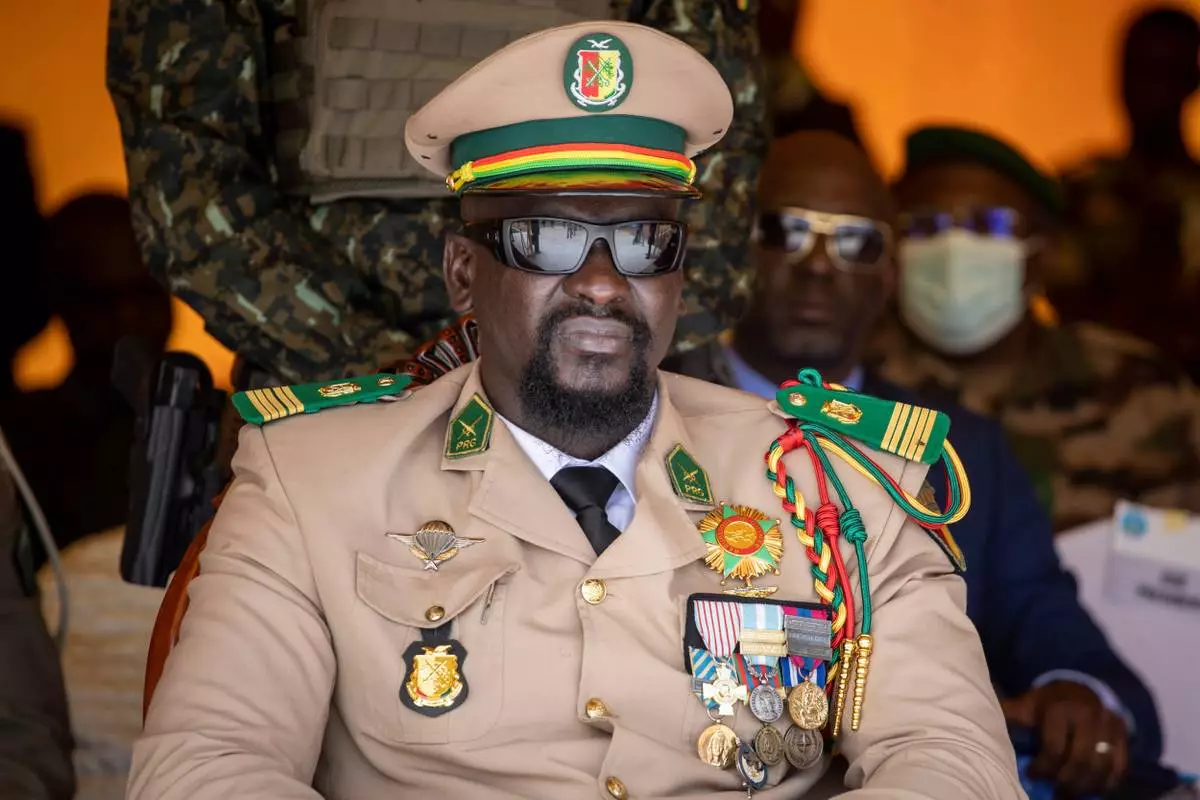
FILE - Guinea's junta leader Col. Mamady Doumbouya watches over an independence day military parade in Bamako, Mali on Sept. 22, 2022. (AP Photo, File)