South China's tech hub of Shenzhen City has taken steps to accelerate the development of its embodied intelligence industry by fully unleashing its advantages in supply chains and human resources, further consolidating the city's status as the world factory of international intelligent manufacturing.
Embodied intelligence refers to the integration of artificial intelligence into physical entities, such as humanoid robots, enabling them to sense, learn and interact with their environment.
AI-powered mobile phones, AI-driven computers and intelligent robots are key examples of embodied intelligence devices.
At the Shenzhen Institute of Artificial Intelligence and Robotics for Society, a group of researchers and leaders in charge of research and development from enterprises observed and shared insights on a newly developed agile robot hand.
Possessing tactile perception capability, the robot hand is able to detect variations in external pressure and temperature and its palm has an embedded camera, which is capable of capturing visual signals.
"Typically, large models all apply internet data, but internet data cannot offer tactile signals or signals from cameras embedded in the palm of a robot hand. So, such signals are especially critical for us to train the basic models of new robots. We can use them to train more large models and make them fit better with various movements that we find in human society, and this is a big advantage that we are trying to combine," said Zhang Jianguo, director of the Robotic Systems Center of the resarch institute.
The institute is currently spearheading collaborative efforts across Shenzhen's embodied intelligence industrial chain, mobilizing upstream and downstream companies to tackle common technical challenges in the sector.
By means of the value of connectivity of integrated platforms, the enterprises can also help robot makers collect real data from a wide variety of application scenarios. "Data collected from a wide range of scenarios, including manufacturing, water utilities, power grids and municipal operations, will be gathered into a credible platform. With further integration, it will produce a richer and more diverse description of multiple scenarios, such as production and manufacturing," said Ding Ning, executive vice president of the research institute.
Shenzhen has recently released a three-year action plan to promote technological innovation and industrial development for the sector of embodied intelligence robot.
The plan set out more specific goals such as cultivating no less than 10 enterprises each valued at over 10 billion yuan (about 1.4 billion U.S. dollars) in the embodied intelligence field, achieving a scale of related industries that are worth more than 100 billion yuan, and establishing an industrial cluster grouping more than 1,200 embodied intelligence robotics companies.
"We will provide comprehensive support for enterprises by focusing on making breakthroughs in key technologies and supply of elements, including data collection, scenario supply, human resources policy support, etc. Our goal is also clear. By seizing the pivotal time window and the opportunities brought by the development of embodied intelligence, within two to three years, we will cultivate a trillion-yuan-grade embodied intelligence industrial cluster in Shenzhen and the broader Guangdong-Hong Kong-Macao Greater Bay Area city cluster in south China that serves both China and the rest of the world," said Zhang Lin, director of the Shenzhen City Science and Technology Innovation Bureau.
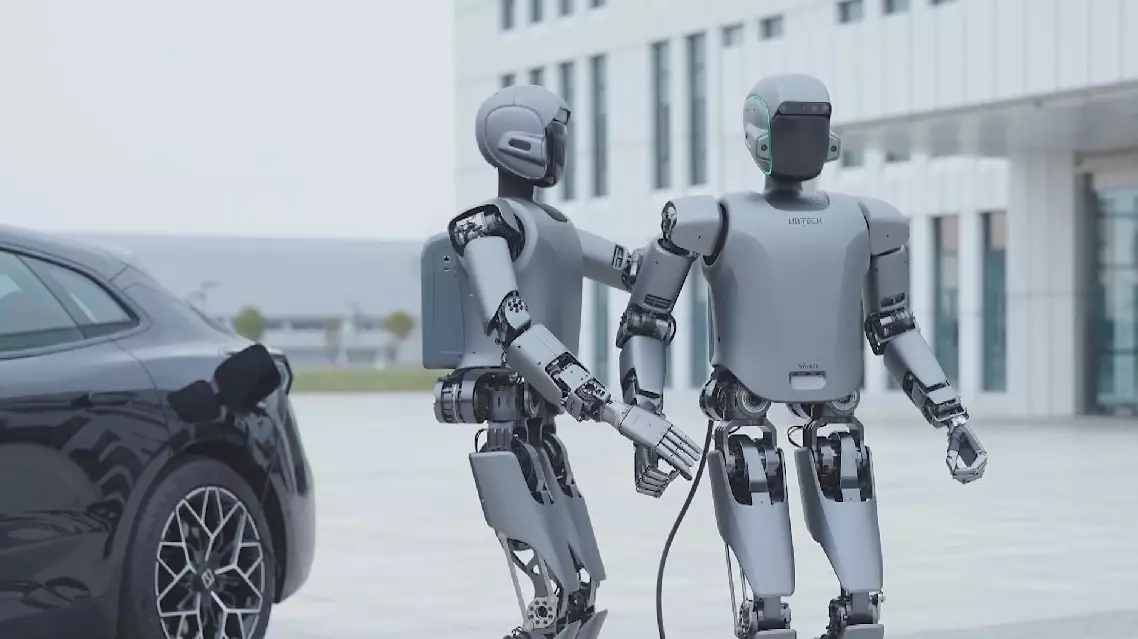
South China's Shenzhen accelerates development of embodied intelligence industry