As part of the city's pioneering advancements in embodied intelligence, a tech company in Shenzhen -- a major innovation hub in southern China's Guangdong Province -- has developed an ultra-thin, highly realistic, and stretchable 'electronic skin' that gives robots a sense of touch similar to that of humans.
Humans interact with the world through their skin. To help robots better perceive their surroundings, now a type of electronic skin - a highly flexible, lightweight material that can be stretched and squeezed easily - has been introduced to mimic the subtle functionality of human skin. Just like human skin detects the slightest touch or pressure, this electronic skin can sense forces as small as a single gram.
"We achieved compatibility between each material at the chemical level, allowing them to integrate seamlessly, layer by layer. The resulting device is just a few dozen microns thick, with a multi-layer structure. This structure deforms under pressure, causing changes in its electrical properties. By examining these electrical properties, we can determine the corresponding force applied -- similar to how human skin transforms pressure into bioelectric signals," said Lai Jiancheng, founder of Tujian Technology.
A small piece of e-skin contains as many as 4,000 micro-sensors, enabling it to detect even the slightest changes in the environment. Its special design also ensures that if part of it is damaged, the remaining areas continue to function normally, much like human skin. The material also conforms perfectly to irregular surfaces, such as robotic fingers, and is extremely durable, making it ideal for applications in robotics.
"As you can see, this is a crisscross structure, and at each intersection of the cross lines lies a sensor. You can regard it as similar to the pixels on a phone screen -- each point is like a pixel that can sense changes in pressure, temperature, and even proximity. These variations can all be detected," Lai explained.
Lai said the material can be applied to surfaces of any shape without altering its internal structure.
The breakthrough comes as Shenzhen accelerates innovation in core components for embodied AI systems. At a local robotics manufacturing company, a new generation of collaborative robots that can work seamlessly with humans has been developed. These robots, featuring upgraded arms, have already shipped over 80,000 units globally and are leading the industry in exports.
Inside the company's showroom, a new embodied AI robot demonstrates its capabilities by performing a full hospitality routine -- waving its hands and serving water.
"Our components are 90 percent self-developed, including motor encoders, controllers, drivers, and sensors. We have built a solid foundation in the early stages, allowing us to reduce the price to just 199,000 yuan (about 27,380 U.S. dollars), and we expect even lower prices in the future as the supply chain improves further," said Lan Xulin, chief scientist at Yuejiang Technology.
Local authorities in Shenzhen have launched an open bidding mechanism to select the best candidate firms to lead major research projects. This approach has driven breakthroughs in critical humanoid robotics components such as dexterous hands, core joints, reducers, and radar systems.
"Actually, when our company was still very small, we received funding of around 200,000 yuan from the government, and gradually, we won bids for major projects with funding of up to 20 million yuan. We've always received strong support from Shenzhen's Science, Technology and Innovation Bureau. Our goal is to achieve rapid mass production through self-developed technologies and to continuously upgrade our products in real-world applications, ultimately enabling humanoid robots to integrate into our daily lives and work as soon as possible," said Lang.
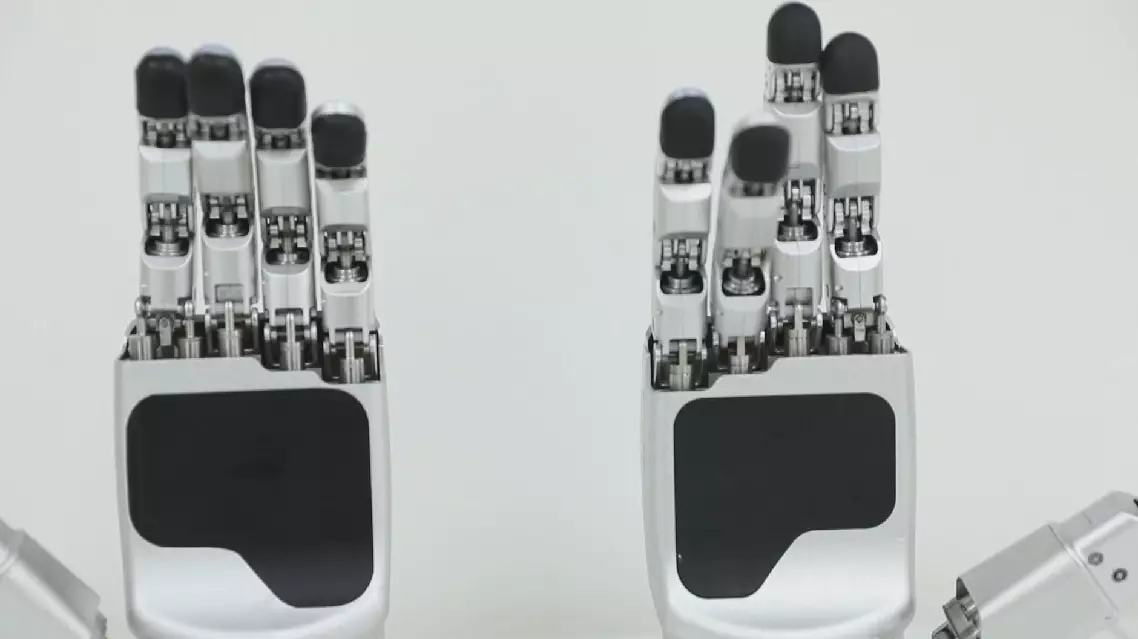
Shenzhen tech company unveils hyper-realistic robot 'e-skin'