Local people in Luxembourg were given a splash of Chinese culture as a series of traditional dragon boat races were held along the Moselle River in the Remich commune on Sunday, drawing a number of teams and visitors from several countries to join in the festivities.
The event came ahead of the upcoming Dragon Boat Festival, also known as the Duanwu Festival, a traditional Chinese holiday to commemorate the ancient Chinese poet Qu Yuan. Celebrated on the fifth day of the fifth month of the Chinese lunar calendar, the festival will this year fall on June 19.
The fourth Luxembourg International Dragon Boat Festival saw a bumper entry of 17 teams from different countries competing in the races, attracting tens of thousands of spectators from Luxembourg and neighboring countries.
Aside from the racing on the river, the event also included more Chinese elements to keep attendees well entertained, including traditional music performances and vibrant dragon and lion dances which delighted the crowds.
Officials say the festival further demonstrates the strong ties which exist between Luxembourg and China.
"We have of course economic relationships, but beyond these economic relationships, it's important also to have cultural [and] sporting cooperation, and the dragon [boat] festival is a good occasion to underline this," said Leon Gloden, Luxembourg's Minister for Home Affairs.
Others taking part in the event pointed to the festive atmosphere and say that dragon boat racing embodies the spirit of teamwork.
"[It's] not about the individual, but about everybody else. I think that's the spirit that we try and carry forward and that's what the history and the tradition is all about. And we're happy to be part of it," said one participant.
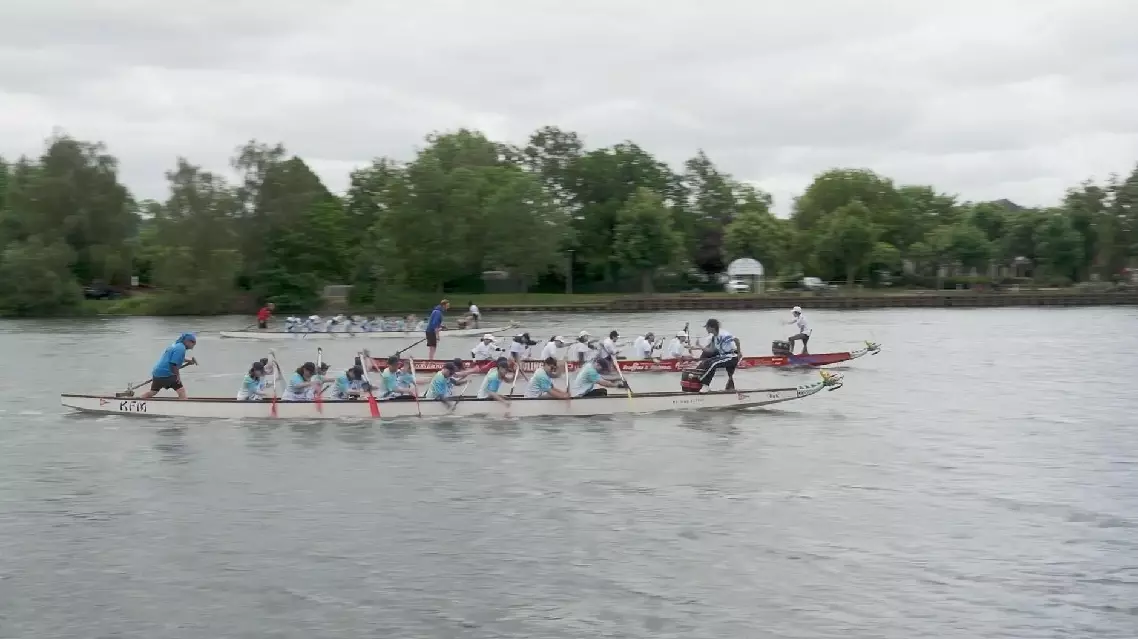
Dragon boat race in Luxembourg offer spectators splash of Chinese culture

China will build and renovate 770,000 kilometers of urban underground pipelines during the 15th Five-Year Plan period from 2026 to 2030, an official said at a press conference in Beijing on Monday.
The country's existing urban underground pipelines run a total length of 3.9 million kilometers, with the total built up utility tunnels running 7,700 kilometers, said Chen Shaopeng, director of the building energy efficiency and sci-tech department at the Ministry of Housing and Urban-Rural Development.
This year, China is mulling multi-trillion-yuan investment through a "Six Networks" initiative, as the country works to expand domestic demand and stabilize economic growth, with the "Six Networks" including water networks, new-type power grids, computing power networks, next-generation communication networks, urban underground pipeline networks and logistics networks.
As one of the "Six Networks," urban underground pipeline networks comprises of gas, water supply, drainage, sewage, heating pipelines and utility tunnels.
Chen said, during the 15th Five-Year Plan period, China plans to build and renovate 200,000 kilometers of gas pipelines, 175,000 kilometers each of drainage and water supply pipelines, 100,000 kilometers of sewage pipelines, and 120,000 kilometers of heating pipelines.
"[We will] advance the construction and renovation of urban drainage facilities, including drainage pipes and canals, pumping stations, flood discharge channels, storage facilities and smart platforms. For water supply networks, the focus is on upgrading aging and damaged city water distribution pipes. As for gas pipeline networks, the priority is renovating pipelines with outdated materials and serious corrosion. For heating networks, the focus is on carrying out the urban heating 'warmth project' and accelerating the renovation of aging heating pipelines and inefficient heat exchange stations," said Chen.
Guan Peng, director of the Department of Fixed Asset Investment with the National Development and Reform Commission (NDRC), said at the press conference that the NDRC and the Ministry have actively supported underground pipeline projects through ultra-long special treasury bonds.
"In 2026, a fund of 160 billion yuan (about 23.6 billion U.S. dollars) in [ultra-long special treasury bond] has been arranged, 25 billion yuan more than the previous year, to [actively] support the construction and renovation of urban underground pipeline networks, including gas, drainage, water supply and heating," said Guan.
Alongside physical construction and renovation, relevant departments will strengthen digital monitoring of urban infrastructure, enabling real-time supervision, dynamic risk alerts and rapid emergency response.
China to build, renovate 770,000 km of urban underground pipelines