Skip to Content Facebook Feature Image

Fired Justice Department pardon attorney accuses the agency of 'ongoing corruption,' abuse of power

News

Fired Justice Department pardon attorney accuses the agency of 'ongoing corruption,' abuse of power
News

News

Fired Justice Department pardon attorney accuses the agency of 'ongoing corruption,' abuse of power

2025-04-08 10:02 Last Updated At:10:11

WASHINGTON (AP) — The Justice Department's recently fired pardon attorney accused the leadership of the law enforcement agency of “ongoing corruption," testifying Monday at a congressional hearing meant to showcase concerns that the Trump administration is assaulting the rule of law, abusing its power and forcing out career civil servants.

“It should alarm all Americans that the leadership of the Department of Justice appears to value political loyalty above the fair and responsible administration of justice,” said Liz Oyer, who has said she was fired last month after refusing to recommend that the gun rights of actor Mel Gibson, a supporter of President Donald Trump's, be restored.

More Images
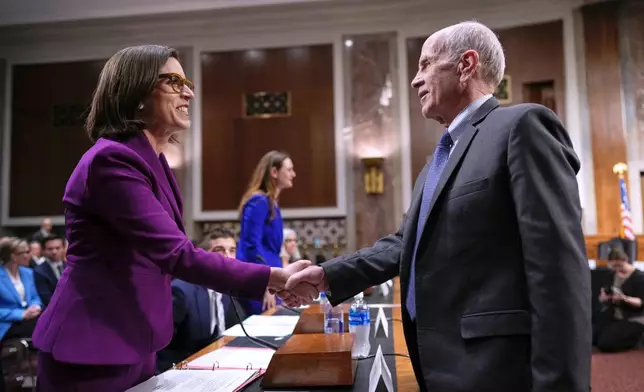
Former Justice Department attorney Liz Oyer, left, is welcomed by Sen. Peter Welch, D-Vt., to testify to House and Senate Judiciary Committee members at a hearing about the Justice Department, on Capitol Hill in Washington, Monday, April 7, 2025. (AP Photo/J. Scott Applewhite)
Former Justice Department attorney Liz Oyer, left, is welcomed by Sen. Peter Welch, D-Vt., to testify to House and Senate Judiciary Committee members at a hearing about the Justice Department, on Capitol Hill in Washington, Monday, April 7, 2025. (AP Photo/J. Scott Applewhite)

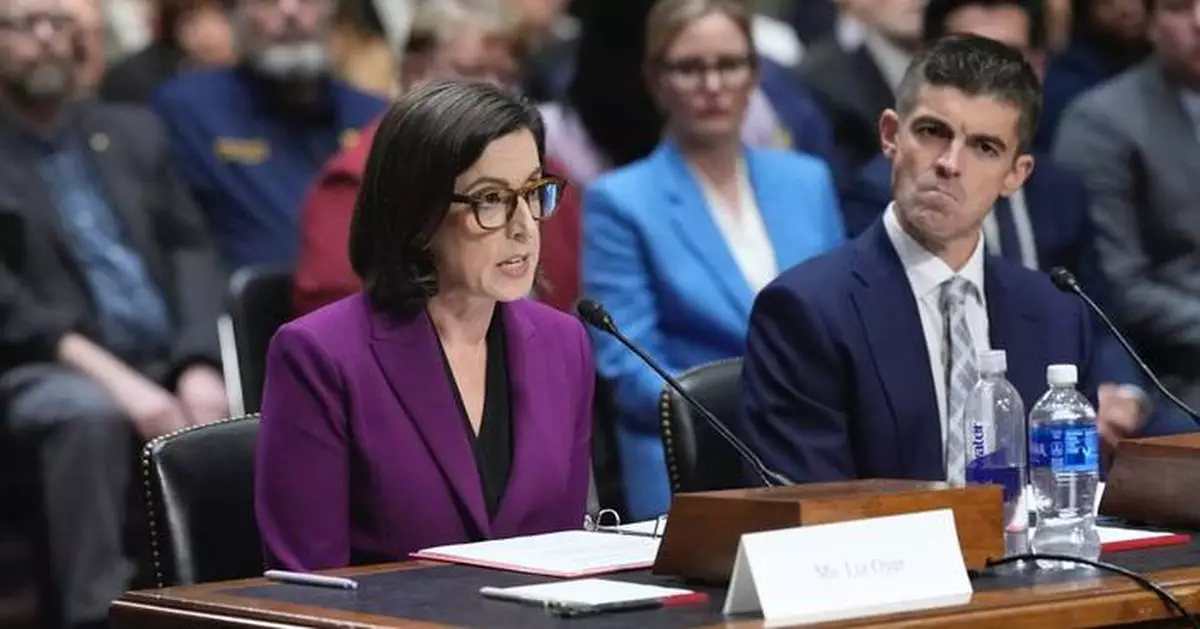
Former Justice Department attorneys Liz Oyer and Ryan Crosswell, testify before the House and Senate Judiciary Committee members during a hearing on the Justice Department under President Donald Trump, on Capitol Hill in Washington, Monday, April 7, 2025. (AP Photo/J. Scott Applewhite)
Former Justice Department attorneys Liz Oyer and Ryan Crosswell, testify before the House and Senate Judiciary Committee members during a hearing on the Justice Department under President Donald Trump, on Capitol Hill in Washington, Monday, April 7, 2025. (AP Photo/J. Scott Applewhite)
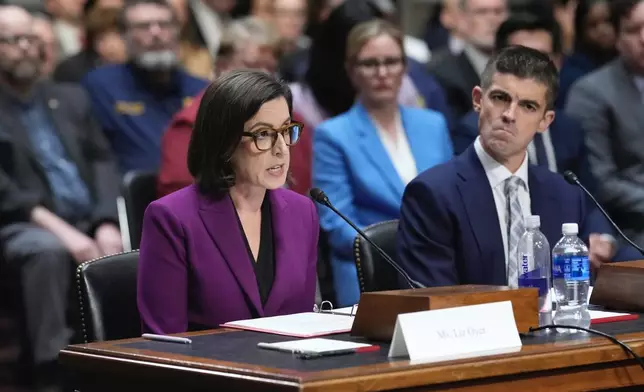
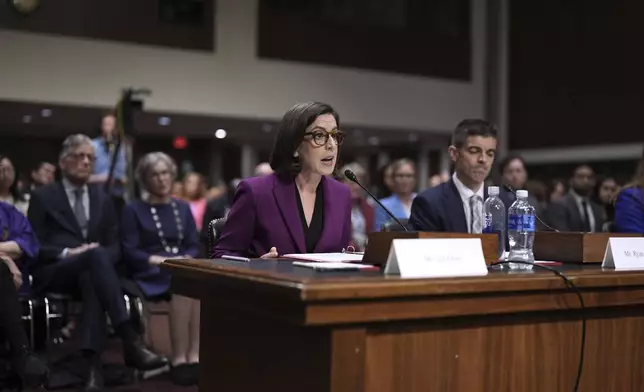
Former Justice Department attorney Liz Oyer testifies before the House and Senate Judiciary Committee members during a hearing on the Justice Department under President Donald Trump, on Capitol Hill in Washington, Monday, April 7, 2025. (AP Photo/J. Scott Applewhite)

Former Justice Department attorney Liz Oyer testifies before the House and Senate Judiciary Committee members during a hearing on the Justice Department under President Donald Trump, on Capitol Hill in Washington, Monday, April 7, 2025. (AP Photo/J. Scott Applewhite)

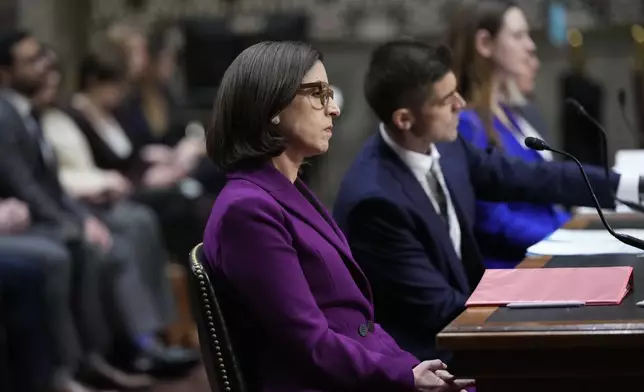
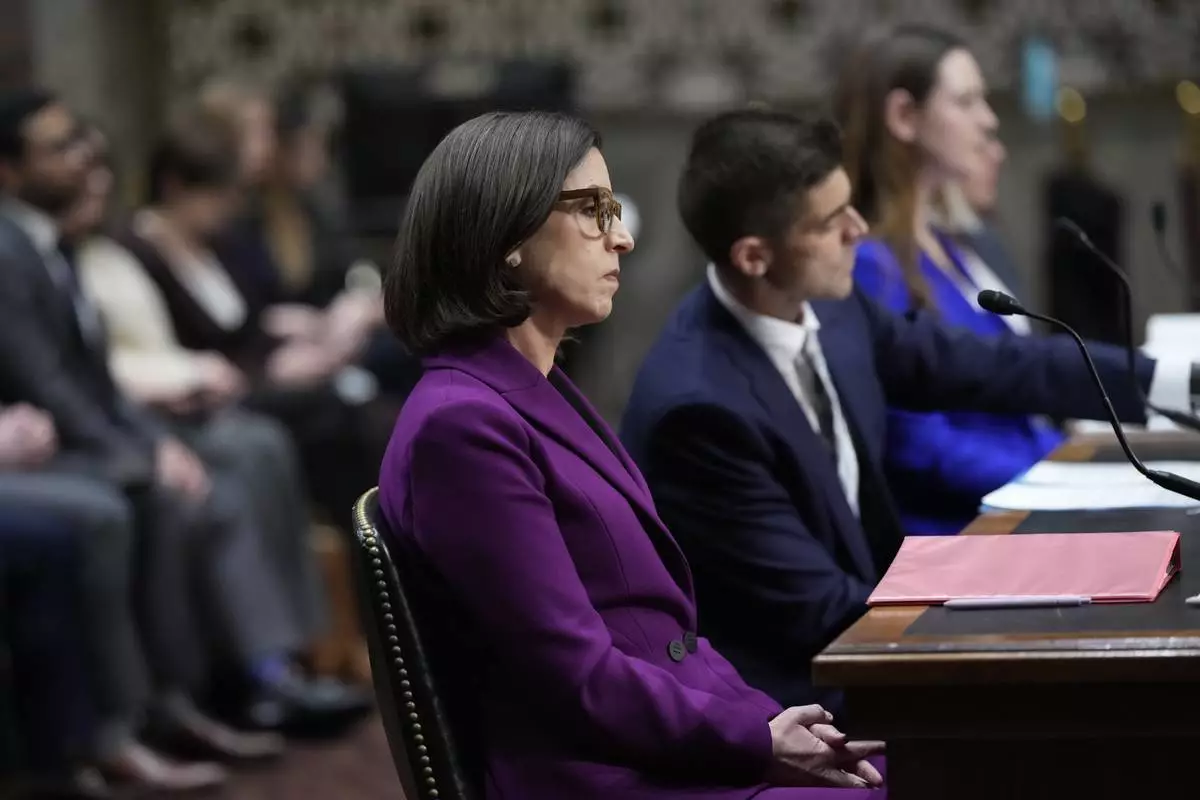
Former Justice Department attorneys Liz Oyer, left, and Ryan Crosswell participate in a hearing on the Justice Department on Capitol Hill in Washington, Monday, April 7, 2025. (AP Photo/J. Scott Applewhite)

Former Justice Department attorneys Liz Oyer, left, and Ryan Crosswell participate in a hearing on the Justice Department on Capitol Hill in Washington, Monday, April 7, 2025. (AP Photo/J. Scott Applewhite)

“It should offend all Americans that our leaders are treating public servants with a lack of basic decency and humanity," she added.

The hearing represented the first time in the new Trump administration that Justice Department lawyers who were either recently fired or quit have spoken before Congress about the circumstances of their departures and their concerns about the agency's direction. It unfolded as a wave of resignations and firings have hollowed out the ranks of experienced career lawyers at the department and as Attorney General Pam Bondi and her leadership team team have signaled little patience for dissent within the workforce, including by suspending a government attorney who admitted in court that the deportation of a Maryland man to a notorious El Salvador prison was a mistake.

"The Trump administration has unleashed an all-out assault on these public servants, who are now facing attacks on their employment, their integrity, their well-being, and even their safety,” Stacey Young, a lawyer who left the Justice Department in January and is now leading a group that advocates for department employees, told lawmakers at a hearing convened by members of the House and Senate Judiciary committees.

The warnings were stark, with lawyers who spent years at the Justice Department recounting their experiences with unprecedented political pressure that they said made them deeply uneasy and obliterated the institution's norms.

Oyer decried what she described as the “callous cruelty with which DOJ leadership is treating dedicated public servants.” She testified about being abruptly fired without explanation last month, one day after refusing to endorse the restoration of Gibson’s gun rights following a misdemeanor domestic violence conviction, and being told security officers were waiting in her office to escort her out of the building.

She said Justice Department leaders tried as recently as Friday night to intimidate her into silence by dispatching armed deputy marshals to her house to deliver her a letter warning her against testifying, though she was able to forestall the arrival of the officers at her home.

“The letter was a warning to me about the risks of testifying here today. But I am here because I will not be bullied into concealing the ongoing corruption and abuse of power at the Department of Justice," Oyer said.

A Justice Department spokesperson did not immediately respond to a message seeking comment on Oyer's testimony. Deputy Attorney General Todd Blanche has previously dismissed Oyer's statements as inaccurate, without elaborating. The department attempted to invoke executive privilege to prevent Oyer from telling Congress about the circumstances of her departure. The legal principle broadly refers to a president’s power to keep information from the courts, Congress and the public to protect the confidentiality of presidential decision-making. Her lawyer, Michael Bromwich, said the argument that her testimony was barred by executive privilege was “completely without merit.”

Another witness was former public corruption prosecutor who resigned under protest amid the Justice Department’s dismissal of its case against New York Mayor Eric Adams. Ryan Crosswell, who was not involved in the Adams case, described the events surrounding the move to dismiss the Adams case — so that the Democrat could help Trump’s immigration crackdown — as “among the saddest in the department’s history.”

“In a properly functioning justice system, any public official wishing to avoid prison has to live by one rule of thumb: obey our nation’s laws,” Crosswell said. “And this action raised an even more chilling question: Is the Justice Department that will drop charges against those who acquiesce to a political command a Justice Department that will bring charges against those who don’t?”

He recalled how a senior Justice Department official directed Crosswell's section to identify two prosecutors willing to submit a motion seeking the dismissal of the Adams case, with the implicit offer of career advancement for those who did and potential punishment for those who did not. One ultimately stepped forward. Crosswell resigned.

“I didn’t have a job lined up or insurance lined up, but I’d rather be unemployed and not be insured than to work for someone that would do something like that to my colleagues,” he said.
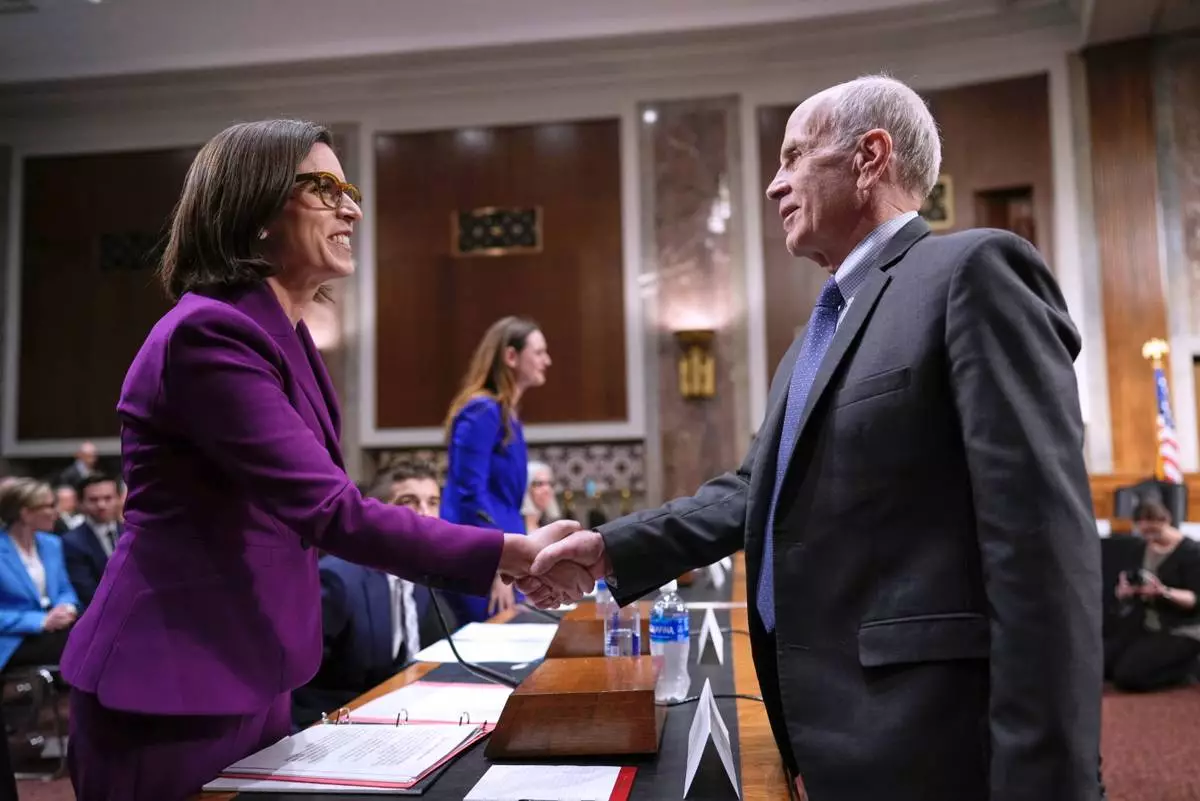
Former Justice Department attorney Liz Oyer, left, is welcomed by Sen. Peter Welch, D-Vt., to testify to House and Senate Judiciary Committee members at a hearing about the Justice Department, on Capitol Hill in Washington, Monday, April 7, 2025. (AP Photo/J. Scott Applewhite)
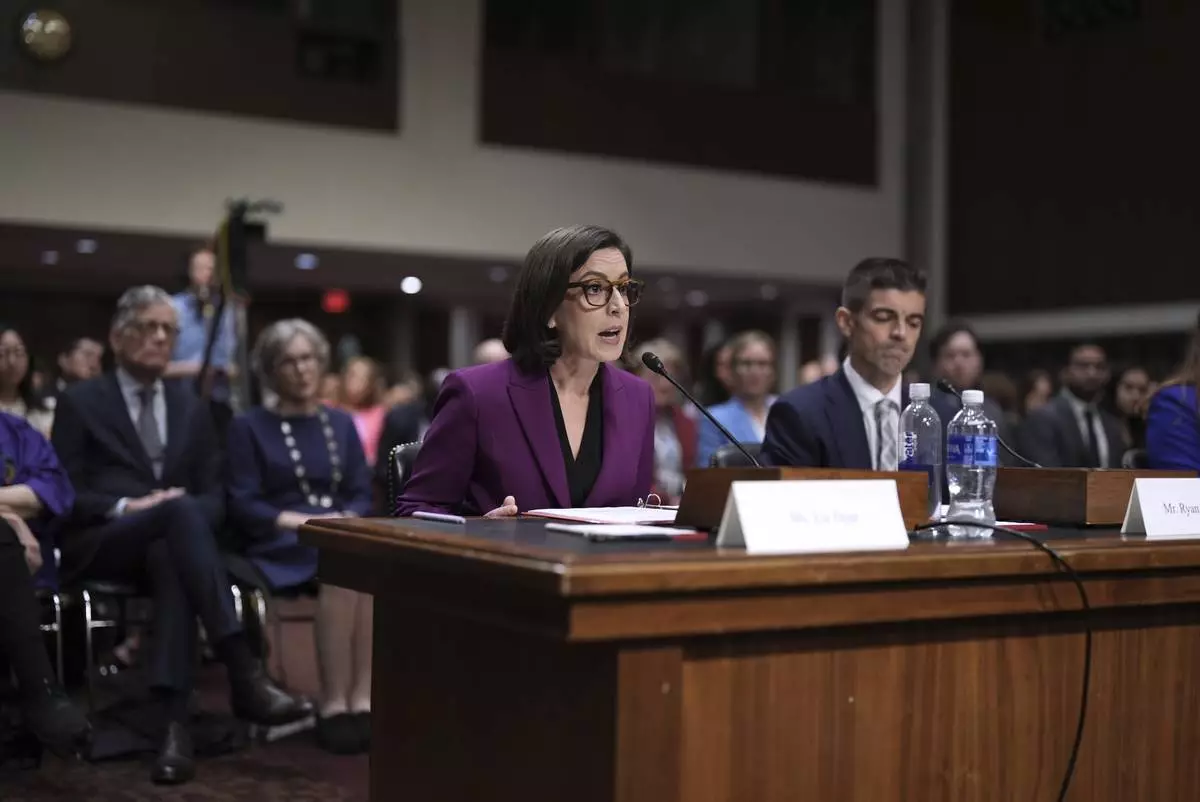
Former Justice Department attorney Liz Oyer, left, is welcomed by Sen. Peter Welch, D-Vt., to testify to House and Senate Judiciary Committee members at a hearing about the Justice Department, on Capitol Hill in Washington, Monday, April 7, 2025. (AP Photo/J. Scott Applewhite)

Former Justice Department attorneys Liz Oyer and Ryan Crosswell, testify before the House and Senate Judiciary Committee members during a hearing on the Justice Department under President Donald Trump, on Capitol Hill in Washington, Monday, April 7, 2025. (AP Photo/J. Scott Applewhite)
Former Justice Department attorneys Liz Oyer and Ryan Crosswell, testify before the House and Senate Judiciary Committee members during a hearing on the Justice Department under President Donald Trump, on Capitol Hill in Washington, Monday, April 7, 2025. (AP Photo/J. Scott Applewhite)
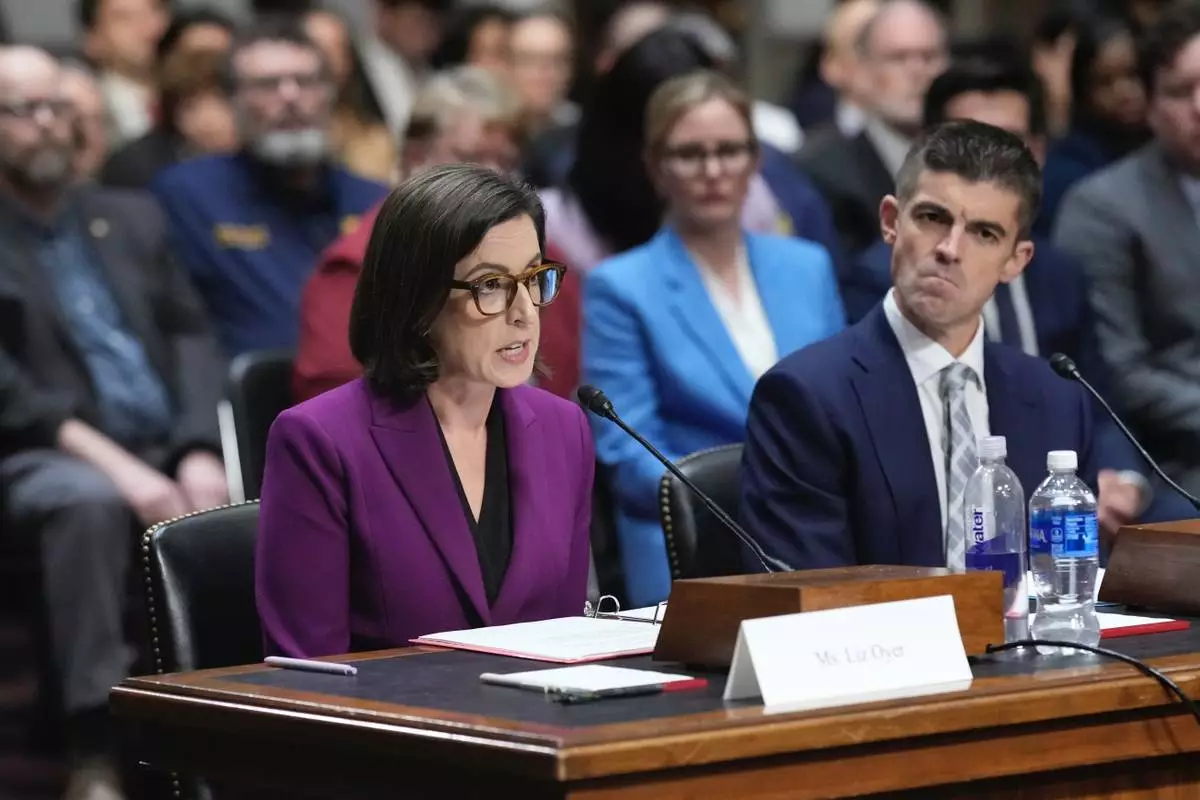
Former Justice Department attorney Liz Oyer testifies before the House and Senate Judiciary Committee members during a hearing on the Justice Department under President Donald Trump, on Capitol Hill in Washington, Monday, April 7, 2025. (AP Photo/J. Scott Applewhite)

Former Justice Department attorney Liz Oyer testifies before the House and Senate Judiciary Committee members during a hearing on the Justice Department under President Donald Trump, on Capitol Hill in Washington, Monday, April 7, 2025. (AP Photo/J. Scott Applewhite)

Former Justice Department attorneys Liz Oyer, left, and Ryan Crosswell participate in a hearing on the Justice Department on Capitol Hill in Washington, Monday, April 7, 2025. (AP Photo/J. Scott Applewhite)


Former Justice Department attorneys Liz Oyer, left, and Ryan Crosswell participate in a hearing on the Justice Department on Capitol Hill in Washington, Monday, April 7, 2025. (AP Photo/J. Scott Applewhite)

JERUSALEM (AP) — Over two dozen families from one of the few remaining Palestinian Bedouin villages in the central West Bank have packed up and fled their homes in recent days, saying harassment by Jewish settlers living in unauthorized outposts nearby has grown unbearable.

The village, Ras Ein el-Auja, was originally home to some 700 people from more than 100 families that have lived there for decades.

Twenty-six families already left on Thursday, scattering across the territory in search of safer ground, say rights groups. Several other families were packing up and leaving on Sunday.

“We have been suffering greatly from the settlers. Every day, they come on foot, or on tractors, or on horseback with their sheep into our homes. They enter people’s homes daily,” said Nayef Zayed, a resident, as neighbors took down sheep pens and tin structures.

Israel's military and the local settler governing body in the area did not respond to requests for comment.

Other residents pledged to stay put for the time being. That makes them some of the last Palestinians left in the area, said Sarit Michaeli, international director at B’Tselem, an Israeli rights group helping the residents.

She said that mounting settler violence has already emptied neighboring Palestinian hamlets in the dusty corridor of land stretching from Ramallah in the West to Jericho, along the Jordanian border, in the east.

The area is part of the 60% of the West Bank that has remained under full Israeli control under interim peace accords signed in the 1990s. Since the war between Israel and Hamas erupted in October 2023, over 2,000 Palestinians — at least 44 entire communities — have been expelled by settler violence in the area, B'Tselem says.

The turning point for the village came in December, when settlers put up an outpost about 50 meters (yards) from Palestinian homes on the northwestern flank of the village, said Michaeli and Sam Stein, an activist who has been living in the village for a month.

Settlers strolled easily through the village at night. Sheep and laundry went missing. International activists had to begin escorting children to school to keep them safe.

“The settlers attack us day and night, they have displaced us, they harass us in every way” said Eyad Isaac, another resident. “They intimidate the children and women.”

Michaeli said she’s witnessed settlers walk around the village at night, going into homes to film women and children and tampering with the village’s electricity.

The residents said they call the police frequently to ask for help — but it seldom arrives. Settlement expansion has been promoted by successive Israeli governments over nearly six decades. But Benjamin Netanyahu’s far-right government, which has placed settler leaders in senior positions, has made it a top priority.

That growth has been accompanied by a spike in settler violence, much of it carried out by residents of unauthorized outposts. These outposts often begin with small farms or shepherding that are used to seize land, say Palestinians and anti-settlement activists. United Nations officials warn the trend is changing the map of the West Bank, entrenching Israeli presence in the area.

Some 500,000 Israelis have settled in the West Bank since Israel captured the territory, along with east Jerusalem and the Gaza Strip, in the 1967 Mideast war. Their presence is viewed by most of the international community as illegal and a major obstacle to peace. The Palestinians seek all three areas for a future state.

For now, displaced families of the village have dispersed between other villages near the city of Jericho and near Hebron further south, said residents. Some sold their sheep and are trying to move into the cities.

Others are just dismantling their structures without knowing where to go.

"Where will we go? There’s nowhere. We’re scattered,” said Zayed, the resident, “People’s situation is bad. Very bad.”

An Israeli settler herds his flock near his outpost beside the Palestinian village of Ras Ein al-Auja in the West Bank, Sunday, Jan. 11, 2026. (AP Photo/Mahmoud Illean)

An Israeli settler herds his flock near his outpost beside the Palestinian village of Ras Ein al-Auja in the West Bank, Sunday, Jan. 11, 2026. (AP Photo/Mahmoud Illean)

A Palestinian resident of Ras Ein al-Auja village, West Bank burns trash, Sunday, Jan. 11, 2026. (AP Photo/Mahmoud Illean)

A Palestinian resident of Ras Ein al-Auja village, West Bank burns trash, Sunday, Jan. 11, 2026. (AP Photo/Mahmoud Illean)

Palestinian children play in the West Bank village of Ras Ein al-Auja, Sunday, Jan. 11, 2026. (AP Photo/Mahmoud Illean)

Palestinian children play in the West Bank village of Ras Ein al-Auja, Sunday, Jan. 11, 2026. (AP Photo/Mahmoud Illean)

Palestinian residents of Ras Ein al-Auja village, West Bank pack up their belongings and prepare to leave their homes after deciding to flee mounting settler violence, Sunday, Jan. 11, 2026. (AP Photo/Mahmoud Illean)

Palestinian residents of Ras Ein al-Auja village, West Bank pack up their belongings and prepare to leave their homes after deciding to flee mounting settler violence, Sunday, Jan. 11, 2026. (AP Photo/Mahmoud Illean)

Palestinian residents of Ras Ein al-Auja village, West Bank pack up their belongings and prepare to leave their homes after deciding to flee mounting settler violence, Sunday, Jan. 11, 2026. (AP Photo/Mahmoud Illean)

Palestinian residents of Ras Ein al-Auja village, West Bank pack up their belongings and prepare to leave their homes after deciding to flee mounting settler violence, Sunday, Jan. 11, 2026. (AP Photo/Mahmoud Illean)

Recommended Articles