Kyle Tucker has agreed to a $240 million, four-year contract with the Los Angeles Dodgers, according to a person familiar with the deal, bolstering the team's chance for a third consecutive World Series championship.
Tucker can opt out of the deal after years two and three, according to the person who spoke to The Associated Press on Thursday night on condition of anonymity because the agreement was pending a physical.
Tucker's $60 million average annual value would be the second-highest in baseball history, without factoring in deferred money, behind Shohei Ohtani’s $70 million in his 10-year deal with the Dodgers that runs through 2033.
Tucker becomes the latest accomplished veteran scooped up by the deep-pocketed Dodgers, who will have seven of the majors’ 29 biggest contracts by average annual value in 2026. Los Angeles’ previous big move of the offseason was signing former New York Mets closer Edwin Díaz, widely considered to be the best reliever on the free agent market, to bolster their subpar bullpen.
The Dodgers will welcome Tucker’s exceptional bat for the heart of their order, but he also fixes one of their few roster deficiencies as an everyday corner outfielder after Michael Conforto and several others largely struggled last season in left field. Tucker seems likely to play right field for Los Angeles, allowing the club to move Teoscar Hernández back to left.
The Mets and the Toronto Blue Jays, who lost to the Dodgers in last year's World Series, were believed to be in the mix for Tucker's services. “Let me know when you see smoke,” Mets owner Steve Cohen posted on X on Thursday, before following with a second post clarifying that he was “waiting for a decision.”
When healthy, Tucker is among the best all-around players in the majors. But he played in just 214 regular-season games over the past two years.
He batted .266 with 22 homers and 73 RBIs with the Chicago Cubs last season. He was acquired in a blockbuster trade with Houston in December 2024 that moved slugging prospect Cam Smith to the Astros.
Tucker was slowed by a pair of injuries in his lone season with the Cubs. He sustained a small fracture in his right hand on an awkward slide against Cincinnati on June 1. He also strained his left calf against Atlanta on Sept. 2.
After getting off to a fast start with his new team, Tucker hit just .231 with five homers in 41 games after the All-Star break. He served as Chicago's designated hitter in the playoffs as the Cubs eliminated San Diego in the first round before losing to Milwaukee in a five-game NL Division Series.
Tucker, who turns 29 on Saturday, rejected a $22,025,000 qualifying offer in November, so his new deal means the Cubs will get a compensatory draft pick — likely in the No. 77-80 range.
Tucker was selected by Houston with the No. 5 pick in the 2015 amateur draft. He played in three World Series with the Astros, winning a ring in 2022.
He hit at least 29 homers and drove in at least 92 runs for three straight seasons from 2021-23. He won a Gold Glove in 2022 and led the AL with 112 RBIs in 2023.
He was limited to 78 games in his final season with Houston because of a fractured right shin, but he hit .289 with 23 homers and 49 RBIs.
The Tampa, Florida, native is a .273 hitter with 147 homers, 490 RBIs and an .865 OPS in 769 career games. He also has 119 steals in 135 attempts.
AP Baseball Writer Ronald Blum and AP Sports Writer Greg Beacham contributed to this report.
AP MLB: https://apnews.com/hub/MLB
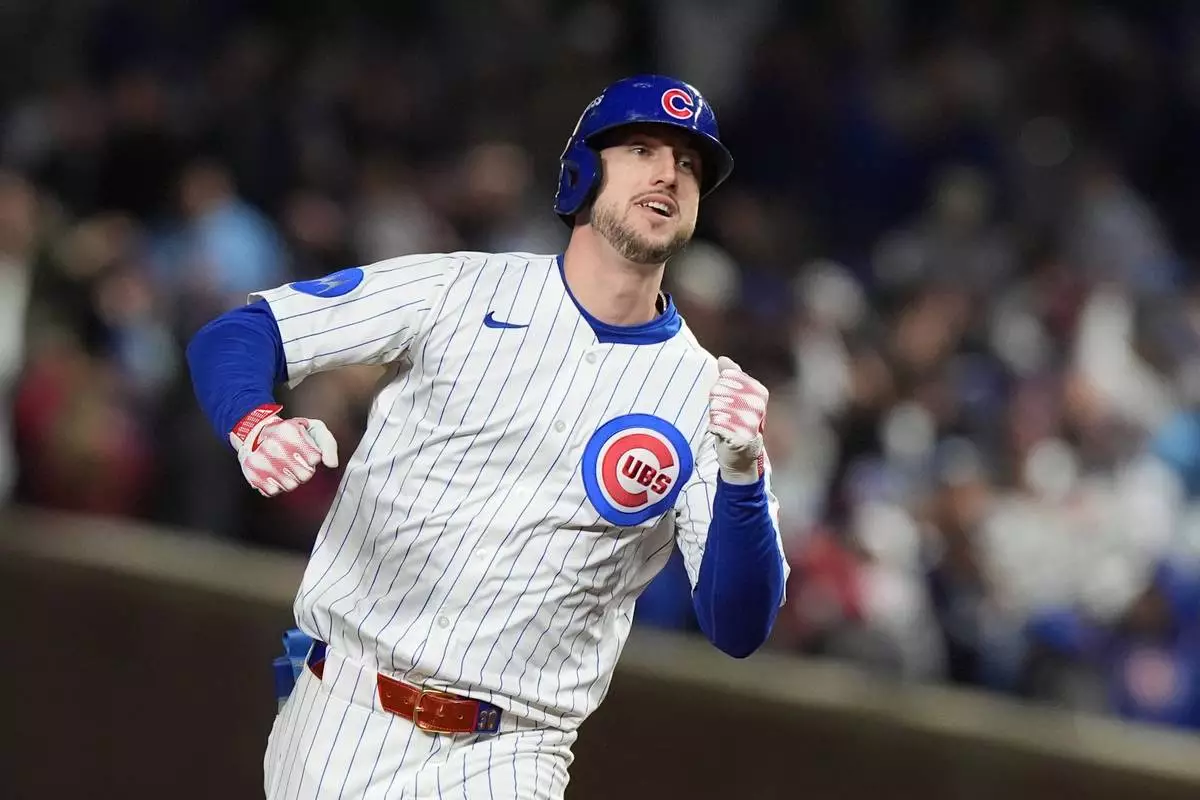
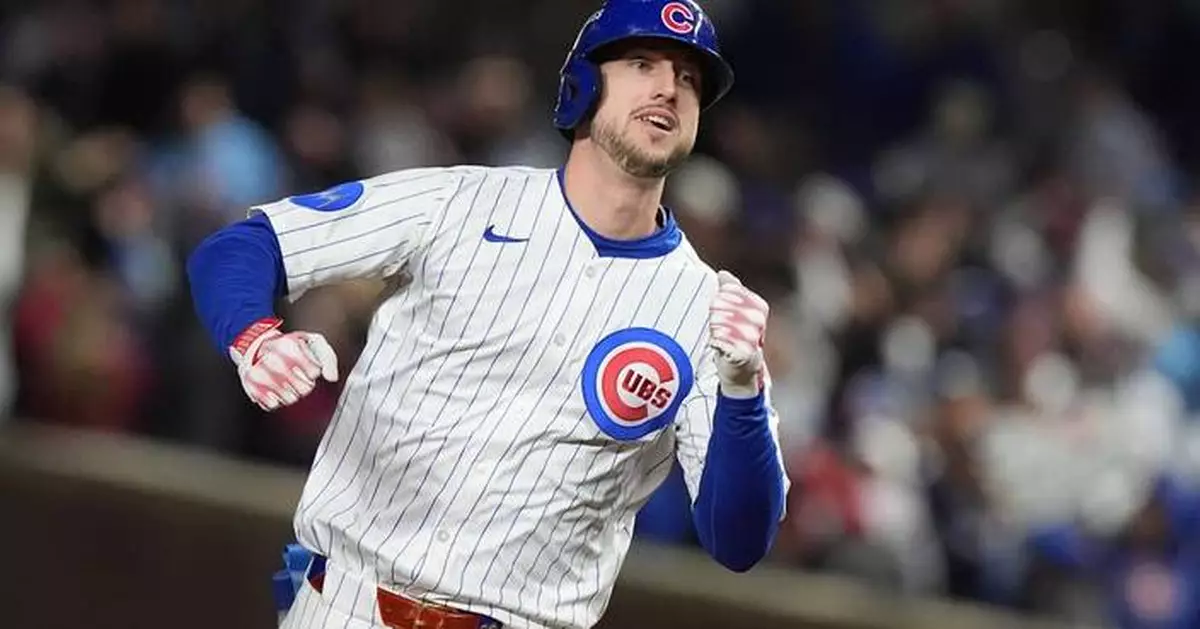
FILE - Chicago Cubs' Kyle Tucker runs the bases after hitting a solo home run during the seventh inning of Game 4 of baseball's National League Division Series against the Milwaukee Brewers, Oct. 9, 2025, in Chicago. (AP Photo/Nam Y. Huh, File)
The first round of primary elections is showing how this year's midterms will be taking place on shifting political ground for incumbents.
That was particularly true in Texas — the first state to redraw its congressional districts last year — where incumbent members of Congress have been pushed to runoffs and another has been scuttled from the House altogether.
Former Rep. Colin Allred, who abandoned his initial U.S. Senate run to pursue Texas' 33rd Congressional District, is headed to a runoff with Rep. Julie Johnson, who holds the U.S. House seat that used to be his.
Democratic Rep. Al Green, an outspoken liberal who has twice been ejected from President Donald Trump’s State of the Union addresses for protesting, and newly elected Rep. Christian Menefee will compete in the May 26 runoff for a Houston-area district.
Rep. Dan Crenshaw, a Republican and former Navy SEAL with an independent streak, faced attacks from the party’s hard right that he was not in lockstep with Trump, and was the state’s only House Republican not to win the president's endorsement. He lost to Steve Toth, a Republican state lawmaker who received late backing from Sen. Ted Cruz.
An incumbent is also in a close race in North Carolina that was too early to call early Wednesday.
A look at where things stand after Tuesday's primaries:
In a North Carolina primary rematch from four years ago, two-term U.S. Rep. Valerie Foushee is angling to hold off a primary challenge from county official Nida Allam in a race testing the heft of Democrats’ progressive and establishment wings.
Foushee, a former local elected official and state legislator, represents the 4th Congressional District, which includes liberal strongholds of Durham, Chapel Hill and Carrboro, as well as about half of Cary. In the primary, she boasts backing from Democratic Gov. Josh Stein, his predecessor and current U.S. Senate nominee Roy Cooper, and more than 100 current or retired elected officials and activist groups.
Allam, a Durham County commissioner backed by Sen. Bernie Sanders, is aiming to tap into discontent among liberals that Democratic Party leaders and elected officials haven’t been forceful enough in resisting the agenda of Trump and fellow Republicans. The daughter of Indian and Pakistani immigrants, she said she was driven to politics by the shooting deaths of three of her friends — Muslim university students — in 2015.
Political action committees spent more than $1 million combined supporting Allam or opposing Foushee, according to campaign finance reports. But Foushee also received a late boost of outside support from a PAC that backs what it calls “sensible” regulation on artificial intelligence.
Whoever wins the Democratic contest should be a heavy favorite in November over Republican and Libertarian candidates. Kamala Harris defeated Donald Trump in the 2024 presidential election in the district by a 2-to-1 margin.
A former House member in Texas' 32nd District, Allred launched a congressional comeback after ditching a second run for the U.S. Senate in December, making the switch after Rep. Jasmine Crockett jumped into the Texas Senate race.
Johnson, an attorney, served six years in the Texas House before winning Allred’s former seat in 2024.
Whoever wins their coming runoff will be the favorite in November to represent a redrawn Dallas-area district that heavily leans Democrat.
Allred was an NFL linebacker for Tennessee Titans before becoming a civil rights lawyer and serving in Congress.
The unusual primary between two sitting Democratic congressmen in Texas was the result of redrawn voting maps that Trump ordered ahead of November’s midterm elections. Green, 78, switched to run in the newly redrawn 18th Congressional District after his current district was redrawn to favor Republicans.
Menefee, 37, was sworn in to Congress only a month ago after winning a special election to fill the remaining term of Rep. Sylvester Turner, who died last year. For some Houston voters, Tuesday’s primary was their third time casting ballots in a congressional race in four months, sowing confusion.
Green, who was first elected to the U.S. House in 2004, is one of his party’s most outspoken Trump critics and filed articles of impeachment during the president’s first term.
The primary is one of the generational competitions among Democrats this year, as younger candidates argue it's time for a new crop of party leaders. Green has faced concerns from within the party, which is increasingly unwilling to defer to seniority.
Crenshaw, seeking his fifth term in Texas’ 2nd Congressional District, was the state’s only House Republican whom Trump didn’t endorse heading into the nation’s first big primary of 2026.
The former Navy SEAL, whose independent streak sometimes clashed with fellow Republicans, spent the primary trying to fend off attacks from the party’s hard right that he wasn't in step with Trump’s agenda.
Toth, a state representative and member of the GOP’s hard-right caucus in the Legislature, picked up a big endorsement late in the primary from Cruz.
“This campaign has been a referendum on representatives who campaign one way and govern another, and the people have spoken,” Toth said in a statement after his victory.
Crenshaw, who lost his right eye when he was hit with an improvised explosive device in Afghanistan in 2012, had clashed with Cruz over the senator’s support of Trump’s unfounded claim that he won the 2020 presidential election.
He was one of the few Texas Republican candidates for Congress in 2022 who acknowledged that President Joe Biden’s victory in 2020 was legitimate, a position that occasionally found him at odds with fellow Republicans.
Crenshaw also drew the ire of conservatives when a video clip went viral of him criticizing some Republican politicians as “grifters” and “performance artists” who simply tell conservative voters what they want to hear.
Associated Press reporter John Hanna contributed to this report.
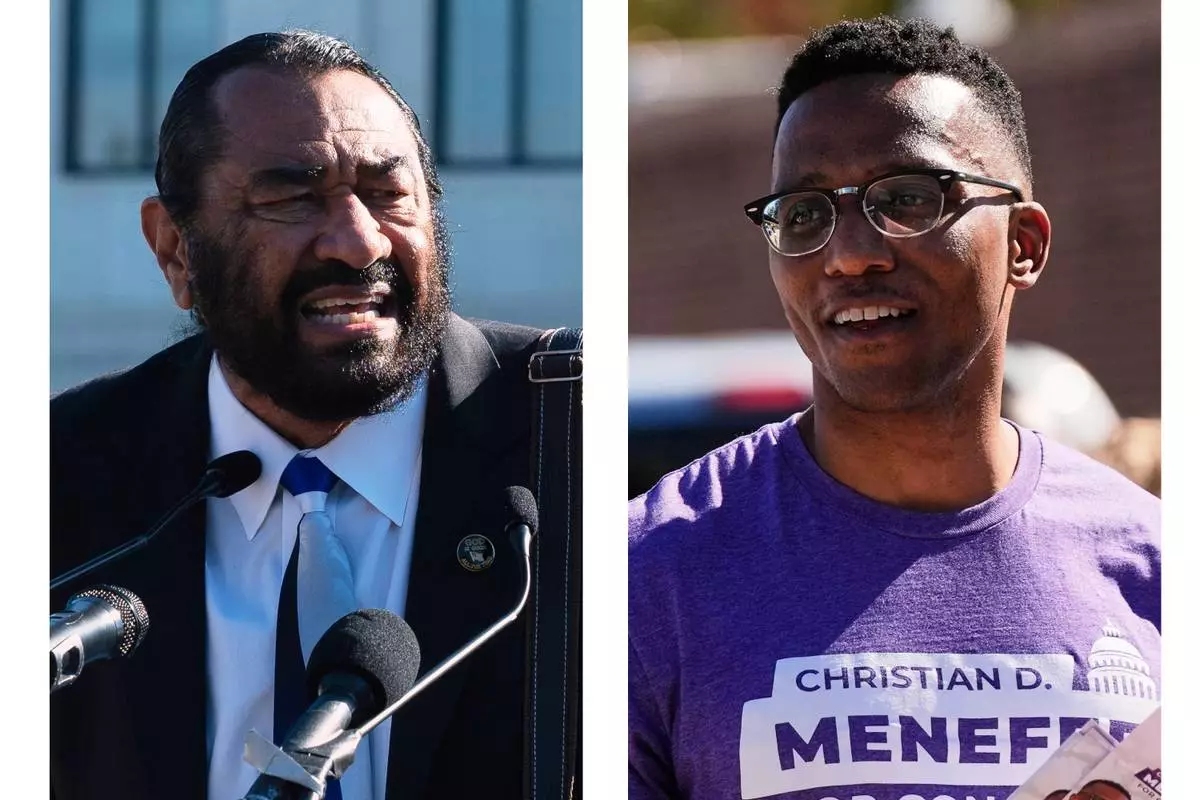
This combination of file images shows Rep. Al Green, D-Texas, in Washington on Oct. 15, 2025, left, and Rep. Christian Menefee, D-Texas, in Houston on Nov. 4, 2025. (AP Photo/Cliff Owen/Ashley Landis)
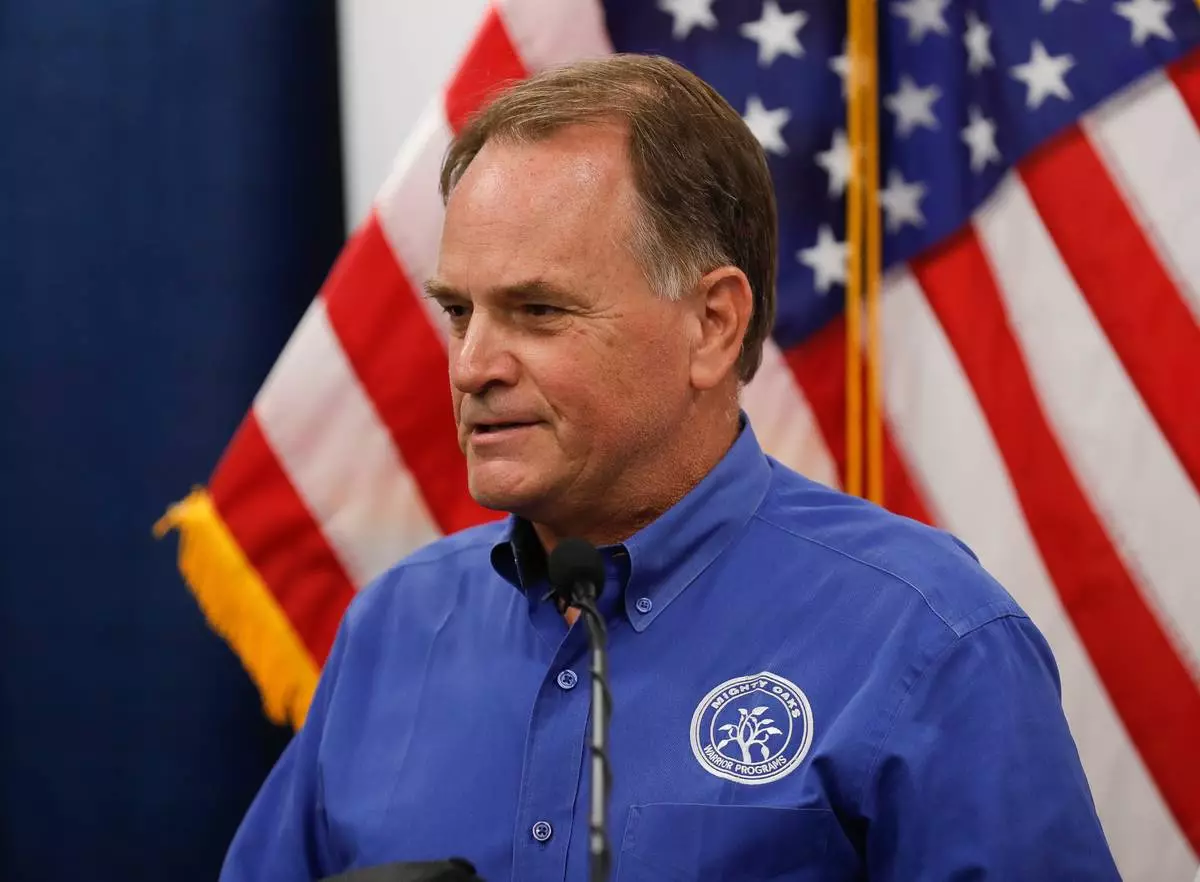
Texas Rep. Steve Toth, R-The Woodlands, speaks during a news conference Tuesday, Aug. 25, 2020, in Porter, Texas. (Jason Fochtman/Houston Chronicle via AP)