REDWOOD CITY, Calif.--(BUSINESS WIRE)--Apr 8, 2025--
Riverbed, the leader in AIOps for observability, today announced a major expansion of the Riverbed Platform—delivering a bold set of AI-powered observability solutions that bring together Riverbed Generative, Predictive and Agentic AI, along with innovative data observability modules for unified communications applications, network packets and Intel® Thunderbolt™ and Wi-Fi connected devices.
Click to Gallery
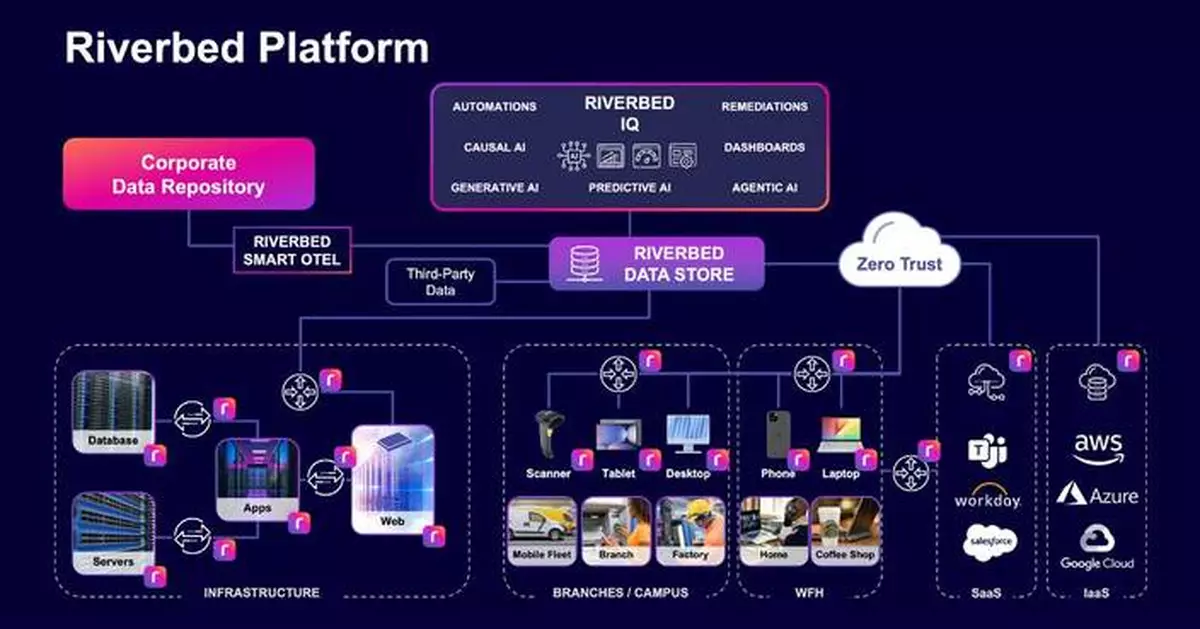
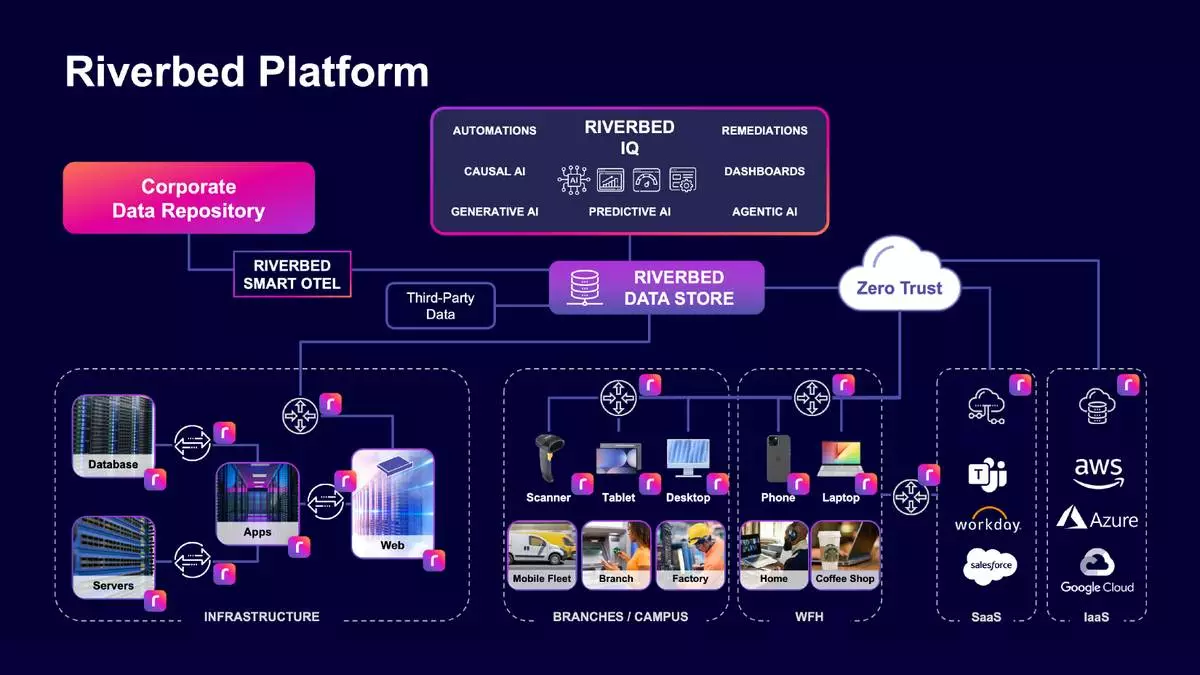
The Riverbed Platform delivers a powerful alternative to fragmented point tools by unifying observability across enterprise IT into an open AI-powered architecture. The Platform provides full-stack, full-fidelity observability across every layer of the digital enterprise, and the architecture includes: the patented Riverbed Data Store, designed to intelligently collect, correlate, and surface only the most relevant data; Riverbed IQ Ops, which applies advanced AI—including Generative, Predictive, Agentic, and Causal capabilities—to automate tasks, accelerate resolution, and prevent issues before they impact users; and Riverbed Smart OTel, enhancing OpenTelemetry by exporting only high-value, targeted data streams—enabling enterprise-grade observability data to fuel critical projects.
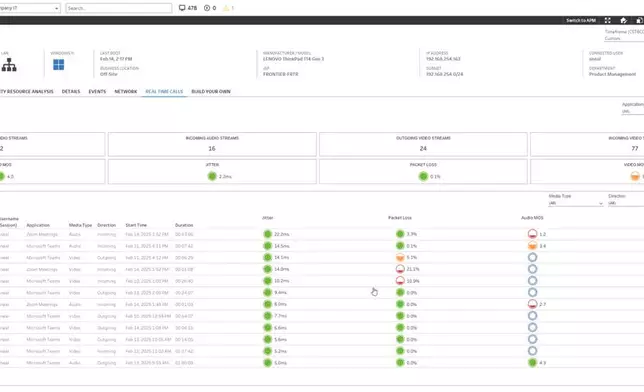
The Riverbed Unified Communications (UC) Module delivers real-time analytics and visibility into platforms like Microsoft Teams, Zoom, and WebEx. When paired with Riverbed IQ Ops, IT teams can shift from reactive to predictive—solving UC issues before they impact user experience.
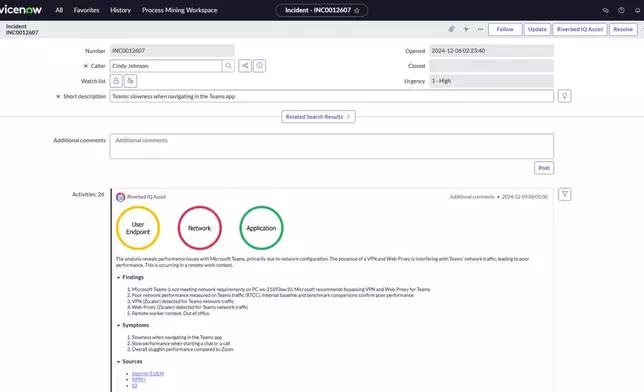
Riverbed IQ Assist™ revolutionizes AIOps, with Generative AI that delivers instant, context-rich insights—with no long chatbot threads or tedious prompts required. IQ Assist surfaces root cause graphically and suggests remediations, empowering IT teams with real answers, right when they need them. IQ Assist integrates with ITSM platforms like ServiceNow, and supports an expanding library of GenAI use cases—or customers can build their own.
The Riverbed Platform delivers a powerful alternative to fragmented point tools by unifying observability across enterprise IT into an open AI-powered architecture. The Platform provides full-stack, full-fidelity observability across every layer of the digital enterprise, and the architecture includes: the patented Riverbed Data Store, designed to intelligently collect, correlate, and surface only the most relevant data; Riverbed IQ Ops, which applies advanced AI—including Generative, Predictive, Agentic, and Causal capabilities—to automate tasks, accelerate resolution, and prevent issues before they impact users; and Riverbed Smart OTel, enhancing OpenTelemetry by exporting only high-value, targeted data streams—enabling enterprise-grade observability data to fuel critical projects.
This press release features multimedia. View the full release here: https://www.businesswire.com/news/home/20250408734177/en/
“Customers want to consolidate observability tools, deploy AI that delivers ROI, and feed their enterprise data repositories,” said Dave Donatelli, CEO of Riverbed. “That’s exactly what Riverbed delivers—and our customers rewarded Riverbed with 102% observability bookings growth in Q1 2025. Our platform enables Riverbed to deliver rapid innovation, as showcased in today’s broad slate of new announcements.”
Watch the Launch Webcast:Riverbed to Unveil Game-Changing AI Observability Solutions
Expanded AI Capabilities with Riverbed Generative, Predictive and Agentic AI
Riverbed customers are running over 64 million Riverbed AI remediations annually and seeing impressive ROI. At the core of today’s announcement is Riverbed’s expanded AI capabilities that make it easier to manage AIOps and go from reactive to predictive IT operations.
“We’re excited about Riverbed’s continued investment in AIOps for Observability, and new innovations and AI capabilities that are now available on the Riverbed Platform,” says Zeno Tadjine, ICT support officer at The Princess Alexandra Hospital NHS Trust. “We recently started using Riverbed’s generative AI solution IQ Assist at the service desk level for troubleshooting, and it’s a great tool to have. IQ Assist serves up insights and recommendations that enables us to resolve issues faster, optimize more workflows and automate AI remediations. In partnership with Riverbed, The Princess Alexandra Hospital NHS Trust is leveraging AIOps to improve IT Service Desk efficiency and clinician productivity, which results in additional time and resources we can allocate towards delivering even better patient care. Riverbed’s IQ Assist will definitely help us enhance user satisfaction.”
New Data Collection Modules to Eliminate IT Visibility Blind Spots
Technology-driven blind spots remain one of the biggest challenges facing enterprise IT. Riverbed is closing those gaps with the launch of three powerful new data collection modules—now available through the Riverbed Unified Agent—providing IT teams with deeper visibility, actionable insights, and the ability to proactively resolve issues before they disrupt the business.
Riverbed is also unveiling enhancements for Aternity, to support cloud-native environments and virtual desktop infrastructures. Kubernetes Operator automates observability for cloud microservices applications, accelerating deployment by up to 300% while freeing IT teams to focus on performance optimization and system reliability. Aternity VDI Intelligence provides expanded support and insights for virtual environments including real-time and multi-session VDI visibility, improving the user experience and enabling proactive optimization. The VDI observability solution includes expanded platform integration including with Citrix, IGEL, ChromeOS, Omnissa (formerly VMware), and Azure Virtual Desktop.
Smart OTel™: Precision Observability to Support Enterprise Data and AI Needs
Today’s announcements follow the release of Riverbed Smart OTel™, an innovate new approach to OpenTelemetry that helps IT teams better support enterprise data and AI projects. While other OTel enabled products dump massive streams of raw telemetry that’s hard to manage, Smart OTel leverages the Riverbed Data Store platform-wide collection to surface the precise data required, and exports that data to any standard OTel collector. Smart OTel also allows customers to convert third-party data into OTel compliant insights, and leverages Riverbed AI automations to further process the data prior to exporting, adding even more precision filtering, all as part of Riverbed IQ Ops.
Riverbed Platform Architecture Provides Unique Value to Enterprise Customers
Launched in 2024, the Riverbed Platform delivers a powerful alternative to fragmented point tools by unifying observability across enterprise IT into an open AI-powered architecture. It provides full-stack, full-fidelity visibility across every layer of the digital enterprise—including applications, networks, endpoint devices, digital employee experience (DEX), public cloud, zero trust, and mobile environments—far beyond the narrow scope of typical monitoring solutions.
At the core of the platform is the patented Riverbed Data Store, designed to intelligently collect, correlate, and surface only the most relevant data. This precision not only reduces noise but also integrates with third-party tools to deliver a holistic view across complex ecosystems. Powering this intelligence is Riverbed IQ Ops which applies advanced AI—including Generative, Predictive, Agentic, and Causal capabilities—to automate tasks, accelerate resolution, and prevent issues before they impact users. Complementing this is Riverbed’s innovative Smart OTel approach, which enhances OpenTelemetry by exporting only high-value, targeted data streams—enabling enterprise-grade observability data to fuel critical projects.
“Organizations today require AI-powered observability solutions that deliver full-fidelity data and streamline the process to extract valuable insights,” said Bob Laliberte, Principal Analyst at theCUBE Research. “With this launch, Riverbed demonstrates its ability to execute, rapidly developing and integrating comprehensive AI observability technologies into its innovative and open platform. The Riverbed Platform is well-suited to enable enterprises to consolidate IT tools, manage complex IT environments, drive significant ROI and improve business outcomes.”
The solutions announced today are all generally available, with the exception of Agentic AI* (Q2 2025) and NPM+ Packet Capture* (2H 2025). For more information on Riverbed’s latest product innovations, visit www.riverbed.com.
About Riverbed
Riverbed, the leader in AIOps for observability, helps organizations optimize their user’s experiences by leveraging AI automation for the prevention, identification, and resolution of IT issues. With over 20 years of experience in data collection and AI and machine learning, Riverbed’s open and AI-powered observability platform and solutions optimize digital experiences and greatly improves IT efficiency. Riverbed also offers industry-leading Acceleration solutions that provide fast, agile, secure acceleration of any app, over any network, to users anywhere. Together with our thousands of market-leading customers globally – including 95% of the FORTUNE 100 – we are empowering next-generation digital experiences. Learn more at riverbed.com.
Riverbed and certain other terms used herein are trademarks of Riverbed Technology LLC. All other trademarks used herein belong to their respective owners.
* This future functionality is not included in the current offering and may be subject to separate pricing and adjusted timing.
Connect with Riverbed
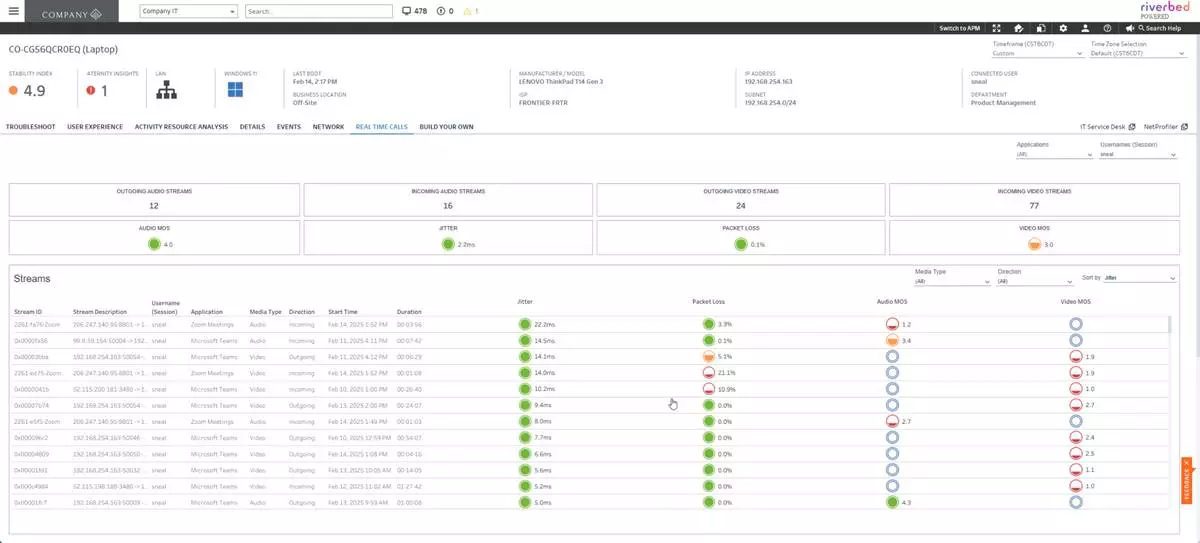
The Riverbed Unified Communications (UC) Module delivers real-time analytics and visibility into platforms like Microsoft Teams, Zoom, and WebEx. When paired with Riverbed IQ Ops, IT teams can shift from reactive to predictive—solving UC issues before they impact user experience.
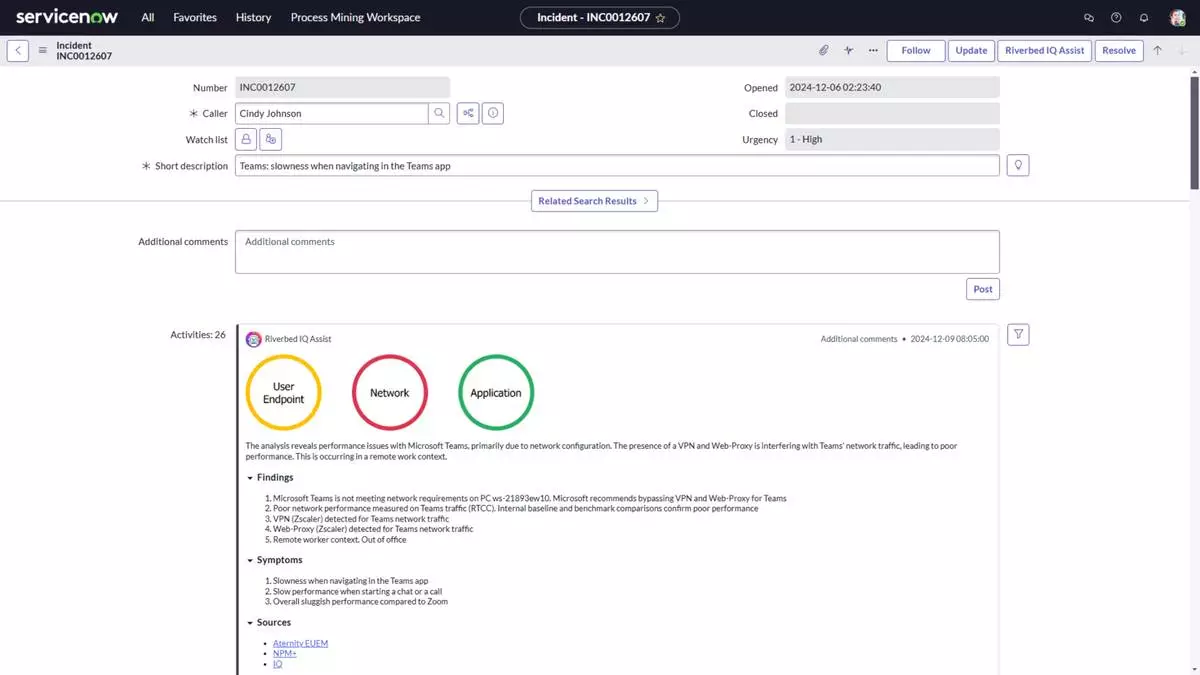
Riverbed IQ Assist™ revolutionizes AIOps, with Generative AI that delivers instant, context-rich insights—with no long chatbot threads or tedious prompts required. IQ Assist surfaces root cause graphically and suggests remediations, empowering IT teams with real answers, right when they need them. IQ Assist integrates with ITSM platforms like ServiceNow, and supports an expanding library of GenAI use cases—or customers can build their own.
The Riverbed Platform delivers a powerful alternative to fragmented point tools by unifying observability across enterprise IT into an open AI-powered architecture. The Platform provides full-stack, full-fidelity observability across every layer of the digital enterprise, and the architecture includes: the patented Riverbed Data Store, designed to intelligently collect, correlate, and surface only the most relevant data; Riverbed IQ Ops, which applies advanced AI—including Generative, Predictive, Agentic, and Causal capabilities—to automate tasks, accelerate resolution, and prevent issues before they impact users; and Riverbed Smart OTel, enhancing OpenTelemetry by exporting only high-value, targeted data streams—enabling enterprise-grade observability data to fuel critical projects.
Tulsi Gabbard resigned as President Donald Trump’s director of national intelligence on Friday, saying she needed to step away as her husband battles cancer. She is the fourth Cabinet official to depart during Trump’s second term. There had been rumblings that Gabbard would split with the president after he decided to strike Iran, which caused some division within his administration.
Trump is heading to a toss-up congressional district in New York to test his midterm message on the economy, even as voters largely disapprove of his stewardship of it. The focus of the event is to promote the tax law Trump signed last year, particularly the quadrupling of the deduction for state and local taxes, which is critical in a high-tax state like New York.
Trump on Thursday said the U.S. will send an additional 5,000 troops to Poland, stirring confusion following weeks of changing statements from Trump and his administration about reducing — not increasing — the American military footprint in Europe. And in Sweden, Secretary of State Marco Rubio faced NATO allies confused by contradictory administration statements.
The Latest:
In a social media post, the president wrote that Gabbard was “unfortunately” leaving his administration at the end of June.
“Her wonderful husband, Abraham, has been recently diagnosed with a rare form of bone cancer, and she, rightfully, wants to be with him,” Trump wrote.
He added, “Tulsi has done an incredible job, and we will miss her,” and that Gabbard’s “highly respected Principal Deputy Director of National Intelligence, Aaron Lukas, will serve as Acting Director of National Intelligence.”
Gabbard has resigned as Trump’s director of national intelligence, saying she needed to step away as her husband battles cancer.
She is the fourth Cabinet official to depart during Trump’s second term. In her resignation letter, which she posted on the social platform X, she wrote: “Unfortunately, I must submit my resignation, effective June 30, 2026. My husband, Abraham, has recently been diagnosed with an extremely rare form of bone cancer.”
There had been rumblings that Gabbard would split with Trump after he decided to strike Iran, which caused some division within his administration. Joe Kent, the director of the National Counterterrorism Center, announced his resignation in March, saying he “cannot in good conscience” support the war.
Gabbard, a veteran and former Democratic congresswoman from Hawaii known for opposing foreign wars, faced an awkward moment when the U.S. joined Israel’s attacks on Iran on Feb. 28.
▶ Read more
Sen. Roger Wicker, the GOP chair of the Senate Armed Services Committee, is telling Trump not to settle for a peace deal with Iran.
In a statement, Wicker says the president “is being ill advised to pursue a deal that would not be worth the paper it is written on.”
“Our commander-in-chief needs to allow America’s skilled armed forces to finish the destruction of Iran’s conventional military capabilities and reopen the strait,” he added.
Wicker’s statement stands in contrast to the position of a small but crucial number of Republicans who are calling on Trump to end a war that he started without congressional approval.
GOP leaders in both chambers have struggled this week to find the votes necessary to defeat war powers resolutions brought by Democrats that would compel Trump to end the war. A handful of Republicans have switched their votes to try to end the war.
Warsh, in his remarks, said he saw former Fed chair Alan Greenspan as a model for the role, explaining that the Fed can help with the nation’s prosperity.
“Our mandate at the Fed is to promote price stability and maximum employment. When we pursue those aims with wisdom and clarity, independence and resolve — inflation can be lower; growth, stronger; real take-home pay, higher,” Warsh said.
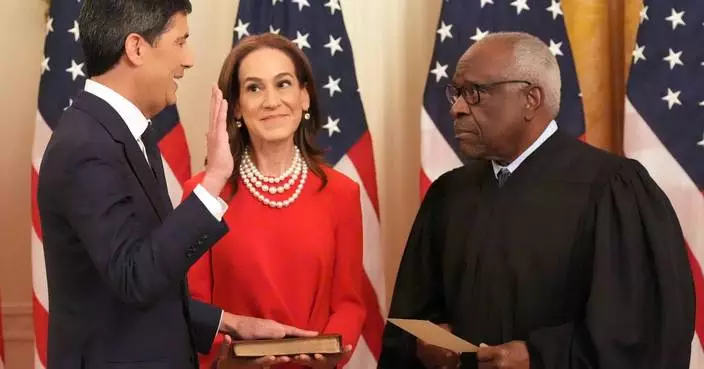
Kevin Warsh has been sworn in as Fed chair by Supreme Court Justice Clarence Thomas.
Warsh said it was an honor to be sworn in by his “esteemed friend,” Thomas. He explained Kavanaugh’s presence by telling the audience the two of them had worked at the White House earlier in their careers.
He’s also talking about former Fed chair Alan Greenspan, calling him an idol.
Greenspan was sworn in at the White House by President Ronald Reagan.
Warsh said that, like Greenspan, he intends to fill the role of Fed chair “with energy and purpose.”
“I really mean this. This is not said in any other way,” Trump said. “I want Kevin to be totally independent. I want him to be independent and just do a great job.”
“Don’t look at me, don’t look at anybody. Just do your own thing and do a great job, okay?” he added.
The pressure Trump placed on outgoing Fed chair Jay Powell to lower interest rates raised questions about the independence of the Federal Reserve.
The East Room was packed for the ceremony, which usually is held at the Federal Reserve Building.
Among those attending are Kevin Hassett, director of the National Economic Council and at one point a top contender to succeed Jay Powell as Fed chair, until Trump decided he wanted to keep Hassett at the White House.
Supreme Court Justice Clarence will deliver the oath. Supreme Court Justice Brett Kavanaugh was also present, as were members of Trump’s Cabinet, other top Trump administration officials, and current and former members of Congress.
Trump opened with praise for Warsh, predicting that he “will go down as one of the truly great chairmen of the Federal Reserve.”
“I think he’s got abilities that very few people have,” Trump said.
When Acting Attorney General Todd Blanche signed off on a nearly $1.8 billion fund meant to compensate Trump’s allies for alleged political prosecution, he may have pleased his boss. But the eyebrow-raising move — has agitated the same Republican lawmakers he would need to secure the permanent job.
Blanche insists he’s not auditioning for the job of attorney general. But a succession of splashy steps taken under his watch at the Justice Department, including an indictment of former FBI Director James Comey, have left no doubt that he’s trying to prove his loyalty to the president.
The fund in particular has put Blanche at the center of a Republican firestorm just when he aims to establish himself as the perfect person for the job for the remainder of Trump’s term. Read more
Texas Attorney General Ken Paxton is riding high ahead of his Republican primary runoff against Sen. John Cornyn, now that he has the president’s backing.
“I don’t know if y’all noticed this, but Donald Trump endorsed me,” Paxton told a small rally in a town outside Austin, inciting whoops and applause.
The senate race in Texas has drawn gobs of money and attention, including from Trump, who continues encouraging voters to boot any politician who displeases him.
Paxton has been turning his focus to state Rep. James Talarico, opening his latest event with attacks on the Democratic nominee, a sign of his confidence heading into Tuesday.
▶ Read more:
Democrats are cheering rulings by federal judges in Maine and Wisconsin that dismissed Justice Department demands for detailed voter registration information.
The DOJ has sued at least 30 states and the District of Columbia seeking to force the release of voter information including dates of birth, addresses, driver’s license numbers and partial Social Security numbers. Thursday’s defeats follow similar rulings in Arizona, California, Massachusetts, Michigan, Oregon and Rhode Island, In Georgia, a judge dismissed a DOJ lawsuit filed in the wrong city, prompting the Trump administration to refile elsewhere.
Bianca Shaw, state director of Common Cause Wisconsin, said the decision protects voters “from an unauthorized national database that would have been a goldmine for hackers and a tool for intimidation.”
Maine Secretary of State Shenna Bellows, a Democrat and Trump opponent who is running for governor, said the ruling affirms that states run elections.
Trump has a reputation for slashing his taxes using techniques that some experts find aggressive. Now the Justice Department has told the president he doesn’t have to worry about being called out on it.
In an extraordinary decision this week, the IRS is suspending probes into his past returns to settle a lawsuit that Trump brought against the agency he ultimately runs. Trump says tax authorities targeted him politically — a claim for which he has given no proof — and that he was right to seek a remedy.
Law experts say the move is unprecedented and unfair.
“This is giving the president and his affiliates completely different set of rules than everyday taxpayers,” said Brandon DeBot, policy director at New York University’s Tax Law Center.
▶ Read more:
“Iran is trying to create a tolling system,” Rubio said. “That’s just not acceptable. It can’t happen. If that were to happen in the Straits of Hormuz, it will happen in five other places around the world.”
Iran’s official Mizan news agency reported that 35 vessels passed through the Strait of Hormuz in coordination with Iran’s Revolutionary Guard navy in the previous 24 hours.
Without specifying the nationalities of the vessels, Mizan quoted the Revolutionary Guard navy as saying that the oil tankers, container ships and other commercial ships transited the strait after obtaining permission and in coordination with, and under the protection of, the Revolutionary Guard navy.
Iran has demanded the right to collect the tolls as a precondition for reopening the waterway vital to world oil supplies.
The Trump administration remains ready to resume mediation efforts that have been stalled for some time, Rubio said.
With concerns high in Europe, particularly in the Baltic states, that the administration’s interest in ending the conflict is waning, Rubio told reporters that the U.S. still believes the “the war can only end with a negotiated settlement. It will not end with a military victory by one side or the other.”
Previous rounds of talks were unfortunately “not fruitful,” Rubio said, but “if we see an opportunity to pull together talks that are productive, not counterproductive, and that have the chance to be fruitful, we’re prepared to play that role.”
The secretary of state said he and other foreign ministers discussed the issue of reopening the critical waterway, and that he reiterated the need for a “Plan B” if a deal isn’t reached between Washington and Tehran.
“Someone’s going to have to do something about it, okay?” Rubio said. “They’re not just going to voluntarily reopen the straits in that scenario.”
Rubio said he received lots of “nods” from European allies when he brought it up Friday. In the same breath, Rubio confirmed what Iranian officials had been saying, that progress is being made in the negotiations.
“I wouldn’t exaggerate it and I wouldn’t diminish it,” he said. “But there’s more work to be done.”
Rubio says America’s NATO allies understand that eventually there will be a reduction in the U.S. troop presence in Europe as the Trump administration evaluates its force posture globally.
“I think there’s a broad recognition that there are going to be eventually less U.S. troops in Europe than there has historically been for a variety of reasons,” Rubio told reporters.
NATO allies have been confused by contradictory statements coming from Trump and his top aides, including an announcement last week that troop levels would be reduced in Poland that Trump appeared to reverse on Thursday. A previously announced troop reduction in Germany appears to be going ahead but Rubio noted that the Germans “didn’t freak out about it” because it brought the numbers back to where they were three years ago.
The U.S. secretary of state has met with his NATO foreign minister counterparts in Sweden and reiterated U.S. demands for Europe and Canada to increase their defense spending and military industrial capabilities.
In meetings with his colleagues in Helsingborg on Friday, Rubio said the U.S. remains committed to NATO but said the force posture of American troops in Europe is contingent on what allies contribute. The alliance has been jolted by Trump’s abrupt decisions on troop deployments.
Trump has expressed strong dissatisfaction with some allies and their reluctance or refusal to assist in the war with Iran. Rubio said the president’s views and “frankly, disappointment at some of our NATO Allies and their response to our operations in the Middle East, they are well documented” and need to be addressed by NATO leaders at their summit in Turkey in July.
While the president’s handpicked candidates are winning GOP primaries, many are untested heading into general elections this fall. Trump’s own approval rating sits at a low point, and he’s spending his political capital, alienating would-be allies and threatening to detail GOP priorities.
Trump’s announcement of nearly $1.8 billion “anti-weaponization” fund for people he believes were wrongly prosecuted blindsided senators already fuming over his push for $1 billion to provide security for his new White House ballroom. The audacity of the arrangement proved too toxic for the Senate to bear.
Sen. Thom Tillis of North Carolina called it “stupid on stilts” and a “payout for punks.”
“So the nation’s top law enforcement official is asking for a slush fund to pay people who assault cops? Utterly stupid, morally wrong — Take your pick,” said Sen. Mitch McConnell of Kentucky, the former majority leader.
Voting on a roughly $70 billion budget package that would fuel Trump’s immigration and deportation operations for the remainder of his presidential term, into 2029, was postponed until Congress resumes next month. That blows Trump’s June 1 deadline to have it on his desk.
Trump shrugged when asked during an Oval Office event if he was losing control of the Senate.
“I really don’t know,” the president said.
And it wasn’t just the Senate. For the first time this year, enough Republican House members broke ranks to signal support for a war powers resolution from Democrats that’s designed to halt Trump’s military action in Iran. House Speaker Mike Johnson postponed the voting to avoid confronting the president.
Trump’s political revenge tour met its potential match this week as angry Republican senators, pushed to a breaking point by his seemingly insatiable and outlandish demands — particularly a $1.776 billion fund for Jan. 6 rioters and others he believes were wrongly prosecuted — did the unthinkable.
They simply refused, closed up shop, and went home.
The moment was as rare as it was daring, a sudden flex from the Congress that has become a shell of its former self as a coequal branch, the Republican majority almost always more willing to accommodate the Republican president than to confront him.
▶ Read more:
Rubio says America’s NATO allies understand that eventually there will be a reduction in the U.S. troop presence in Europe as the Trump administration evaluates its force posture globally.
“I think there’s a broad recognition that there are going to be eventually less U.S. troops in Europe than there has historically been for a variety of reasons,” Rubio told reporters.
NATO allies have been confused by contradictory statements coming from Trump and his top aides, including an announcement last week that troop levels would be reduced in Poland that Trump appeared to reverse on Thursday. A previously announced troop reduction in Germany appears to be going ahead but Rubio noted that the Germans “didn’t freak out about it” because it brought the numbers back to where they were three years ago.
The U.S. secretary of state has met with his NATO foreign minister counterparts in Sweden and reiterated U.S. demands for Europe and Canada to increase their defense spending and military industrial capabilities.
In meetings with his colleagues in Helsingborg on Friday, Rubio said the U.S. remains committed to NATO but said the force posture of American troops in Europe is contingent on what allies contribute. The alliance has been jolted by Trump’s abrupt decisions on troop deployments.
Trump has expressed strong dissatisfaction with some allies and their reluctance or refusal to assist in the war with Iran. Rubio said the president’s views and “frankly, disappointment at some of our NATO Allies and their response to our operations in the Middle East, they are well documented” and need to be addressed by NATO leaders at their summit in Turkey in July.
“Who do they think they are to judge Raúl?” Gerardo Hernández asked as the crowd cheered. He’s one of five Cubans accused of being a spy who was imprisoned and later released by the U.S. in 2014.
“For the United States, the law is a tailor-made suit,” he said before punching the air with this fist, to a shout of “Viva Raúl!”
The crowd responded to his call: “Homeland or death, we will vanquish!”
Thousands of people have crowded along Havana’s famed seawall to decry the U.S. indictment. Attendees include daughter, Mariela Castro, and his grandson, Raúl Guillermo Rodríguez Castro. Salsa songs with biting anti-Trump lyrics are booming across the old city.
The Castro indictment has many thinking the Trump administration is following a playbook it used to capture then-Venezuelan President Nicolás Maduro in a military operation in January. Maduro is now imprisoned in the U.S. on federal drug trafficking charges and has pleaded not guilty.
The U.S. military touted the arrival of the USS Nimitz aircraft carrier group for maritime exercises in the Caribbean Sea as the charges against Castro were announced. But professor William LeoGrande, a Latin America specialist at American University, warned against assumptions that a Maduro-like extraction would succeed in Cuba.
“The United States certainly has the military capability to seize Raúl Castro, just as they seized Maduro, although it would probably be more costly,” LeoGrande said. But Castro has been retired for almost a decade. “He still has influence and the leadership seeks his opinion on major decisions, but he is not running the government on a day-to-day basis. If the US were to abduct him, it would not change the operations of government, unlike what happened in Venezuela.”
A huge crowd of Cubans rallied Friday outside the U.S. Embassy in Havana to honor former President Raúl Castro and to protest the Trump administration’s criminal indictment.
“The Cuban people reaffirm that neither threats, nor blockade, nor energy embargo, nor false accusations will be able to break the will of an entire people in defense of their Revolution,” read a statement published by state media.
Raúl Castro has rarely appeared in public since stepping down and handing over to President Miguel Díaz-Canel, who was joined by military leaders at the rally.
Castro was last seen surrounded by tens of thousands of people at a state-organized rally on May 1.
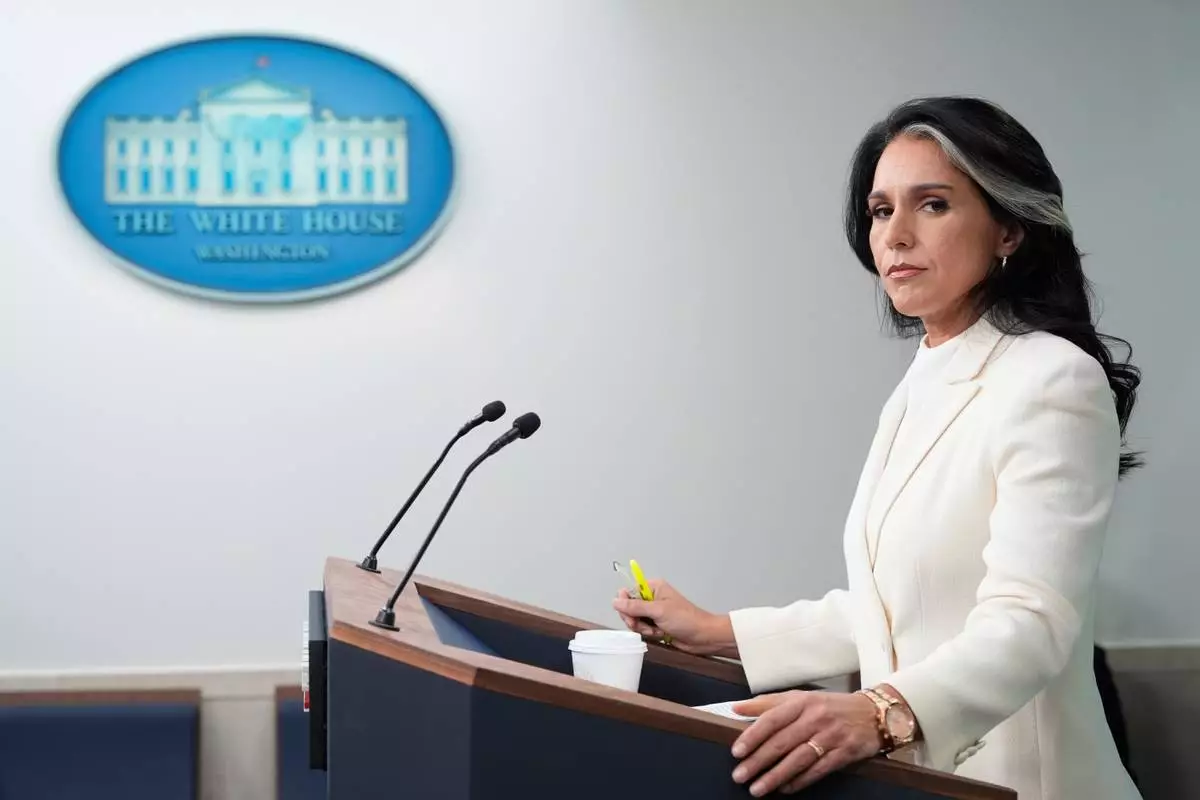
FILE - Director of National Intelligence Tulsi Gabbard speaks with reporters in the James Brady Press Briefing Room at the White House, July 23, 2025, in Washington. (AP Photo/Alex Brandon, File)
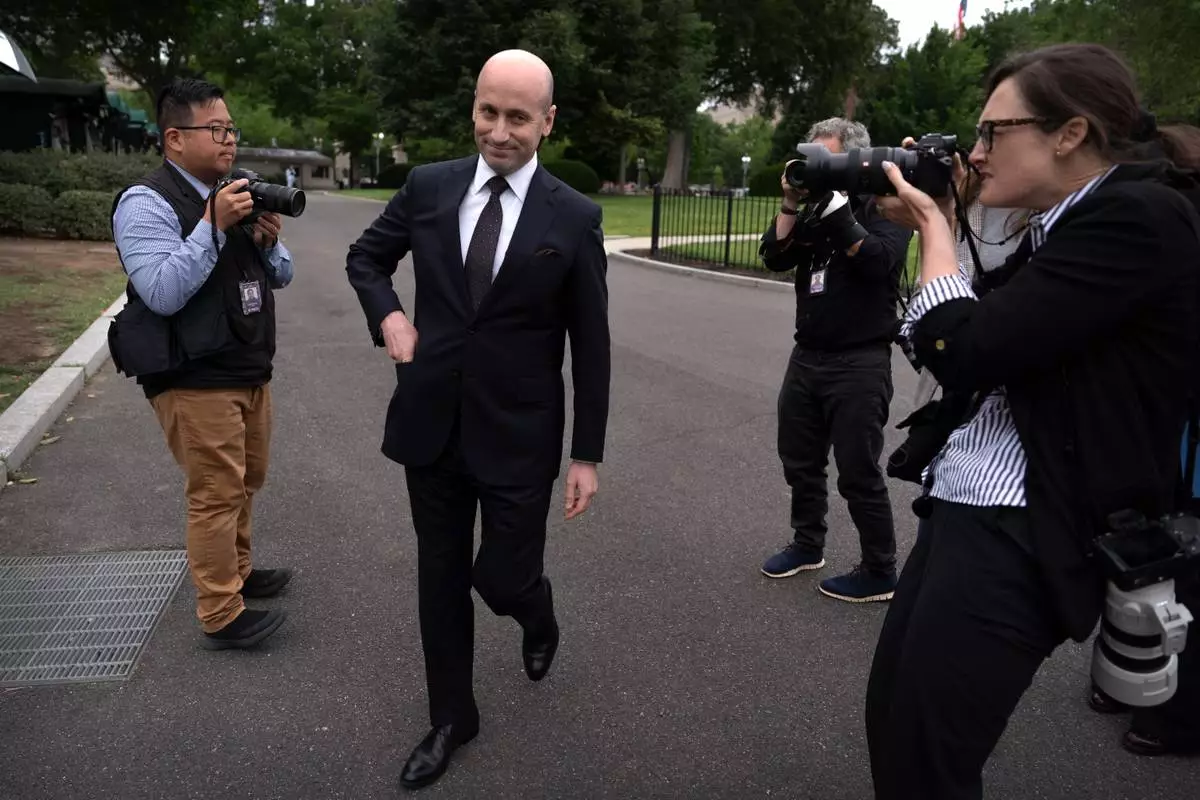
Stephen Miller, White House deputy chief of staff, leaves after speaking to reporters outside the White House, Thursday, May 21, 2026, in Washington. (AP Photo/Mark Schiefelbein)

Work continues on the construction of the ballroom at the White House, Thursday, May 21, 2026, in Washington, where the East Wing once stood, as work also begins for the upcoming UFC fight on the South Lawn. (AP Photo/Pablo Martinez Monsivais)

President Donald Trump speaks to reporters aboard Air Force One, Friday, May 15, 2026, as he returns from a trip to Beijing, China. (AP Photo/Mark Schiefelbein)