The "reciprocal tariffs" announced by U.S. President Donald Trump last Wednesday have sparked strong discontent among the Italians, who believe the tariff policy is damaging Italy's interests and undermining global trade system.
In 2024, Italian exports to the United States took up 10 percent of its total exports, according to data from Italian National Institute of Statistics released in March. The value of Italian exports to the United States reached 65 billion euros (about 71.31 billion U.S. dollars) last year, according to the Italian industry association Confindustria. Italian media analysis suggests that Italy is one of the European Union countries most severely impacted by the U.S. tariffs.
Local residents in Rome expressed opposition to the U.S. tariff policy, viewing it as detrimental to Italy's relevant industries.
"The U.S. tariffs will bring serious issues to international trade. The Trump administration's policy is erroneous and unacceptable for the international trade system," said Pietro, a resident.
"The U.S. is imposing tariffs on islands inhabited solely by penguins. It is imposing tariffs on everyone in the world," said Elena, another resident.
Meanwhile, fears are also mounting among Italians over the potential repercussions on the global trade landscape.
"Imposing tariffs will undoubtedly have a severe impact on the economy. Levying tariffs amidst ongoing global conflicts brings no benefits to the economy. Provoking a trade war in this moment of 2025 is detrimental to the entire world," said Simone, also a resident.
"I believe the U.S. tariff policy is a complete disruption to the economy and democratic systems. The U.S. tariffs will face repercussions, benefiting only organized crime in the end. With the raised tariffs, goods will flow to the black market through organized crime, reminiscent of the prohibition era in the U.S. in the 1930s. Similar consequences are likely to occur this time," said Donata, another resident.

Italian residents condemn US tariffs for undermining global trade system

Italian residents condemn US tariffs for undermining global trade system
U.S. stocks extended losses on Friday as an unexpectedly weak employment report and surging oil prices tied to the ongoing Middle East conflict heavily weighed on investor sentiment.
The Dow Jones Industrial Average fell 0.95 percent to 47,501.55. The S and P 500 sank 1.33 percent to 6,740.02. The Nasdaq Composite Index shed 1.59 percent to 22,387.68.
Nine of the 11 primary S and P 500 sectors ended in the red. The consumer discretionary and materials sectors led the laggards, dropping 1.96 percent and 1.89 percent, respectively. Consumer staples and energy managed slight gains, advancing 0.29 percent and 0.13 percent, respectively.
The February jobs report dealt a blow to market confidence, revealing that non-farm payrolls unexpectedly contracted by 92,000, widely missing market expectations of a 55,000-job addition. Consequently, the national unemployment rate rose to 4.4 percent.
While the weak data quashed notions of a stabilizing labor market, analysts suggested the Federal Reserve is unlikely to cut interest rates this month because the energy price shock poses a significant risk of reigniting inflation.
San Francisco Federal Reserve President Mary Daly noted in a media interview that the report commands attention, acknowledging that the labor market may be weaker than previously observed.
Global oil prices surpassed 90 U.S. dollars per barrel on Friday. Tanker traffic in the critical Strait of Hormuz has slowed to a near-standstill, raising concerns that Gulf exporters may soon be forced to halt production due to depleted storage capacity.
The broader market sell-off dragged down major technology shares, with the "Magnificent Seven" closing mostly lower. In earnings news, Marvell Technology soared 18.35 percent to pace the Nasdaq, while Gap dropped 14.41 percent.
Financial equities also faced pressure with BlackRock down 7.17 percent, marking its worst trading session since April 4. The steep decline followed the investment management firm's unprecedented decision to cap client withdrawals from one of its private credit funds, signaling potential growing stress within the broader credit markets.
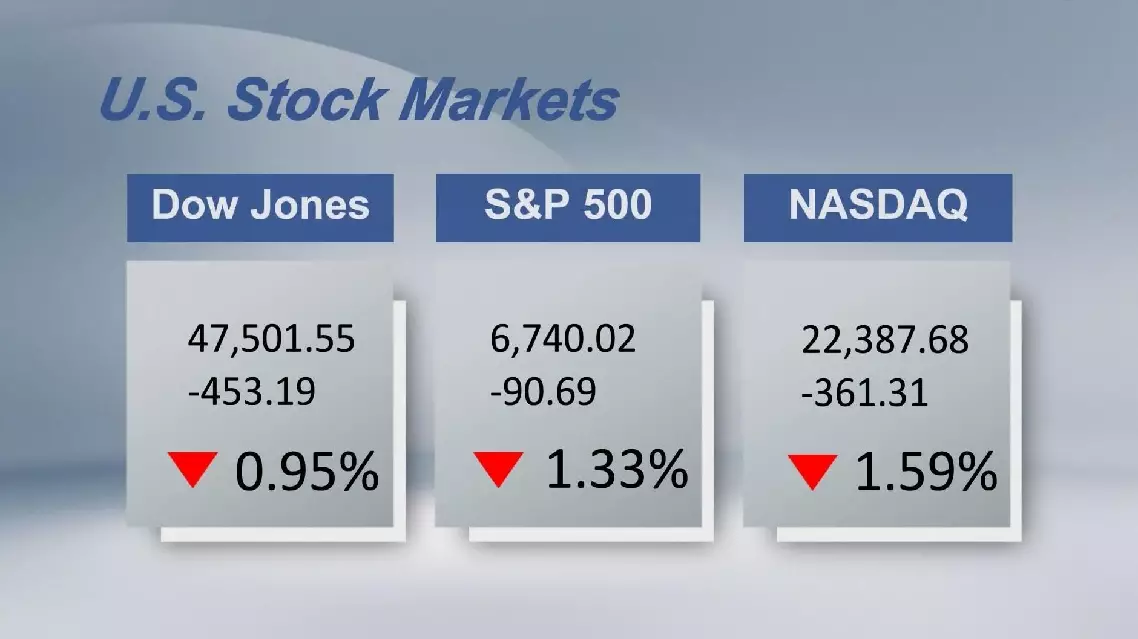
U.S. stocks drop amid weak jobs data