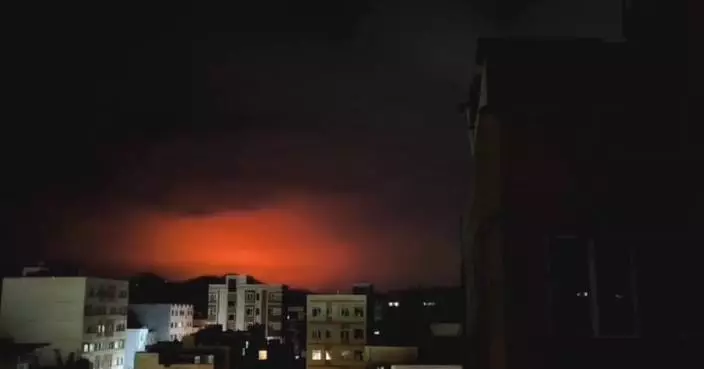
Israel announced on Friday that it had renewed airstrikes against Iran, while Iran launched two new waves of attacks on Israel using a large number of missiles.
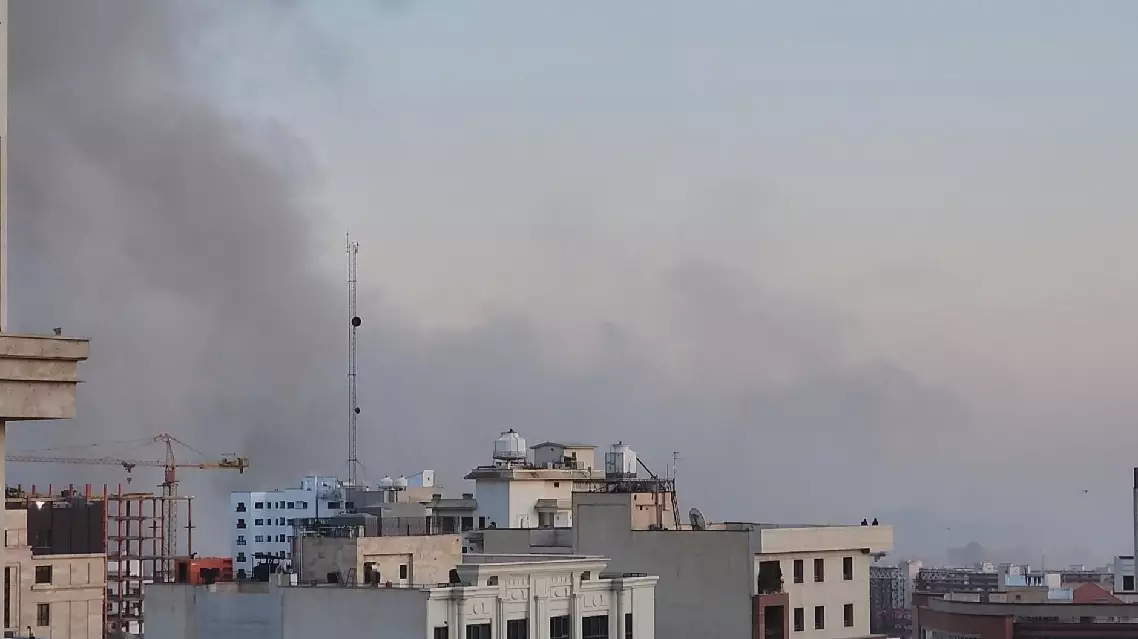
Huge explosions were heard in Tehran on Friday afternoon, according to China Central Television (CCTV) reporter Li Jiannan.
"It's around 18:00 local time on the 6th. Just a few minutes ago, as you can see in the direction I'm pointing, there are multiple explosions not far from our reporting point, with thick smoke billowing from these sites," Li said, reporting from the scene.
The Israel Defense Forces (IDF) announced on Friday afternoon that the Israeli Air Force had launched a new wave of airstrikes against Iranian regime targets in Tehran and Isfahan, marking the 15th wave of strikes on Tehran since the United States and Israel launched joint military attacks on Iran a week ago.
Iran's semi-official Tasnim news agency reported the same day that the United States and Israel attacked residential areas in Ilam Province, destroying multiple residential buildings.
In addition, an official in Qom Province said that three locations in Qom were also hit in the new wave of U.S.-Israeli attack.
The IDF said in a statement on Friday that it dismantled an underground bunker beneath the Iranian leadership compound in central Tehran.
Approximately 50 Israeli Air Force fighter jets dropped about 100 bombs on the site, it said.
The IDF alleged that the bunker was intended for use by Iran's late Supreme Leader Ali Khamenei as a secure emergency command center, although he was killed at the start of the U.S.-Israeli attack on Saturday.
It alleged that the compound continued to be used by senior Iranian officials, adding that it spanned multiple streets in central Tehran and included several entrances and meeting rooms for senior members of the Iranian government.
The Islamic Revolution Guard Corps (IRGC) said in a statement on Friday that it had launched the 22nd wave of Operation True Promise 4 against Israel, using a large number of ballistic missiles, including its latest super-heavy Khorramshahr-4.
The missiles were fired "directly into the heart of the occupied territories," the statement said.
U.S. and Israeli military bases in Gulf countries, Tel Aviv, Ben Gurion Airport, and military sites in Haifa were all targeted by Iranian missiles.
On Friday evening, the IRGC announced it had launched the 23rd wave of Operation True Promise 4, using drones and missiles to strike U.S. and Israeli targets.
Israel's emergency services, Magen David Adom, said that no casualties had been reported following Iran's latest wave of missile attacks on central Israel.
The IRGC also claimed its missiles and drones destroyed U.S. THAAD radars stationed in the United Arab Emirates (UAE) and Jordan, as well as the U.S. FPS-132 radar in Qatar, according to Iranian media reports.
Iran's semi-official Fars News Agency, citing an IRGC official, reported that a new style of attacks using next-generation missiles will be introduced against U.S. and Israeli targets in the coming days.
The official said the production of missiles and missile systems continues uninterrupted on assembly lines in Iran, but did not provide further details.
The death toll from the U.S. and Israeli airstrikes on Iran has reached 1,332, according to the Iranian Red Crescent Society.
The U.S.-Israeli attacks have damaged 3,643 civilian sites across Iran, including 3,090 homes and 528 commercial and service facilities.
Israel, Iran trade airstrikes as war enters 7th day