Skip to Content Facebook Feature Image

Venezuelan immigrant shares harrowing ordeal at Guantanamo Bay prison

China

China

China

Venezuelan immigrant shares harrowing ordeal at Guantanamo Bay prison

2025-04-10 19:52 Last Updated At:21:27

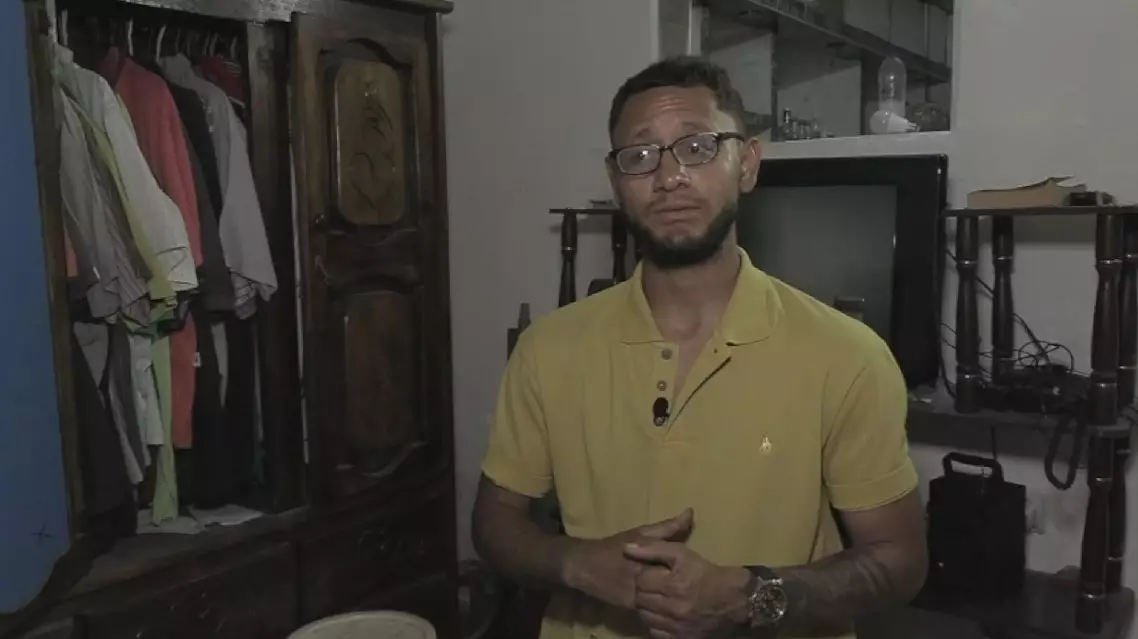
A Venezuelan immigrant, now safely back in his hometown of Maracay, Venezuela, revealed the harrowing ordeal he faced during two weeks of detention at the U.S. military prison in Guantanamo Bay, Cuba.

The prison has long been infamous for its severe human rights violations. Recently, the U.S. government began transferring immigrants from several countries to this facility.

Diuvar Uzcategui (transliteration), detained at Guantanamo in February of this year, described enduring unbearable conditions during his two-week confinement. He recounted his pitch-black, filthy cell and rare outings to the "yard," a recreation area with four cages, which officials called "entertainment."

"[The cell is] about two meters by two meters in size. Inside, there is a cement bed, and the toilet is extremely dirty, with a completely rusted iron close stool. A small stool serves as a dining table, and there is a red door with a hole in it. They would pass food through a small window," he said.

He revealed that what officials termed "prisoner's recreation" was essentially being moved from his less than four-square-meter cell to a slightly larger cage. This stark contrast only added to the dehumanizing environment he endured.

"In the 14 days I was there, I was taken to the "yard" three times for "entertainment," which is what they call recreation. There were four cages in the yard. To me, it felt like when lions or tigers are put in a cage," he said.

Uzcategui recounted one particularly haunting incident involving a fellow detainee, who attempted to take his own life during a moment of despair.

"One of my fellow detainees, in despair, tried to hang himself with a bedsheet. The soldiers came in, grabbed him, and twisted his arm. Because he had tried to commit suicide, they took all his belongings and left him completely naked. Sometimes, they would tie him to a chair," he said.

According to Venezuelan media reports, many Venezuelan undocumented immigrants have no criminal record, but have been unjustly detained at the Guantanamo prison during their deportation process and cut off from all external contact.

"The direct transfer of Venezuelans to overseas prisons without judicial procedures is unprecedented in U.S. legislative history. This highlights America's double standards on human rights issues," said Mary Montoya, a lawyer.

"[The U.S.] uses Guantanamo, located on Cuban territory, to systematically violate the human rights of people from all over the world who have not been tried," said Julio Chavez, chairman of the Venezuelan Overseas Immigration Criminal Investigation Special Committee.
Venezuelan immigrant shares harrowing ordeal at Guantanamo Bay prison

Venezuelan immigrant shares harrowing ordeal at Guantanamo Bay prison
The Iranian government is focusing on public concerns and maintaining stable supplies of essential goods amid recent protests, Iranian President Masoud Pezeshkian said in a televised interview on Sunday.

In the city of Karaj, northwest of the capital Tehran, daily life has largely continued as normal. A video filmed by a local resident on Sunday shows food stores open and grocery shelves fully stocked.

"This is the block near my home, and there are some food stores here. Daily life continues here. Last night we did not see many protests in Karaj. Right now the city is very safe. This is a grocery store close to my home. All the food is available; nothing is in shortage. Here are noodles and different types of beans. Here are dairy products, cheese, and yogurt. I also checked other grocery stores and didn't see any shortages. Everything is available," said local resident Ali Reza.

Iranian officials have described recent disturbances as acts orchestrated by the "enemy," including some carried out by well-trained and armed "terrorists." The incidents have caused casualties among security personnel and civilians, as well as property damage.

The Secretary of Iran's Supreme National Security Council Ali Larijani has directed authorities to severely punish the "terrorists."

Meanwhile, Iran's police chief Ahmad-Reza Radan said on Sunday that the police had raised alert levels and arrested several leaders of the troublemakers during the operations on Saturday.

President Pezeshkian noted in the interview that the normal demands of the Iranian people are reasonable and justified, but they must realize that triggering riots and carrying out terrorist acts are the enemy's attempts to undermine the country. He urged the public to remain vigilant.

Also on Sunday, Iranian Parliament Speaker Mohammad Baqer Qalibaf warned that Tehran would regard U.S. and Israeli bases and facilities in the Middle East as "legitimate targets" if Washington takes military action against Iran. His remarks followed media reports saying U.S. President Donald Trump is "seriously considering authorizing a strike" against Iran.

Iranian state media reported that at least 109 members of Iran's security forces have been killed in clashes since the protests began 14 days ago. Meanwhile, human rights groups based outside the country said the number of protesters killed has exceeded 200, though the figure could not be independently verified.

The protests initially erupted over a sharp depreciation of the rial and sweeping subsidy reforms. Iranian authorities have blamed the unrest on foreign-linked agents and sanctions imposed by the United States.

Iranian president says government focusing on ensuring supplies amid protests

Iranian president says government focusing on ensuring supplies amid protests

Recommended Articles