
Eleven states in the U.S. have active measles outbreaks as of Tuesday, when North Dakota joined the list after confirming its first cases since 2011.
The U.S. Centers for Disease Control and Prevention's confirmed measles case count is 935, more than triple the amount seen in all of 2024. The three-month outbreak in Texas accounts for the vast majority of cases, with 702 confirmed as of Tuesday. The outbreak has also spread to New Mexico, Oklahoma and Kansas.
Two unvaccinated elementary school-aged children died from measles-related illnesses in the epicenter in West Texas, and an adult in New Mexico who was not vaccinated died of a measles-related illness.
Other states with active outbreaks — which the CDC defines as three or more related cases — include Indiana, Michigan, Montana, Ohio, Pennsylvania and Tennessee.
North America has two other ongoing outbreaks. One in Ontario, Canada, has resulted in 1,243 cases from mid-October through April 29. And the Mexican state of Chihuahua had 922 measles cases and one death as of Tuesday, according to data from the state health ministry. Health officials in Mexico and the U.S. say all three outbreaks are of the same measles strain.
Measles is caused by a highly contagious virus that’s airborne and spreads easily when an infected person breathes, sneezes or coughs. It is preventable through vaccines, and has been considered eliminated from the U.S. since 2000.
As the virus takes hold in U.S. communities with low vaccination rates, health experts fear that spread could stretch on for a year. Here's what else you need to know about measles in the U.S.
Texas state health officials said Tuesday there were 19 new cases of measles since Friday, bringing the total to 702 across 29 counties — most of them in West Texas. The state also added two hospitalizations to its count Friday, for a total of 91 throughout the outbreak.
State health officials estimated about 1% of cases — fewer than 10 — are actively infectious.
Fifty-seven percent of Texas' cases are in Gaines County, population 22,892, where the virus started spreading in a close-knit, undervaccinated Mennonite community. The county has had 403 cases since late January — just over 1.7% of the county's residents.
The April 3 death in Texas was an 8-year-old child, according to Health Secretary Robert F. Kennedy Jr. Local health officials in Texas said the child did not have underlying health conditions and died of “what the child's doctor described as measles pulmonary failure.” A unvaccinated child with no underlying conditions died of measles in Texas in late February — Kennedy said age 6.
New Mexico was steady Tuesday with 67 total cases. Seven people have been hospitalized since the outbreak started. Most of the state's cases are in Lea County. Three are in Eddy County, two in Doña Ana County and one in Chaves County.
Indiana confirmed two more cases April 21 in an outbreak that has sickened eight in Allen County in the northeast part of the state — five are unvaccinated minors and three are adults whose vaccination status is unknown.
The cases have no known link to other outbreaks, the Allen County Department of Health has said.
Kansas added two cases Wednesday for a total of 48 across eight counties in the southwestern part of the state. The state has had one hospitalization.
The state's first reported case was linked to the Texas outbreak based on genetic testing.
Montcalm County, near Grand Rapids in western Michigan, has an outbreak of four cases that state health officials say is tied to the Ontario outbreak. The state had nine confirmed measles cases as of Friday, but the remaining five are not part of the Montcalm County outbreak.
Montana state health officials announced five cases April 17 in unvaccinated children and adults who had traveled out of state, and later confirmed it was an outbreak. All five are isolating at home in Gallatin County in the southwest part of the state.
They were Montana’s first measles cases in 35 years. Health officials didn’t say whether the cases are linked to other outbreaks in North America.
North Dakota announced its first measles case since 2011 on Friday, and by Tuesday, there were nine cases.
All are in Williams County in western North Dakota on the Montana border. The state health department said Monday that three of the confirmed cases are linked to the first case — an unvaccinated child who health officials believe got it from an out-of-state visitor.
The other five cases, announced Tuesday, were people who were not vaccinated and did not have contact with the other cases, causing concern about community transmission. The state health department said four people diagnosed with measles attended classes while infectious at a Williston elementary school, middle school and high school.
The state has two outbreaks. Ashtabula County near Cleveland has 16 cases. And Knox County in east-central Ohio has 20 — 14 among Ohio residents and the rest among visitors.
The Ohio Department of Health confirmed 34 measles cases and one hospitalization Thursday. That count includes only Ohio residents. Cuyahoga County, which includes Cleveland, has had one case. So have Allen, Defiance, Holmes counties.
Oklahoma added one case for a total of 14 confirmed and three probable cases as of Tuesday. The outbreak is linked to Texas and New Mexico.
The state health department is not releasing which counties have cases, but Cleveland, Oklahoma and Sequoyah counties have had public exposures in the past couple of months.
There are eight measles cases in Erie County in far northwest Pennsylvania, officials said Friday. The county declared an outbreak in mid-April. The state has said it has 13 cases overall in 2025, including international travel-related cases in Montgomery County and one in Philadelphia.
Tennessee had six measles cases as of last week. Health department spokesman Bill Christian said all cases are the middle part of the state, and that “at least three of these cases are linked to each other” but declined to specify further. The state also did not say whether the cases were linked to other outbreaks or when Tennessee's outbreak started.
The state health department announced the first measles case March 21, three more on April 1 and the last two on April 17, but none of the news releases declared an outbreak. However, Tennessee was on a list of outbreak states in a CDC report April 17.
Cases also have been reported in Alaska, Arkansas, California, Colorado, Florida, Georgia, Hawaii, Illinois, Kentucky, Louisiana, Maryland, Minnesota, Missouri, New Jersey, New York, Rhode Island, Vermont, Virginia and Washington.
Cases and outbreaks in the U.S. are frequently traced to someone who caught the disease abroad. In 2019, the U.S. saw 1,274 cases and almost lost its status of having eliminated measles.
The best way to avoid measles is to get the measles, mumps and rubella vaccine. The first shot is recommended for children between 12 and 15 months old and the second between 4 and 6 years old.
Getting another MMR shot is harmless if there are concerns about waning immunity, the CDC says. People who have documentation of receiving a live measles vaccine in the 1960s don’t need to be revaccinated, but people who were immunized before 1968 with an ineffective measles vaccine made from “killed” virus should be revaccinated with at least one dose, the agency said.
People who have documentation that they had measles are immune and those born before 1957 generally don’t need the shots because most children back then had measles and now have “presumptive immunity.”
In communities with high vaccination rates — above 95% — diseases like measles have a harder time spreading through communities. This is called “herd immunity.”
But childhood vaccination rates have declined nationwide since the pandemic and more parents are claiming religious or personal conscience waivers to exempt their kids from required shots. The U.S. saw a rise in measles cases in 2024, including an outbreak in Chicago that sickened more than 60.
Measles first infects the respiratory tract, then spreads throughout the body, causing a high fever, runny nose, cough, red, watery eyes and a rash.
The rash generally appears three to five days after the first symptoms, beginning as flat red spots on the face and then spreading downward to the neck, trunk, arms, legs and feet. When the rash appears, the fever may spike over 104 degrees Fahrenheit, according to the CDC.
Most kids will recover from measles, but infection can lead to dangerous complications such as pneumonia, blindness, brain swelling and death.
There’s no specific treatment for measles, so doctors generally try to alleviate symptoms, prevent complications and keep patients comfortable.
AP Science Writer Laura Ungar contributed to this report.
The Associated Press Health and Science Department receives support from the Howard Hughes Medical Institute’s Science and Educational Media Group and the Robert Wood Johnson Foundation. The AP is solely responsible for all content.
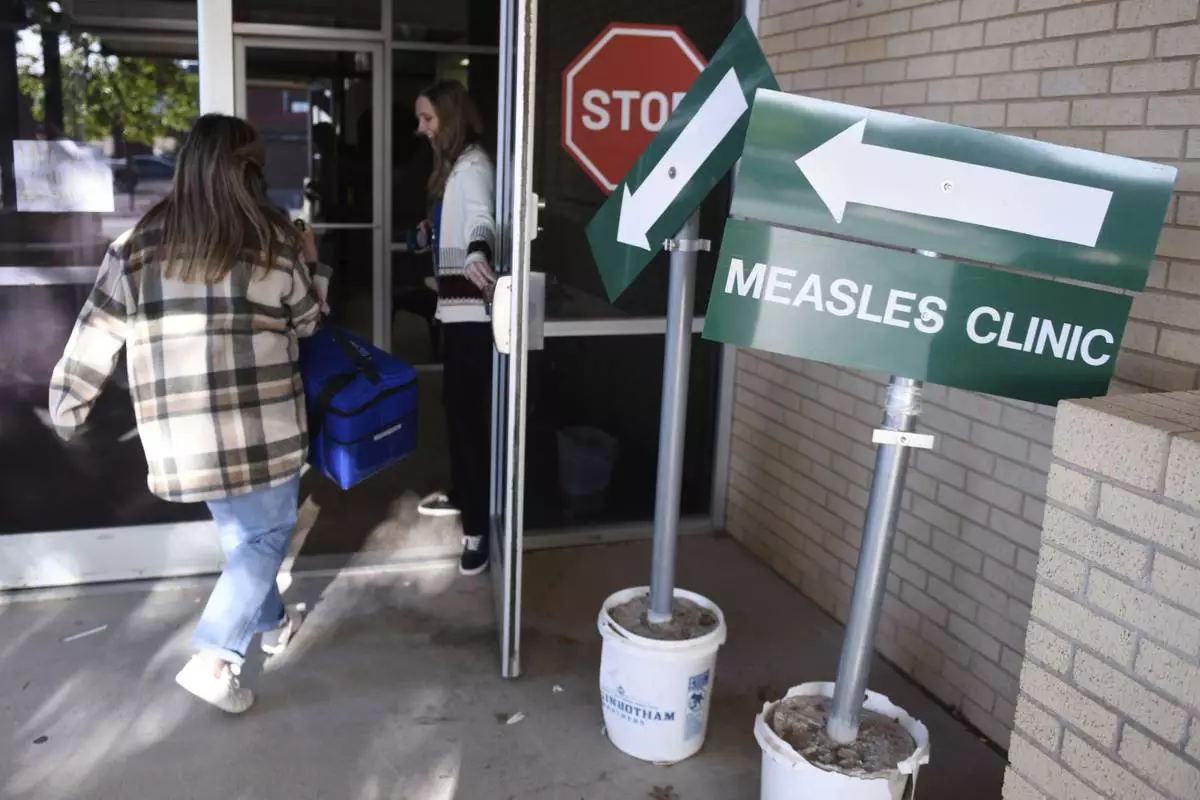
Health department staff members enter the Andrews County Health Department measles clinic carrying doses of the measles, mumps and rubella vaccine, Tuesday, April 8, 2025, in Andrews, Texas. (AP Photo/Annie Rice)

Health and Human Services Secretary Robert F. Kennedy Jr., left, arrives at Reinlander Mennonite Church after a second measles death, Sunday, April 6, 2025, in Seminole, Texas. (AP Photo/Annie Rice)