Scientists in Malaysia are reprocessing industrial byproducts into advanced raw materials, leveraging Chinese expertise and funding to support the country's green economy.
Malaysia's prized crops of durian and palm oil create vast amounts of waste biomass, providing cheap and abundant raw materials for researchers seeking sustainable alternatives for various industries.
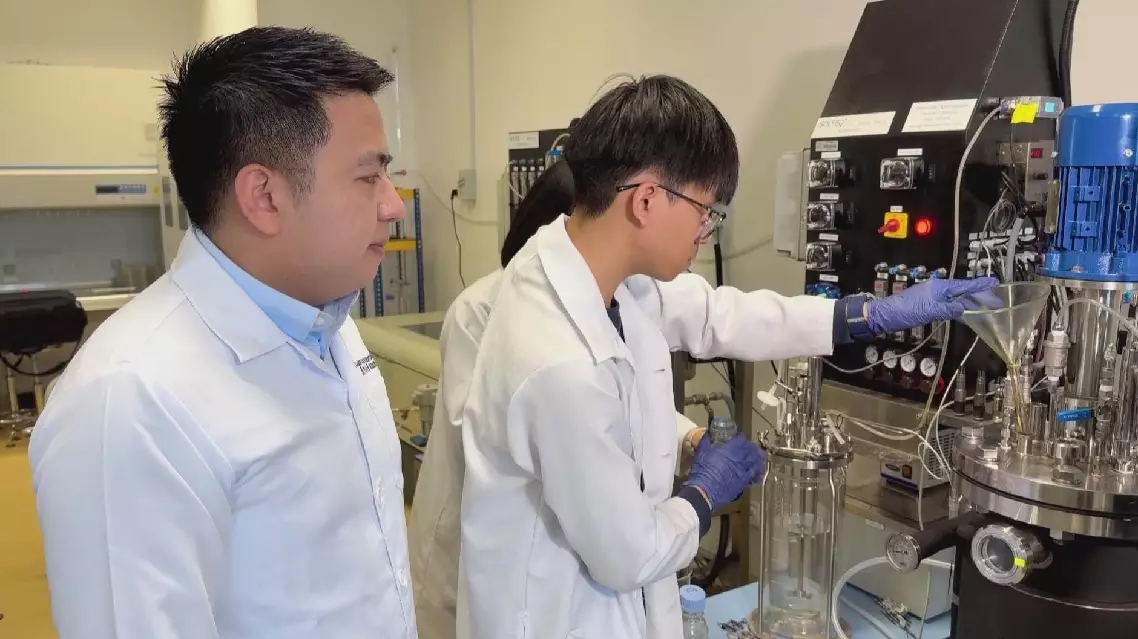
At the Malaysian campus of China's Xiamen University in Kuala Lumpur, one project aims to use the discarded husks of durian fruit to create a substance stronger than steel, with potential applications in aerospace, automotive, and robotics.
The team begins by grinding the durian husks into a fine powder, processing it through several steps to produce an ultra-light nanocellulose material that is not only eco-friendly but also significantly stronger than many conventional materials.
"This nano material, it is not only sustainable, but it's so much stronger compared to a lot of conventional material in the market. So because of this very unique properties, we can use it in aircraft industry, car industry and maybe robot. It's so much lighter, even compared to aluminum composite. How much lighter is it? Half of it," said Dr. Tan Khang Wei, an associate professor at Xiamen University Malaysia.
The project is funded by Chinese capital through a company that plans to market the end product.
"They see that maybe they can do something which is greener and more sustainable using Malaysia biomass resources," Tan said.
Meanwhile, another research team is collaborating with experts from Xiamen University's main campus in China to turn byproducts from palm oil biodiesel production into high-value compounds.
"One of the major by-product from biodiesel production is the crude glycerol. We use it to undergo microbial fermentation to convert into a much higher value-added compound, which is 1,3-propanediol. And then 1,3-propanediol is the precursor that can be used to produce a polyester resin," said Dr. Tan Jian Ping, an assistant professor at Xiamen University Malaysia.
These resins can then be used to create products such as fabrics and carpets.
"If we are going through the bio-based approach, it's definitely a much greener approach as compared to the chemical," said the assistant professor.
These initiatives are part of the broader Malaysia-China comprehensive strategic partnership, which aims to strengthen people-to-people, academic, and scientific cooperation between the two countries. At the Malaysian campus, researchers are advancing these goals with Chinese expertise and investment while contributing to Malaysia's push for a more sustainable economy.
Malaysia, China collaborating to reuse waste biomass

Geoeconomic confrontation is the leading short-term global threat in 2026, the World Economic Forum (WEF) warned in its Global Risks Report 2026 released on Wednesday ahead of its annual meeting in Davos, Switzerland.
The report ranks geoeconomic confrontation as the top risk for 2026, followed by interstate conflict, extreme weather, societal polarization, and misinformation and disinformation. It also identifies geoeconomic confrontation as the most severe risk over the next two years.
"I think if there is to be one key takeaway from the report, it's that we are entering an age of competition and this new competitive order is then shaping current global risks, but it is also shaping and to some extent hindering our ability to actually cope with them. That's really the key takeaway. If we take a look at, the number one risk both for 2026 and two years out, it's dual economic confrontation. But then if we look at the risks 10 years out. It's really the climate and environment related risks. All of these things require global cooperation and that's where we're seeing a big backsliding in this new age of competition," said Saadia Zahidi, managing director of the WEF.
Economic risks showed the largest increase in the two-year outlook, with concerns over economic downturns, inflation, rising debt and potential asset bubbles intensifying amid geoeconomic tensions, the report said.
Environmental risks remain the most severe overall, led by extreme weather, biodiversity loss and critical changes to Earth systems. The report noted that three-quarters of respondents expect a turbulent environmental outlook.
Risks related to adverse outcomes of artificial intelligence rose sharply, climbing from 30th in the two-year horizon to fifth in the 10-year outlook, reflecting concerns over impacts on labor markets, society and security.
The 21st edition of the report draws on views from more than 1,300 experts, policymakers and industry leaders.
The WEF's annual meeting will be held in Davos from Jan 19 to 23 and draw nearly 3,000 guests from more than 130 countries and regions to participate.
"So overall, we are starting to see this shift away from what have traditionally been the ways in which people have been able to cooperate. Now, that is not to say that any of this is a foregone conclusion. And I think that's a really important message around the risks report. None of this is set in stone. All of this is in the hands of leaders. Whether they choose to cooperate and invest in resilience or whether they do not. So that's really what we'll be focused on next week in Davos bringing leaders together under this overall theme of 'a spirit of dialogue' and trying to reestablish relationships, cooperation and trust. That's the fundamental," said Zahidi.
WEF warns of rising geoeconomic risks in 2026