China has remained the world's largest online retail market for a 13th consecutive year, with its digital consumption exceeding 23.8 trillion yuan (about 3.39 trillion U.S. dollars), official data shows.
The figure was released at a national e-commerce work conference held from Tuesday to Wednesday.
The conference said that China's e-commerce sector has achieved solid gains in high-quality development over the past five years, emerging as a new source of momentum to foster new quality productive forces and playing an important role in advancing the country's new development paradigm.
Despite rising external uncertainties, China has continued to expand its win-win cooperation, increasing the number of Silk Road e-commerce cooperation partner countries to 36.
E-commerce has become a major engine for job creation and industrial upgrading. Employment in the sector has surpassed 78 million, and express delivery volumes have seen an average annual growth of nearly 20 percent over the past five years.
Software and information services linked to cloud computing and big data have also expanded rapidly.
The conference outlined the Ministry of Commerce's e-commerce policy priorities for 2026, including strengthening innovation-driven growth, improving the country's development environment, and expanding international cooperation.

China remains world's largest online retail market for 13th straight year
Tokyo stocks rose Friday, with the benchmark Nikkei stock index ending at a fresh record high, buoyed by optimism over a settlement in the Middle East conflict.
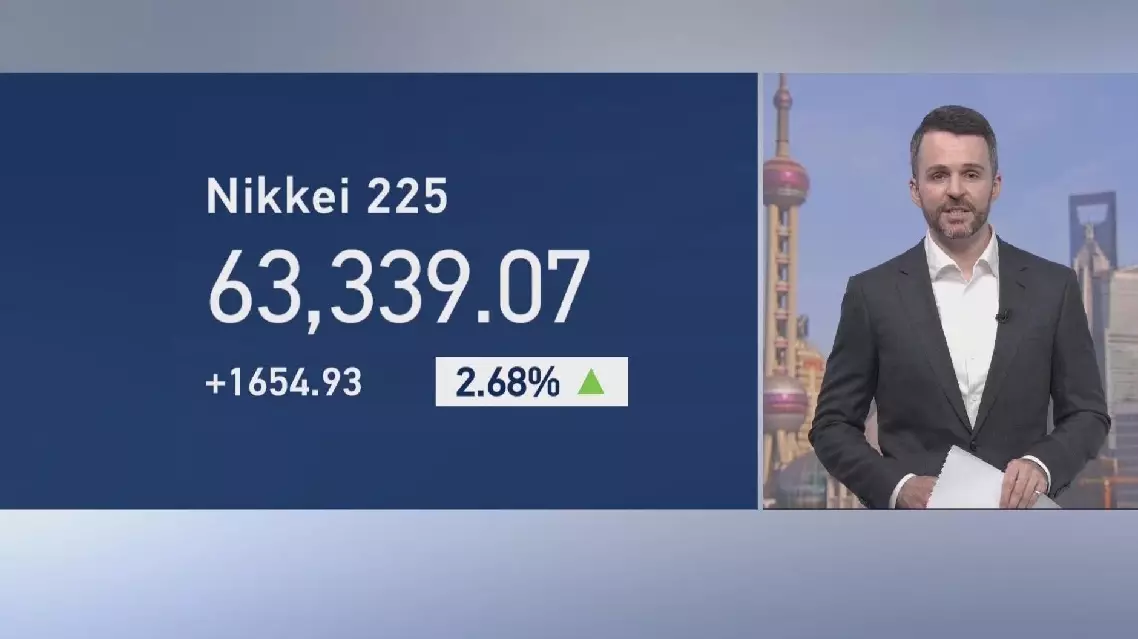
The 225-issue Nikkei Stock Average ended up 1,654.93 points, or 2.68 percent, from Thursday at 63,339.07.
The broader Topix index, meanwhile, finished 38.65 points, or 1.00 percent, higher at 3,892.46.
"There was some optimistic trade around the latest U.S.-Iran talks, but this optimism seems to be based on the fact that things aren't getting drastically worse in the region rather than the situation improving significantly," Timothy Pope, a market analyst for China Global Television Network (CGTN), recapped the day's developments.
"This optimism was most strongly on display, I think, in Tokyo today, where the Nikkei rose 2.7 percent with hopes for some relief on oil prices and other currently scarce materials. It's not just oil that is not getting out of the region. As we know, it's other petrochemicals and things like helium as well. The general performance was pretty strong. Metals producers were doing fairly well in Tokyo, but in Japan as well, the market is very much focused on AI stocks. And today, the gains were strong for SoftBank -- it was up almost 12 percent after a bit of a battering earlier in the week. And that SoftBank gain contributed nearly a third to the Nikkei's overall gains on Friday," said Pope.
Tokyo stocks end higher as U.S.-Iran talks fuel cautious optimism