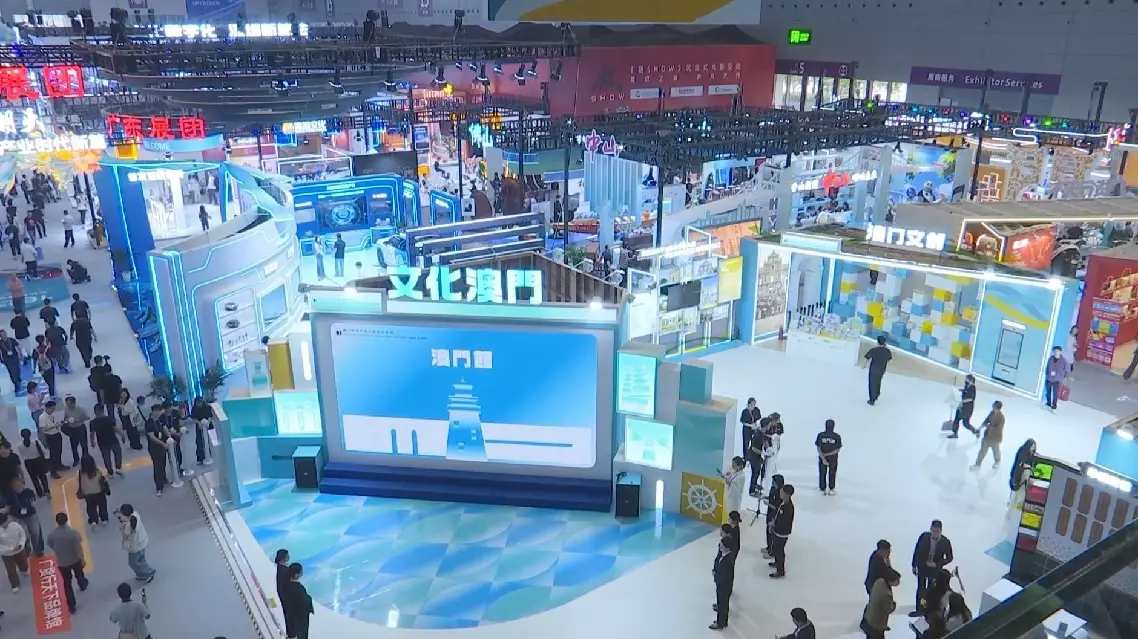
The ongoing 22nd China (Shenzhen) International Cultural Industries Fair has brought together high-quality cultural industry resources from around the world, with China's achievements in the high-quality development of its cultural industry taking the center stage.
In total, eight exhibition halls are set up at the Shenzhen World Exhibition and Convention Center, with over 120,000 cultural products on display and new quality productive forces empowered by artificial intelligence (AI) as highlights.
The five-day event, starting Thursday, has attracted 310 exhibitors from 65 countries and regions, and over 35,000 overseas professional visitors from 110 countries and regions are expected to attend the event.
"China is a very good market. Because we have already in Egypt more shops inside the museum,we have a new idea taking a shop here," said Ahmed, an exhibitor from Egypt.
"I'm really too busy to handle it all. There are a lot of people here. The customers are very friendly and seem to be very interested in our culture and history. We also look forward to meeting new friends and new partners through this excellent platform," said Asilbek Khonkhujaev, an exhibitor from Uzbekistan.
This year's event has, for the first time, set up a dedicated exhibition area for APEC economies, showcasing the Asia-Pacific region's achievements in cultural tourism.
The region's specialty products, creative cultural products inspired by intangible cultural heritage, and regional delicacies are also on display.
Exhibits featuring high-end technology also attract visitors to experience.
"From design sketch to production of the sample shoes, it only took us one day to prepare the 3D printed shoes we displayed on site today. We also successfully restored the Tang Sancai 1,000 years ago with it." said Zhu Dianjun, vice president of Tencent Group.
Sancai, or tri-colored glazed pottery, is made of white clay and coated with a layer of glaze. The producing technique of Sancai, which prevailed in the Tang Dynasty (618-907), was very complex and listed as one of China's National Intangible Heritages in 2008. From creative generation to full-process production, artificial intelligence has permeated every aspect of the cultural industry.
At the event, several enterprises are showcasing their innovative applications of artificial intelligence throughout the entire chain, including content creation, game development, and copyright protection, presenting a new picture of high-quality development of China's cultural industry. "Intellectual property protection is also a pain point for the content creation industry. By using this (AI risk control) product, we can automate the entire process from monitoring and evidence collection to evidence storage, which greatly enhances our work efficiency," said Guo Ping, vice president of 37 Interactive Entertainment Group.
China Int'l Cultural Industries Fair highlights AI-empowered new quality productive forces