NEW YORK--(BUSINESS WIRE)--Apr 14, 2025--
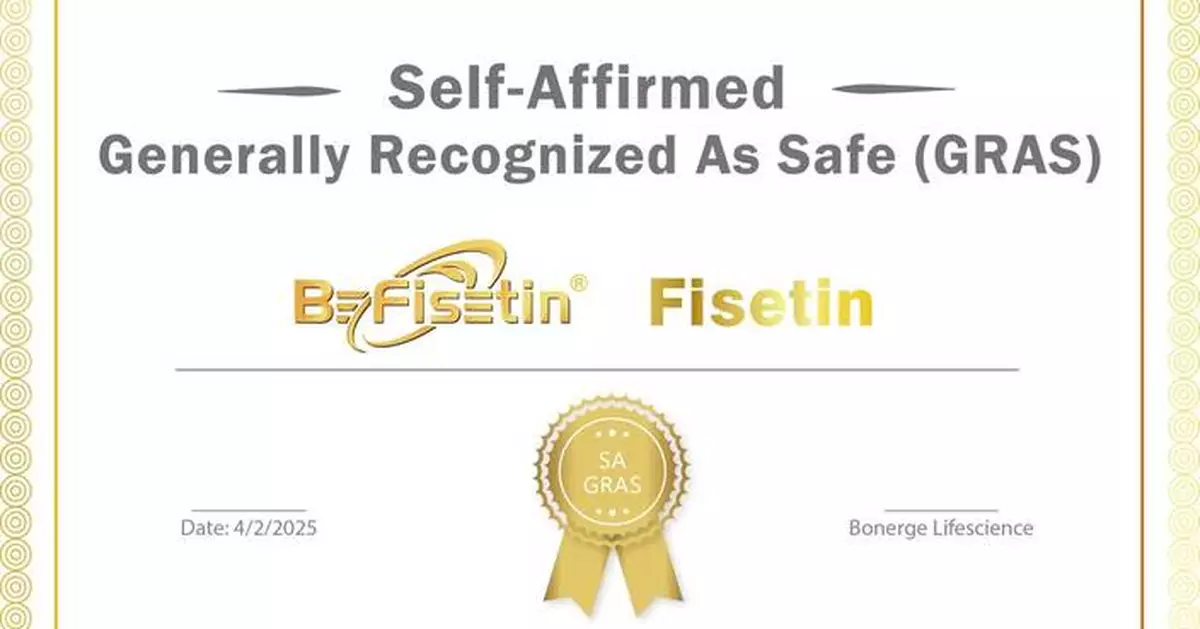
Bonerge Lifescience, a trusted innovator in longevity ingredients, proudly announces a historic milestone: on April 2, 2025, its premium fisetin ingredient, BeFisetin ®, has achieved Self-affirmed Generally Recognized as Safe (SA-GRAS) status in the United States. This landmark accomplishment positions Bonerge as the first company globally to secure GRAS certification for fisetin powder, setting a new global benchmark for safety and reliability in the next-generation anti-aging market.
This press release features multimedia. View the full release here: https://www.businesswire.com/news/home/20250413308210/en/
BeFisetin: Establishing the Gold Standard to Address Chaos in the Fisetin Market
The current fisetin market is plagued by alarming quality inconsistencies. While vague claims of "Fisetin 98% HPLC" dominate as the mainstream specification, actual fisetin content in these products ranges only between 75%-85%, with significant impurities concealed under this ambiguous standard.
For plant extracts derived from non-edible sources, the removal of harmful components is critical. Fisetin, extracted from inedible Anacardiaceae plants, contains large amounts of toxic lacquer, waxes, and wood debris. Eliminating these impurities is essential to producing safe, high-quality fisetin. Yet, the absence of clear, stringent quality standards has made it impossible to verify purity, allowing low-quality products to flood the market.
Many suppliers exploit rudimentary testing methods to falsely label products as "98% HPLC," misleading consumers and perpetuating a cycle where inferior products overshadow genuine quality. This chaos forces brands to settle for subpar fisetin, stifling innovation in premium formulations.
Establishing a gold standard for fisetin quality has been Bonerge’s mission from the start. Recognizing the challenges—extensive R&D, industry-first breakthroughs, and short-term financial sacrifices—we named our product BeFisetin as a constant reminder: "To be or not to be" hinges on our commitment to redefine excellence in fisetin. BeFisetin is not just a product—it’s a pledge to restore integrity and drive progress in the fisetin industry.
What Defines the Gold Standard for Fisetin?
BeFisetin: The 1st All-Natural Fisetin to be Granted SA-GRAS
BeFisetin ® is the first all-natural fisetin to attain SA-GRAS certification. For all dietary supplement ingredients, SA-GRAS represents a critical milestone, but its significance is unparalleled in advancing fisetin as a premium raw material. This certification sets the gold standard for the industry, requiring adherence to rigorous criteria: well-defined quality specifications, scientifically validated testing protocols, GMP-compliant manufacturing environments, and comprehensive safety assessments —all of which elevate fisetin from an underregulated botanical to a clinically trusted ingredient. By establishing these benchmarks, SA-GRAS not only ensures consumer safety but also paves the way for innovation in longevity-focused formulations.
“Beyond regulatory compliance, this accomplishment reflects our foundational commitment to scientific excellence and consumer safety—principles that drive every stage of our ingredient innovation,” stated Gloria, Product Manager of Bonerge. “SA-GRAS BeFisetin ® provides brands with a scientifically validated ingredient that meets international regulatory requirements, enabling them to develop innovative products with assurance.”
A Vision for Trusted Longevity Foundation
The GRAS certification of BeFisetin ® marks the beginning of Bonerge’s mission to redefine aging. By prioritizing rigorous science and consumer safety, Bonerge aims to foster transparency in the anti-aging market, and we are committed to providing scientifically grounded solutions that empower individuals to age healthily. As global interest in senotherapeutics grows, BeFisetin ® stands at the forefront, offering brands a trusted, scalable ingredient to meet the rising demand for effective and safe longevity products.
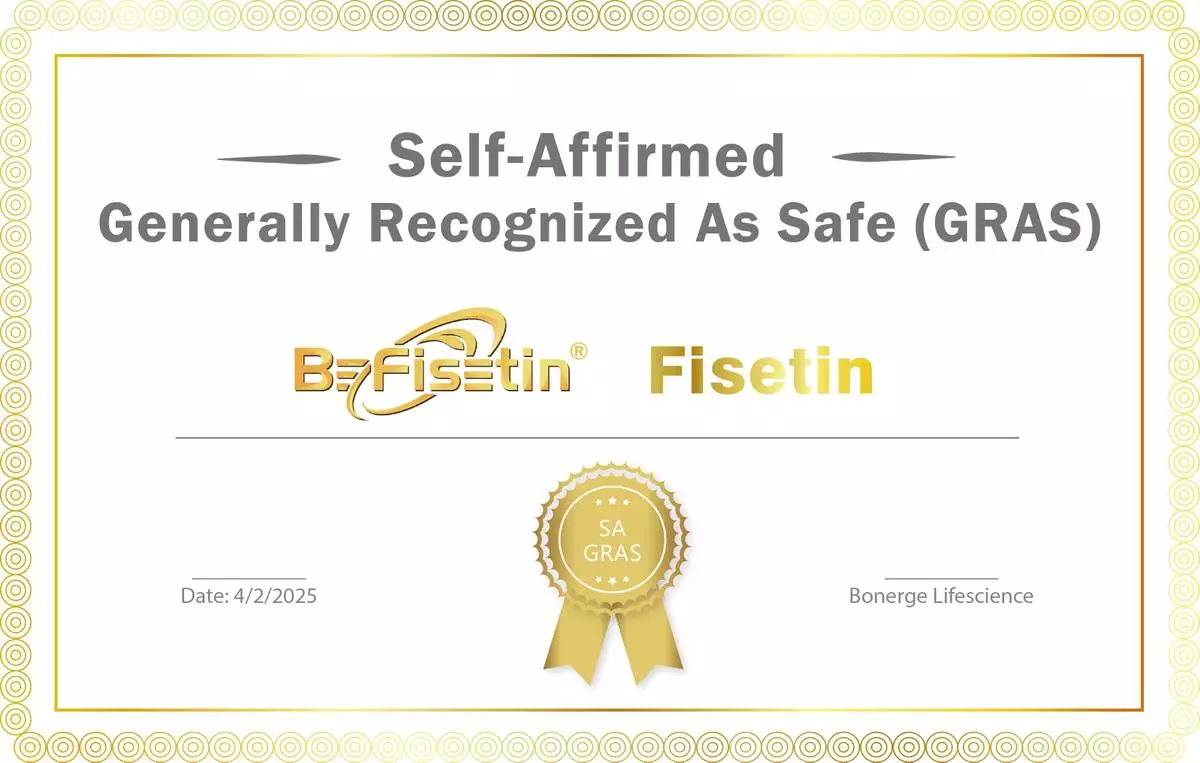
BeFisetin®: GRAS certified Fisetin for safe use in dietary supplements and health products.

WASHINGTON (AP) — Chief Justice John Roberts has led the Supreme Court 's conservative majority on a steady march of increasing the power of the presidency, starting well before Donald Trump's time in the White House.
The justices could take the next step in a case being argued Monday that calls for a unanimous 90-year-old decision limiting executive authority to be overturned.
The court's conservatives, liberal Justice Elena Kagan noted in September, seem to be “raring to take that action.”
They already have allowed Trump, in the opening months of the Republican's second term, to fire almost everyone he has wanted, despite the court's 1935 decision in Humphrey's Executor that prohibits the president from removing the heads of independent agencies without cause.
The officials include Rebecca Slaughter, whose firing from the Federal Trade Commission is at issue in the current case, as well as officials from the National Labor Relations Board, the Merit Systems Protection Board and the Consumer Product Safety Commission.
The only officials who have so far survived efforts to remove them are Lisa Cook, a Federal Reserve governor, and Shira Perlmutter, a copyright official with the Library of Congress. The court already has suggested that it will view the Fed differently from other independent agencies, and Trump has said he wants her out because of allegations of mortgage fraud. Cook says she did nothing wrong.
Humphrey's Executor has long been a target of the conservative legal movement that has embraced an expansive view of presidential power known as the unitary executive.
The case before the high court involves the same agency, the FTC, that was at issue in 1935. The justices established that presidents — Democrat Franklin D. Roosevelt at the time — could not fire the appointed leaders of the alphabet soup of federal agencies without cause.
The decision ushered in an era of powerful independent federal agencies charged with regulating labor relations, employment discrimination, the air waves and much else.
Proponents of the unitary executive theory have said the modern administrative state gets the Constitution all wrong: Federal agencies that are part of the executive branch answer to the president, and that includes the ability to fire their leaders at will.
As Justice Antonin Scalia wrote in a 1988 dissent that has taken on mythical status among conservatives, “this does not mean some of the executive power, but all of the executive power.”
Since 2010 and under Roberts' leadership, the Supreme Court has steadily whittled away at laws restricting the president's ability to fire people.
In 2020, Roberts wrote for the court that “the President’s removal power is the rule, not the exception” in a decision upholding Trump’s firing of the head of the Consumer Financial Protection Bureau despite job protections similar to those upheld in Humphrey’s case.
In the 2024 immunity decision that spared Trump from being prosecuted for his efforts to overturn the 2020 election results, Roberts included the power to fire among the president's “conclusive and preclusive” powers that Congress lacks the authority to restrict.
But according to legal historians and even a prominent proponent of the originalism approach to interpreting the Constitution that is favored by conservatives, Roberts may be wrong about the history underpinning the unitary executive.
“Both the text and the history of Article II are far more equivocal than the current Court has been suggesting,” wrote Caleb Nelson, a University of Virginia law professor who once served as a law clerk to Justice Clarence Thomas.
Jane Manners, a Fordham University law professor, said she and other historians filed briefs with the court to provide history and context about the removal power in the country's early years that also could lead the court to revise its views. “I'm not holding my breath,” she said.
Slaughter's lawyers embrace the historians' arguments, telling the court that limits on Trump's power are consistent with the Constitution and U.S. history.
The Justice Department argues Trump can fire board members for any reason as he works to carry out his agenda and that the precedent should be tossed aside.
“Humphrey’s Executor was always egregiously wrong,” Solicitor General D. John Sauer wrote.
A second question in the case could affect Cook, the Fed governor. Even if a firing turns out to be illegal, the court wants to decide whether judges have the power to reinstate someone.
Justice Neil Gorsuch wrote earlier this year that fired employees who win in court can likely get back pay, but not reinstatement.
That might affect Cook's ability to remain in her job. The justices have seemed wary about the economic uncertainty that might result if Trump can fire the leaders of the central bank. The court will hear separate arguments in January about whether Cook can remain in her job as her court case challenging her firing proceeds.
A worker shovels snow and ice in front of the Supreme Court building during the first snowfall of the winter season on Friday, Dec. 5, 2025, in Washington. (AP Photo/Mark Schiefelbein)
President Donald Trump speaks during a Cabinet meeting at the White House, Tuesday, Dec. 2, 2025, in Washington. (AP Photo/Julia Demaree Nikhinson)