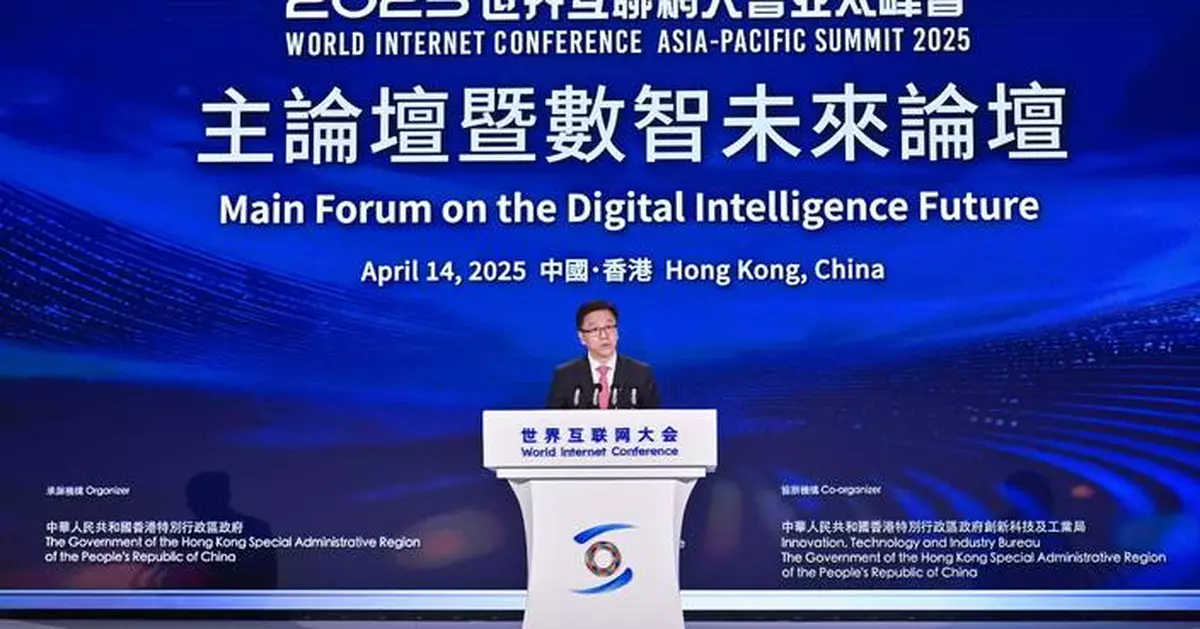
Speech by SITI at World Internet Conference Asia-Pacific Summit - Main Forum on the Digital Intelligence Future
Following is the speech by the Secretary for Innovation, Technology and Industry, Professor Sun Dong, at the World Internet Conference (WIC) Asia-Pacific Summit - Main Forum on the Digital Intelligence Future today (April 14):
Vice-chairman Francis Gurry (Vice-chairman of the WIC), Secretary General Ren Xianliang (the Secretary General of the WIC), distinguished guests, ladies and gentlemen,
Good afternoon. Again welcome to Hong Kong.
Under the theme of "Integration of AI and Digital Technologies Shaping the Future - Jointly Building a Community with a Shared Future in Cyberspace", this Summit brings together experts and leaders to explore the establishment of a solid foundation for digital intelligence, the advancement of "AI+" applications across diverse industries, and the resolution of critical challenges in security and governance in the digital era. These areas are pivotal for every economy to fully unlock the potential of the digital economy, drive technological progress and enhance economic competitiveness.
Today, digital intelligence is no longer confined to predictive algorithms or data-driven decision making. It is augmenting human capabilities and redefining governance, commerce, and communication. More importantly, the future will be determined not only by how fast AI and machines learn, but also by how well we, the humanity, adapt and integrate these intelligent systems into our daily lives.
Hong Kong has long benefited from the unwavering support of our motherland in its journey to become an international innovation and technology (I&T) centre. The national strategies have prioritised technological innovation as a core pillar of development, showcasing substantial support for Hong Kong's progress in this area. The Government of the Hong Kong Special Administrative Region (SAR) has made significant investments in various forms of infrastructure to strengthen the foundation for local I&T development and foster technological innovation.
Among all, a key priority is to reinforce Hong Kong's strong R&D (research and development) capabilities, with three local universities ranked among the world's top 20 for data science and AI in the QS 2025 subject rankings. Our global research collaboration platform, the InnoHK Research Clusters, has established collaborations with more than 30 world-renowned universities and research institutes from 12 economies, brought together more than 2,500 researchers from home and abroad, and established a total of 30 InnoHK research laboratories, more than half of which focus on AI and robotics-related technologies.
In addition to the AI Supercomputing Centre (AISC) established by Cyberport in December last year, the Hong Kong Microelectronics Research and Development Institute, which focuses on third-generation semiconductor core technology, is crucial to powering AI systems. Looking ahead, we are preparing to establish the Hong Kong AI Research and Development Institute, which will focus on supporting upstream R&D efforts and facilitating the transformation of R&D outcomes into practical applications, marking another significant step forward in Hong Kong's innovation journey.
More than just a transformative tool for upgrading traditional industries, AI is a dynamic catalyst for innovation and reinvention. The concept of "AI+", signifying the seamless integration of AI into various sectors, is bringing about unprecedented breakthroughs and unlocking new opportunities. Hong Kong has firmly grasped this potential to accelerate the development of new quality productive forces and enhance its global competitiveness by intensifying our efforts to promote new industrialisation.
To this end, the Hong Kong SAR Government has implemented targeted initiatives to assist local manufacturers in adopting smart technologies, advancing production processes and enhancing productivity. For example, the $10 billion New Industrialisation Acceleration Scheme provides financial support to enterprises in fields such as AI, robotics, life and health technology, new energy and advanced manufacturing to set up new smart production facilities in Hong Kong.
Furthermore, a $10 billion Innovation and Technology Industry-Oriented Fund is about to be set up to channel more market capital to invest in emerging and future industries of strategic importance. We will also launch the I&T Accelerator Pilot Scheme to attract professional start-up service agencies to enrich Hong Kong's start-ups ecosystem by leveraging their extensive business network and experience.
While the integration of AI across industries is propelling innovation and growth, the exponential growth of digital intelligence demands a new framework - one built on ethical responsibility, robust security, and inclusivity. No single economy or industry can tackle these challenges alone. As we discuss how to build a robust foundation for digital intelligence, let us not forget to embrace collaborative intelligence - the synergy between human ingenuity and artificial advancements, and strengthen cross-regional, cross-sector and cross-cultural collaboration to ensure that technology amplifies human potential rather than replacing it. This is the truly unbreakable foundation of digital intelligence.
Being Asia's world city and a strategic hub for digital innovation, Hong Kong will continue to contribute its I&T power to promote collaboration and innovation across the Asia-Pacific region, and the world. As we reflect on the transformative power of AI and digital technologies, let us continue to work together to break new ground, transcend boundaries and borders, and contribute to the betterment of humanity.
Before I close, I would like to express my sincere gratitude to each and every one of you for your unwavering support and commitment in making the WIC Asia-Pacific Summit a meaningful and impactful experience. Thank you very much.
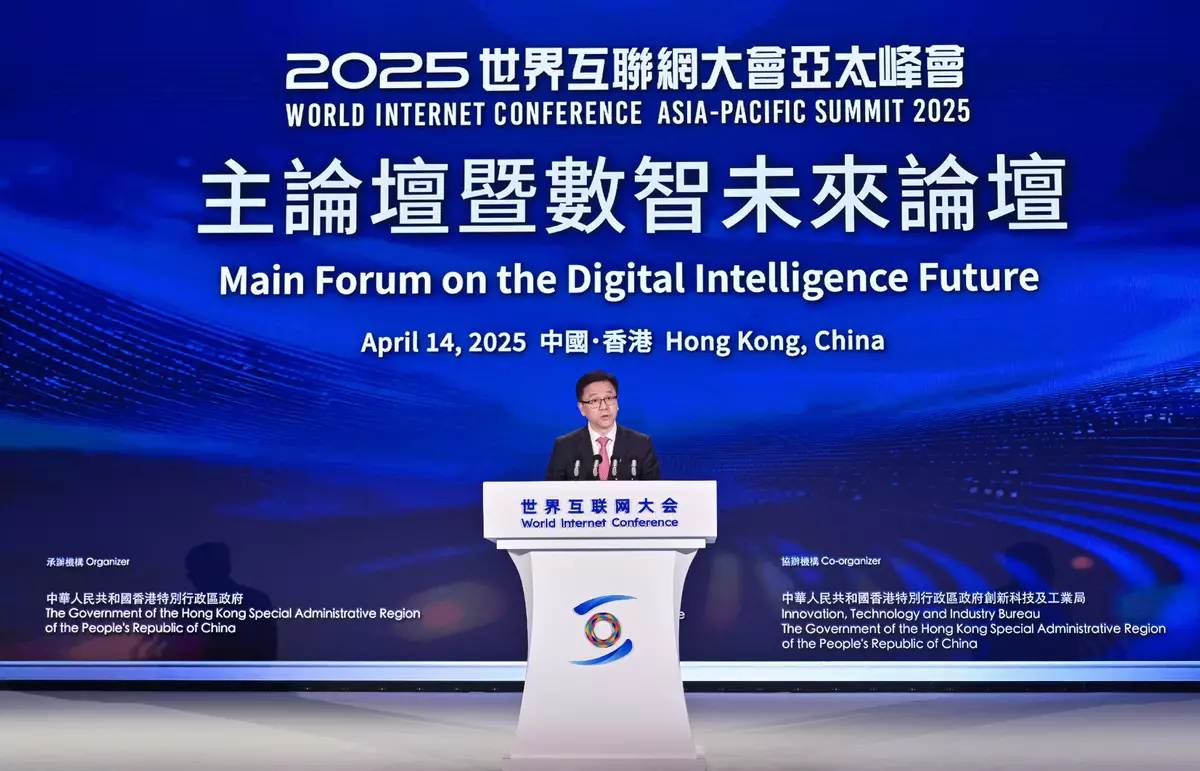
Speech by SITI at World Internet Conference Asia-Pacific Summit - Main Forum on the Digital Intelligence Future Source: HKSAR Government Press Releases